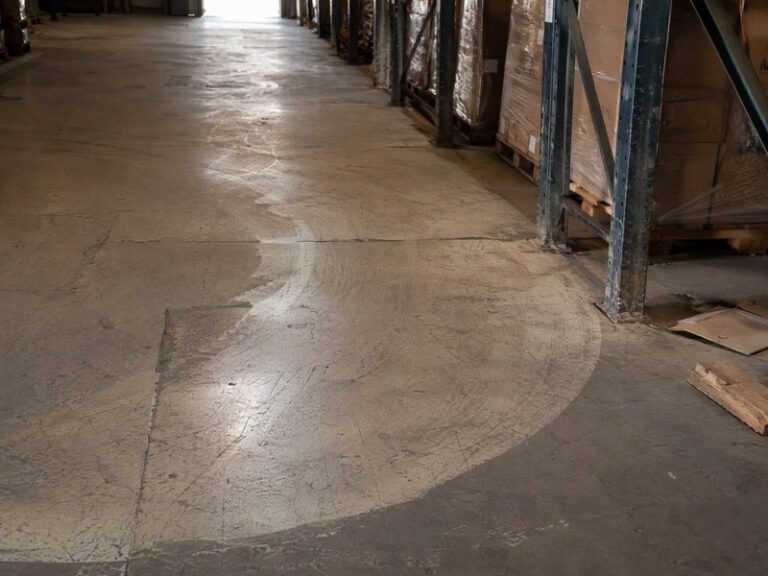
Polyurethane floor service life runs from eight to twenty-five years, and the range is set by thickness and duty rather than by brand.
A thin sealer in a dry store may reach twelve years. A 6 mm screed in a chemical washdown area may need rebuilding at eight. Neither figure is a defect; both are arithmetic.
This article gives service life by system, explains the material budget that decides it, and sets out the surface signatures that tell you which clock is running.
Service life by system, in one table
The honest answer to how long a floor lasts is a polyurethane floor service life range per system, not a single figure. Anyone who quotes one number without naming the duty is quoting a hope. The table below is the range we work to on industrial projects.
The number that decides the range is the sacrificial thickness: the material between the surface and the substrate, which is consumed from the top as the floor is used.
A layer schedule with three coats has more of that budget than a single-coat product, which is why two systems from the same manufacturer can differ by a decade.
Duty matters as much as thickness. A light wheel load class in a foot-traffic corridor is a very different proposition from steel wheels in a freezer, and the same system can differ by ten years between the two.
And the cleaning protocol matters more than most owners expect, because grit rolled into a film is the main mechanism that consumes it.
Table 1: Service life by duty class on a 6 mm screed.
| Duty | Example | 6 mm screed |
|---|---|---|
| Light | Foot traffic, hand pallet | 20-25 years |
| Medio | Forklift, no grit | 15-18 years |
| Pesado | Steel wheels, grit | 10-15 años |
| Severe | Hot tyres, abrasives | 6-10 years |
What actually ends the life of a floor
Polyurethane floor service life ends at one of four points: a turning wheel, a leaking drain, a moving joint, or a chemical sitting overnight. None of them is spread evenly across the hall.
That is why the material on the busiest square metre decides the life of the whole area, not the average across the hall.
The cost argument follows from the same fact. Most of the money is spent on the area that fails first, and that area is almost always a lane rather than a room.
The distress pattern you observe tells you which mechanism is running, and it is visible long before the floor becomes unusable.
One more distinction is worth making for a client. A floor that is worn is doing its job and needs a renewal; a floor that has failed has stopped doing its job and needs a diagnosis. The two are priced very differently.
A floor that has been in service for fifteen years and still reads as a floor is not a lucky floor. It is a floor that was specified with enough material and inspected often enough to be renewed before it reached the slab.
None of that requires a specialist. A maintenance supervisor with a camera, a plan and a straight edge can produce a record that a coating supplier will accept as the basis for a renewal quote, which is the only purpose the document has to serve.
Read the surface before reading the invoice. A polished track and a lifting sheet are two different stories with two different endings.
Thickness is the only real budget
Polyurethane floor service life is consumed from the top down. Everything above the substrate is available to lose, and nothing below it can be replaced cheaply.
Lose one mm a year from a 6 mm screed — a deliberately pessimistic loss rate — and you have roughly five years before rebuilding. Lose the same mm from a 0.6 mm coating and the first year is the last.
A recoat interval should therefore be calculated from loss rate rather than copied from a brochure, and the coating thickness and DFT figure has to be the dry film, not the wet coat. The arithmetic takes ten minutes and changes the design.
The annual walkover is where the loss rate gets measured, with a straight edge and a camera at the same six points each year.
The renewal decision is therefore a comparison of two costs rather than a judgement about appearance. That framing is what makes a layer schedule conversation possible with a finance team, because appearance has no line in a budget.
Where a floor is recoated before the substrate shows, the layer schedule can be renewed rather than replaced, and that is where the real saving sits. The difference between those two outcomes is usually a single inspection that happened in time.
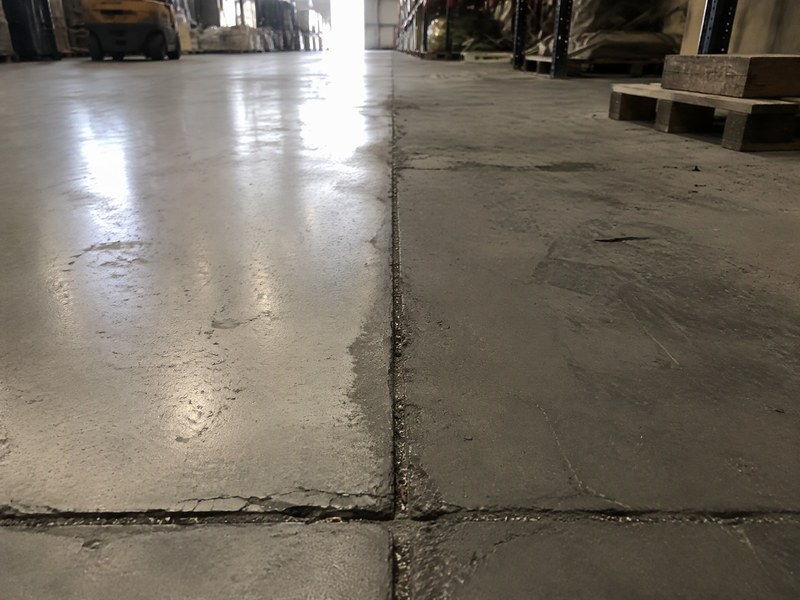
Figure 1: a worn lane and an unworn aisle on one slab, shot from the same height.
Duty, lanes and the honest average
A polyurethane floor service life is usually estimated for an average, and floors do not fail at the average.
The whole-life cost of an average specification is therefore worse than it looks, because the first failure drives the whole replacement.
A better approach is to build the lanes heavier than the aisles. Six mm in two lanes and three elsewhere costs little more and moves the failure date out by years.
A wheel load class stated in tonnes per day is not the same as one stated in wheel type, and the second is the more useful input. A steel wheel at low tonnage scrubs harder than a rubber tyre at high tonnage. A machine shop floor is a different duty again, where point loads and swarf dominate.
Duty also changes with season. Grit on a winter floor cuts several times faster than the same wheel on a clean surface, so a cleaning protocol that includes grit removal buys real life.
Where the distress pattern appears only in one lane, the answer is local reconstruction rather than a whole-hall rebuild.
Six signatures and what each one means
Six signatures cover most failures: a polished track, a lifting sheet, a crescent crack, blisters, chalking and a soft patch. Reading them correctly is the difference between a repair and a replacement.
A polished track means the sacrificial thickness is thinning in that lane. A dull, chalky surface means ultraviolet exposure rather than abrasion.
A lifting sheet means water at the interface, and any renewal plan will be wasted unless the moisture is addressed first.
Crescent cracks at columns or doorways point to movement, and they belong to the slab rather than to the coating.
Soft or sticky patches mean chemical attack, and they usually sit where a spill is allowed to stand rather than where it is washed away.
Table 2: Six signatures and their usual cause.
| Signature | Cause | Response |
|---|---|---|
| Polished track | Abrasion | Recoat before substrate |
| Lifting sheets | Humedad | Barrier, then rebuild |
| Crescent cracks | Thermal movement | Review joints |
| Blisters | Vapour or solvent | Strip and retest |
| Chalking | UV exposure | Aliphatic topcoat |
| Soft patches | Chemical attack | Check the spill list |
The plan most owners never make
Every polyurethane floor service life has an end date, whether or not the owner has written one down. The only question is whether it is scheduled or discovered.
The same arithmetic applies to a single bay as to a whole hall. A cost spreadsheet with one row per bay shows which areas earn their next renewal and which are being carried by the rest.
A planned rebuilding cycle is cheaper for three reasons: the area can be released in phases, material can be ordered in one batch, and the surface beneath is still sound.
That last point is the whole-life cost argument in one sentence. Renewing a sound floor is a coating job; rebuilding a failed one is a removal job with disposal costs.
An annual walkover is what turns a cycle into a plan, and it takes an hour on a 5,000 square metre floor.
Where a site has several buildings, run the inspection on one calendar slot rather than per building. A single annual visit that covers all of them costs less and produces a comparison that a per-building rota never does.
Write the date of the last work on the plant room wall. It saves an argument about age every time the floor is discussed.
Where the money actually goes
A polyurethane floor service life decision is usually made on capital cost and reviewed on whole-life cost, and the two answers are rarely the same.
Compare a sealer renewed every four years with a screed replaced once at year twelve. The sealer wins on invoice and loses on total spend.
The sacrificial thickness is what makes the arithmetic work. Less material means a shorter recoat interval and a higher cumulative spend, even though the first invoice is smaller.
Downtime is the line that is almost never in the coating quote and almost always the largest number in the comparison. A plant that loses output for three days pays for the floor several times over in a single closure.
Add downtime. A closure costs more in lost output than the material difference in most plants, and that cost repeats with every renewal.
Table 3: What a renewal costs besides material.
| Artículo | Share of renewal cost |
|---|---|
| Material | 30-40% |
| Preparation and labour | 30-40% |
| Closure and lost output | 15-30% |
| Protection and cleaning | 5% |
A heavier layer schedule therefore buys fewer closures rather than a better finish, which is the argument to make to a finance team rather than to a maintenance manager.
The same logic explains why a floor is rarely replaced as a single project. Most renewals happen bay by bay, over several years, and a plan that assumes one closure for the whole hall usually underestimates the disruption and overestimates the saving.
Cleaning is a wear variable
Polyurethane floor service life depends on cleaning as much as on chemistry: a floor swept and washed weekly outlasts the same floor left uncleaned, by years rather than months.
Grit is the mechanism. The film is consumed by abrasion, and most abrasion in a warehouse is grit being rolled into the surface by traffic.
A cleaning protocol has three elements: daily sweep, weekly wash with a neutral detergent, and an annual review with the coating supplier.
The recoat interval on a well-maintained floor is longer than the manufacturer’s figure, and an unmaintained floor misses it by a wide margin.
Where a distress pattern appears despite good cleaning, the cause is usually a cleaning chemical rather than a cleaning frequency.
What an inspection should record
An annual walkover is not a survey: it is a walk with a camera, a plan and four questions, and it is the cheapest document in the maintenance file. Ten minutes per 1,000 square metres is a realistic allowance once the route is established.
Record where the sacrificial thickness is thinning, whether the recoat interval is still on schedule, and whether duty has changed since the last visit.
Photograph the same six locations from the same position every year. A sequence is far better evidence than a single report, and it is what a floor QC testing record is built from.
Record the weather on the inspection day as well. A floor that looks chalky in a dry summer and a floor that looks chalky in a wet winter are telling you different things about the same surface.
Note the cleaning protocol in practice rather than on paper: what is used, how often, and whether the team has been given the right product. A bucket of the wrong detergent will undo a year of careful specification.
Keep the file with the whole-life cost comparison. When the floor is replaced, the file makes the next decision an informed one rather than a repeat.
Six questions that produce a real estimate
First, what is the duty, in tonnes per day and wheel type? Second, what is the sacrificial thickness in the proposed build?
Third, what cleaning will actually happen, not what the specification says? Fourth, what recoat interval does the supplier expect, and does it fit the capital plan?
Fifth, what distress pattern has appeared on similar floors in the same industry? That is the question that produces a number rather than a range.
The wheel load class belongs in that list because it drives the loss rate more than any other single input, and it is the one a client can usually state from their weighbridge records.
Write the answers down and keep them with the photographs. In three years the person who answered will have moved on, and the number will be the only record of what the last floor actually achieved in that building.
There is a sixth question worth asking quietly: how long did the last floor actually last, and what ended it? Most clients can answer that from memory, and the answer is usually more accurate than any theoretical table, because it includes the site conditions that no table can know.
Ask them in that order and the estimate writes itself. Skip the first and the answer is a guess dressed as a specification.
Where answers are unknown, price two options rather than one. A whole-life cost comparison forces the assumptions into the open, which is where they belong.
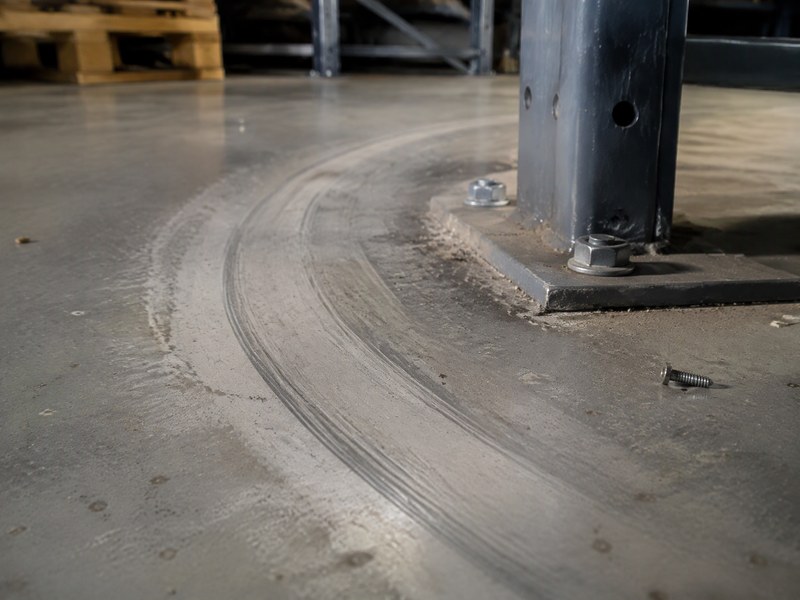
Figure 2: the same lane in close view, polished through beside a racking foot.
Frequently asked questions
How long does a polyurethane floor last?
Eight to twenty-five years depending on system and duty. A sealer in light use may reach twelve; a 6 mm screed under heavy traffic ten to fifteen.
Does thickness really change the service life?
Yes. Life is set by the material available to lose, so a 6 mm screed has roughly ten times the budget of a 0.6 mm coating.
Can a worn polyurethane floor be recoated?
Usually yes, if the film is sound and wear has not reached the substrate. Abrade, test a patch, then recoat.
What makes a PU floor fail early?
Moisture at the interface, chemical attack outside the specification, grit in traffic lanes, and missed maintenance.
How often should a floor be inspected?
Once a year for most industrial floors, with photographs from fixed positions so change is comparable.
Is a thicker floor cheaper over time?
Usually. The capital cost is higher once, but renewal is less frequent and downtime is paid fewer times.
Does cleaning affect service life?
Yes. Grit rolled into the film is the main abrasion mechanism, and a weekly wash removes it.
Why food plants work with Kaida Paint
Kaida Paint quotes by build and duty rather than by price per square metre, and states the polyurethane floor service life each system is expected to reach. Send the traffic, the cleaning chemicals and the area, and the reply will give a thickness, a life range and the inspection frequency that keeps both true.


 English
 Spanish
 Portuguese
 Arabic
 French
 Italian
 Russian
 Indonesian
 Swedish