
The two products are often quoted against each other and are not competing for the same job. One is a cement-based urethane, the other a resin mortar, and the difference shows up at the first hot wash.
They are not substitutes. Thermal shock separates them first, moisture tolerance decides what a damp slab allows, and each failure mode points back to a chemistry, so the wash temperature usually picks the product before price is discussed.
Why do two names describe different things?
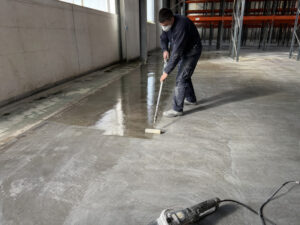
A PU screed is a resin mortar: polyurethane binder, graded filler, trowelled to 6 to 9 mm. It cures by chemical reaction and has no cement in it.
A cement urethane is a three-part system in which a polyurethane binder is mixed with cement and aggregate. It is also trowelled, at a similar thickness, and it also cures by reaction, but the cement changes how it behaves.
The name is the source of most confusion. Both are urethanes, both are screeds, and one contains cement while the other does not, which is enough to make a specification ambiguous if it uses the words interchangeably.
The practical difference is in movement. Cement reduces the coefficient of thermal expansion of the cured material, and that single property decides which product survives a washdown at 90 degrees.
Thermal shock is where the two diverge
Hot water on a cold floor warms the surface faster than the mass beneath can follow. The strain concentrates at the nearest restraint, and the material’s response decides whether it cracks or flexes.
A cementitious urethane expands at a rate closer to concrete, so the differential between floor and slab is smaller. That is why it survives repeated thermal cycling where a resin mortar eventually cracks at the joints.
A resin mortar has higher elongation and absorbs more strain, which is an advantage under movement from other causes. The two mechanisms are different and both are useful, which is why the choice depends on which threat dominates.
Table 1: The two systems at a glance, at equal thickness.
| Propiedad | Urethane cement | PU resin screed |
|---|---|---|
| Thermal expansion | Close to concrete | Más alto |
| Alargamiento | 10 to 20 per cent | 20 to 60 per cent |
| Tolerancia a la humedad | Alta | Moderado |
| Cure at 10 C | Slow | Moderado |
Moisture tolerance and the damp slab
A cement system tolerates a higher moisture emission than a resin mortar, because the cement in the mix is less sensitive to water arriving from below during cure.
That does not make it a damp-proof membrane. Where a slab is actively wet, neither product is the answer, and the moisture question becomes a question about the source of the water rather than the floor.
In practice the difference matters on older ground floors without a membrane. A cement system can often be installed where a resin mortar would need a surface membrane first, which changes the programme by a day and the cost by a layer.
Ask for the declared limit in the same units for both products. Two suppliers quoting moisture tolerance in different units is a comparison that cannot be made. The declared values behind those units are covered under certifications explained.
Cure time decides the programme, not the price
Cure time is the reason many projects choose a resin mortar. A polyurethane screed usually reaches walk-on in 8 to 12 hours, takes full traffic in about 72 hours and can take a washdown the next day; a cement system often needs 24 to 48 hours before foot traffic.
On a live plant that difference is the whole project. A floor that opens a day later may miss the shutdown window, and the cost of a second window exceeds any saving on material.
Cold weather exaggerates it. At eight degrees a cementitious urethane may need three days, and a PU screed two, and neither fits a weekend.
Where the programme is fixed and the wash is hot, the honest answer is sometimes a cement system installed in a longer window rather than a resin one installed in a window that is too short.
Screed types and where each one fits
Screed types fall into three groups in practice: resin mortar, cement-based urethane, and hybrid systems that blend the two. Each is trowelled to a similar thickness and behaves differently under heat and moisture.
The hybrid is worth knowing about. It usually combines a cement filler with a flexible binder, and it lands between the two on both thermal expansion and elongation, which makes it a reasonable compromise where neither extreme applies.
Where a plant has a wet room at 90 degrees next to a dry store at ambient, the two rooms may need different systems. A single specification across the building is the most common error we see in screed types selection.
Ask each supplier which group their product belongs to. The answer is usually available and rarely offered, because the trade name is more useful to marketing than the chemistry is to a buyer.
Cost comparison, on a like-for-like basis
A cost comparison at equal thickness usually shows the cement system slightly cheaper on material and slightly more expensive on labour, which lands the two within about 10 per cent of each other installed.
Table 2: Installed cost index, 6 mm, 2026, with washdown time at 20 degrees.
| Sistema | Index | Washdown, 20 degrees |
|---|---|---|
| PU resin screed | 270 | 24 horas |
| Cementitious urethane | 295 | 48 hours |
| Hybrid screed | 290 | 36 horas |
The numbers are close enough that price should not decide the specification. Programme and thermal exposure should, and both are free to assess before the tender.
Where a quote shows a difference of 30 per cent or more, the two bids are not for the same product. Look at the thickness and the number of passes before looking at the total. The build-up is compared in PU screed vs coating.
Failure modes, and what they tell you
The failure mode of each system is distinctive, which is useful when a floor fails and nobody remembers what was installed.
Table 3: Reading a failure back to a chemistry.
| Symptom | More typical of | Cause |
|---|---|---|
| Crescent cracks at joints | PU resin screed | Thermal cycling above 80 C |
| Surface erosion, no cracking | Urethane cement | Chemical attack or abrasion |
| Blisters in patches | Either | Moisture above the declared limit |
| Debond at the edge | Either | Preparation or water ingress |
The first row is the most useful. Crescent cracking radiating from a joint on a floor that is washed hot is a thermal diagnosis, and changing the resin without changing the temperature will produce it again.
The second row is where a cement system differs. It tends to erode rather than crack, which looks like wear and is often treated as wear until the thickness is measured.
Specification traps
Three traps appear repeatedly. The first is a specification that says cementitious when it means cement-based urethane, or the reverse, which changes the product and the price.
The second is a thickness written as a range. Six to nine millimetres is a range that will be priced at six and installed at six, whatever the thermal load requires.
The third is a wash temperature that nobody tested. A plant that assumes 60 degrees and actually washes at 85 has specified the wrong system and will discover it in the second winter.
All three are cheap to fix on paper and expensive to fix on a floor, which is the argument for a specification review before the tender rather than after the failure.
Which one we would choose, and why
Where the wash is above 80 degrees and repeated every shift, we specify the cement system and accept the longer cure. Where the wash is warm rather than hot and the programme is tight, we specify a resin mortar.
Where neither condition dominates, the hybrid is a defensible middle, provided the supplier can show test data rather than a description.
That is the whole decision. A polyurethane screed and a cementitious urethane are both good products; the failure is almost always a specification that chose one without asking what the room is washed with.
Questions that separate the two before you buy
The comparison above is only useful if it can be applied to a live project. Six questions do that, and each has an answer that points to one product rather than the other.
First, what is the wash temperature and how often does it repeat. Second, is the slab damp or without a membrane. Third, how long can the room be closed. Fourth, what is the chemical load. Fifth, does the floor move for other reasons. Sixth, what does the client expect in year ten.
A polyurethane screed that answers those six is a specification. One that answers two is a preference expressed as a document, and it will be priced by whoever reads it most charitably.
Table 4: Six questions and the answer each one favours.
| Question | Points to |
|---|---|
| Wash above 80 C, repeated | Urethane cement |
| Damp slab, no membrane | Urethane cement |
| 48-hour window only | PU resin screed |
| Concentrated chemical | Neither; check the medium |
| Slab moving for other reasons | PU resin screed |
| Ten-year life expected | Whichever matches the wash |
The fourth row is the one that surprises people. Where the medium is a solvent or a concentrated acid, neither urethane is the right answer, and a failure mode record from a chemical plant will show it quickly.
The sixth row is the one clients ask about most and suppliers answer least. Expected life is not a property of the product; it is the product matched to the wash, the traffic and the detailing, and it can only be estimated per room.
Where two answers conflict, the thermal one usually wins. A floor that cracks at year two in a hot wash bay costs more than the extra day of cure it would have taken to avoid it.
That is also the honest basis for a cost comparison: compare the two products on the room they will both have to survive, not on the average of the building.
Write the six answers into the tender. A supplier who receives them prices one product; a supplier who does not prices the cheapest interpretation, and the difference appears as a variation later.
Our own quotations carry the six answers on the first page, and where a client cannot supply one we mark it as an assumption rather than filling it in silently.
The thermal question is where thermal shock evidence is usually missing. Ask for the wash temperature, the number of cycles per shift and the age of the oldest floor in the building, and the answer describes the risk better than any product claim.
Where a plant has no history because the building is new, a trial area is the substitute. Ten square metres washed at the real temperature for a month tells you more than a decade of assumption.
The chemical question follows the same pattern. A floor that survives a hot wash can still fail a cold acid, and the thermal shock conversation is not a substitute for a resistance table with concentrations on it. The declared ranges are covered under resistencia química.
Taken together, the six answers turn a product argument into a specification. That is the point of the exercise, and it is why we would rather spend an hour on the answers than a day on the comparison.
One last practical point. Whichever product is chosen, the detailing is the same: coves carried behind the cladding, drains with a flange and a fall that reaches it, and joints that allow the movement the floor will see.
A floor that fails at a cove is not a chemistry failure. It is a detail that was installed the same way in both systems, and changing the product without changing the detail will reproduce it.
That is the argument for reading this comparison alongside a detailing drawing. The chemistry decides which floor survives the wash; the drawing decides whether it can be cleaned.
If you are comparing two quotations for a hot wash bay, ask each supplier for the wash temperature they assumed and the cure window they priced. Those two numbers explain most of the difference between bids that look similar on the page, and they are the first two questions worth asking of any supplier quoting either product. A third is what the supplier would install in their own building, which is usually the most honest answer in the meeting.
That is not a formality. A polyurethane screed priced with three assumptions in it is a quotation that will be revised, and the revision always arrives at the least convenient moment in the programme.

Figure 1: crescent cracking in a resin screed along a joint after hot washdown.

Figure 2: surface erosion on a cement-based screed where the aggregate stands proud.
Frequently asked questions
Is cementitious urethane the same as a PU screed?
No. A PU screed is a resin mortar with no cement. A cementitious urethane mixes a urethane binder with cement and aggregate, which changes thermal expansion and moisture tolerance.
Which is better for hot washdown?
Cementitious urethane, because its expansion is closer to concrete. A resin mortar has higher elongation but a larger differential against the slab, and cracks at joints under repeated thermal cycling.
Does cement-based urethane stop moisture?
No. It tolerates a higher emission rate than a resin mortar, but an actively wet slab needs the source fixed before either system is installed.
Why does cure time matter so much?
Because on a live plant the window is the project. A cement system often needs 24 to 48 hours, which can push a floor past a shutdown and into a second one.
Is there a cost difference?
About 10 per cent installed at equal thickness, which is small enough that programme and thermal exposure should decide instead of price.
How do I tell which one is on my floor?
Look for crescent cracks at joints, which point to a resin mortar under thermal cycling, or surface erosion without cracking, which is more typical of a cement system.
Can they be combined in one building?
Yes, and often should be. A wet room at 90 degrees and a dry store at ambient rarely need the same product, and a single specification usually over-specifies one and under-specifies the other.
Why food plants work with Kaida Paint
Both systems come from Kaida Paint, and the recommendation follows the wash temperature rather than the order. We quote the thickness and the cure window together, because a floor that cannot open in time is not a floor the plant can use. The wash temperature decides more than any other input, which is why we ask for it before quoting a build.



 English
 Spanish
 Portuguese
 Arabic
 French
 Italian
 Russian
 Indonesian
 Swedish