
In a cold store the floor decision is made by two numbers that never appear on a brochure: the temperature at which the material can be applied, and the number of times the room will be defrosted.
Cold store flooring in polyurethane screed and a cement-based polyurethane both work in cold rooms, and they fail in different ways. Choosing between them is a question about the building rather than about the resin.
This article sets out how each behaves in a freezer, what sub-zero work actually requires, and the details around panels and doors that decide whether a cold store floor stays sound.
What is different about a cold store
Cold store flooring has to answer two questions a chill store never asks. Both are about the transitions: can it be installed into a room that cannot be warmed, and can it survive being defrosted?
A cold store is a box inside a building. The slab beneath it is insulated, the walls are panels, and the temperature is held within a degree or two all year.
The freezer temperature that matters is not the set point but the range, and a room held at minus 25 °C for a decade is a kinder environment than one that swings ten °C every weekend.
That constancy is helpful for a floor. The problem is not the steady state but the transitions: defrosting, loading, and the repair work that happens on a live room.
A freezer temperature of minus 25 °C also changes how materials behave. Resins become harder and more brittle, and a film that is flexible at 20 °C may crack at minus 20 °C.
The moisture is another difference. Water in a freezer does not evaporate, so a leak or a cleaning spill stays where it lands and freezes there.
Cold store flooring at 6 to 9 mm handles all of that better than a thin coating, and the thickness is the reason rather than the brand.
Where a cold store is being refurbished, the floor is usually replaced while the panels stay. That sequence constrains everything that follows.
The two systems, compared honestly
Cold store flooring in polyurethane is a resin system with a filler, applied at 6 to 9 mm. It is flexible, it tolerates movement, and it is applied at temperatures above about 10 °C.
The cement-based system is a polyurethane hybrid: rigid, more tolerant of moisture in the substrate, and applicable at lower temperatures. The cementitious urethane comparison is the one to read before choosing between them.
The difference matters at the slab. A cold store slab often has a high moisture content because it has been covered for years, and that favours the cement-based product.
Where the slab is dry and the room can be warmed, the resin system is more forgiving of movement and easier to repair.
Where the room cannot be warmed, the cement-based system is often the only realistic option, because sub-zero application is beyond most resin systems.
Table 1: The two systems compared for cold store work.
| Propiedad | PU screed | Urethane cement |
|---|---|---|
| Minimum application | About 10 C | Lower, product dependent |
| Flexibilidad | Alta | Bajo |
| Tolerancia a la humedad | Needs a primer limit | Alta |
| Thermal cycling | Tolerates | Rigid, cracks |
| Repair in cold | Difficult | Possible |
Both are good products. The mistake is choosing one because it is cheaper per kilogram without checking whether the building can accept it.
Application temperature is the real constraint
Most resin systems need the substrate at 10 °C or above. A freezer at minus 25 °C cannot be brought there without a temporary heating plan that costs money and time.
A sub-zero application product solves the temperature problem and creates a different one, because the film cures slowly in the cold and must not be loaded until it has.
A thermal shock of that size is a capital event rather than a maintenance one, and the floor should be selected for the number of them the plant expects over the life of the room.
The cement-based system can be applied at lower temperatures, and some products are rated for work on a cold substrate. That is the practical reason it dominates freezer refurbishment.
Where sub-zero application is claimed, ask for the substrate temperature, the air temperature and the curing time at that temperature. A claim without numbers is a claim about a laboratory.
Check the freezer temperature the room will return to, not the temperature on the day of the work. A floor applied warm and returned to minus 25 immediately will be stressed before it has cured.
Plan a hold period. Most products need 24 to 72 hours at a moderate temperature before the room is pulled down, and that period belongs in the programme. The cure schedule after application has to be agreed with the refrigeration contractor before the pull-down date, because the first defrost cycle is what cracks an under-cured floor.
Defrosting and the cycling load
Every cold store is defrosted, and the way it is done decides how much stress the floor sees. A planned hygiene shutdown is the cheapest moment to inspect the floor and repair small damage before the room is pulled down again.
The thermal shock that a room can tolerate is a design input, and it should be stated in the brief rather than discovered during the first shutdown.
A defrost cycle that brings the room to plus 5 for a weekend is a different event from a weekly air defrost that keeps the room below zero.
Each thermal shock event tests the bond between the floor and the slab, and a floor laid on a damp slab will pass the first event and fail the fourth.
Repeated warming and cooling drives thermal shock into the floor and into every joint and cove. The material expands on the way up and contracts on the way down.
A rigid system resists that movement until it cracks; a flexible one accommodates it. That is the main argument for a resin system in a room that is defrosted regularly.
Where the defrost cycle includes water washing, the floor also sees liquid water at a temperature it was never designed for, and the joints take the worst of it.
Write the defrost regime into the specification. A floor selected for a room that is never warmed is a different product from one selected for a room that is washed weekly.
Ice, and the damage it does quietly
An ice crystal needs only a hairline crack and a little water. It does not need a defect visible to the eye, which is why freezer floors fail in places nobody has walked.
Water in a freezer becomes ice in the joints, in the coves and under any lifted edge. Ice expands as it forms, and that expansion prises details apart.
An ice crystal that forms in a hairline crack widens it on every cycle, and within a season the crack is a route to the slab.
That is why a freezer floor needs a seamless surface with no open joints, and why a repair in a cold store rarely lasts if the water source is not removed.
The other ice problem is at doors. Warm air entering a doorway condenses, freezes, and forms a ridge that traffic then breaks away, taking floor with it.
Where a threshold has been patched repeatedly, the damage usually starts at the patch edge, and the cure is to rebuild the detail rather than fill it again.
Air curtains, strip curtains and a ramped threshold all help. None of them is a coating detail, and all of them affect how long the coating lasts.
Where a floor is already lifting, ice crystal growth is usually the mechanism, and the repair has to remove the water path rather than simply fill the crack. Where a frozen room also holds chemicals, the secondary containment detail has to be designed before the panels go back, because an ice crystal will find any gap in the liner.
Blast freezers and the extreme case
The blast room runs at minus 35 to minus 40 and cycles faster than a storage room. The floor sees more movement and more ice in a week than a store sees in a year.
Cold store flooring selected for a blast room is a heavier build than the same product in a chill store, because the traffic is heavier and the temperature range is wider.
Traffic in a blast freezer is heavy and often tracked. Pallet trucks, racking legs and steel wheels all concentrate load on a floor that is at its most brittle.
The build should be heavier than a store, and the joints should be minimised rather than merely sealed. Every joint in a blast freezer is a future ice trap.
Where a blast room floor is replaced, plan the work around the freezing cycle. A floor that is installed and then immediately frozen has not cured, and the failure appears within weeks.
Cold store flooring installed in phases also lets the plant learn from the first bay, which is worth more than a laboratory report when the second bay is priced.
Consider a temporary room or a phased replacement. Half a blast freezer working is better than a whole one closed for a fortnight, and the floor can be installed in two operations.
Where a plant has both a store and a blast freezer, specify them separately. One product across both usually means one of them is over-specified and the other is under-specified.
Panels, thresholds and the details
A cold store wall is a panel system, and the floor has to meet it without creating a thermal bridge or a dirt trap. The panel base is also where a floor is most likely to be cut during a later fit-out, so the detail should be drawn and photographed before the panels are finally fixed.
An insulated panel sits on a kerb or a channel, and the floor is usually brought up to that kerb and sealed. The seal is the detail that matters.
An insulated panel that moves with temperature will crack any cove bonded rigidly across its base, so the seal should be flexible and the cove should stop short of the joint.
Every insulated panel in the room should be listed on the floor drawing with the detail at its base, so that a later alteration starts from a drawing rather than from memory.
Where the floor is brought up the panel face, it must stop below the panel joint and be capped. A cove that runs over a panel joint will crack as the panel moves.
At the door, a threshold detail has to accommodate the door track, the ramp and the movement of the slab. That is three interfaces in 300 mm.
Where an insulated panel is replaced later, the floor detail has to be cut back and rebuilt. A detail that can be cut out and reinstated is worth more than one that is monolithic.
A cold store floor is judged by what happens at minus 25 °C, not by how it looked at 15 °C, so the handover photographs should be taken after the first pull-down as well as before.
Photograph every panel base and threshold before handover. Those images are the reference when a leak or a lift appears two winters later.
Moisture in a cold store slab
A freezer slab is usually insulated beneath and covered above, so it has had little opportunity to dry. Moisture readings in existing cold stores are often high.
Cold store flooring over a damp slab is possible with a barrier, but the barrier is a separate operation with its own cure time, and that time belongs in the programme.
That is the strongest argument for a urethane cement in a refurbishment, because it tolerates a damp substrate far better than a resin system.
Where a resin system is used, the slab needs a moisture barrier or a moisture-tolerant primer, and the primer’s limit has to be checked against the reading.
The freezer temperature also affects the instrument, and a meter that is cold-soaked reads differently from one at room temperature. Let the equipment settle before trusting the number.
A thermal shock during a shutdown is also the moment to take the readings, because the room has been warmed and the slab has stopped moving.
Take readings at depth rather than at the surface, and take them after the room has been at working temperature for a few days. A reading taken during a shutdown describes the shutdown.
Where readings are above the primer’s tolerance, the sequence changes: barrier first, then the floor. That is a programme decision, not a product decision.
Record the readings and the barrier specification in the handover file. In a cold store, that record is the only evidence of what was done before the panels went back.
Repair in a live cold store
Repairs in a freezer are done in short windows, at temperature, with materials that will cure in the cold. That is a specialist job and it should be planned.
A cold store flooring repair needs a warm substrate, so a local repair usually involves heating a patch, which is slow and visible.
A cement-based repair can be done colder, which is why it is often used for patching even where the original floor was resin.
The patch must be keyed into the existing floor, sealed at the perimeter, and left with a small chamfer rather than a vertical edge that traffic can catch.
Keep a repair kit on site with the same batch, stored above freezing. A kit that has frozen is a kit that has been ruined.
Record every repair with its date and location. In a cold store, the pattern of repairs predicts where the next failure will be, and that is the information a capital plan needs.
Choosing between them, in five questions
One: can the room be warmed to 10 °C for the installation? Two: what is the slab moisture reading at depth?
Three: how often is the room defrosted, and to what temperature? Four: what traffic, and on what wheels?
Five: what is the defrost cycle for the first week after installation, and who controls it?
If the answer to the first question is no, the urethane cement is usually the answer. If the room is warm and the cycling is frequent, the resin system is the better long-term choice.
Table 2: Build by cold room type.
| Room | Build | Nota |
|---|---|---|
| Chill store, 2 C | 6 mm | Standard resin |
| Freezer, -25 C | 9 mm | Flexible system |
| Blast freezer | 9 mm, minimal joints | Heavy traffic |
| Dock and threshold | 9 mm | Ice and impact |
| Anteroom | 4 mm | Light traffic |
Table 3: Programme for a freezer replacement.
| Paso | Duration | Constraint |
|---|---|---|
| Empty and isolate | 1-2 days | Stock movement |
| Warm the room | 2-4 days | Heater capacity |
| Prepare and prime | 1-2 days | Moisture reading |
| Body and seal | 1-2 days | Temperatura |
| Cure before pull-down | 2-3 days | Do not rush |

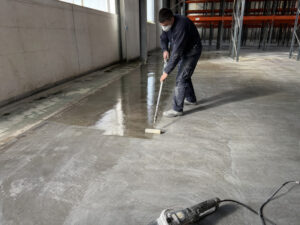
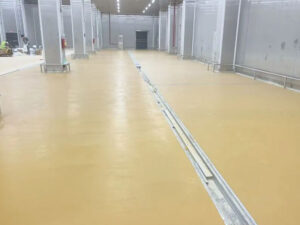
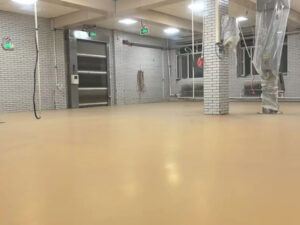
Figure 1: heaters and an installer working inside the cold store before pull-down.

Figure 2: the threshold where the resin meets the panel base, with the seal visible.
Frequently asked questions
Can a PU screed be installed in a freezer?
Only if the substrate can be brought to about 10 °C. Most freezers need temporary heating, which is a programme cost rather than a product issue.
Is urethane cement better for cold stores?
It tolerates lower application temperatures and damp slabs better. It is more rigid, so it needs more joints and more care where the slab moves.
How often should a freezer floor be defrosted?
That is a hygiene decision, but the floor should be selected for the frequency and the temperature swing, not for the steady state.
Why do freezer floors crack at the joints?
Ice forms in any open joint or crack, expands, and widens it. Minimising joints matters more than sealing them.
Can a cold store floor be repaired at temperature?
Sometimes, with a cement-based system. Resin repairs need a warmed patch, which is slow and visible.
What moisture reading is acceptable?
It depends on the primer. Above the stated tolerance, a barrier is needed before the floor, whatever the product.
How long before the room can be pulled down?
Typically two to three days at a moderate temperature. Pulling a room down early is the most common cause of early failure.
Why food plants work with Kaida Paint
Kaida Paint supplies both cold store flooring systems and cement-based ones, and we will tell a client which one their building can actually accept rather than which one is cheaper per kilogram. Send the room temperature, the slab readings and the defrost regime, and we will return a build, a programme and the cure period the room needs before it is pulled down.


 English
 Spanish
 Portuguese
 Arabic
 French
 Italian
 Russian
 Indonesian
 Swedish