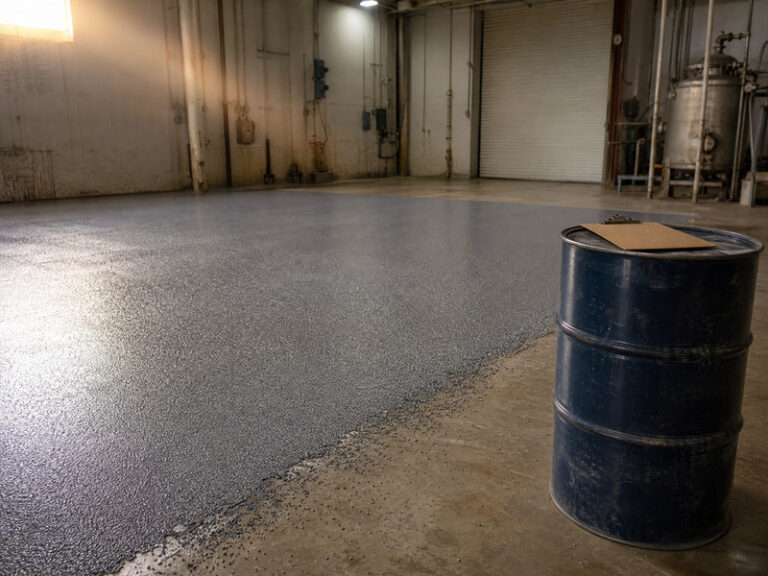
Epoxy flooring cost per square foot in a food plant runs from about 3.50 to 9.00 USD installed for a standard epoxy build-up, and from 9.00 to 15.00 USD for a cementitious urethane system built for hot washdown. The spread is not a pricing trick; it is preparation, thickness and downtime.
Three numbers decide where a project lands: how much substrate preparation the slab needs, how thick the system has to be for the chemical and thermal load, and how long the area can be out of service. A quote that gives one rate per square foot without those three is not comparable with anything.
This breakdown separates the five cost lines that make up an installed price, gives ranges per system for 2026, and shows how to compare two quotes line by line.
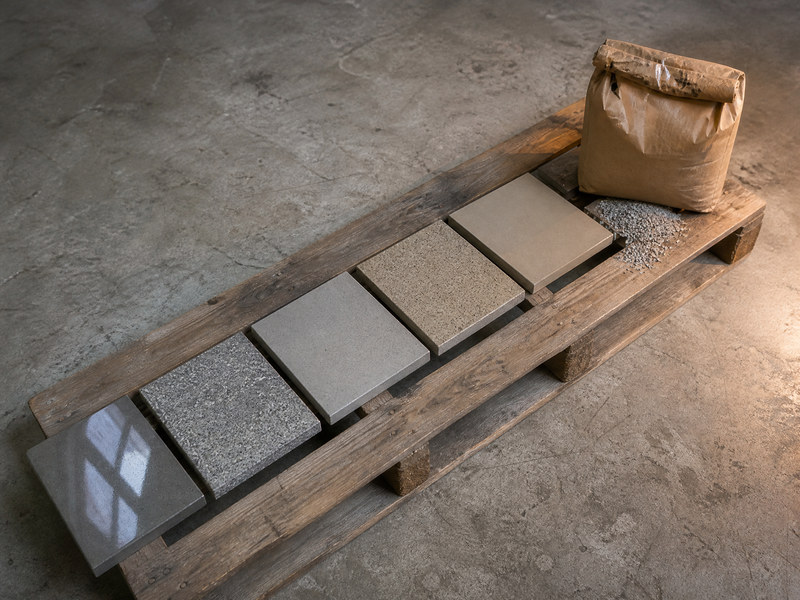
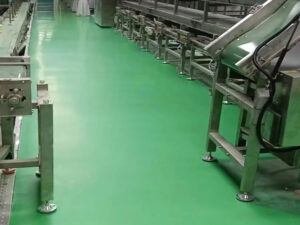
Figure 1: Where the money goes on a food plant epoxy floor. Preparation and mobilisation together often exceed the visible resin cost.
1. What the headline price includes, and what it hides
A headline resin floor price per m2 usually covers material, labour and a nominal preparation allowance. What it hides is how much grinding was assumed, whether moisture control is included, and what thickness the body coat actually reaches. The ranges below are 2026 tenders on food-plant work, not list prices, and they move with resin and labour rather than with the index.
Two contractors can both quote 6.00 USD per square foot and deliver different floors. One assumes a 300 micron coating on a sound slab; the other builds a 1 mm broadcast system with moisture suppression. The second is not expensive; the first is thin.
The practical rule for a flooring budget food plant is to demand the build-up in writing before comparing price. Five lines, each with a quantity, turn a rate into a scope.
Regional labour rates explain part of the spread and none of the comparability problem. A rate quoted in one country cannot be transplanted to another without the preparation allowance, the access conditions and the shift pattern attached to it. Treat any figure you find online, including the ranges below, as a planning number, then replace it with a quotation on your own slab.
2. Cost line 1: substrate preparation
Substrate preparation is the largest single variable and typically 25 to 35 percent of the installed resin floor price per m2. It covers diamond grinding or shot blasting, crack repair, and removal of old coatings or contamination.
A sound, clean, 28-day-old slab may need one pass of grinding. A 30-year-old dairy floor with fat saturation, patch repairs and failing screed may need scarifying, levelling and three passes before any resin is applied. The substrate preparation cost can differ by a factor of three on the same nominal area.
What to specify: the preparation method, the target surface profile (usually CSP 3 to 4), and the acceptance check (visual, plus a moisture and adhesion test on a trial patch). Preparation is also where most programme overruns start, because it is the one line that cannot be compressed by adding resin. The substrate preparation cost fixes the floor’s fate: a bond that is right at the surface holds for a decade, and a bond over a weak, dusty layer fails in a season.
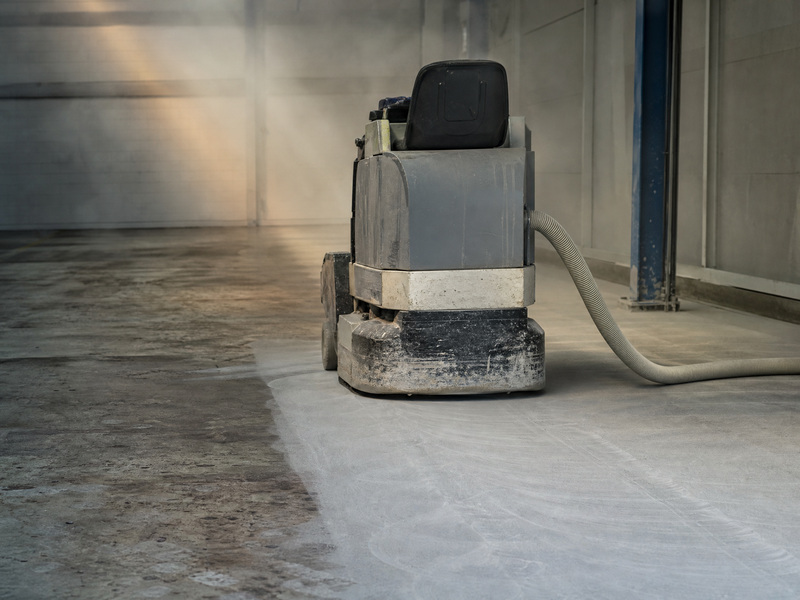
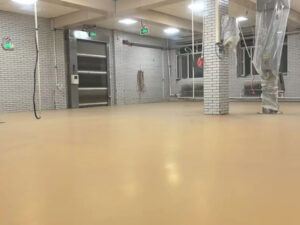
Figure 2: Preparation passes are counted, not estimated. Each additional pass is a visible line in the substrate preparation cost.
3. Cost line 2: primer and moisture control
The primer line is small in material terms, 8 to 12 percent, but it carries the moisture risk. A slab reading above the system limit needs a moisture suppression primer or a surface damp-proof membrane, and that changes both cost and programme.
Skipping it is the most common reason an epoxy floor cost turns into a repair cost eighteen months later. Blistering and disbonding are moisture signatures, and they appear in patches that follow the slab, not the traffic.
Moisture limits are set by the system, not by the building. A primer rated for 90 percent relative humidity and one rated for 75 percent are different products at different prices, and the test result decides which one you are allowed to use.
Ask for the moisture test result with the date and method, and for the primer type by name. A quote that includes “primer” without a product is not a quote you can compare. A moisture test costs a few hundred dollars on a typical bay, and it is the cheapest line in any per-square-foot calculation. The expensive version of the same decision is finding the problem after the topcoat has cured.
4. Cost line 3: body coat and aggregate
The body coat is where thickness and slip class are bought. A broadcast aggregate at 300 to 600 g/m² gives an R10 to R11 surface in a 1 mm system; heavier broadcast and a thicker body coat move it to R12, and both add cost.
This line usually runs 30 to 38 percent of the total. It is also the line most often quietly reduced when a contractor is asked to match a lower price. The aggregate rate drops, the body coat thins, and the epoxy floor cost falls by 15 percent while service life falls by more.
Specify the nominal thickness in millimetres and the aggregate rate in grams per square metre. Both are checkable after the fact with a thickness gauge and a straightedge, which is why a broadcast aggregate figure belongs in the quotation and not only in the data sheet.
5. Cost line 4: topcoat and coving
The topcoat decides chemical resistance at the surface and how the floor cleans. A standard amine-cured epoxy topcoat is adequate in dry areas; a polyurethane topcoat adds UV stability and better resistance to some acids, at roughly 10 to 20 percent more on that line.
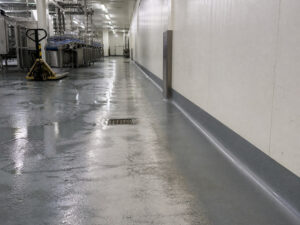
Coving, kerbs and drain details sit here too, and they are priced by the linear metre rather than the square metre. A 100 mm coved skirting along 200 m of wall is a real number, often 8 to 15 USD per linear foot in a food plant, measured along the wall line and excluding internal corners. It is also the detail auditors look at first.
A quote that omits coving is not cheaper; it has moved the cost to the variation account.
Drain details are priced per unit because each one is a hand-built collar. A kitchen floor drain collar, formed and sealed at 1:5, is 30 to 60 minutes of work; a trench drain end piece takes longer. On a plant with 40 outlets, that line alone can reach 8,000 to 16,000 USD, and it explains why two epoxy flooring cost per square foot figures diverge on the same area.
6. Cost line 5: mobilisation, phasing and downtime
Site setup covers access, plant, welfare, waste removal and demobilisation. On a single open bay it may be 8 percent; on a phased job with four mobilisations it can reach 15 percent, and that is before downtime.
Downtime cost is the line most often left out of the flooring budget food plant calculation, and the one that decides the project. If a line contributes 4,000 USD of gross margin per hour of production time and the floor keeps it down for 48 hours, the downtime cost is 192,000 USD, which dwarfs the difference between two resin systems.
That arithmetic changes the buying decision. A fast-cure system at 12 USD per square foot that returns the line in 24 hours can be cheaper than an 8 USD system that takes 72. When you present a flooring budget food plant internally, put the downtime cost next to the installed price, not in an appendix.
Shift premiums belong in the same line. Night work, weekend setup and out-of-hours supervision typically add 15 to 25 percent to labour, and a phased job may need four separate mobilisations. That is why a floor budget built from a single day-shift rate is usually 20 percent light.
7. Price per square foot by system type
A uretano cementoso system costs more because it is a different material class, not because of margin. It is placed at 6 to 9 mm with a graded aggregate, which means more material per square metre and a slower application. The epoxy flooring cost per square foot looks lower because the build-up is thinner.
The table below is the range we see in 2026 tenders for food and beverage plants, installed, including preparation, coving to 100 mm and standard drainage details. It is a planning range, not a quotation: labour rates, access and phasing move it by 20 to 30 percent.
Table 1: Installed epoxy flooring cost per square foot by system, 2026 planning ranges, food plant conditions.
| Sistema | Typical thickness | USD per sq ft | USD per m² | Where it fits |
|---|---|---|---|---|
| Epoxi de capa fina | 0.3-0.5 mm | 3.50-6.50 | 38-70 | Dry storage, packaging, offices |
| Epoxy, broadcast | 1.0-1.5 mm | 5.50-9.00 | 59-97 | Light wet process, corridors |
| Poliuretano | 2.0-3.0 mm | 7.00-11.00 | 75-118 | Wet process, cold rooms, thermal cycling |
| Cementitious urethane | 6.0-9.0 mm | 9.00-15.00 | 97-161 | Hot washdown, fats, dairy, brewing |
| MMA | 3.0-4.0 mm | 8.00-13.00 | 86-140 | Fast return to service, cold rooms |
Coving, kerbs and drain collars are additional and should be measured separately: allow 8 to 15 USD per linear foot of coving and 150 to 400 USD per drain detail, depending on the termination.
Table 2: How project size moves the epoxy flooring cost per square foot for a 1 mm broadcast system.
| Zona | USD per sq ft | Why the rate moves |
|---|---|---|
| 150 m² | 9.00-11.00 | Mobilisation spread over a small area, edge work dominates |
| 500 m² | 7.00-9.00 | One mobilisation, one phase, normal access |
| 1,500 m² | 5.50-7.50 | Continuous production, plant stays on site |
| 4,000 m² | 5.00-6.50 | Bulk material, weeks of work, phased handover |
8. How to compare two quotes honestly
Comparing two epoxy floor cost figures requires how to specify a floor so quotes compare line by line. Put them side by side as a table and mark the gaps; a missing line is a variation waiting to happen.
Table 3: Quote comparison worksheet. Any blank cell is a scope gap, not a saving.
| Line | What to compare | Unit |
|---|---|---|
| Preparación | Method, passes, profile target, crack repair | m², lump sum |
| Moisture control | Test result attached, primer type | m² |
| Body coat | Nominal thickness, aggregate rate | mm, g/m² |
| Seal coat | Chemistry, number of coats | m² |
| Detalles | Coving height, kerbs, drain collars | linear m, each |
| Programme | Phases, cure window, return to service | days |
| Acceptance | Tests, sampling rate, retention | per 500 m² |
That is the only way an epoxy flooring cost per square foot becomes a number you can defend in a capital review. The lowest resin floor price per m2 is usually the one with the most blanks. Fill the table before you choose, and keep the downtime cost in the same view.
Payment structure belongs in the comparison too. Retention and acceptance at handover change a contractor’s cash position over twelve months. A contractor who prices for that risk can look 3 to 5 percent more expensive on paper while being the cheaper offer in cash terms. Read the payment terms next to the rate, then decide.
Two adjustments sit outside the rate itself. Freight and duty apply to imported material, and currency moves the material share by a few percent over a long project. Neither belongs inside a per-square-foot figure, but both belong in the capital request.
One last check before you sign: confirm what happens if the moisture reading fails after the floor has been removed. A clear allowance for a damp-proof membrane, priced as a provisional sum with a stated rate, is cheaper than discovering the variation mid-project when the plant is already empty.
Frequently asked questions
What is a realistic epoxy flooring cost per square foot for a food plant?
For a 1 mm broadcast epoxy system including preparation and coving, expect 5.50 to 9.00 USD per square foot in 2026. Below 5.00 usually means a thinner body coat, a smaller preparation allowance, or details priced separately. At the top of the range, the same build-up with heavier reinforcement reaches 9.00. Ask which build-up the rate describes before treating it as a benchmark for your own budget.
Why is my quote double the price I saw online?
Online figures usually describe a garage coating: one pass of grinding, no moisture control, no coving, no phasing. A food plant adds moisture control, coving, phasing, a heavier broadcast aggregate, acceptance testing and a warranty tied to the build-up.
Does a thicker floor always cost more per square foot?
Not linearly. Material rises with thickness, but preparation, mobilisation and access are fixed costs spread over the area. On a small repair, a thicker system may add less than 15 percent to the total.
How much does downtime add to the epoxy floor cost?
It depends on the line, not the floor. A line earning 4,000 USD of margin per hour that stops for 48 hours carries 192,000 USD of downtime cost, which is usually larger than the entire flooring budget food plant figure.
Can I reduce the price by skipping the moisture test?
You can skip the test, but not the moisture. If the slab is above the system limit, the floor will blister and the repair will cost more than the test and the primer combined.
Is cementitious urethane worth twice the price of epoxy?
In a room with daily hot washdown and fats, yes: epoxy in that service typically fails at the bond line within two to three years. In a dry packing hall, it is money spent on a property you do not need.
How do I compare a square foot price with a square metre price?
Multiply the square foot price by 10.76. A 6.00 USD per square foot system is about 65 USD per m². Always check whether coving and drainage are inside or outside the rate.
Why food plants work with Kaida Paint
Kaida Paint formulates and manufactures epoxy, polyurethane, cementitious urethane and MMA systems for food and beverage plants, and supplies them either as finished systems or as OEM and private-label production for distributors. Every batch ships with a certificate of analysis and a batch record, and the TDS and SDS are issued in the buyer’s language. Our technical team reviews drawings and phasing plans before quoting, because preparation and programme decide the price more than the resin does. If you send a floor plan with the area schedule and the washdown regime, we will return a build-up by zone with the thickness and aggregate rate stated line by line.


 English
 Spanish
 Portuguese
 Arabic
 French
 Italian
 Russian
 Indonesian
 Swedish