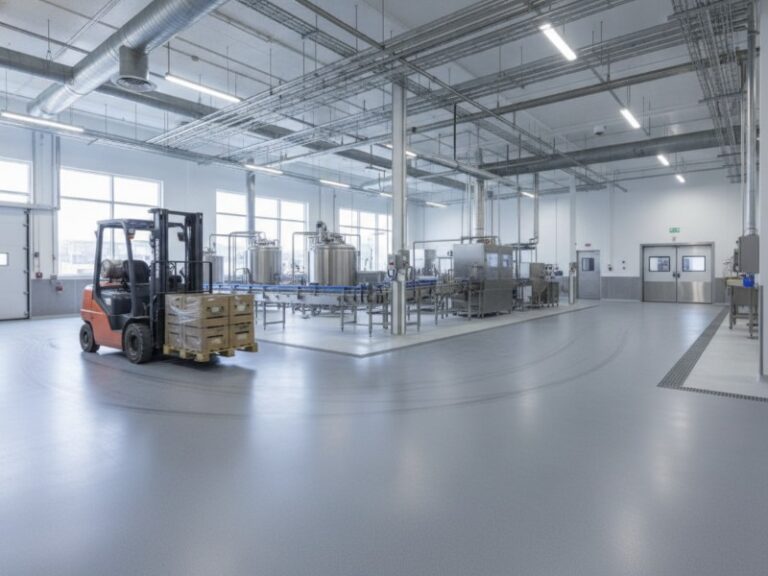
Urethane cement flooring is a heavy-duty seamless industrial flooring system made from polyurethane resin, cement, and aggregates. It is designed for thermal shock, chemical exposure, heavy traffic, and frequent washdowns where epoxy coatings typically fail.
You should use urethane cement flooring when your facility faces:
- High temperatures above 140°F
- Daily steam cleaning or hot water washdowns
- Heavy forklift and steel-wheeled cart traffic
- Organic acids or aggressive chemicals
- Cold-storage or high-moisture environments
In this complete guide, you will learn how urethane cement works, how it compares to epoxy, when it becomes essential, what it costs, how to select the right system, and how to avoid common installation mistakes.
Should You Use Urethane Cement Flooring?
| Scenario | Recomendación |
|---|---|
| Extreme heat, thermal shock, chemicals, heavy traffic | ✅ Best choice |
| Budget-limited, low-stress, short-term floors | ❌ Not ideal |
| Steam cleaning, acids, or freezer transitions are involved | ✅ Better than epoxy |
1. What Is Urethane Cement Flooring?
Urethane cement flooring is a high-performance polymer-modified seamless flooring system applied at thicknesses from 3/16 to 3/8 inch (5 to 10 mm). It is a hybrid composite that leverages the flexibility and chemical resistance of polyurethane with the compressive strength and thermal mass of cementitious aggregates.
1.1 What Is Urethane Cement Made Of?
The material combines four primary components into a dense, cross-linked matrix:
- Polyurethane Resin: Provides flexibility, adhesion, and broad chemical resistance.
- Cementitious Filler (Portland or Calcium Aluminate Cement): Contributes compressive strength, dimensional stability, and thermal mass.
- Aggregate Particles (Graded Silica or Quartz): Controls viscosity, reduces shrinkage, and enhances wear resistance.
- Specialized Additives: Includes catalysts, plasticizers, and anti-microbial agents for specific regulatory compliance (USDA, FDA).
1.2 Why Urethane Cement Works Better in Extreme Environments
The synergy of these materials creates an interpenetrating polymer network (IPN). The polymer phase absorbs shock and resists chemical attack, while the cementitious phase prevents creep under heavy loads and anchors the system to the concrete substrate. This unique combination allows the floor to withstand temperatures from -20°F to 220°F (-29°C to 104°C) while maintaining integrity through thousands of freeze-thaw cycles.
2. Urethane Cement vs Epoxy: Which Is Better?
Understanding the difference between urethane cement and epoxy is critical to making the right investment. While epoxy is an economical solution for many commercial settings, it is not a substitute for urethane cement in demanding industrial environments.For a deeper look at urethane cement vs epoxy cost over 10 years, see our full comparison.
2.1 Quick Comparison: When to Choose Which
| Requirement | Better Choice |
|---|---|
| High-temperature environments (>140°F) | Cemento de uretano |
| Daily steam cleaning | Cemento de uretano |
| Heavy forklift and steel-wheel traffic | Cemento de uretano |
| Organic acid or chemical exposure | Cemento de uretano |
| Cold-weather installation | Cemento de uretano |
| Budget-limited projects | Epoxi |
| Light commercial or residential spaces | Epoxi |
2.2 Detailed Technical Comparison
| Propiedad | Cemento de uretano | Epoxi |
|---|---|---|
| Resistencia a la temperatura | -20°F to 220°F | Up to 140°F |
| Resistencia al choque térmico | Excelente | Poor |
| Chemical Resistance (pH range) | 2-12 | Limitado |
| Vapor Permeability | Moderate (allows breathing) | Low (blistering risk) |
| Minimum Installation Temperature | As low as 35°F | Requires >50°F |
| Estabilidad UV | Bien | Pobre (amarillos) |
| Flexibilidad | Alta | Low (brittle) |
| Time to Foot Traffic | 6-8 hours | 16-24 horas |
| Service Life (Heavy Traffic) | 10-15+ years | 5-8 años |
2.3 When Epoxy Is the Right Choice
Epoxy remains an excellent choice for light-to-medium duty applications where temperatures remain stable below 140°F, chemical exposure is minimal, and initial cost is the primary constraint. Commercial garages, residential basements, and light manufacturing are all suitable applications for high-performance epoxy systems.
2.4 Why Facilities Switch to Urethane Cement
We have analyzed numerous facilities where epoxy floors failed within 18-24 months. The most common failure modes include:
- Delamination from Steam Cleaning: Hot water and steam pressure lift the epoxy from the concrete substrate.
- Cracking under Thermal Shock: Rapid temperature changes cause brittle epoxy to crack and spall.
- Corrosión química: Organic acids or harsh cleaners break down the epoxy polymer, creating a sticky or powdery surface.
3. When Do You Absolutely Need Urethane Cement?
Through field observations and analysis of over 200 installations, we have identified five non-negotiable scenarios where urethane cement is not just recommended but functionally required.
3.1 Extreme Thermal Cycling Environments
Facilities that undergo routine hot-cold transitions—daily steam cleaning or moving between freezers and ambient zones—place enormous stress on floor coatings. Urethane cement flexes with the substrate, preventing delamination.
Typical Applications:
- Cold storage warehouses with freezer-to-ambient transition zones
- Food processing plants with daily sanitation protocols
- Commercial bakeries and breweries
- Meat and poultry processing facilities
3.2 Heavy Chemical Exposure Areas
Urethane cement exhibits exceptional resistance to chemicals that would degrade other coatings:
- Organic Acids: Lactic, acetic, citric, fatty acids
- Inorganic Acids: Sulfuric, hydrochloric, phosphoric acids (up to 30%)
- Caustic Alkalis: Sodium hydroxide (up to 50%)
- **Cleaning Agents, Solvents, and De-icing Salts
3.3 High-Traffic and Heavy Mechanical Loading Zones
Industrial flooring must withstand forces that standard coatings cannot endure long-term.
Critical Thresholds:
- Daily traffic exceeding 500 forklift passes
- Impact loads exceeding 1,000 lb dropped from 3 feet
- Steel-wheeled pallet jacks and equipment
Our Testing: In a major logistics center, our 24-month comparative test showed urethane cement maintained less than 0.5 mm of wear depth, while epoxy exhibited 2.3 mm of wear and required partial replacement after 16 months.
3.4 Sanitary and Food Processing Environments
FDA-compliant urethane cement systems are the gold standard for sanitary environments. They create a seamless, non-porous surface that eliminates harborage points for bacteria.
Regulatory Considerations:
- USDA approval for direct food contact
- FDA 21 CFR compliance
- HACCP compatibility
Case Study: Poultry Processing Plant, Texas
A major poultry plant suffered from delamination and bacterial growth in the seams of a failed epoxy floor. After switching to urethane cement with an anti-microbial additive in 2012, the floor remains in service today with routine maintenance only.
3.5 Cold-Weather and Moisture-Sensitive Applications
Urethane cement cures through chemical reaction rather than evaporation, making it suitable for:
- Installation during winter months or in unheated buildings
- Application over “green” concrete with high residual moisture
- High-humidity environments where production cannot stop
4. Industries That Use Urethane Cement Flooring
Urethane cement serves a variety of demanding sectors. Understanding these verticals can help you determine if it is the right solution for your project.
- Comida y bebida: Dairy processing, breweries, meat packing, citrus processing, commercial kitchens
- Pharmaceutical Manufacturing: Sterile production areas requiring seamless surfaces
- Cold Storage Warehouses: Transition zones subject to condensation and freezing
- Chemical Plants: Secondary containment and processing areas
- Commercial Laundries and Car Washes: Extreme moisture and chemical exposure
4.1 Food and Beverage Flooring
Food processing facilities require flooring that withstands daily sanitation, organic acids, and temperature fluctuations. Urethane cement meets USDA and FDA requirements while providing a seamless, bacteria-resistant surface.
4.2 Pharmaceutical Flooring
Pharmaceutical manufacturing demands sterile, seamless, and chemically resistant surfaces. Urethane cement systems comply with stringent GMP standards and provide long-term durability in cleanroom environments.
4.3 Cold Storage Flooring
Cold storage warehouses face extreme temperature transitions and condensation. Urethane cement’s thermal shock resistance and vapor permeability make it the industry standard for freezer-to-ambient transition zones.
5. How Is Urethane Cement Flooring Installed?
Proper installation is critical to unlocking the performance of urethane cement. The process requires skilled applicators and strict adherence to protocol.
5.1 The 4-Step Installation Process
- Stage 1: Substrate Preparation (Shot-blasting or grinding)
Achieve Concrete Surface Profile (CSP) 3-5 for optimal mechanical bond. Perform moisture testing and pull-off adhesion tests on representative areas. - Stage 2: Primer Application
Apply compatible urethane primer to penetrate the substrate and improve adhesion. - Stage 3: Trowel Application
The two-component material is mixed on-site and applied with a serrated trowel. Working time is typically 15-20 minutes per batch. - Stage 4: Sealer or Topcoat (Optional)
A clear sealer enhances chemical resistance, with anti-slip aggregate broadcast into the final coat.
5.2 Curing Time Schedule
| Activity | Tiempo necesario |
|---|---|
| Set to light foot traffic | 6-8 hours (temperature dependent) |
| Set to light hand carts | 12-16 hours |
| Full chemical cure | 48-72 horas |
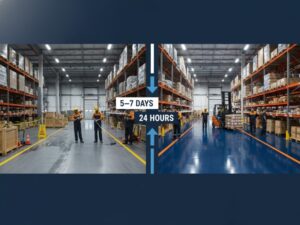
| Complete cure for heavy loads | 5-7 días |
Critical Note: A common cause of premature failure is loading the floor too early, before the polymer network has fully cured.
5.3 Quality Control Standards
- Concrete Surface Profile (CSP): CSP 3-5 required for optimal bond
- Pruebas de humedad: Maximum 90% RH for urethane cement application
- Pull-off Adhesion Test: Minimum 200 psi typically required
- Temperature Requirement: Substrate and ambient temperature above 35°F
6. How Much Does Urethane Cement Flooring Cost?
Initial material costs for urethane cement typically range from $8 to $15 per square foot, compared to $3 to $7 for epoxy. However, total cost of ownership tells a different story.
6.1 20-Year Life Cycle Cost Analysis
For a standard 10,000 sq ft facility, the long-term economics favor the durable option.
| Factor de coste | Cemento de uretano | Epoxi | Standard Coating |
|---|---|---|---|
| Initial Installation | $120,000 | $60,000 | $35,000 |
| Expected Service Life | 15 years | 7 years | 4 años |
| Maintenance (20 years) | $12,000 | $45,000 | $80,000 |
| Replacement (20 years) | $120,000 | $180,000 | $245,000 |
| Total 20-Year Cost | $252,000 | $285,000 | $360,000 |
6.2 Hidden Cost Considerations
Downtime is often the most expensive factor. For a facility generating $10,000/hour in revenue, the extended cure time requires scheduling, but the promise of a 15-year service life means fewer disruptive shutdowns for repairs.
Structural Surcharge: Urethane cement is roughly 30-40% heavier than epoxy. For elevated floors, a structural engineering assessment may be required.
7. How to Choose the Right Urethane Cement System
Selecting the correct system is not one-size-fits-all. To compare options in more detail, see our full urethane cement flooring system solution. To maximize ROI and meet operational demands, consider the following factors.
7.1 System Types
- Urethane Cement Mortar System: High-build (up to 1/2 inch) for the most demanding heavy-load applications. Excellent for crack bridging.
- Self-Leveling Urethane Cement: Creates an ultra-smooth, flat surface ideal for high-traffic aisles requiring glide.
- Slurry Urethane Cement: Troweled system that is excellent for covering uneven substrates.
- Anti-Slip Urethane Cement: Formulated with specific aggregates to meet safety COF requirements in wet areas.
7.2 Thickness Selection
- 5mm (3/16 inch): Suitable for light-to-medium traffic where chemical resistance is primary.
- 9mm (3/8 inch): Recommended for heavy traffic, high-impact areas, and severe thermal shock.
7.3 Texture and Anti-Slip Requirements
- Smooth Finish: For easy cleaning in dry areas.
- Anti-Slip (Medium Grit): For wet environments or areas with oils/grease.
- High Grip (Coarse Aggregate): For areas with heavy water runoff or steep inclines.
7.4 VOC and Sustainability
Many modern urethane cement formulations are low-VOC, contributing to better indoor air quality and helping facilities achieve LEED certification.
8. When Should You NOT Use Urethane Cement?
While urethane cement is an exceptional product, it is not the right solution for every project. Being transparent about its limitations strengthens credibility and helps users make better decisions.
Urethane cement is likely not cost-justified for:
- Light commercial or residential spaces without extreme conditions
- Projects with very limited budgets and short building tenure
- Temporary or secondary low-use storage areas
- Applications without significant thermal, chemical, or mechanical stress
For these scenarios, high-quality epoxy or polyurethane coatings often provide adequate performance at a lower initial cost.
9. Common Installation Mistakes to Avoid
Even the best material can fail if installed incorrectly. Drawing from our project experience, here are the most frequent pitfalls:
- Mistake 1: Inadequate Surface Preparation. Failing to achieve the correct CSP results in poor adhesion.
- Mistake 2: Incorrect Mixing Ratios. The two-component system requires precise measurement. Use automated proportioning equipment.
- Mistake 3: Overworking the Material. Once the material begins to polymerize, additional manipulation breaks down the developing network.
- Mistake 4: Inadequate Joint Preparation. Control joints must be routed and filled with compatible sealants.
- Mistake 5: Installation Under Adverse Conditions. Even though urethane cement is more forgiving, installing outside specified temperature ranges can lead to defects.
10. Maintenance and Care Guidelines
Proper maintenance extends the service life of urethane cement flooring significantly.
Daily Maintenance:
- Sweep or dust mop to remove abrasive debris
- Clean spills immediately to prevent staining
- Use pH-neutral or mild alkaline cleaners
Weekly Maintenance:
- Scrub with rotary floor machine and approved cleaner
- Inspect for damage at joints and edges
Periodic Maintenance:
- Reapply sealer every 3-5 years in high-traffic areas
- Repair any cracks or chips promptly
- Schedule annual professional inspection
Factors Affecting Service Life:
- Traffic volume and type
- Chemical exposure frequency and concentration
- Temperature cycling intensity
- Maintenance quality and consistency
11. Urethane Cement Flooring FAQs
Q: Urethane cement flooring vs epoxy flooring, which is better?
A: For extreme environments with high heat, chemicals, or steam cleaning, urethane cement is better. For budget-limited commercial or residential projects with stable conditions, epoxy is the better choice.
Q: How thick should urethane cement flooring be?
A: Typically 5mm (3/16 inch) for moderate traffic and 9mm (3/8 inch) for heavy-duty areas.
Q: Can urethane cement be installed over moisture?
A: Yes. Urethane cement can be applied over green concrete with high residual moisture (up to 90% RH), unlike epoxy systems.
Q: Is urethane cement food safe?
A: Yes. FDA-compliant and USDA-approved formulations are available for direct food contact areas.
Q: How long does urethane cement take to cure?
A: Light foot traffic in 6-8 hours, light carts in 12-16 hours, full chemical cure in 48-72 hours, and heavy loads in 5-7 days.
Q: Can urethane cement be repaired?
A: Yes. Damaged sections can be cut out and patched with fresh material. Small repairs typically cost $1.50 to $2.50 per square foot.
Q: Is urethane cement slip-resistant?
A: Yes. Non-slip aggregates can be broadcast into the surface to achieve the required coefficient of friction (typically ASTM C1028 values of 0.60-0.85).
Q: What temperature range can urethane cement withstand?
A: Urethane cement can withstand temperatures from -20°F to 220°F (-29°C to 104°C) while maintaining structural integrity.


 English
 Spanish
 Portuguese
 Arabic
 French
 Italian
 Russian
 Indonesian
 Swedish