Descripción
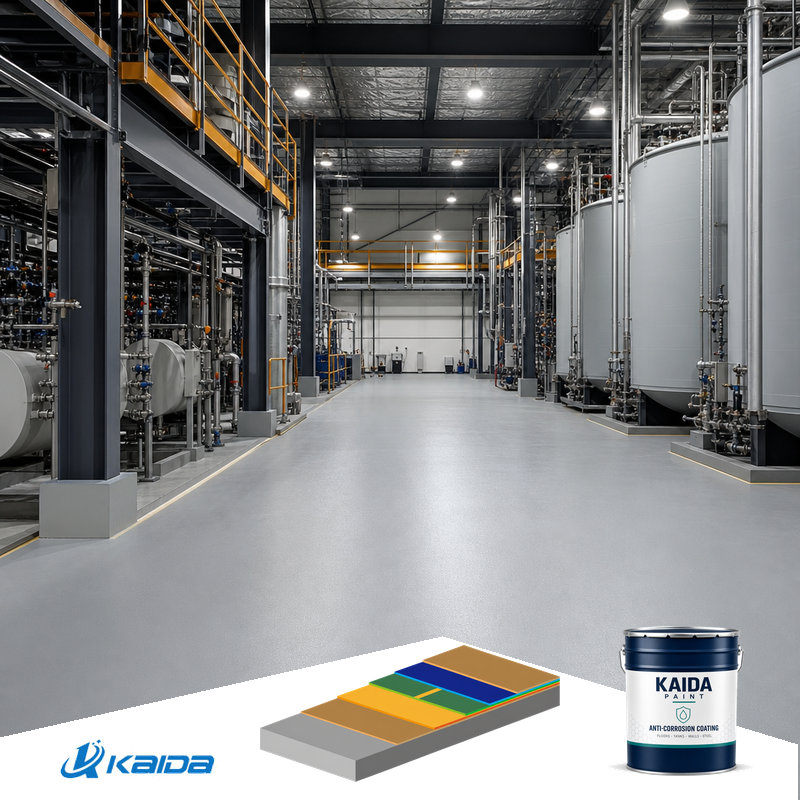
FRP flooring is a glass-reinforced plastic floor — fiberglass cloth bonded in resin over a prepared concrete slab — and it sits between a heavy epoxy coating and a full vinyl ester lining in both cost and chemical reach. ACF-UP-FRP is built at 2–5 mm, declared against 75% sulfuric acid and 40% hydrochloric acid, with a quoted life of 3–5+ years. Choose FRP where the medium is medium-duty and the floor has to stay economical; step up to vinyl ester when immersion, solvent or concentrated acid enters the brief. The ACF-UP-FRP system uses a vinyl ester penetrating primer, three layers of glass cloth in polyester resin, a mortar body and a polyester topcoat, built at 2–5 mm for medium-duty chemical exposure. This page explains what “three cloth five oil” actually means, which media the system is declared against, how it is installed, and where a buyer should step up to a vinyl ester system instead.
| Artículo | Especificación |
|---|---|
| Sistema | 3-cloth 5-coat glass reinforced (FRP) corrosion-resistant flooring |
| Model | ACF-UP-FRP |
| Resin | Vinyl ester penetrating primer; polyester laminating and topcoat resin |
| Refuerzo | 3 layers glass fiber cloth / mat |
| Finished thickness | 2–5 mm (0.08–0.20 in) |
| Acabado | Matte, uniform color; gloss topcoat available |
| Service life quoted | 3–5+ years in the duty it was specified for |
| Application method | Hand lay-up and roller application, ambient cure, no hot work |
What is FRP flooring, and what does “three cloth five oil” mean?
FRP stands for fiberglass reinforced plastic. In flooring, that means glass cloth or mat is laid into wet resin in successive layers, so the finished floor is a composite rather than a film. The Chinese trade term for the standard build translates literally as “three cloth, five oil” — three layers of glass cloth and five applications of resin, where “oil” is the historical word for a resin coat and has nothing to do with oil.
That distinction matters when comparing quotations. A supplier offering “three cloth three coat” is selling a thinner build at a similar headline description; the coat count is what fills the weave, seals pinholes and builds the barrier. On a site where the floor meets acid daily, the difference between three and five resin applications is the difference between a three-year and a five-year floor.
Where FRP flooring sits in the market is equally practical. It costs less than a vinyl ester lining and performs better than a heavy-duty coating. For medium chemical exposure with mechanical load — a chemical warehouse floor, a battery plant aisle, a wastewater channel — it is often the correct economic answer.
Scope of the term. In this page FRP means a polyester-matrix glass-reinforced floor: the primer is vinyl ester, the laminate and the topcoat are polyester. Glass-reinforced floors built on epoxy and on vinyl ester resin are specified on separate pages in this range, and their acid envelopes differ — a point worth settling before any of the three is compared on price.
Which chemicals is ACF-UP-FRP declared against?
The values below are the manufacturer’s declared 7-day immersion results, with no change to the cured film. They describe the resin’s resistance, not a warranty for a specific process stream.
| Medio | Concentración | Resultado |
|---|---|---|
| Sulfuric acid | 75% | No change after 7 days |
| Hydrochloric acid | 40% | No change after 7 days |
| Nitric acid | 45% | No change after 7 days |
| Acetic acid | 60% | No change after 7 days |
| Sodium hydroxide | 80% | No change after 7 days |
| Hydrofluoric acid | 20% | No change after 7 days |
| Phosphoric acid | 80% | No change after 7 days |
Two boundaries belong next to that table. First, an immersion result is a screening test; where a specification depends on it for a service guarantee, ask for the test report with the medium, the concentration and the temperature stated. Second, scope. Polyester resin is a medium-duty binder for dry or wash-down service at ambient temperature. For permanent immersion, specify the vinyl ester 3-cloth floor. For solvent contact or hot process liquor, check the temperature against the vinyl ester data before specifying.
The polyester class is one entry in a longer comparison, set out in corrosion resistant flooring in polyester class.
How is the FRP flooring built up?
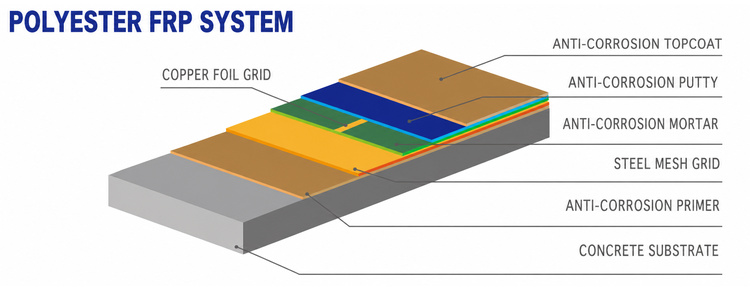
- Concrete substrate — ground, sound, dust-free; cracks and voids opened and filled.
- Vinyl ester penetrating primer — anchors the laminate into the cement matrix. Using a vinyl ester primer under a polyester laminate is deliberate: it is the bond line that decides whether the floor stays attached.
- Glass fiber cloth × 3 in polyester resin — the structural layer; each cloth fully wetted out and rolled free of air.
- Mortar body — builds thickness and load capacity over the laminate.
- Grinding — the cured mortar is ground to plane.
- Putty — closes the weave and pinholes.
- Polyester topcoat — the barrier and wearing surface, pigmented, matte; a faster-curing resin gives a harder surface and a uniform color.
The primer/laminate pairing is the part buyers question most. A vinyl ester primer over polyester laminate is not a cost cut — it is how the system keeps adhesion on a damp-ish or alkaline slab while the bulk of the build stays in the cheaper resin.
What are the mechanical properties?
| Test item | Unit | Resultado |
|---|---|---|
| Resistencia a la compresión | N/mm² | ≥ 60 (8,700 psi) |
| Pencil hardness | H | ≥ 2H |
| Abrasion loss (750 g / 500 r) | g | ≤ 0.02 |
| Resistencia a los golpes | Kg/cm² | ≥ 80 |
For a glass-reinforced floor these values mean the surface takes drum handling, pallet trucks and wash-down equipment without breaking into the reinforcement. The manual’s performance text rates this build as medium-duty with lower impact tolerance than the vinyl ester systems, while its test table gives the same ≥ 80 Kg/cm² value as those systems. We publish the table value and treat the text as the conservative reading: this is a floor for chemical resistance with moderate mechanical duty, not for steel-wheeled forklifts.
Where is FRP flooring specified?
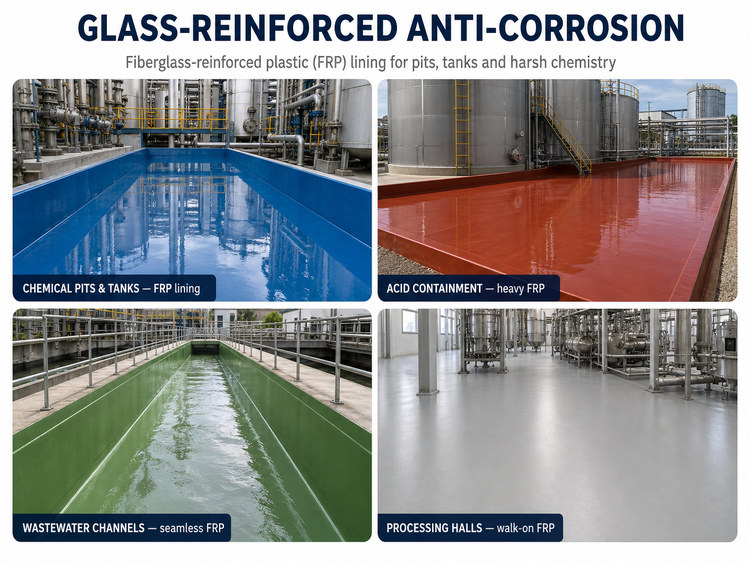
- Battery manufacturing and assembly plants, where electrolyte spill is the governing risk
- Industrial and municipal wastewater pools, channels and wet wells
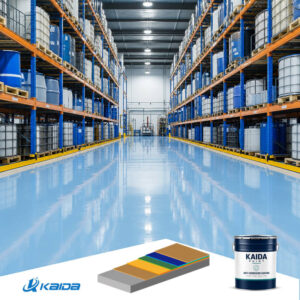
- Chemical warehouses, drum storage and decanting areas
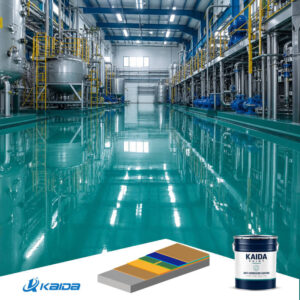
- Chemical plant aisles and secondary containment areas with moderate spill risk
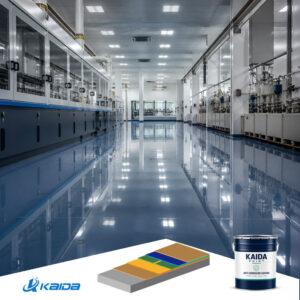
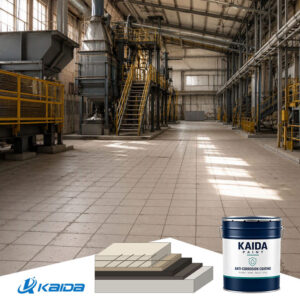
- Heavy industrial halls that need chemical resistance plus a seamless, cleanable surface
For the all-epoxy version of the same 3-cloth build, see fiberglass reinforced epoxy flooring.
How is FRP flooring installed?
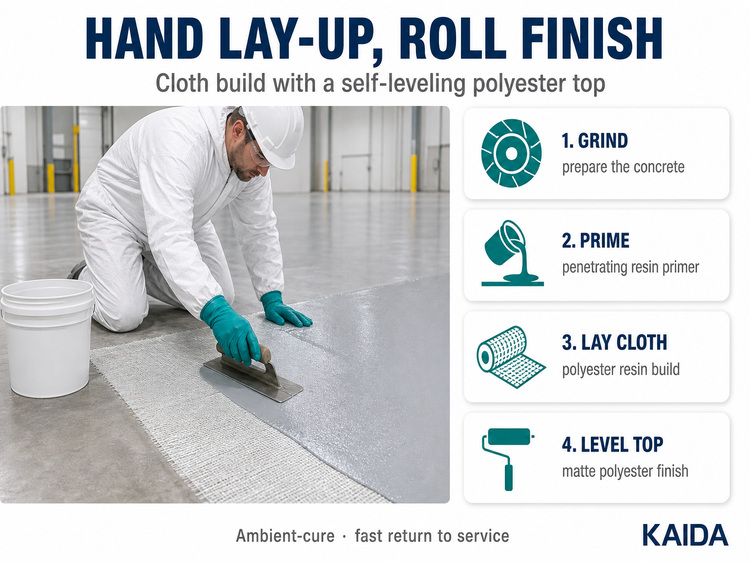
- Preparación — diamond grinding, defect repair, dust removal, moisture check.
- Cebado — vinyl ester penetrating primer to saturation.
- Lay-up — three glass cloth layers impregnated with polyester resin, lapped and de-aired.
- Grinding — cured laminate ground flat and free of laps.
- Mortero — mortar screeded to level and ground.
- Putty and topcoat — putty to close the surface, then polyester topcoat in the specified number of passes.
- Cure and handover — dry, off-traffic cure window, then inspection against the specification.
Styrene emission during cure is the practical constraint on a live plant, not fire risk — the system is cold-applied with no hot work. Most projects are phased overnight or by zone with extraction and temporary screens.
For the vinyl ester version of the same lay-up, see vinyl ester flooring.
Why is the quoted life 3–5+ years, and when should you step up?
The service life figure is shorter than the vinyl ester systems, and that is a design statement rather than a weakness. Polyester resin has more ester linkages in its backbone than vinyl ester, so water and acid eventually reach them; the floor protects well for its service window instead of promising a decade it cannot deliver.
| Situation | Correct system |
|---|---|
| Medium chemical exposure, dry or wash-down service, moderate load | ACF-UP-FRP (this system), 2–5 mm |
| Permanent immersion, tanks and pools, aggressive acid | Vinyl ester 3-cloth 5-coat flooring or tank lining |
| Concentrated acid plus heavy abrasion | Vinyl ester high-build mortar flooring |
| Forklift traffic and impact with chemical exposure | Steel mesh reinforced heavy-duty system |
Lay-up can be reduced to one cloth three coats or two cloths four coats where the duty is lighter. What cannot be reduced is the primer: a thin primer under a three-cloth laminate is where most early failures start.
Where the duty is concentrated acid with abrasion, see vinyl ester high-build mortar flooring.
What does FRP flooring cost, and how is it quoted?
FRP flooring is priced from measured area, lay-up, substrate condition and access. It is typically the lowest-cost glass-reinforced option per square meter (sq ft), because the laminate and topcoat are polyester while only the primer is vinyl ester.
Three items move a quotation more than the resin price: substrate repair volume, the number of details (drains, curbs, plinths) and the cure time the site can allow. If a quotation is materially cheaper for the same stated build, check the topcoat pass count and whether the hardener ratio is fixed by weight or left to the trowel — those are the two places a thin price hides on a polyester build.
FRP is quoted per square meter (sq ft) of finished area, FOB or CIF named port. Lead time is a working-day range from approved sample, and the minimum order is set by the smallest area a hand-lay-up crew can be mobilised for.
Frequently asked questions
Is FRP flooring the same as a fiberglass lining?
Practically yes. “FRP flooring” and “fiberglass lining” describe the same composite: glass reinforcement bonded in resin. The term lining is more often used for tanks and pools, flooring for trafficable slabs. Both are hand laid, both are seamless, and both depend on the substrate preparation more than on the brand of resin.
Can FRP flooring be used outdoors?
Yes, with a topcoat grade selected for UV exposure. Polyester resin weathers better than epoxy in sunlight, but an unshaded roof deck or outdoor containment yard still needs the UV-stable topcoat and a color that does not chalk visibly. Freeze-thaw is acceptable on a sound slab.
How is a damaged FRP floor repaired?
The damaged area is cut back to sound laminate, the edges are feathered, and the build is reinstated layer by layer — primer, cloth, mortar, putty, topcoat. Because the system is bonded rather than laid as sheet, a local repair is a normal maintenance operation.
Does it need a separate moisture barrier?
No separate membrane is required, but the slab has to be dry enough for the primer to penetrate rather than sit on a vapor layer. On slabs without a damp-proof membrane, moisture is tested before the specification is fixed; that test is the cheapest insurance on the whole project.
Why projects specify Kaida Paint for FRP flooring
Each order ships with batch records and a material declaration, and the method statement fixes the substrate moisture limit, the dew point rule and the coat count before work starts — the three items that decide whether the floor reaches its quoted 3–5 years. The technical file records the lay-up and thickness actually installed, so the floor can be checked at handover against what was priced.
Kaida Paint supplies the vinyl ester primer, the polyester laminating resin, the mortar and the topcoat as one system, so the primer/laminate pair is matched rather than assembled from two suppliers. That pairing is the single most common cause of delamination when it is got wrong.
Send the medium and concentration, the area, the mechanical duty and the substrate condition. We will tell you whether FRP is the right system or whether the duty needs a vinyl ester build, and quote against those inputs.
—
Autor: Kaida Paint Technical Team — flooring systems engineering, anticorrosive resin flooring Last updated: 13 November 2026

 English
 Spanish
 Portuguese
 Arabic
 French
 Italian
 Russian
 Indonesian
 Swedish