
Descripción
Anti static vinyl ester flooring is a fiberglass-reinforced resin floor that combines chemical resistance with a controlled electrical path to earth, so a spill, a solvent wash-down or a dry winter shift cannot turn the floor into a charge source. ACF-VE-3F5C-AS is built at 3–5 mm and declared against 75% sulfuric acid and 40% hydrochloric acid. The ACF-VE-3F5C-AS system bonds three cloth layers into vinyl ester resin, adds a conductive putty and a copper foil grounding (earthing) network, and finishes with a static-dissipative vinyl ester topcoat at 3–5 mm. This page covers how the grounding path is built, what the system resists chemically, where it is specified, and how resistance targets are agreed before installation.
| Artículo | Especificación |
|---|---|
| Sistema | Anti static / static dissipative vinyl ester corrosion-resistant flooring, 3-cloth 5-coat |
| Model | ACF-VE-3F5C-AS |
| Electrical path | Conductive putty layer + copper foil grounding tapes bonded to the building earth |
| Refuerzo | 3 layers glass fiber cloth / mat |
| Finished thickness | 3–5 mm (0.12–0.20 in) |
| Acabado | Matte to satin static-dissipative topcoat; orange-peel anti-slip option |
| Service life quoted | 5–8+ years under the media and traffic it was specified for |
| Application method | Hand lay-up, ambient cure, no hot work |
How does anti static vinyl ester flooring actually dissipate charge?
Charge dissipation is a layered electrical circuit, not a property of the topcoat alone. The topcoat conducts charge slowly across its surface, the conductive putty beneath spreads it, and copper foil tapes bonded into the system carry it to the building grounding point.
Three details decide whether that circuit works in service:
- grounding continuity. Copper tapes are laid in a grid, bonded to each other and to the earth bar, and their resistance is measured before the topcoat goes on. A floor with no verified earth connection is an insulated floor with conductive additives in it.
- Uniform conductivity. Conductive putty is applied at a consistent thickness; a thin patch becomes a bottleneck and the surface reads unevenly when tested.
- Topcoat cure. Static-dissipative performance develops with cure. Testing too early gives a misleading reading in either direction.
Targets for a protective floor of this type are normally set out in the client’s ESD control plan and read against IEC 61340-5-1, which separates conductive, dissipative and insulative ranges. We agree the target range and the test method in writing before the first mix, and we test the finished floor against that same method — not against a generic claim.
Which chemicals does ACF-VE-3F5C-AS resist?
The anti static system uses the same vinyl ester chemistry as the standard 3-cloth 5-coat build, so the chemical envelope is the same. Each medium below was tested by 7-day immersion with no change to the cured film.
| Medio | Concentración | Resultado |
|---|---|---|
| Sulfuric acid | 75% | No change after 7 days |
| Hydrochloric acid | 40% | No change after 7 days |
| Nitric acid | 40% | No change after 7 days |
| Acetic acid | 80% | No change after 7 days |
| Sodium hydroxide | 20% | No change after 7 days |
| Hydrofluoric acid | 20% | No change after 7 days |
| Phosphoric acid | 100% | No change after 7 days |
One limitation worth stating before it becomes a site argument: solvents that swell the resin also affect the conductive network’s stability. Where the area is regularly washed with strong solvent or solvent-bearing cleaner, the topcoat grade has to be reviewed, and in some cases a different resin family is the better answer. Solvent exposure is a specification question, not a maintenance detail.
For the non-conductive version of the same build, see vinyl ester flooring.
Term note. Buyers searching for epoxy vinyl ester flooring are looking for this same family: the vinyl ester systems in this catalog are supplied as vinyl ester grades and, depending on the component, epoxy-vinyl ester hybrid grades. The shorter term vinyl ester is used throughout this page.
In a conductive build, the conductive layer is one of the five
The term three cloth five oil counts cloth layers and resin applications, and in an anti static system the conductive layer has to be counted inside that number rather than added on top of it. The copper foil grid or the conductive putty is an application in the schedule, not a fitting installed afterwards.
Count it outside the five and the build is short one coat: barrier thickness drops, and the continuity the grounding relies on becomes a separate item that nobody owns. That is why the grounding layout and the laminate schedule belong on the same drawing — the same reason the conductive layer is specified before the topcoat, not after.
Floors that must also survive chemical attack without carrying charge are compared in corrosion resistant flooring with ESD control.
How is the conductive build assembled?

- Concrete substrate — ground, sound, voids filled, moisture verified.
- Vinyl ester penetrating primer — anchors the system and isolates the slab.
- Glass fiber cloth × 3 in vinyl ester resin — structural layer, resistant to cracking under point loads.
- Mortar and grinding — builds body and levels the surface.
- Conductive putty — the charge-spreading layer, applied at uniform thickness.
- Copper foil tapes — laid in a grid, bonded and connected to the building earth, with continuity measured and recorded.
- Second conductive putty pass — encapsulates the tape grid so the topcoat bonds to putty, not to bare copper.
- Static-dissipative vinyl ester topcoat — applied as a poured or rolled finish, matte to satin, with an orange-peel anti-slip option.
The copper grid is the part that differentiates this system from simply adding carbon to a topcoat. It also makes the floor diagnosable: if a reading drifts years later, the tape layout is on the as-built drawing and the fault can be located instead of guessed.
For a poured topcoat on the same laminate, see self leveling vinyl ester flooring.
What are the mechanical properties?
| Test item | Unit | Resultado |
|---|---|---|
| Resistencia a la compresión | N/mm² | ≥ 60 (8,700 psi) |
| Pencil hardness | H | ≥ 2H |
| Abrasion loss (750 g / 500 r) | g | ≤ 0.02 |
| Resistencia a los golpes | Kg/cm² | ≥ 80 |
The mechanical values match the standard vinyl ester system, which matters in plants that combine ESD control with real production loads — battery assembly fixtures, plating jigs and instrument trolleys all concentrate load on a small area.
Where is anti static vinyl ester flooring specified?
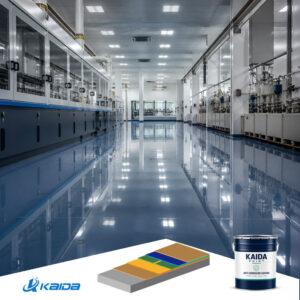
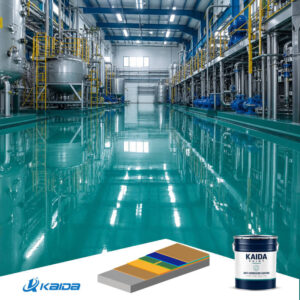
- High-precision chemical plants and pilot lines with solvent and acid exposure
- Oil depots, fuel loading areas and gas station forecourts
- Chemical tank farms and tank containment curbs
- Chemical and analytical laboratories
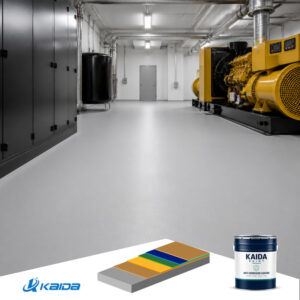
- Battery and electronics plants where acid electrolyte and static control coexist
- Solvent stores and drum decanting rooms

The combination is what buyers come for: most ESD floors on the market are epoxy, which is adequate for electronics but softens under concentrated acid. Most acid-resistant floors are insulative. This system is specified where both requirements land on the same square meter (sq ft).
How is anti static vinyl ester flooring installed and tested?
The installation follows the standard vinyl ester sequence, with two added hold points for the electrical layer.
- Substrate preparation — grinding, repair, moisture and dew-point check.
- Primer and fiberglass lay-up — three cloth layers, fully wetted and de-aired.
- Mortar and grinding — body build, leveled and ground.
- Conductive putty — applied, cured, checked for coverage.
- Copper foil grid — laid, bonded, connected to earth; continuity measured and recorded before proceeding.
- Second putty pass and topcoat — encapsulation and static-dissipative finish.
- Electrical acceptance test — surface resistance and system-to-earth resistance measured at the agreed points, with results recorded against the specification.
- Entrega — as-built tape layout drawing, test record, cleaning and maintenance instructions.

Test points are agreed in advance — a floor tested at three convenient spots and a floor tested on the grid the client specified are different documents. We record the points on the as-built drawing so later audits compare like with like.
Where forklift traffic governs rather than charge, see steel mesh reinforced anti-static flooring.
How thick is it, and how long does it last?
The system is built at 3–5 mm with three cloth layers. Quoted service life is 5–8+ years, conditional on the medium matching the specification, the substrate being dry and properly prepared, and the anti static properties being re-tested on the maintenance schedule rather than assumed.
| Opción | Espesor | Typical duty |
|---|---|---|
| 1 cloth 3 coats | Specified per project | Light chemical contact, ESD-controlled assembly areas |
| 2 cloths 4 coats | Specified per project | Regular chemical contact, trolley traffic |
| 3 cloths 5 coats (standard) | 3–5 mm | Acid and solvent contact, battery and plating areas, heavy wash-down |
What does it cost, and how is it quoted?
ACF-VE-3F5C-AS costs more than the standard system because of the conductive putty, the copper grid and the electrical testing. Quotations are built from measured area, build, substrate condition, the grounding layout and the test regime required by the client’s ESD plan.
The item most often underestimated is grounding: distance to the earth bar, the number of connection points and whether the existing building earth is usable. Those are survey items, and a quotation that ignores them will come back as a variation.
Pricing is per square meter (sq ft), FOB or CIF named port. Because the conductive layer and the grounding test are fixed items rather than variable ones, the minimum order is set by crew mobilisation and the lead time runs from sample approval to the continuity test at handover.
Frequently asked questions
Does the floor stay dissipative for its whole life?
The conductive network is metallic and embedded, so it does not deplete the way an additive in a thin coating can. Performance is maintained by cleaning with the specified neutral cleaner and avoiding waxes, polishes and solvent-heavy strippers that leave an insulative film. Periodic re-testing is the only reliable way to confirm it.
Can the floor be retrofitted over an existing slab?
Not reliably as a surface treatment. A dissipative topcoat applied over an existing insulative floor has no earth path, so charge has nowhere to go. Retrofitting means removing the existing system down to the substrate and rebuilding with the copper grid.
What surface resistance should be specified?
Set by the client’s ESD control plan, read against IEC 61340-5-1 ranges. Where a buyer has no in-house plan, we ask what is being protected — electronics, solvents, or dust — and agree a target range in writing before installation, because “anti static” without a number is not testable.
Is the matte finish slippery?
The standard matte finish is not textured. Orange-peel anti-slip is available where the floor gets wet, and the two can be combined by area: smooth in clean zones, textured at wash-down points and ramps.
Why projects specify Kaida Paint for anti static vinyl ester flooring
Kaida Paint supplies the conductive putty, the static-dissipative topcoat and the vinyl ester laminate as one system, so the conductivity of the layers is designed together rather than assembled from three suppliers’ products. The copper grid layout, the test point schedule and the acceptance values are issued as part of the method statement, and the test record is handed over as an as-built document.
For projects with an ESD control plan, send the plan and the target resistance range with the area and the chemical list. We will return a build recommendation, an grounding layout and a quotation against those inputs.
—
Autor: Kaida Paint Technical Team — flooring systems engineering, anticorrosive and ESD resin flooring Last updated: 13 November 2026

 English
 Spanish
 Portuguese
 Arabic
 French
 Italian
 Russian
 Indonesian
 Swedish