
A uv stable polyurethane is the right floor for a building where daylight reaches the slab, and the wrong one for a building where it does not.
The distinction is not marketing. A uv stable polyurethane is a declared product, and an aliphatic binder resists ultraviolet light where an aromatic one does not, and the visible difference appears within one summer in a skylit bay.
This article covers where the requirement comes from, how to survey the light, what changes at an open loading bay, and the details that decide whether the colour survives.
Where the daylight actually lands
Start with a light survey rather than a product choice. Walk the building at midday with the roof plan and mark every place where sun reaches the floor.
The solar gain through a roof light is concentrated on a patch of floor that is often a metre wide, and that patch is where a standard aromatic floor will fail first.
Skylights in a distribution centre are usually 4 to 10 per cent of roof area. That is enough solar gain to change a floor and not enough to appear in a specification.
Table 1: How much daylight reaches the floor, by opening.
| Opening | Lit area | Risk |
|---|---|---|
| Roof light, 5% of roof | Patch beneath each | High in the patch |
| Glazed wall, south | Up to 10 m band | High across the band |
| Dock door, open daily | 2-4 m strip | High, plus rain |
| High-level window, north | Diffuse, wide | Low but cumulative |
Glazed walls produce a much wider band. A south-facing dock door can throw light ten metres into a warehouse in winter, when the sun is low.
The uv dose is the product of intensity and time, which is why the same window produces a different result in Aberdeen and in Seville.
A south-facing glazed wall can deliver more solar gain to a floor in January than a roof light delivers in June, and the survey has to be done when the sun is low to see it.
Record the survey on a drawing with the lit zones shaded. That drawing becomes the basis for the colour specification and for the tender.
Why the binder decides the outcome
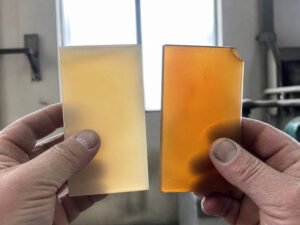
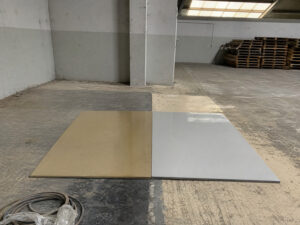
An aromatic isocyanate binder contains a benzene ring that absorbs ultraviolet light and rearranges. The film turns amber, and no additive stops it.
A uv stable polyurethane uses an aliphatic isocyanate with no ring to absorb the light, so the colour stays close to the sample for years.
The rest of the formulation is broadly similar. Abrasion, chemical resistance and adhesion come from the resin body and the filler.
That is why the premium is a colour premium rather than a performance premium, and why the decision belongs to the areas that are seen.
Table 2: The two grades, side by side on the points that matter.
| Property | Aromatic | UV stable |
|---|---|---|
| Colour in daylight | Ambers in 1-2 years | Stable for years |
| Gloss retention | Falls quickly | Holds longer |
| Abrasion | Equivalent | Equivalent |
| Chemical resistance | Equivalent | Equivalent |
| Topcoat cost | Baseline | +40 to 80% |
A clear sealer over a decorative base makes the difference obvious. A clear aromatic film develops an amber cast that reads as dirt even when the floor is clean.
Where a client has already accepted an aromatic floor elsewhere, the comparison will be made in the same building within a year. Plan for that conversation.
What belongs in a colour specification?
A colour specification should be a document, not a sentence. Name the colour, the gloss level and the reference panel that will be used at handover.
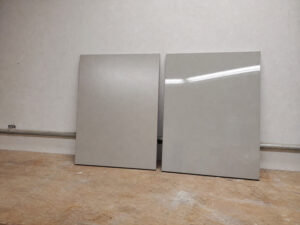
Keep one panel from the delivered batch, store it in the dark, and photograph it beside the floor at twelve months. That pair of photographs settles most colour arguments.
Choose a mid-tone where the budget is tight. Whites and pale greys show a change that a mid-grey or an oxide red absorbs, whatever the binder.
The specular gloss matters as much as the hue. A high-gloss finish shows every mark and every shift in sheen, while a mid-sheen finish hides both.
Where a client wants a very light floor in a skylit bay, the uv stable polyurethane is not optional. It is the only way to keep that colour for more than a season.
Write the gloss level as a number rather than a word. Satin and matt mean different things to different suppliers, and the sample is the only common reference.
What changes at an open loading bay
A dock is not a warehouse with a hole in it. Rain, grit, freeze-thaw and direct sun arrive together, and the floor sits in the worst of all four.
The uv dose at an open bay is far higher than under a roof light, and it arrives at a low angle in winter, which reaches further across the slab.
Wind-driven rain reaches the first two metres of a bay floor and stands against the door frame in every storm. That is where a coating fails first, and it is rarely where the samples were taken.
Water is the bigger practical problem. A film that is sound inside can lift at a threshold where water stands against a door frame.
A thermal movement also concentrates at a bay. A slab that expands in the sun and contracts at night moves against the door frame, and a rigid detail cracks there first.
The cleaning regime at a dock is harsher too. Grit is dragged in daily, and a floor that is swept weekly inside may need sweeping twice a day at the door.
Where a bay is fully open, a standard polyurethane is the wrong family. No grade of floor coating is designed for permanent weather, and the honest answer is a different system.
Which details decide whether the colour survives?
A floor is judged at its edges, and a dock threshold is the edge that gets judged most often because everyone walks over it. The threshold, the door frame, the column base and the drain all receive the same material and fail first if the detail is wrong.
Carry a thermal movement joint through the coating at every construction joint. A floor that bridges a moving joint will crack along the same line.
Form a small upstand at door frames rather than a feather edge. A feathered edge is a knife blade waiting for a pallet truck.
Where a clear sealer is used over a decorative base, two thin coats beat one thick one. A single heavy coat traps solvent and hazes.
Check the specular gloss at the door in daylight. A gloss that looks even under roof lights can show roller marks against a bright opening.
Allow for movement at a bay threshold with a compressible insert rather than a rigid fill. A rigid fill transfers the movement into the coating, and the crack appears within the first winter.
Photograph every detail before handover. Those photographs are the reference when a detail is damaged a year later.
What happens to the surface after a summer?
Two things happen to any film in daylight: the colour moves and the surface dulls. A stable binder slows both, and neither is stopped entirely.
The dulling is chalking in its early stage. The binder at the very top degrades into a fine powder that wipes off on a finger.
In a food plant, that powder is a contamination risk rather than an appearance problem, and the visible rooms are usually specified with the stable grade for that reason alone.
In a warehouse it is cosmetic, and a buffing machine restores the sheen at the cost of a maintenance shift.
A cleaning regime that avoids aggressive alkaline cleaners slows the process. Strong caustic at high temperature attacks a film faster than sunlight does.
Record the appearance at twelve months against the reference panel, and record it again at three years so the trend is visible rather than the single data point. That record sits beside the service life survey for the floor as a whole. That record is the difference between a defect claim and a normal ageing conversation.
Where to spend and where to save
The premium is 40 to 80 per cent on the topcoat material and 5 to 8 per cent on the installed price of a full build, because the topcoat is a small part of the volume.
Spend it in the lit zones: the skylit aisles, the glazed entrance, the canteen and any bay that stands open.
Save it in the dark, where a uv stable polyurethane would be paying for a property the room cannot use: plant rooms, under fixed racking, cold stores and back-of-house corridors where no solar gain ever arrives.
Where a building has both, use one uv stable polyurethane in the lit areas and an aromatic elsewhere, and keep the same colour code across both.
Where a client has a brand colour, apply it in the stable grade in every room a visitor can reach. The cost difference on 200 square metres is trivial against repainting a colour that has drifted.
A single ambered patch in an otherwise stable floor looks like a defect even when it is the correct chemistry for that room.
A uv stable polyurethane in a room with no openings is a specification error that costs real money and delivers nothing, and it happens on most tenders where nobody has walked the building.
The most common waste we see is a full aliphatic build in a windowless warehouse. It is not a better floor; it is a more expensive one.
How do you test the claim before you buy?
Ask which isocyanate family the product uses. An HDI-based aliphatic binder is what the phrase should mean, and a datasheet that avoids the question is avoiding the answer.
Ask for the uv dose used in any accelerated test, and the test method. A result quoted without either cannot be compared with another supplier.
Then run the cheap test. Two cured panels on a windowsill for a season, one in the dark as a control, will rank two products honestly.
Where a specular gloss claim is made, ask for the measured value and the angle. Gloss is measured at a 60° angle for most floors, and the number without the geometry is meaningless.
A supplier who can answer all four is describing a product. One who repeats the phrase is describing a brochure.

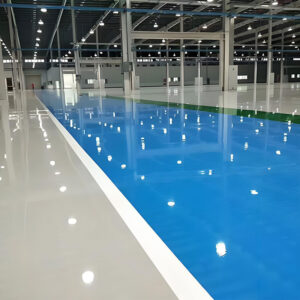
Figure 1: roof lights above the aisle, with their reflection across the floor.
Specifying it so the tender is fair
Write the requirement by zone, not by building. A tender that asks for one system across a mixed building will be priced either too high or too thin.
Name the colour specification and the reference panel, and require the panel to be retained by the client rather than the contractor.
Require the topcoat to be aliphatic with the isocyanate family stated, and require chalking resistance to be demonstrated by a panel test at twelve months.
Where a uv stable polyurethane is specified only in the lit zones, say so on the drawing with the zones shaded. Ambiguity here is the main cause of substitution.
Note the thermal movement details in the same clause. A stable topcoat over a cracked joint is a colour success and a structural failure.
Add one line about the cleaning regime expected in service, because a floor cleaned with the wrong chemical will fail in a way no binder can prevent.
What we will not claim
We will not claim that a uv stable polyurethane is more abrasion resistant. It is more colour stable, and wear is a separate property.
We will not claim that it survives permanent weather. Under a canopy or inside a door that stands open, yes. Fully exposed, no.
We will not claim that an aromatic floor has failed because it changed colour. It has done what the chemistry predicts, and the film is usually sound.
What we will do is survey the light, shade the drawing, and quote two grades side by side so the decision is made with both numbers visible.
Table 3: Which grade belongs in which zone.
| Zone | Grade | Reason |
|---|---|---|
| Skylit aisle | Aliphatic | Direct daylight |
| Glazed entrance | Aliphatic | Visible to visitors |
| Open loading bay | Aliphatic, sheltered | Sun and rain |
| Dry store | Aromatic | No daylight |
| Under racking | Aromatic | Rarely seen |

Figure 2: sunlight across the bay floor, with a pallet truck at the threshold.
Where a project has an unusual light condition, a roof light detail or a glazed wall that throws light in winter, ask for a survey rather than a product recommendation.
The cheapest mistake to avoid is specifying the whole building at the highest grade. The second cheapest is specifying none of it.
Frequently asked questions
Do I need a UV stable floor in a skylit warehouse?
If the lit area is visible or carries a pale colour, yes. In a dark store under the same roof, an aromatic grade is the correct and cheaper choice.
How much more does a UV stable polyurethane cost?
Forty to eighty per cent more on the topcoat material, which is typically five to eight per cent of the installed price of a full build.
Will an aromatic floor change colour if there are roof lights?
Yes, within one summer in a lit patch. The change is cosmetic and the film underneath is normally sound.
Can I use a clear sealer over a decorative floor?
Only an aliphatic one. An aromatic film turns amber within a year, which on a pale floor reads as a defect.
Does a UV stable floor stop chalking?
It slows it. Some surface powder is normal in daylight, and it matters in food areas rather than in warehouses.
Is a UV stable floor suitable for an open loading bay?
Under a canopy, yes. Fully exposed, no floor coating is designed for permanent weather.
How do I prove the colour held at handover?
Retain a panel from the delivered batch and compare it with the installed floor after a year.
Why food plants work with Kaida Paint
Kaida Paint supplies both grades from the same plant and states the isocyanate family on every uv stable polyurethane datasheet. Send the roof plan and the room list, and we will return a shaded drawing with the zones that need the stable grade marked, plus a reference panel from the batch you would receive.


 English
 Spanish
 Portuguese
 Arabic
 French
 Italian
 Russian
 Indonesian
 Swedish