
Brewery flooring and dairy flooring are specified in resin because the room attacks a floor from both ends of the pH scale in the same shift.
Caustic at 80 °C strips fat and protein. Acid at ambient strips mineral scale. A floor has to survive both, plus sugar, yeast and a hundred people walking on it wet.
This article sets out what each of those does to a resin, where the failures start, and how to specify a build that lasts a decade rather than a warranty period.
Two acids and one alkali, in the same room
A polyurethane screed flooring is chosen for this room because the attack is chemical rather than mechanical, and chemistry is where a resin system wins over stone or tile.
Lactic acid comes from milk and from fermentation. It is weak, it is persistent, and it sits on a floor in a thin film for hours after a spill.
Brewery flooring in polyurethane screed resists it well. An epoxy resists it less well, and a cement-based topping resists it poorly because the acid attacks the binder matrix.
Vinegar and cleaning solutions based on acetic acid are the second front. They are used to dissolve beer stone and milk scale, and they are stronger than the acid in the product itself.
At the other end, a hot caustic wash removes protein and fat. It softens many resins and it attacks the joint sealant before it attacks the floor.
A floor that passes an acid test and fails a caustic test is common. Both belong in the specification, with concentrations and temperatures.
Ask for the cleaning schedule before the tender. The chemicals on the wall are the real specification, and they are rarely the ones in the brochure. A kitchen in the same building meets fat and hot oil rather than acetic acid, which is a different commercial kitchen floor specification.
Table 1: Typical exposure and the material property it tests.
| Exposure | Typical condition | Property tested |
|---|---|---|
| Lactic acid | 3-10%, ambient | Acid resistance |
| Acetic acid | 2-5%, ambient | Acid resistance |
| Caustic | 1-3%, 70-80 C | Alkali and heat |
| Wort | 80 C at sparge | Heat and sugar |
| Chlorine | 200-500 ppm | Oxidation |
What acid attack actually looks like
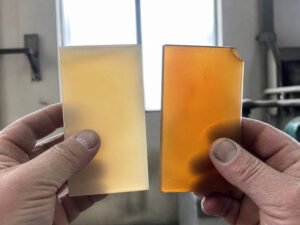
Acid attack on a resin floor is not dramatic. The surface dulls, then develops a chalky film that wipes off, then starts to feel rough.
Under a lens the film has lost its binder at the surface and the filler is standing proud. That is the point at which dirt starts to stick.
Brewery flooring at 6 mm tolerates years of that. A 0.3 mm coating reaches the same condition in months, because there is less material to lose.
The acid concentration matters more than the exposure time in most plants. A 1 per cent solution left overnight does less damage than a 5 per cent solution splashed and rinsed.
Where acetic acid is used daily for descaling, the floor beneath the equipment should be built heavier than the circulation areas, and the joint sealant should be selected for acid.
Test a sample of the actual cleaning solution on a cured offcut for a week. It costs nothing and it answers the question before the order.
Hot caustic and the joint that fails first
A caustic wash at 70 to 80 °C is the standard hygiene cycle in a dairy. It removes protein effectively and it is aggressive to organic binders.
Brewery flooring also holds its colour better than a cementitious topping under that cycle, which matters where a plant is visible to visitors.
The floor usually survives it. The sealant at the wall junction usually does not, and the failure appears as a soft, blackened bead that no longer adheres.
Once the bead fails, water gets behind the cove and the wall finish starts to deteriorate. The floor is blamed for a detail that was specified separately.
Specify an acid and alkali resistant sealant, and state the temperature. A standard silicone or polyurethane sealant rated to 60 °C will not survive a nightly cycle at 80 °C.
Where a caustic wash runs at high concentration, check the floor’s chemical resistance chart at that concentration and temperature rather than at the headline figure.
The other vulnerable point is the drain connection. A caustic cycle loosens a poorly bonded flange, and the leak shows up as a damp patch beside the gully.
Temperature cycling is the slow failure
A brewery floor is washed at 80 °C and then left at 8 °C. That cycle, repeated nightly for years, is a fatigue load on every interface in the build.
Thermal shock of that kind shows as fine crazing at first, then as a network of hairline cracks that hold soil and resist cleaning.
Brewery flooring at 9 mm spreads that gradient further than a 6 mm build, which is why the brewhouse usually carries the heavier specification.
The mechanism is differential movement. The surface expands faster than the body beneath it, and the bond line takes the strain.
A thermal shock that arrives with a steam lance is different from one that arrives with a hose. The first should be banned in a resin room, and the second should be written into the cleaning method.
Thicker builds resist it better because the temperature gradient is spread over more material. That is one reason a 6 mm screed outlasts a 0.5 mm coating in a washdown room.
A thermal shock that is concentrated in one place, such as under a tank outlet, produces a local failure rather than a general one. That is a detail problem, not a product problem.
Where the washdown water can be cooled to 60 °C, the service life of every interface in the room improves. It is worth raising with the hygiene team.
What do sugar, wort and yeast actually do?
Sugar is not aggressive to resin, but it is sticky, and a sticky floor collects everything that lands on it.
A wort spill left overnight dries to a hard, glossy film that is difficult to remove without hot water and detergent, and the removal is harder on the floor than the spill.
A wort spill on a warm floor dries faster than on a cold one, and a brewhouse floor is warm for most of the shift, so the morning clean is the one that matters.
Where a wort spill reaches a joint or a drain, the sugar ferments in place and produces a persistent odour that no amount of rinsing removes.
A yeast residue is worse. It is acidic, it is sticky, and it forms a biofilm that protects the organisms beneath it from cleaning.
A yeast residue on a trowelled floor is easier to remove than the same residue on a worn, pitted one, which is the argument for keeping the surface in good condition rather than recoating when it fails.
That biofilm is a hygiene finding as much as a floor problem, and it forms most readily in the fine texture of a worn surface.
Smooth, dense surfaces clean better than rough ones, which is the argument for a tight trowel finish rather than a heavily broadcast one in a brewhouse.
Drainage: where brewery floors are won
A brewery produces more liquid per square metre than almost any other food room, and most of it arrives suddenly when a vessel is emptied.
A drain channel across the room handles volume better than a series of gullies, because it intercepts the flow rather than waiting for it to reach a point.
The fall into the channel should be 1 in 80 to 1 in 100, with a steeper apron within a metre of the outlet so that solids move rather than settle.
Where a drain channel is added to an existing slab, the channel has to be set into a chase with a sealed edge. A channel that sits on the surface with a bead of sealant will leak within a season.
A drain channel set at the low point of a bay also needs a removable basket that a single operator can lift when it is full of grain.
Grating selection matters in a brewhouse. A bar grating passes grain and hops; a mesh grating blocks and floods. Choose for what will be washed into it.
Where a caustic wash cycle runs nightly, the channel should be stainless rather than a coated concrete channel. A coated channel edge chips under hoses and buckets within a year.
Test the drainage with a hose before handover, at the flow rate the room will actually see. A floor that drains slowly when tested with a bucket will flood in service.
Tank plinths and the load path
A tank plinth concentrates load and liquid in the same place. The base of a fermenter is where a spill runs, where cleaning water pools, and where the floor carries the weight.
Form the plinth in the same material as the floor, with a coved junction rather than a right angle. A separate concrete plinth is a joint waiting to fail.
A tank plinth in a dairy usually sits in a wet corner, and the corner is where the cove and the drain meet. Three details in one square metre, and all three are where failures start.
Where a tank plinth is steel, the floor beneath it should be built to the same standard as the floor around it, because water reaches there and stays.
Allow for the plinth to be re-formed if a tank is replaced. A plinth cast into the slab is permanent; one formed in resin can be cut out and rebuilt.
Load spreading matters on a suspended slab. A tank leg on a 6 mm screed is fine; the same leg on a 0.5 mm coating will crush the film at the contact point.
Check the plinth level against the fall. A plinth that sits proud of the drainage path creates a puddle that never dries.
The surface itself: trowelled, not broadcast
Brewery flooring is usually finished with a tight trowel and a light seal rather than a heavy aggregate broadcast.
Brewery flooring finished with a tight trowel also repairs better, because a patch can be blended into a flat surface instead of standing out against a texture.
A trowel finish gives a dense, closed surface that cleans easily and drains well. Broadcast grit gives slip resistance at the cost of cleanability.
The compromise is a fine aggregate in the seal, at a low rate, in the wet zones only. That keeps the flat areas cleanable and the walkways safe.
Where a trowel finish is specified, the skill of the applicator matters more than the product. A trowel mark is a permanent feature and a dirt trap.
Check the finish with a straight edge and a low light before the seal goes on. Once sealed, every ridge is fixed in place.
A tight finish is also easier to repair. A patch blended into a trowelled surface is nearly invisible; a patch in a broadcast surface never matches.
Specifying a brewery floor in six lines
One: brewery flooring at 6 to 9 mm, with the build stated per zone rather than per building.
Two: chemical resistance to lactic acid, to acetic acid at the cleaning dilution, and to caustic at the wash temperature.
Three: falls of 1 in 100 to a drain channel, with the channel set into a chase and sealed.
Four: coves at 75 mm, capped, with an acid and alkali resistant sealant rated for the wash temperature.
Five: plinths and tank bases formed in the same material, coved at the junction, and checked for level against the fall.
Six: a finish schedule that states where the surface is trowelled and where it carries aggregate, with the slip reading required in each zone.
Table 2: Build by zone in a brewhouse.
| Zone | Build | Finish |
|---|---|---|
| Brewhouse floor | 9 mm | Trowelled, light seal |
| Filling and packaging | 6 mm | Fine aggregate seal |
| Wet walkway | 6 mm | Broadcast, heavier |
| Dry store | 3 mm | Trowelled |
Where brewery floors fail
The first failure is at the wall junction, where a standard sealant softens under a nightly caustic wash and the cove separates.
The second is at the drain, where water gets under a poorly sealed flange and the screed beneath becomes saturated.
The third is under a tank, where a plinth that was cast separately moves and cracks the floor around it.
The fourth is general, in rooms where the washdown temperature was never stated and the resin was selected for ambient conditions.
Table 3: The four failure points and the fix.
| Point | Failure | Fix |
|---|---|---|
| Wall junction | Soft sealant, open cove | Rated sealant, capped cove |
| Drain flange | Leak under the floor | Sealed chase, tested |
| Tank base | Cracked plinth | Formed in resin, coved |
| Wash water | Crazing across the room | State temperature, thicker build |

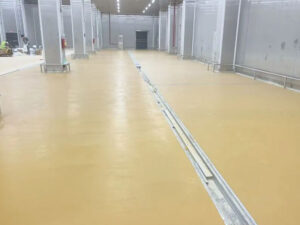
Figure 1: the stainless channel running to the wall cove, with the screed either side.

Figure 2: a plinth cast in the floor material, with the cove running round its base.
Frequently asked questions
Why is polyurethane used in breweries rather than epoxy?
Because the room exposes the floor to acid and hot caustic in the same shift. Polyurethane handles both better than a standard epoxy at the same thickness.
Does lactic acid attack a resin floor?
Weak lactic acid at ambient temperature is tolerated well by polyurethane. Cement-based toppings suffer more because the acid attacks the binder.
What washdown temperature can a PU screed take?
Most systems accept 60 to 80 °C. Above that, or with a steam lance on one spot, the surface degrades.
Why do brewery floor joints fail first?
The sealant is usually specified separately and rated for lower temperatures than the wash cycle, so it softens and loses adhesion.
How much fall does a brewhouse need?
A fall of 1 in 80 to 1 in 100 holds through the brewhouse, with a steeper apron at the channel outlet so solids keep moving.
Can yeast residue damage a floor?
It is acidic and sticky, and it forms a biofilm that holds moisture against the surface. Cleaning is the defence, not a thicker floor.
Should a brewery floor be smooth or textured?
Trowelled and tight in production areas, with a fine aggregate only in wet walkways. Rough surfaces clean badly and hold soil.
Why food plants work with Kaida Paint
Kaida Paint supplies brewery flooring with a chemical resistance table that states concentration and temperature, not just a tick, and we will match the build to the wash regime you actually run. Send the cleaning schedule, the tank layout and the drainage drawing, and we will return a zone-by-zone build with the coves and plinths detailed.


 English
 Spanish
 Portuguese
 Arabic
 French
 Italian
 Russian
 Indonesian
 Swedish