Self-Leveling Epoxy Floor Coating

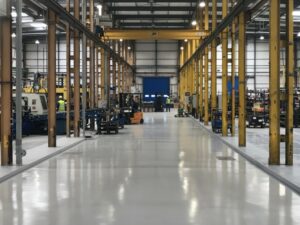
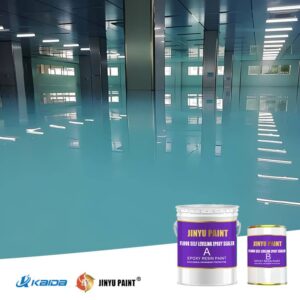
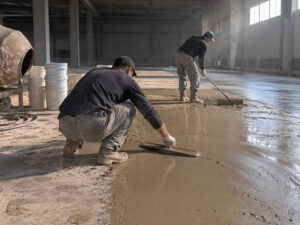
A self-leveling epoxy floor coating is poured and spread with a notched trowel, then left to flow out under its own weight, so one pass leaves a seamless gloss surface instead of the lap marks a roller leaves. KAIDA PAINT® supplies it as a set of layers: an E820 body coat and a topcoat — E8300, E8302 or E8308 — with E552 as the anti-static variant. Coverage runs 0.8–1 kg/m² per pass. What decides whether the method fits is not the finish but the slab: ±4 mm per 2 m.

These are the layers that go into a resinous flooring system, supplied as one package so the mixing ratios and the inter-coat window are stated for the combination rather than for each pack on its own. Application steps are covered in the separate epoxy flooring application guide; this page is about which layers to buy. The term shifts by market — self levelling epoxy in the UK and Ireland, self-leveling epoxy flooring rather than coating in parts of North America — and the build underneath the name is the same one.

KAIDA PAINT® PRODUCTS

What the Method Changes

A self-leveling build is decided by three things, and only the third one is about appearance.

  • One pass, one continuous surface. E820, E8300, E8302 and E552 are each placed at 0.8–1 kg/m² per pass with a notched trowel and finished with a defoaming roller. Because the material keeps flowing after it is spread, the surface has no laps and no seams — which is why the method is specified on large open floors rather than on small rooms and corridors.
  • The topcoat decides the surface, the body coat does not. E820 is the same intermediate coat in every build on this page. What you walk on is E8300, E8302 or E8308 — so the selection question is a top coat question, not a body-coat question.
  • It levels the coating, not the floor. The trowel moves material from the high side to the low side across a few millimetres of film. A slab outside ±4 mm per 2 m is still outside ±4 mm per 2 m after the coating cures, and the film ends up thin where the slab dips.

The Five Products, by Layer

Mix ratios, coverage and hardness as published on each product’s technical data sheet. Coverage is theoretical and stated per pass.
ProductLayer roleMix A:BTheoretical coverageHardnessApplication temperature
E820 Epoxy Self-Leveling Intermediate Floor CoatBody (intermediate) coat5:10.8–1.0 kg/m²Not stated on the TDS5–35 °C
E8300 Self-Leveling Epoxy Floor Top CoatTopcoat, low-VOC gloss5:10.8–1 kg/m²>1H5–35 °C
E8302 Solvent-Free Self-Leveling Epoxy Floor Top CoatTopcoat, solvent-free4:10.8–1 kg/m²>2HAbove 10 °C
E8308 Epoxy Colored Sand Self-Leveling TopcoatTopcoat, colored sand, slip-resistant6:1About 2 kg/m²>2H5–35 °C
E552 Anti-Static Self-Leveling Epoxy CoatingTopcoat, conductive4:10.8–1 kg/m²>2H5–35 °C

Four of the five are placed at 0.8–1 kg/m² per pass, which is 80–100 kg per 100 m². E8308 carries its colored sand in the pack and goes down at about 2 kg/m², so the same 100 m² takes roughly 200 kg. Volume is set by the number of passes the duty calls for, not by the product name.

What Each Topcoat Changes in the Build

Which surface a floor needs is a separate question, answered on the epoxy top coat page. What changes here, when the topcoat is poured rather than rolled, is the volume you order, the weather window you can place in, and how the surface behaves under traffic.

  • E8300 — the low-VOC gloss topcoat. Compressive strength ≥70 MPa, hardness >1H, and dilution of up to 5% is permitted, which makes it the one of the three that can be adjusted to site temperature. At 0.8–1 kg/m² it is the lightest pour of the three, and the lowest material cost per square metre.
  • E8302 — the solvent-free topcoat. Compressive strength >70 MPa, hardness >2H, dilution not recommended. It applies above 10 °C in 35–85% relative humidity, the widest humidity band of the five products here, which matters on sites without dehumidification — this is the one that can still be placed on a damp week. Specify it where the floor sits inside an occupied building, a school or a hospital and solvent odour during application is excluded.
  • E8308 — the colored sand topcoat. Colored quartz sand is part of the pack, so the aggregate sits at the surface rather than being broadcast over it. It goes down at about 2 kg/m² — roughly twice the material of the other two — so it is a heavier pour, a heavier freight and a higher material cost per square metre, and that extra material is what buys the grip. It is also the one of the three used on decorative floors as well as production floors.

For a conductive floor, E552 is not interchangeable with the three above: it needs its own anti-static primer beneath it to carry the earth path, so it is specified as a separate build and not as a topcoat option. The full conductive build is described under anti-static epoxy floor.

The Slab Decides It, Not the Product

Self-leveling epoxy is specified from the slab first. The values below are what the E820 and E8308 data sheets require; where a project sits outside them, the coating is the wrong place to spend money.

Substrate requirementValueNotes
Compressive strength≥20 MPaE820 and E8308 data sheets
Tensile strength≥1.5 MPaE820 and E8308 data sheets
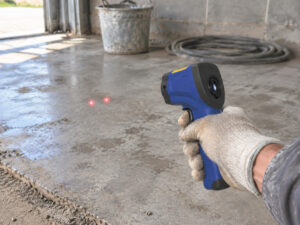
Flatness±4 mm per 2 mThe limit that decides whether a poured floor is viable
Moisture content<8%E820 and E552 data sheets
Relative humidity35–80% typical; 35–85% for E8302Hygrometer reading taken on site
Substrate temperature5–35 °C for four of the five; above 10 °C for E8302Read from the data sheet, not assumed

A floor outside ±4 mm per 2 m needs the slab corrected before any coating goes down — grind the high spots, or lay a leveling compound and let it cure. Above 8% moisture the coating is at risk of disbonding, so the moisture is dealt with first, by a moisture-control system or by a cementitious urethane base that tolerates it.

Where a Self-Leveling Epoxy Coating Is the Wrong Specification

Four conditions move the specification off this page. Each has a system that fits it better, and we will say so at enquiry stage rather than quote a coating that will fail.

  • The floor has to fall to a drain. Specify a trowel-applied mortar screed. A poured coating flows to its own level and will not hold a designed fall.
  • The floor takes live steam or thermal shock. Specify cementitious urethane. The epoxy topcoats here are for ambient-temperature service.
  • The floor has to carry full duty the same day. Specify MMA acrylic or polyaspartic and polyurea. The data sheets here allow up to 48 hours to full cure at 25 °C before the floor takes its full chemical and wear duty.
  • The floor sees daylight. Cap the epoxy with a polyurethane topcoat. Epoxy ambers under UV, so the wear layer on an exposed floor is polyurethane, not epoxy.

Frequently Asked Questions

How thick is a self-leveling epoxy floor coating?

These are coats, not slab replacements. The data sheets state coverage rather than film thickness — 0.8–1 kg/m² per pass for four of the five products, about 2 kg/m² for E8308. Build thickness comes from how many passes the duty calls for, and that is set at specification: send the traffic, the chemicals and the wash-down routine, and the number of passes follows.

I have a 600 m² warehouse floor that is 6 mm out of level over 3 m. Can self-leveling epoxy fix it?

No. 6 mm over 3 m is outside the ±4 mm per 2 m the data sheets require, and a poured coating follows the slab rather than correcting it. Grind the high spots or lay a leveling compound first, then apply the coating over a flat base. Correcting the level with coating material costs more than correcting the slab.

I am specifying for an occupied building — is E8300 or E8302 the right topcoat?

E8302, where solvent odour during application would reach people working in the building. It is solvent-free with hardness >2H and dilution not recommended, and it applies above 10 °C in 35–85% relative humidity. E8300 is the low-VOC gloss topcoat, hardness >1H, thinnable up to 5% on site — the one to specify where a bright gloss and the lowest material cost per square metre lead, and where the area can be closed off while it cures.

Our plant hoses the floor down every night — will a self-leveling epoxy hold up?

Yes, where the wash-down is chemical and abrasive without thermal cycling — E8308 is the one specified there, because the colored sand gives grip under wet cleaning. Where the plant steam-cleans, hot-washes at temperature or runs cold rooms, the specification moves to cementitious urethane instead. The plant types we build for are listed under food and beverage processing flooring.

How much material do I need for 500 m²?

At 0.8–1 kg/m² per pass, 500 m² takes 400–500 kg of body coat or standard topcoat per pass. With E8308 at about 2 kg/m² the same area takes roughly 1,000 kg per pass. Add the primer as a separate line, and confirm the number of passes before the order is placed.

We are recoating an epoxy floor that is scuffing but not lifting — will a self-leveling coat bond to it?

Yes, if the existing floor is sound, fully bonded and abraded to a profile the primer can grip. If it is lifting, blistering or contaminated with oil, it comes off first, because the new floor bonds to whatever is underneath it. Test adhesion on a small area and confirm slab moisture is at or below 8% before committing the whole area.

Do you supply the primer and the body coat with the topcoat?

Yes. The primer, the E820 body coat and the topcoat are quoted together with the mixing ratios stated for the combination, so the inter-coat window and the surface preparation grade are set for the build rather than for each pack on its own.

What does a self-leveling epoxy floor coating cost, and what drives the price up?

Cost is set by the build, not by the floor area alone: the number of passes, the topcoat chosen and the condition of the slab all move it. E8308 uses roughly twice the material per square metre of E8300 or E8302, so the topcoat choice alone changes the material cost materially — and a slab outside ±4 mm per 2 m adds preparation before any coating is ordered. Send the area and the duty and we will quote the build.

Send the floor area, the flatness reading for the slab and what the floor has to resist — chemicals, temperature, traffic and wash-down routine. We will name the body coat, the topcoat and the number of passes, and come back with the pack quantities and the technical data sheets for each layer.

How KAIDA PAINT® Coatings Are Made

KAIDA PAINT® and JINYU PAINT® are brands of the same manufacturing group.

KAIDA PAINT® COATINGS, YOUR BEST CHOICE