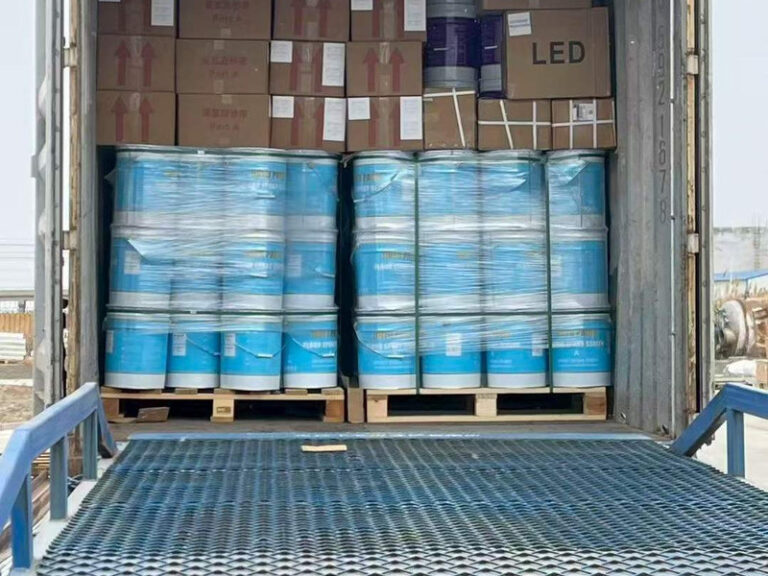
The last five minutes before a container leaves decide most claims.
Buying from a polyurethane flooring manufacturer in China is a documentation and packing exercise as much as a chemical one. The resin is rarely the problem on a first order; the paperwork, the pallet and the freight terms usually are.
The short version: ask for the reactor count, the batch size range and a two-minute video of the packing area. Those three answers separate a factory from a trader before a price is discussed.
This guide covers the three kinds of China PU flooring supplier, the export documentation a shipment needs, how container loading affects damage rates, and what an Asia supplier should be able to show before you pay a deposit.
Three kinds of supplier, and only one makes the resin
Three groups appear in a search for a polyurethane flooring manufacturer: factories that react their own resin, blenders that buy base and fill it, and traders that ship other people’s drums. Only the first can change a formulation.
All three can serve you well, and all three can fail differently. A factory can adapt a formulation; a blender can be fast and cheap; a trader can offer a range it does not control.
The question to ask is not which is best but which one you are talking to. A company that answers “we manufacture” and then cannot describe its reactor capacity is a trader with a website.
For a first order the distinction matters less than the documentation. For a second order, or a formulation change, it decides whether you have a partner or a purchase.
Questions that separate a factory from a trader
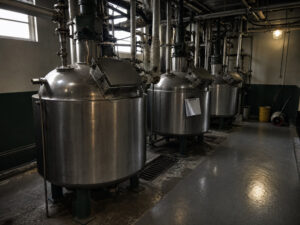
Ask for the production address, the number of reactors and the batch size range. A factory knows these numbers without checking; a trader forwards the question.
Ask which raw materials are imported and which are local, and what happens when a local supplier changes spec. The answer reveals whether the China PU flooring chain is understood or simply purchased.
Where a factory visit is not practical, ask for a short video of the same route. Two minutes of walking from the store to the packing line tells you more than a brochure about how the factory thinks.
Ask for a video call walking through the packing area. It is a small request, and refusal is informative. Most genuine manufacturers will do it within a week.
None of this is about distrust. It is about knowing which levers your polyurethane flooring manufacturer can actually pull when your project needs a cure time adjusted for a cold plant.
A polyurethane flooring manufacturer that can change a formulation is a different proposition from one that cannot, and the difference only appears when a project needs something non-standard, which most eventually do.
A factory visit settles the question faster than any document. Standing in the raw material store, it is obvious whether lots are labelled and separated, and whether the quarantine area is real or painted on the floor.
Export documentation: the part that delays shipments
Export documentation for a resin shipment is short but unforgiving: commercial invoice, packing list, bill of lading, certificate of origin and, for most markets, a safety data sheet in the right format.
Dangerous goods classification is where first orders stall. Many polyurethane components are not classified as dangerous, but some hardeners are, and a mis-declared pack can be held at the port for weeks.
Classification runs in three steps. Read section fourteen of the safety data sheet for the transport information, confirm the UN number and packing group rather than accepting a verbal non-hazardous statement, and book the space as dangerous goods if either applies. Under the UN model regulations a liquid with a closed-cup flash point of 60 degrees Celsius or below is class 3, and the packing group follows the flash point and the boiling point rather than the product name.
Ask for the transport classification of every component before the order, not after. A China PU flooring supplier who can quote the UN number and packing group has shipped before.
Table 1: Documents a first shipment needs, and who usually prepares them.
| Document | Prepared by | Common failure |
|---|---|---|
| Commercial invoice | Supplier | Value inconsistent with the packing list |
| Packing list | Supplier | Pallet count differs from the loading photo |
| Bill of lading | Forwarder | Consignee name misspelled |
| Certificate of origin | Chamber or supplier | Wrong origin criterion for the tariff |
| Safety data sheet | Supplier | Language or revision out of date |
| Dangerous goods declaration | Supplier or forwarder | Classification missing for a hardener |
Six cut-offs decide whether a container sails. Booking closes about fourteen days before the vessel, the shipping instruction and verified weight about seven days, the gate-in about four, the bill of lading draft about two, and the certificate of origin before the forwarder releases the set. Each cut-off belongs to a named person on one side of the order, and the delays that cost a week are the ones nobody owned.
Table 2: The six cut-offs between a confirmed order and a sailing container.
| Stage | Cut-off before sailing | Owner | If it slips | Buffer to keep |
|---|---|---|---|---|
| Booking | About 14 days | Forwarder | Space lost to a rolled booking | 3 dagar |
| Shipping instruction and verified weight | About 7 days | Supplier | Container not loaded | 2 dagar |
| Gate-in | About 4 days | Trucker | Missed vessel and a later sailing | 1 day |
| Bill of lading draft | About 2 days | Forwarder | Documents released late at destination | 1 day |
| Certificate of origin | Before release | Chamber or supplier | Tariff preference lost | 3 dagar |
Container loading and what survives the sea
Container loading is where a cheap packing decision becomes an expensive claim. Pails that are not braced move in heavy weather, and a pallet that collapses takes the labels with it.
Ask for a loading photo before the doors close. It costs nothing, it shows the bracing, and it is the only record you will have if the container arrives shifted.
Pallet configuration should be agreed with the forwarder rather than decided at the factory. A 20 foot container holds 18 to 20 tonnes of resin, and the count changes with the pack size.
Where a shipment mixes pack sizes, ask for a plan drawing. Mixed pallets are where counts go wrong, and a miscount is discovered at the worst possible moment.
Where a container is loaded in a single shift, ask for the count to be photographed pallet by pallet. An order from a polyurethane flooring manufacturer that arrives one pack short is a claim, and a photograph settles it in a day.
Three failures cover most first shipments. A short count is settled by the pallet photograph and the packing list, so require both before the doors close. A damaged pack is settled by a joint survey at destination, requested within three days of discharge. A dangerous goods hold is settled by the declaration and the safety data sheet, which is why both travel with the documents rather than by email.

Figure 1: bracing and pallet count are visible before the doors close.
Trade terms: what an incoterm actually moves
An incoterm decides where risk and cost transfer, not who is helpful. The trade terms that decide a first order are the incoterm and the payment basis, and both belong in one line of the quotation. FOB puts the container on the vessel at your cost; CIF adds freight and insurance to the destination port, and nothing beyond it.
Most first orders are quoted FOB, which leaves the buyer arranging freight. That is usually cheaper and always more work, and it makes the trade terms conversation clearer because each side’s cost is visible.
Whichever incoterm is agreed, write it in the order confirmation rather than in an email. The shipping documents will be issued against the confirmation, and a mismatch costs a week.
Currency is the last detail. A price in dollars with payment in euros invites a conversion argument, and a polyurethane flooring manufacturer order that is 2 per cent short because of an exchange rate is worse than a slightly higher price agreed upfront.
The choice between incoterms is often made on habit. A first-time importer is usually better served by CIF, because the forwarder sits with the supplier, and the learning curve is shorter.
Ask what the quotation includes, and which incoterm it assumes, before comparing prices. Two FOB prices that differ by 15 per cent usually differ in packing, not in resin.
And ask whether the price holds if the container is short-loaded. Where a polyurethane flooring manufacturer quotation assumes a full container, a part load can move the unit price by a fifth.
Quality risk and how to manage it remotely
You cannot inspect every batch from another continent, so the controls have to be documentary and structural. A factory visit once, a retained sample per batch, and a written release test are the three that matter.
Ask for the batch record of the shipment you receive, not a specimen, and read it against how a factory builds quality in. Where a polyurethane flooring manufacturer cannot supply one, the release test is being done from memory.
Retained samples are the cheapest insurance available. Ask the factory to keep 500 grams of each batch for two years, labelled, and to send one on request if a floor fails.
The second control is a pre-shipment sample tested in your own laboratory or by a third party. It costs a few hundred dollars and it converts an assumption into a measurement.
Table 3: The three controls that make a remote order manageable.
| Control | Kostnad | What it prevents |
|---|---|---|
| Retained sample per batch | Negligible | Arguments about what was supplied |
| Pre-shipment third-party test | Låg | A container of the wrong product |
| Loading photographs | None | Damage claims with no record |
Keep the retained sample of every shipment for two years. When a floor fails, the difference between an export documentation argument and a warranty conversation is often a 500 gram jar in a warehouse.

Figure 2: a batch plate is the smallest piece of evidence a factory can send.
Samples, MOQ and lead time
A first order from a Chinese factory usually starts with a courier sample. Ask for one at your intended build, not a generic panel, and expect one to three weeks including cure.
Minimum order quantities are set by batch size rather than by policy. A factory running two-tonne batches cannot economically supply 200 kilograms, and a China PU flooring order below that is usually a repack of another buyer’s stock; the same arithmetic governs private label and own-brand minimums.
Lead time is quoted from the production slot, not from the order date. A four-week figure in January often becomes six in September, and the difference is loading rather than efficiency.
Where a project has a fixed date, book the slot before the order is complete. A factory that will hold a slot is telling you it has capacity; one that will not is telling you it does not.
Ask what happens if the vessel is missed. A factory that rebooks at its own cost for a delay it caused is a better partner than one that moves the risk back to the buyer in the order confirmation.
A due diligence list for an Asia supplier
An Asia supplier should be able to answer ten questions in writing without a follow-up. The list below is the one we would send, and the order matters less than the completeness.
Send the list before the first call, compare the answers against the twelve-point vetting checklist, and score the writing rather than the confidence. An Asia supplier that replies in writing is showing you the process you will depend on in year two, when the person who answered has moved to another account.
Table 4: Ten questions for a first-order assessment.
| Question | What a good answer includes |
|---|---|
| Who owns the formulation | A named engineer and a process |
| Where is production | Address, reactors, batch size range |
| What is available now | A loading percentage for this quarter |
| How is a batch numbered | A sample record, end to end |
| What testing is done | Values, methods, frequency |
| What documentation ships | The list in Table 1, complete |
| What is the transport class | UN number or a clear non-hazardous statement |
| How is a container loaded | Photo, bracing method, pallet plan |
| What are the trade terms | Payment, currency, validity, MOQ |
| Who handles a complaint | A name, a channel, a time limit |
A supplier who answers nine of the ten and is honest about the tenth is a better partner than one who answers all ten in general terms. The tenth matters most when it concerns the origin criterion on the certificate.
Where the answers are good but the container loading plan is vague, ask for the last loading photograph. It is the single most revealing document in the set, because it shows how the factory actually packs.
Pricing traps in a first quotation
The commonest trap is a price that excludes packing. Pails, pallets, strapping and desiccant are all costs, and a polyurethane flooring manufacturer quoted without them will add them at the invoice.
The second is a price based on a smaller pack size than you need. Per-kilogram prices fall with drum size, and a quotation in 20 kilogram pails is not comparable with one in 220 kilogram drums.
The third is a price without a validity period. Resin prices move with raw materials, and a price that holds for thirty days is a different offer from one that holds for six months.
Ask for a price broken into material, packing and freight. The split makes the comparison honest and shows which line a negotiation should target. It also shows whether the trade terms are quoted on the same basis, which is the most common reason two prices cannot be compared at all.
The split also shows where lead time is being absorbed. A quotation that includes four weeks of storage at the port is not the same offer as one that ships from the production slot.
What we would do differently on a second order
A first order is a test of documentation. A second order is a test of consistency, and that is where retained samples, batch records and a stable lead time matter more than price.
Most buyers who end up disappointed by a China PU flooring supplier were not cheated; they were working with a supplier whose process could not repeat. The remedy is structural, not commercial.
Where the second order arrives with a different colour or a slower cure, the useful question is what changed in the factory rather than what changed in the price. A supplier who can answer that is worth keeping, and one who cannot is worth replacing before the third order makes the question unavoidable.
That is the whole purpose of a first order: not to buy resin cheaply, but to find out how a supplier behaves when something goes wrong. Everything after that is repetition at a larger scale, and most of the risk is retired in the first container.
One pallet tests the paperwork, the packing and the communication at a fraction of the cost of a container, and the lessons transfer directly.
The same discipline applies to packing. A supplier who ships one pallet well will usually ship a container well, and one who ships a loose pallet badly will repeat it at scale.
Frequently asked questions
How do I find a genuine Chinese manufacturer?
Repeat the same three questions through a second contact and compare the answers before a video call. Traders forward the questions; factories answer them.
What documents should ship with a resin order?
Commercial invoice, packing list, bill of lading, certificate of origin, safety data sheet and, where a component is classified, a dangerous goods declaration.
Is FOB or CIF better for a first order?
FOB is usually cheaper and gives you control of freight. CIF is simpler and transfers less visibility, which is why most experienced buyers quote FOB.
How long does a first shipment take?
Four to six weeks from deposit to loading, plus three to six weeks at sea, and longer if a dangerous goods declaration is needed. Courier samples take one to three weeks.
What is a realistic minimum order?
One pallet for most factories, which is 600 to 900 kilograms depending on pack size. Below that the price is dominated by repacking and freight, and a polyurethane flooring manufacturer that quotes under it is usually reselling stock it did not make.
Can I get a batch record for my shipment?
Yes, and you should ask before ordering. A manufacturer that cannot supply one for the batch you receive is not testing at release.
How do I check quality before it ships?
A pre-shipment sample tested by a third party, plus photographs of the loaded container. Both are inexpensive and both create a record.
Why export buyers visit Kaida Paint before signing
Export buyers usually visit once, and the visit is short: the raw material store, the reactor floor, the packing area and the loading bay. A factory visit is only useful if it shows the record for the pack you actually received, the transport classification for every component and the photograph taken before the container doors closed. We put those three on the table during the visit, and we mark a gap as a gap rather than filling it with a description of the system. A polyurethane flooring manufacturer that will do that is easy to audit and hard to impersonate.




 English
 Spanish
 Portuguese
 Arabic
 French
 Italian
 Russian
 Indonesian
 Swedish