
Stock on the floor is what turns a partner into a local supplier.
A PU distributor program only works when both sides can answer one question: what does the distributor get that a direct customer does not. Territory, margin and support are the three answers, and they have to be concrete.
The answer has four parts: an area drawn around customers rather than borders, a margin the partner can quote with, stock that turns inside its shelf life, and a registration rule that stops two partners bidding the same project.
This article sets out how to draw a territory, how a margin structure is built without hidden tiers, what a stock commitment buys, and the training and lead registration rules that stop a dealer network competing with itself.
What a distributor programme has to deliver
A polyurethane floor coating manufacturer sells through distributors for two reasons: reach and inventory. The distributor holds stock, speaks the local language and already has the contractor relationships that a factory cannot build from another continent.
The document also has to survive a change of personnel on either side. A programme that lives in the memory of one sales manager disappears when that manager leaves, and the dealer network is left rereading old emails.
The clause most often missing is the one about a change of ownership. If a dealer network is sold, the polyurethane floor coating manufacturer relationship transfers only if the agreement says so, and a new owner with a different portfolio can quietly stop promoting the range.
A polyurethane floor coating manufacturer transferred without a notice period can leave a distributor holding stock nobody will support.
In exchange the distributor needs protection, margin and technical backing, which is why how to vet the manufacturer behind the programme matters as much as the discount table. Remove any one and the relationship becomes a series of one-off orders that ends when a cheaper drum appears.
The programme document should fit on two pages. Territory, margin, stock, training, support, target and exit. A twelve-page manual usually means the commercial terms are still being invented.
The test of a good PU distributor program is simple: could a new distributor read it and know what to do in the first ninety days? If the answer is no, the document is about the manufacturer rather than the market.
A PU distributor program written for the market names the contractor segments the distributor can actually reach. One segment, done well, is a better start than five half-served.
Territory: draw a line the market recognises
Distributor territory is the clause that causes the most disputes, because it is usually drawn on a map rather than around customers. A country boundary is easy to administer and often meaningless commercially.
Better definitions name the accounts or segments: food processing in a region, warehouse floors in a city cluster, or a named list of key accounts that belong to the distributor regardless of location.
Where a distributor is strong in one vertical and weak in another, split the distributor territory by segment rather than by geography. Two specialists in the same city usually sell more than one generalist.
Write down what happens at the edges. A project in a neighbouring region, a national account with sites in three territories, and an export order from your distributor’s country all need a rule before they arise.
A simple rule covers most of them: the distributor who registers the project first owns it for the duration, whatever the site address. Without that sentence, the distributor territory boundary is tested on every tender.
The most workable arrangement for a new partner is a segment territory with a defined pipeline protection, reviewed after twelve months against the annual target. That gives protection without granting a permanent monopoly.

Figure 1: segment territories are easier to defend than country borders.
Margin structure: three tiers, no surprises
A margin structure is normally expressed as a discount from list, a fixed transfer price, or a rebate on volume. Each produces a different behaviour, and mixing them badly produces a distributor who waits for the quarter to end.
Discount from list is the simplest and the most transparent. The distributor can quote a project without calling you, which matters when a tender closes on a Friday evening.
Rebates reward volume but delay the benefit, and they encourage stock building at year end. Where a rebate is used, make it quarterly and tie part of it to sell-through rather than to purchases.
Publish a project price floor as well. A discount structure that leaves the floor undefined invites a distributor to win a tender at a price the factory cannot supply twice.
Table 1: The three margin models and what each one rewards.
| Model | Rewards | Risk |
|---|---|---|
| Discount from list | Fast quoting, simple admin | Discount creep over time |
| Fixed transfer price | Predictable cost for tenders | Distributor captures windfall on list price |
| Volume rebate | Growth | Stock loading at period end |
A discount from list at 35 to 38 per cent gives the partner room to quote without approval and leaves the project floor visible. A fixed transfer price works when the same tender is quoted repeatedly, because the cost does not move. A quarterly rebate of 2 to 4 per cent tied to sell-through rewards rotation rather than stockpiling, and a rebate tied to purchases rewards the wrong behaviour at quarter end.
Table 2: The same three models with indicative numbers and where the risk sits.
| Model | Indicative figure | Constraint on the partner | Who carries the risk |
|---|---|---|---|
| Discount from list | 35 to 38 per cent off list | Must quote without approval | Factory, through discount creep |
| Fixed transfer price | One price per system per quarter | Cannot reprice mid-tender | Partner, if list prices rise |
| Quarterly rebate | 2 to 4 per cent on sell-through | Must report sales out | Shared, through slower payment |
Whatever the model, publish the project-price mechanism separately. A distributor who cannot respond to a competitive tender within a day will lose it, and a margin structure that requires a head office approval for every quote is a slow partner.
Stock on the floor: what it buys and what it costs
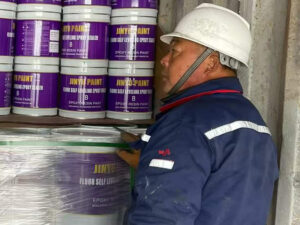
A stock commitment is the difference between a distributor and a reseller. Holding two pallets of the top three systems means a project can start within a week rather than a month.
It also ties up cash and creates a shelf-life problem. Polyurethane has a finite storage life, and stock that sits for eighteen months is a write-off that neither side wants to fund.
The practical answer is a commitment expressed in a rotating quantity rather than a fixed one, with MOQ and lead time for the first order agreed in the same conversation as the shelf-life rule. Two pallets, replenished when one is consumed, with the factory accepting returns of unopened stock within its own shelf life.
Where a distributor refuses any stock commitment, that is a decision rather than a negotiation. It means every order is a project order, which is a legitimate model, and it should be priced as one.
A rotating consignment is the middle path. Stock sits at the distributor, ownership transfers on use, and the factory carries the shelf-life risk it is better placed to manage.
Set a rotation rule rather than a stock rule. Two pallets on the floor is roughly one point two to one point eight tonnes, and at a quarterly volume of about 1.9 tonnes that is about two to three months of cover. With a twelve-month shelf life, the action point is month eight: below two months of cover, replenish; above four months, stop ordering and move stock to another region rather than discount it locally.
Technical training: what a dealer actually needs
Technical training fails when it is a product presentation. A distributor does not need to know the chemistry; they need to know which system to quote for a wet room and which question to ask before quoting.
Three modules cover most of it: substrate and moisture, system selection by zone, and failure diagnosis. Each can be delivered in half a day and tested with a short written exercise.
The diagnosis module is the one that pays. A dealer who can look at a blistering floor and say the slab is damp protects the factory from a warranty claim and themselves from a bad installation.

Figure 2: diagnosis training is what protects both sides from a bad installation.
Refresh the training when a product changes rather than annually. A technical training cycle tied to the calendar is easier to administer and less useful than one tied to the release of a new system.
Where the distributor employs applicators, add a practical day on site. Reading about a stock commitment on a slide is not the same as applying a primer to a damp slab and watching it blush.
Certify the training with a short record rather than a certificate. A list of the three modules and the date completed is enough for a technical training file and far more useful than a framed document.
Registering a project before a competitor does
Lead registration is the mechanism that stops two distributors chasing the same project and destroying the price. It costs nothing to operate and is ignored by most manufacturers until the first dispute.
A workable rule is: first to register, protected for ninety days, provided there is evidence of activity within thirty. Registration without activity is how a dealer network blocks a project it cannot win.
National accounts need a separate rule. Where a customer has sites across three territories, nominate one distributor for the account and let the others supply the services, or the boundaries will be tested on every order.
The factory also has to obey its own rules. A polyurethane floor coating manufacturer that sells direct to a registered account has ended the programme for everyone, whatever the contract says afterwards.
Publish the register, or at least publish the conflicts. A distributor who loses a project to a colleague can accept it if the rule is visible, and will not if the decision appears arbitrary.
A monthly register email takes twenty minutes and removes most disputes. It also gives the factory a view of the pipeline, which is the only reliable forecast a polyurethane floor coating manufacturer gets from a distributor network.
A register also gives the factory an early warning. Where one territory fills with registered projects and delivers none, the problem is capability rather than market, and the fix is different.
A polyurethane floor coating manufacturer that reviews the register monthly will see that pattern in two quarters, which is usually soon enough to change the territory before the relationship has to end.
Setting a yearly target that is not arbitrary
An annual target should be built from the territory rather than from last year plus a percentage. The inputs are the number of food plants or warehouses in the area, the replacement cycle, and the share the distributor can realistically take.
A simple bottom-up model: addressable floors, percentage refurbished each year, average project size, and a target share. An annual target that comes out of that arithmetic can be defended in a review meeting.
Table 3: A bottom-up target model for one territory.
| Input | Example | Notera |
|---|---|---|
| Addressable floors | 40 plants | Wet or dry, over 1,000 m2 |
| Refurbished per year | 10 per cent | Four projects |
| Average project | 1,200 m2 | Mixed systems |
| Target share | 35 per cent | Realistic in year one |
| Resulting volume | 7.6 tonnes | About 1.9 tonnes a quarter at 4.5 kg per m2, net of primer and application loss, for a three millimetre build over 1,680 m2 |
The model also shows when a target is unrealistic. A distributor asked for fifteen tonnes in a territory that refurbishes four projects a year will either fail or sell into someone else’s area.
Three inputs need a source before the arithmetic means anything. Addressable floors come from a named list of plants and warehouses above a stated area, not from a national statistic. The refurbishment rate comes from the last two years of project records rather than an industry average. The share comes from the number of competing stockists in the region and the segments they already serve.
If your system runs at 2 kg per m2, the same share is about 3.4 tonnes, so state the coverage rate before the volume is quoted. Review the model every year rather than the number. A market that adds plants or loses them changes the arithmetic, and an annual target carried forward without revision becomes a formality within two cycles.
The dealer agreement in seven clauses
Seven clauses are enough, each one carrying numbers rather than intentions. Seven clauses cover the commercial relationship, and anything beyond them is usually a lawyer’s preference rather than a business need.
The seven are territory, margin, stock, training, lead registration, target and termination. Each should be one page at most, with numbers rather than intentions.
Termination deserves particular care, and the warranty terms that survive it decide whether the arrangement ends professionally or in a dispute about stock. Notice periods, stock buy-back and the treatment of registered projects in flight matter just as much.
The same clause should say what happens to stock on termination. A buy-back at the last invoiced price is generous and cheap compared with a distributor liquidating pallets into your distributor territory through a third party.
Where the PU distributor program is being rolled out across several countries, keep the same seven clauses and vary only the numbers. A programme that changes structure per market is impossible to administer and unfair to compare.
Signs a programme is not working
Four symptoms appear before a distributor leaves: falling order frequency, requests for extended payment, complaints about response time, and projects lost on price to a competitor you have never heard of.
The first is the one to act on earliest. Falling order frequency usually means the mix has drifted from the projects the partner wins, and a conversation about mix is cheaper than one about price.
The second is misunderstood. A partner asking for longer terms is usually financing stock that is not moving, which points to mix rather than to weakness.
The third, complaints about response time, is a factory problem rather than a market one.
The fourth is the serious one. Where a polyurethane floor coating manufacturer is being undercut locally, the cause is usually a parallel supply route rather than a better competitor, and the distributor territory rules are the place to look.
Where the source is genuine competition, the answer is a product difference rather than a discount. A dealer network that can explain why one system suits a wet room better than another wins on fit rather than on price.
A quarterly review with three numbers, volume, projects registered and training completed, catches all four early. A review that only discusses one number misses the reasons behind it. A polyurethane floor coating manufacturer that rewards volume alone will keep a partner who cannot sell and lose one who can.
Table 4: Three review numbers and what each one tells you.
| Number | Healthy signal | Warning signal |
|---|---|---|
| Order frequency | Monthly or better | Two orders in six months |
| Projects registered | Rising quarter on quarter | Registered but never quoted |
| Training completed | New staff trained within 60 days | Same names for three years |
Frequently asked questions
What should a distributor programme include?
Territory, margin, stock commitment, technical training, lead registration, an annual target and termination terms. Two pages is enough if the numbers are specific.
How should territory be defined?
By segment or named accounts rather than by country boundary. A distributor strong in food processing should not be given every industrial floor in a region.
What margin does a distributor need?
Enough to quote a project without a head-office approval and still fund local stock and technical support. The number is 35 to 38 per cent against list for a stockist model.
Must a distributor hold stock?
Not always. A distributor without stock can operate on project orders, but should be priced as a project buyer rather than as a stockist, because they cannot respond to an urgent refurbishment.
How does registering a project work?
First to register wins protection for a fixed period, provided there is evidence of activity. Without an activity test, registration becomes a way of blocking projects rather than pursuing them.
How is the yearly target set fairly?
Bottom up from the addressable floors in the territory, the refurbishment rate and a realistic share. A polyurethane floor coating manufacturer that builds the number from last year plus an uplift rewards luck and punishes a bad market.
What happens when a distributor underperforms?
A review against the three numbers, then a revised mix or territory rather than a revised target. If neither works, the termination clause should already say how stock and live projects are handled.
Why distributors build a territory on Kaida Paint
A territory is worth what the polyurethane floor coating manufacturer behind it protects. Our PU distributor program runs on seven clauses with numbers rather than intentions. The first is a margin structure that lets a partner quote a Friday tender without calling head office. The second is a lead registration register shared with every partner in the region. The third is a volume goal built from the addressable floors in the area rather than from last year plus an uplift. Where a project is registered first, we price it through the partner rather than around them.














 English
 Spanish
 Portuguese
 Arabic
 French
 Italian
 Russian
 Indonesian
 Swedish