This urethane cement FAQ collects the questions that come up in almost every first meeting, in the order a buyer usually asks them.
Any urethane cement buyer question about cost is really a question about build, and any question about build is really a question about duty.
The answers are short, and each one points to the article that covers it properly.
That is why the same urethane cement FAQ produces different answers in a brewery and a warehouse, and why the conditions are the first thing to write down.
Every buyer question in this list has a short answer and a longer one, and the longer one is always about the conditions.
Where a question has no single answer, the answer names what it depends on rather than pretending there is one figure.
The five questions everyone asks first
What is urethane cement?
A cementitious binder modified with polyurethane resin, placed at 3 to 9 mm and finished by trowel. It resists hot washdown, organic acids and thermal cycling better than a pure resin.
Is it the same as epoxy?
No. Epoxy is a pure resin, cures rigid and tolerates very little moisture in the slab. Urethane cement contains cement, tolerates a damp substrate and resists hot caustic.
How thick should it be?
Three to four millimeters for dry rooms, six for regular washdown, and nine for heavy traffic or thermal cycling. The thickness is a design decision, not a product property.
How long does it last?
Ten to fifteen years in a washdown room at 6 to 9 mm with routine maintenance, and three to five years where the same room is run at 3 mm, which is why that build is not specified for washdown.
How much does it cost?
Per square meter it depends almost entirely on thickness and preparation. A 3 mm floor and a 9 mm floor are not comparable on price, and most quote comparison problems start there.
Questions about the material
Does it need a moisture barrier?
Usually not, within the manufacturer’s stated moisture limit. Above that limit a barrier is still required, so the slab should be tested rather than assumed.
Will it crack?
It can, at restraints and over moving joints. The answer is a joint layout rather than a stronger mix, because movement is designed for rather than resisted.
Can it go outside?
Under a canopy or inside a door that stands open, yes. Fully exposed to weather, urethane cement is not the right choice, and a UV-stable system should be considered instead.
Is it food safe?
It is cleanable, seamless and resistant to food acids. There is no such thing as a food-safe certificate for a floor, and a supplier who offers one is describing a management system.
Questions about cost and quotes
Why are two quotes so different?
Usually thickness, preparation or aggregate. Ask each bidder for the build in millimeters and the consumption in kilograms, and the difference becomes visible. Testing is part of the same comparison: core samples and pull-off tests are normally a separate line rather than a hidden one, and they are the evidence that the floor matches the specification.
Is the cheapest option ever right?
Sometimes, where the duty is genuinely light. The test is whether the cheap quote states a thickness and a preparation method, because a quote that states neither is not yet a quote.
What drives the price most?
Thickness first, preparation second, area third. A large area with difficult access can cost more per square meter than a small one with none.
Questions about installation
How long does a pour take?
A four-person crew places 150 to 250 square meters of self-smoothing material per shift, and less in a room broken up by tanks and curbs.
Does the building have to close?
The area does. A typical washdown room closes for two to four days including cure, and a phased plan can shorten that for a large hall.
What temperature is needed?
A slab between about 5 and 35 C, with 10 to 30 the comfortable band. Below 5 the cement stops hydrating and above 35 the working life collapses.
Can it go over an existing floor?
Over sound concrete, sound epoxy and, with preparation, tile. Not over asphalt, and not over a failing coating.
Questions about cleaning and chemicals
What cleans it?
Neutral detergent for routine cleaning, and the manufacturer’s stated chemicals at stated dilutions for washdown. Caustic at working strength is fine, strong mineral acid is not.
Will chlorine bleach it?
Repeated strong chlorine will dull a colored floor. A mid-tone floor hides it, and a stated dilution limit prevents most of it.
How soon can it be washed?
Neutral detergent once walkable, and caustic or acid only after full chemical cure, which is about seven days at 20 C.
Questions about failure and repair
What usually fails first?
Drains, thresholds and coves, in that order. The open floor is rarely the problem, and the details are where water gets in.
Can it be repaired?
Yes, with a square cut patch and a bond coat, or a flexible filler for a moving crack. A feathered edge will fail, and a rigid filler in a moving crack will crack again. Matching is part of the answer: a patch matches only with the same batch or a close one, and in pale colors a different batch is visible across the room, which is why a repair kit is worth keeping.
Questions about supply and warranty
How do I know the supplier makes it?
Ask for the production address and the batch traceability route, and ask whether the test data comes from an accredited third-party laboratory; an internal report is development data rather than a specification claim. A repackager can supply well, but should say so. Lead time belongs to the same question: two to four weeks from regional stock for a full kit, and longer where the product is imported.
What should the warranty cover?
Adhesion and wear-through, with the exclusions stated and a response time for inspection. A warranty with a response time is worth more than an extra year on the term.
Questions to ask before you sign
Who will be on site?
Named people, with experience of this material rather than of the company. If the contractor cannot name the trowel operator, the crew has not been allocated.
What does the method statement say about temperature?
It should state the slab temperature limit and what happens if the building cannot hold it. A method statement without that line was written for a different building.
Table 1: The five questions that decide most projects.
| Question | Decides |
|---|---|
| What is the duty? | Thickness and chemistry |
| What is on the slab already? | Preparation method |
| What is the washdown regime? | Build and seal |
| How long can the room close? | Schedule and product |
| Who is applying it? | Everything above |
How to use this list
A buyer question list is only useful if it produces a document. Send the five questions in the first table to every supplier and compare the answers.
Then use the rest of this urethane cement FAQ to test the answers that sound thin.
Shortlisting gets easier once the questions are the same for everyone, because the answers become comparable rather than impressive.
Ask for a panel as well, and keep it. A sample panel is the only reference that survives a change of personnel on either side.
Table 2: Documents worth asking for.
| Document | Answers |
|---|---|
| Data sheet with revision date | Material properties |
| Method statement | Installation approach |
| Sample panel | Appearance and texture |
| Reference site | Service performance |
| Warranty wording | After-sales position |
What this FAQ does not cover
It does not cover structural design, drainage design or fire strategy, because those belong to other documents.
It does not cover a specific chemical exposure, because that needs a resistance table at your concentration and temperature.
Where a question falls outside this list, the technical desk of any serious supplier will answer it in a day, and the answer will be specific.
Table 3: Where each answer comes from.
| Topic | Depends on |
|---|---|
| Espesor | Duty and washdown |
| Chemical range | Concentration and temperature |
| Schedule | Slab temperature and access |
| Price | Build and preparation |
| Vida útil | Thickness, traffic and cleaning |
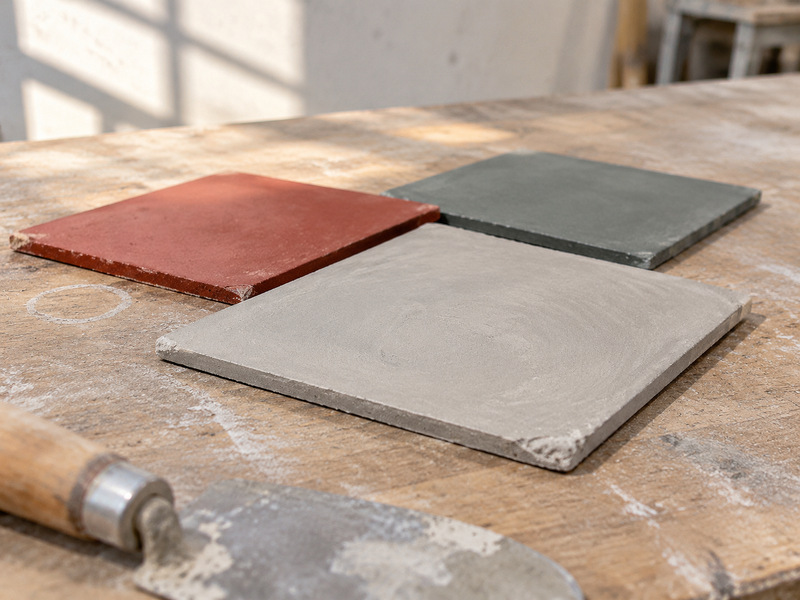
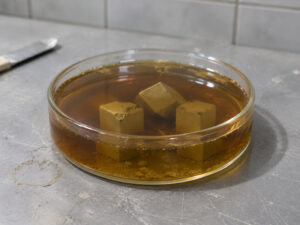
Figure 1: three sample panels laid side by side on a bench.
What buyers get wrong in a quote comparison
The commonest error is comparing a rate per square meter without checking the thickness behind it.
A quote comparison is only valid at equal build, equal preparation and equal detail scope, and those three items are rarely stated.
That is the whole basis of shortlisting, and it works because the questions are identical rather than tailored to each bidder.
Send the five questions to every bidder and ask for the answers in writing, then shortlist the three whose answers are complete. Shortlisting is what makes the comparison possible, and it only works between three, not twelve.
The second error is treating a low price as a negotiating position rather than a specification. A bid that is 30 percent low usually has 30 percent less material in it.
Three contractors who can answer the questions produce three prices worth comparing.
What a walk round should look for
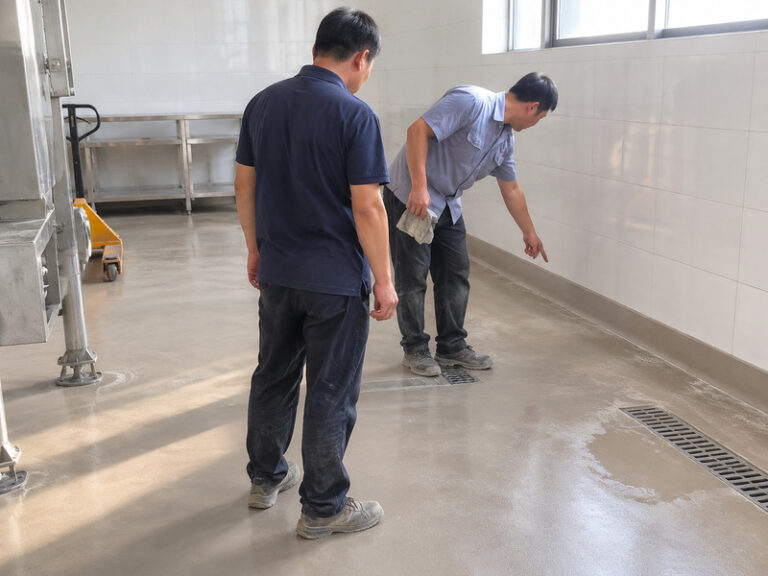
A site visit is not a tour. Walk the busiest lane first, and look at the floor rather than at the building.
Look at the coves, the drain surrounds and the thresholds, because those are where a floor fails first.
A supplier who offers a site visit before the order is a supplier who expects to be checked.
Ask the site manager what has been repaired, and where. A floor with three repairs in one bay is telling you about a detail rather than about a product.
A site visit that includes the maintenance team is worth two that include only the manager, because the maintenance team knows what actually gets cleaned and how.
Take photographs. A site visit that produces no images will be forgotten by the time the quotes arrive.
From sample panel to delivery schedule
The panel is the cheapest buyer question to resolve, and the one most often left until the floor is finished.
A sample panel settles the argument about color and texture before anyone pours concrete, and it costs almost nothing to produce.
The same panel is useful in year five, when after sales support is asked to match a color that has been on a floor for half a decade.
Keep the panel on site for the life of the floor, because it is the reference for every later repair.
A delivery schedule that allows for cure is a schedule written by someone who has installed this material before.
Ask for the delivery schedule with the order, and check that it allows for cure rather than only for installation.
After-sales support is the part nobody tests until something goes wrong, so ask what the response time is and who attends.
Good after sales support includes a named contact, a stated response time and a repair kit that matches the original batch.
After-sales support that is promised rather than described is the item clients remember when a repair is needed at a weekend.
A supplier with a stated after-sales process will describe it in two sentences. One without it will describe the warranty instead.
The part of an organization that a client only meets when something has gone wrong is after-sales support, which is the worst moment to discover it does not exist.
Ask what after sales support looks like in month thirty, when a patch is needed and the original installer has moved on. The answer separates a supplier from a seller.
A supplier who answers a technical question with a brochure is telling you something about the depth of the organization.
Where each answer comes from
The material answers come from a data sheet with a revision date, and the ones that matter most are the moisture limit and the chemical range.
The cost answers come from a build schedule, not from a rate per square meter, because the rate hides the thickness.
The installation answers come from a method statement that names the slab temperature and the hold points.
The failure answers come from a repair record on a real project, which is why a contractor’s own history is worth asking about.
Any answer that cannot be traced to a test report, a method statement or a site record is a guess dressed as advice.
A urethane cement FAQ is only as good as the documents behind it, and a buyer who asks for those documents gets a better floor than one who asks for a discount.
That is the single test that separates a useful FAQ from a marketing page, and it applies to every question above.
Frequently asked questions about the list above
Is urethane cement expensive?
Per square meter it is more than a thin coating and less than a tiled floor over its life. The comparison only works at equal thickness and equal duty.
¿Puedo instalarlo yo mismo?
No. It is a placed material with a short working life, and the finish depends on trowel skill. A site visit from a technical desk is part of the product.
Does it need joints?
Yes, at construction joints, at restraints and where the slab moves. A joint-free floor over a moving slab will crack where it chooses.
How soon can it take forklifts?
Light duty at 24 to 48 hours at 20 C, and heavier point loads after about three days.
What happens if it is installed cold?
The cement stops hydrating and the floor stays soft. Heat and time are the only remedies, and both are cheaper than a replacement.
Can it be used in a freezer?
Yes, with a build that tolerates thermal cycling and an application method that deals with the slab temperature. It is a specialist job rather than a standard one.
Where can I see a completed floor?
Ask any supplier for a reference site you can visit, and take the opportunity. A delivery schedule and a brochure will not tell you what a floor looks like after two winters.
Kaida Paint answers buyer questions from a technical desk rather than a call center, and will send a data sheet, a method statement and two reference sites before quoting. Send your five questions and the room description, and we will answer them in writing.


 English
 Spanish
 Portuguese
 Arabic
 French
 Italian
 Russian
 Indonesian
 Swedish