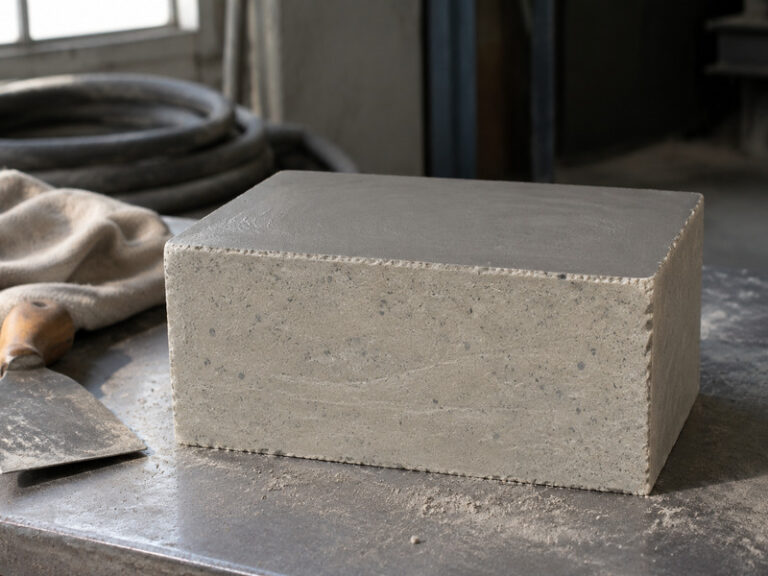
Urethane cement is a floor material in which a cementitious binder is modified with polyurethane resin, placed at 3 to 12 mm and finished by trowel or float.
It exists to solve one problem: floors in wet, hot, chemical environments that a pure resin cannot survive and plain concrete cannot resist.
The definition takes you a minute. The chemistry takes ten. The failure boundary is the part worth learning, because that is where your money is lost.
A buyer who arrives with a brand name rather than a chemistry term can start with Ucrete as a trademark, which follows the same material under the name most plants actually use.
The definition, in one paragraph
Take a cement and aggregate blend, add a polyurethane resin and hardener, mix, place and trowel.
The result cures by two mechanisms at once: the cement hydrates and the resin cross-links. Neither reaction alone produces the material.
That double cure is why urethane cement tolerates a damp substrate and still resists hot caustic. A pure resin tolerates neither.
The definition matters commercially because every product in the family shares it, whatever the trade name on the drum. The three markets that sell it use three vocabularies for that one definition.
What is in the drum
Most systems arrive as three components: a resin, a hardener and a powder blend of cement, fillers and graded aggregate.
The powder is the larger part by mass in most formulations. That is why the material is cheap per kilogram relative to a coating and expensive per square meter at 9 mm.
The resin content determines chemical resistance and flexibility. The powder determines strength, shrinkage and surface texture.
Aggregate grading runs from about 0.3 mm to 3 mm depending on the build. A fine blend gives a smooth troweled surface, and a coarse blend gives load capacity.
The proportion of resin to powder is the single biggest difference between products that carry the same description.
Table 1: Composition in mass parts, with the resin taken as 1.00.
| Fase | Mass parts | Contributes |
|---|---|---|
| Resin (A) | 1.00 | Chemical resistance, flexibility, early strength |
| Hardener (B) | 0.20-0.30, typically 0.25 | Cross-linking, and the dose most sensitive to error |
| Powder (C: cement, filler, aggregate) | 2.60-3.00 | Late strength, water tolerance, load capacity |
Two reactions in one pot
The resin and hardener react by addition, forming a polyurethane network. The cement reacts with water, forming hydrated calcium silicate.
Both reactions happen in the same minutes. The resin sets first and locks the aggregate in place, and the cement continues to hydrate for days.
That sequence explains several behaviors at once. Early strength comes from the resin, so the floor can be walked on within hours.
Later strength comes from the cement, so a floor that is walked on early is not finished curing.
A material that is only resin has no second reaction. A material that is only cement has no early strength and no chemical resistance.
Water tolerance, and why it is measured
Concrete floors fail under coatings because water vapour pushes from below. The usual answer is a moisture barrier or a long drying period.
Urethane cement tolerates a damp substrate because the cement phase continues to hydrate in the presence of water rather than being disrupted by it.
Thermal cycling makes that limit more important rather than less. A damp slab under a floor that is repeatedly heated drives vapour harder than a dry one.
That tolerance is stated as a maximum substrate moisture content, and it is a number, not a slogan.
Ask for the substrate moisture limit and the test method. A product that claims to tolerate any slab is claiming something no cementitious binder can deliver.
A substrate moisture reading taken in February and one taken in July can differ by several percentage points on the same slab, even with the same instrument. Record the method and the temperature with the reading, because a limit stated for one test method does not convert to another.
Where a slab is wetter than the stated limit, a barrier is still required. The material is tolerant, not infinite.
Acid resistance and its limits
The family is specified for organic acids, which is why it appears in dairies, breweries and food plants.
Lactic acid at ambient temperature is the usual benchmark, and most products handle it at working concentrations for years. A dairy rinse typically runs at 1 to 3 per cent, while a clean-in-place circuit can run at 5 to 10 per cent, which is why the table below states a range rather than a single figure.
Acetic acid is stronger in practice because it is used as a cleaning agent at higher concentrations than the acid occurs naturally.
An organic acid at 20 °C and the same acid at 60 °C behave like two different chemicals. That is why the resistance table has a temperature column, and why a tick without one is an answer to a question nobody asked.
A hot washdown also drives a solvent into a surface that would have resisted it cold. The two exposures are not additive; they are worse together than either one alone, which is why a solvent spill in a washdown room is a chemistry event rather than a cleaning problem.
Mineral acids are a different question. Hydrochloric and sulfuric acid attack the cement phase, and a cementitious binder is the wrong choice for a strong mineral acid.
That boundary is not a defect. It is the reason a chemical resistance table exists, and the reason it must state concentration and temperature.
The table is written in mass parts with the resin set at 1.00, because a three-component system is dosed by the whole pack. Converting the same recipe to percentages shifts with the moisture content of the powder and with batch variation, so no percentage is offered here.
Table 2: Tested range by exposure, at the stated concentration and temperature.
| Exposure | Condición | Veredicto |
|---|---|---|
| Lactic acid | 3-10%, 20 °C | Bien |
| Acetic acid | 2-5%, 20 °C | Bien |
| Caustic | 1-3%, 80 °C | Bien |
| Strong mineral acid | Any | Not suitable |
| Steam | Direct | Not suitable |
The failure boundary, stated plainly
The material fails in three places: at the substrate, at the chemical, and at the detail.
At the substrate it fails when the slab is wetter than the stated limit, or when the surface was not prepared. No product rescues a weak bond. The substrate failure also has a slow form. A floor that survives one hot washdown will survive a hundred, and then fail in a single week when the thermal cycling shortens, because the interface between floor and slab fatigues before either material does.
At the chemical it fails when the exposure is outside the tested list, which is usually a strong mineral acid or a solvent.
At the detail it fails where water stands: drain surrounds, thresholds and wall bases that were not coved.
Blistering, softening and threshold cracking are none of them manufacturing defects. All three are specification or workmanship errors, all three are predictable, and all three can be written into the specification before the tender goes out.
The first is blistering at a drain. Water gets under the body through a joint or a poorly sealed outlet, and the film lifts in a ring. The fix is a sealed outlet, and it costs less than the repair it prevents.
The second is softening under a spill. A solvent or a strong acid is left standing, and the surface turns to a paste within hours. The fix is a written spill procedure with a nominated cleaner, not a different product.
The third is a crack at a threshold. The slab moves, the detail is rigid, and the crack opens along the line where traffic crosses. The fix is a flexible joint at the line where the two slabs meet.
None of the three fixes is a different product, and all three are usually omitted because they are not part of the material price.
Table 3: The failure boundary in three lines.
| Condición | Inside the boundary | Outside |
|---|---|---|
| Sustrato | Damp, prepared, sound | Wet beyond limit, weak, dusty |
| Chemistry | Organic acid, caustic, hot water | Mineral acid, solvent, steam |
| Detail | Coved, sealed, flexible joints | Standing water, rigid joints |
Where it is the wrong choice
The material is a working finish for wet, hot, chemical duty. Outside that duty it is an expensive way to cover a floor, and saying so is part of quoting honestly.
Table 4: Where the material is the wrong purchase.
| Situation | Why the material loses | What fits better |
|---|---|---|
| Dry warehouse | No chemical load and no thermal cycle, so wear comes from foot traffic only | A thin coating with enough wear allowance |
| Weekly hot washdown above 90 °C | The resin phase softens at the top of that range | A system rated for that temperature |
| Strong mineral acid storage | The cement phase cannot resist it | A resin system with a tested resistance table |
| Decorative floor | The finish is a working surface, not a showroom one | A decorative resin or a polished concrete |
| Schedule too short for placement | The material is placed and troweled, not painted | A coating system, or a longer shutdown |
The warehouse case is the one buyers find hardest to accept. A dry warehouse has no chemical load and no thermal cycle, so the wear is foot traffic only, and a thin coating with enough wear allowance does the same job for less.
Saying so costs a sale and earns the next three, which is why we say it early.
Reading a claim honestly
A data sheet that says chemical resistant without a table is not making a claim that can be tested. The data sheet fields that make a claim testable are a short list, and a sheet missing them is a brochure.
A table without temperature is half a table, because resistance falls as temperature rises.
A thickness without a tolerance is a wish, because no trowel places an exact figure across a hall.
A warranty that excludes chemical attack is normal, and a warranty that covers it is worth reading closely.
A plant that keeps a log of every hot washdown, every spill and every repair will know more about its floor than any data sheet can tell it. That log is the best specification input available.
Urethane cement is a good material. The claims around it are often looser than the chemistry, and the gap between them is where a buyer should spend their attention.
The five lines that make a comparable brief
State the room and the duty. State the chemicals with concentration and temperature. State the washdown temperature and frequency.
State the substrate condition, including the moisture reading and the age of the slab. State the required thickness and the test that will prove it.
Ask each supplier to price the same five lines and to state what they would change. The changes are the useful part of the reply, because they show which assumption each supplier thinks is wrong.
Keep the reply with the tender documents. In eighteen months nobody will remember which assumption was challenged, and the written reply is the only record of why the build changed.
Five lines, no trade name, and any competent supplier can price it. That brief also makes three quotes comparable, which is the only way a buyer learns what the floor should cost.
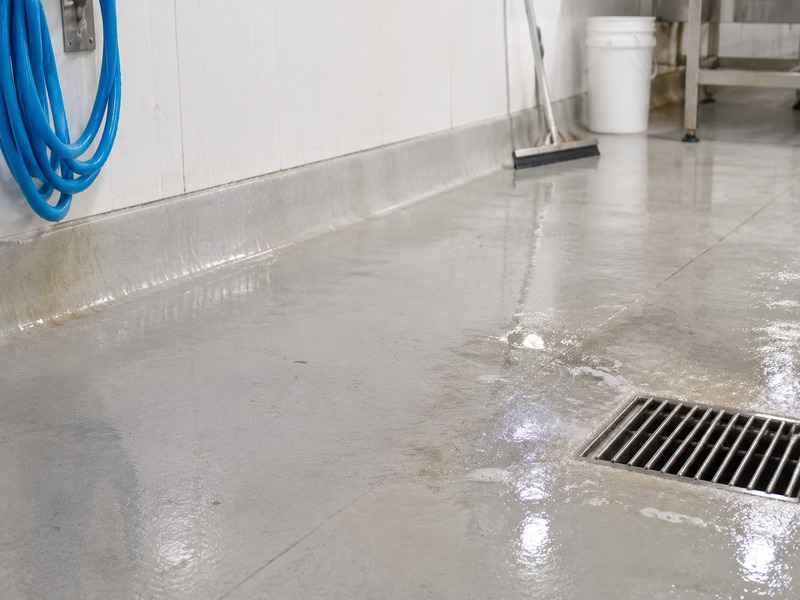
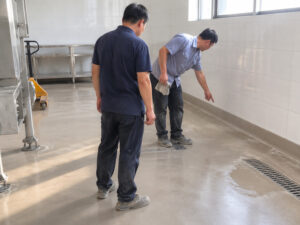
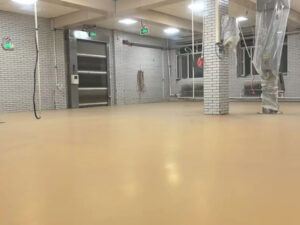
Figure 1: the drain and the cove are where the boundary is tested first.
What the resin ratio and aggregate actually do
Resin content and aggregate grading are the two numbers inside the formulation that decide most of the behavior, and neither appears on the front of a brochure.
Resin content sets chemical resistance and flexibility, and a resin-rich blend resists more and moves more. A lean blend is stiffer and cheaper.
Aggregate grading sets load capacity and surface texture. A 3 mm top size takes a pallet truck better than a 0.5 mm blend, and it also holds dirt in a way that a fine blend does not.
The two interact. A resin-rich blend with coarse aggregate gives a tough floor that cleans moderately; a lean blend with fine aggregate gives a smooth floor with limited chemical range.
Specifying only the product name leaves both numbers unstated, which is why two quotes for the same material can describe different floors.
That is the practical reason the failure boundary sits in the specification rather than in the chemistry. The chemistry is fixed; the ratios are not.
A buyer who asks for the resin content and the aggregate grading will get a straight answer from a competent supplier and a vague one from a reseller.
The washdown question
Hot washdown is the duty that separates this family from every alternative, and it is also the duty most often described vaguely.
Water at 70 to 80 °C, applied nightly to a floor at 10 °C, is a thermal cycling load rather than a single event. The surface expands and the interface between floor and slab resists, and the joints take the rest.
A cementitious binder tolerates that cycle better than a rigid topping, because the resin phase allows some movement and the cement phase is not softened by water. It does not tolerate it as well as a pure polyurethane at the same thickness, which is the price of the chemical resistance.
Frequency is the first thing to quantify, because it changes the build. A room flushed once a week sits inside a 4 to 6 mm build. A room flushed at the end of every shift, or nightly at 70 to 80 °C, is a 6 to 9 mm room. Continuous steam puts the material outside its range.
That last boundary is worth stating plainly, because steam is often described as hot water by the people who operate it. Steam delivers latent heat far faster than water at the same pressure, and no cementitious binder enjoys it.
Organic acid in the wash water changes the picture only slightly. Lactic and acetic acid at cleaning strength are the organic acid case the material is built for, and they sit inside the tested range for most products.
Substrate moisture is the last variable in the cycle. A slab that stays damp under a hot floor is being driven harder than a dry one, and the moisture limit becomes the deciding test.
The washdown temperature, the chemical list and the slab reading belong in the same enquiry for that reason. One without the other two describes a floor that may not exist.
Frequently asked questions
What is urethane cement made of?
A cement and aggregate blend plus a polyurethane resin and hardener, supplied as three components and mixed on site.
Is it the same as epoxy?
No. Epoxy is a pure resin. Urethane cement contains cement, tolerates a damp slab and resists hot caustic that would soften an epoxy.
How thick should it be?
Three to four millimeters for light duty and six to nine for washdown or heavy traffic. The thickness is a design decision, not a product property.
Can it go on a wet slab?
Within the manufacturer’s stated moisture limit. Above that limit a barrier is still required.
What chemicals will damage it?
Strong mineral acids, some solvents and direct steam. Organic acids and caustic at working strength are inside its range.
How long does it last?
Ten to fifteen years in a washdown room with a 6 to 9 mm build and routine maintenance. A 4 to 6 mm build is quoted at 7 to 12 years and a 3 mm build at 3 to 5. The thickness selection article sets out every band against a daily washdown regime.
Why is it so expensive per square meter?
Because it is placed at 6 to 9 mm rather than 0.5 mm. Per kilogram it is competitive; per square meter the thickness dominates.
Working with Kaida Paint
Kaida Paint supplies cementitious polyurethane floors with the moisture limit, the chemical table and the build stated on one page, so a urethane cement specification can be checked rather than assumed. Send the room, the chemicals and the slab reading, and we will say whether the material is inside its boundary or outside it.


 English
 Spanish
 Portuguese
 Arabic
 French
 Italian
 Russian
 Indonesian
 Swedish