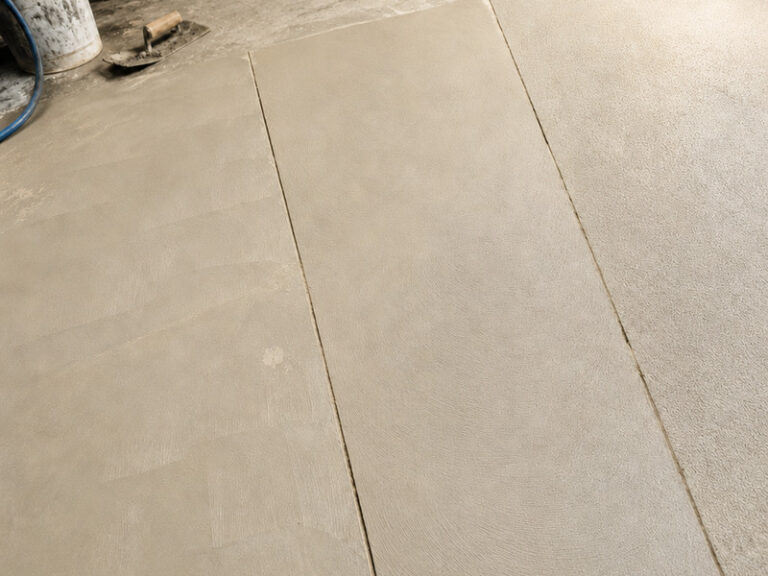
Urethane cement, PU concrete and polyurethane mortar are three names for one family of material: a cementitious binder modified with polyurethane resin, placed at 3 to 12 mm depending on the build and finished by trowel or float.
The names come from the two trades that sell it. Concrete contractors describe what they place; resin contractors describe what they finish. Neither is wrong, and neither is a specification.
This article explains where each term came from, what the words hide about thickness and aggregate, and how a buyer can compare three quotes written in three vocabularies.
Three names, one product, one chemistry
The material is a hybrid. A cementitious binder provides moisture tolerance and dimensional stability, and a polyurethane resin provides chemical resistance and flexibility.
Every product in the family contains both phases. The ratio varies, the aggregate varies, and the build varies, but the chemistry does not.
Resin screed is the older resin-trade name for the same kind of placed system. It may describe a hybrid or a pure resin mortar, which is exactly why it cannot go into a specification.
Both trades sell the same hybrid, so a quote for PU concrete and a quote for a resin screed can describe the same floor, and two quotes using the same word can describe different ones.
The first step in any comparison is therefore to stop reading the name and start reading the numbers behind it.
The binder is a three-component system in most products: a resin part, a hardener part and a powder blend of cement and fillers.
The resin reacts with the hardener while the cement hydrates. Both reactions proceed at once, and the result is a matrix that behaves like neither component alone.
The cement phase gives the material its tolerance of a damp substrate and its low shrinkage. The resin phase gives it resistance to acids, to hot water and to thermal cycling.
That combination is the reason the family is specified in washdown rooms, breweries, freezers and chemical plants rather than in offices.
The mineral fraction is also why the material is expensive per kilogram and competitive per square meter: most of the volume is mineral, and the resin is a small fraction of the mass.
Table 1: The three names and what each implies.
| Nombre | Comes from | Implies | Ask |
|---|---|---|---|
| Urethane cement | Chemistry | Hybrid binder | Which build? |
| PU concrete | Concrete trade | Placed, heavy | Thickness in mm |
| Mortero de poliuretano | Resin trade | 3-6 mm, troweled | Self-smoothing? |
| Resin screed | Older resin-trade term | Hybrid or pure resin, unstated | Resin only, or hybrid? |
| Brand name | Supplier | A single system | Generic equivalent |
Why concrete contractors say PU concrete
A concrete contractor thinks in placed thickness, aggregate grading and finish. The material behaves like a very fine concrete, and it is installed with the tools those crews already own.
A screed rail sets the level, a trowel closes the surface, and a power float can be used on the heavier builds. The vocabulary follows the method rather than the chemistry.
That is the origin of PU concrete as a term. It tells a concrete crew what to expect, and it tells a client that the floor will be placed rather than painted.
The term also carries an implication about thickness. A crew that thinks in concrete will default to 6 to 9 mm, which is often right for heavy duty and often more than a light room needs.
Where a client hears PU concrete, they should ask for the thickness in millimeters, because the phrase itself implies a heavier build without stating one.
Why resin contractors say polyurethane mortar
A resin contractor thinks in coats, primers and finished appearance. The same material arrives as a troweled mortar and is described in the language of resin flooring.
That vocabulary suits a cleanroom, a kitchen or a light production room, where the client is buying a seamless finished surface rather than a structural topping.
The risk is the opposite of the concrete case. A resin contractor may price 3 to 4 mm by habit, which is correct for light duty and thin for a washdown room.
Mix and place are common to both grades. A trowel grade is then closed by hand and sealed, while a self-smoothing grade is spread with a pin rake and flows to level. The application method differs by grade, and the heading on a quote rarely says which one is being priced.
What the two grades share is the thickness the crew assumes when nobody states one.
That assumption is worth more money than any product choice on a typical project, and it is invisible in a quote that names only the material.
Where the two trades actually differ
Aggregate blend is the first. A fine blend with a 0.5 mm top size gives a smooth finished surface and suits 3 to 6 mm. A coarse blend with a 3 mm top size cannot be placed thinner than about 6 mm, because the stone needs matrix above and below it. The heavy aggregate build therefore runs 6 to 12 mm, and it takes load better.
Application method is the second. A self-smoothing grade flows to level and needs a pin rake; a trowel grade needs a crew that can close a surface by hand.
What the supplier catalogue hides
A supplier catalogue lists products by name, and a name is the least useful field in it.
Four fields decide whether an entry can be compared at all: the thickness range, the aggregate top size, the compressive class and the chemical resistance table with concentrations and temperatures. They are usually three pages in, behind the marketing.
A catalogue also tends to hide its own gaps. A product listed for heavy duty without a stated thickness is a product whose duty claim cannot be checked. If any of the four fields is missing, the data sheet fields are worth checking before a price is discussed.
Product naming costs money at that point. Two supplier catalogues can list the same phrase and describe floors that differ by a factor of two in material volume. One calls it a system and lists the build; the other calls it a product and lists a price.
A urethane cement entry in a catalogue is therefore two documents in one: a label for the buyer and a set of numbers for the specifier. Product naming appeals to the first, and the data sheet serves the second.
Read the supplier catalogue for numbers rather than adjectives, and treat the name as a label rather than a promise.
Choosing by room, not by name
The reliable way to choose is to start from the room: what is spilled, at what temperature, how often, and what load moves across it. Thickness selection follows from those four answers, not from the product name.
A dry store needs 3 mm and no chemical resistance beyond cleaning agents. A washdown room at 80 °C needs 6 to 9 mm and a tested resistance to the cleaning chemicals.
A freezer needs a build that tolerates thermal cycling, which points to a higher resin ratio within the same chemistry rather than to a different material.
The application method follows from the room as well. A self-smoothing grade suits an open hall, while a trowel grade suits a room broken up by plinths and drains.
The finished surface and the aggregate blend should be agreed before the build is chosen. A 6 mm build with a 3 mm coarse aggregate cleans far less easily than a 3 mm build with a 0.5 mm fine blend, however carefully either is laid.
A brewery needs acid resistance at ambient and caustic resistance at temperature, and it needs a finished surface that cleans rather than traps. A brewery usually lands at 9 mm, the top of that range, because washdown is continuous.
Table 2: Build by room type.
| Room | Build | Aggregate |
|---|---|---|
| Dry store | 3 mm | Fine, 0.5 mm |
| Kitchen | 4-6 mm | Fine to medium |
| Washdown room | 6-9 mm | Medium, 1-2 mm |
| Brewery floor | 6-9 mm, usually 9 mm | Medium, troweled |
| Freezer | 6-9 mm | Medium, resin rich |
Once the room is described, the name follows. Starting from the name is how a kitchen ends up with a 9 mm floor and a washdown room with 3 mm.
Where the names cross over in practice
The overlap is largest in the middle market segment, between 4 and 6 mm, where a fine aggregate blend and a medium one can produce a very similar finished surface.
A supplier who sells into both a market segment for heavy industry and one for food retail will often list the same product twice under two names, with two data sheets and two prices. Both entries can sit in the catalogue for years without anyone comparing them side by side.
That duplication is not dishonesty. It is product naming doing its commercial job at its most ordinary: one entry reaches a buyer who searches for a concrete term, the other reaches a buyer who searches for a resin term.
Where a distributor lists both, ask for the aggregate blend and the application method for each entry. If the two answers are the same, the two entries are the same product. Then ask both entries to be priced at the same build: the lower of the two is the real market price for that product, and the gap that remains is packaging and minimum order rather than performance.
The specification term is where the crossover stops being harmless. A document that accepts one name and rejects the other will exclude competent bidders for no technical reason.
The sentence is simple: the specification term is the binder and the build, not the trade name. Everything else in the document follows from that.
That is a procurement problem rather than a flooring problem, and it is fixed by one sentence in the tender.
When a name becomes a specification
A trade name becomes a specification at the moment a client writes it into a contract without a thickness or a test.
At that point product naming is doing work it cannot do, and the remedy is to demote the specification term to what it is: a label on a build. It implies a build, a binder and a performance level without stating any of them, and every bidder reads it differently.
The remedy is to demote the name. Use it as a heading, then specify underneath it: binder, thickness, aggregate blend, primer and acceptance test.
Urethane cement is now common enough that the shorthand is no longer needed. A buyer who has never seen the product can search the chemistry and get comparable answers from several suppliers.
A market segment that has bought the same product for twenty years will resist the change, because the name has been a reliable shorthand for a reliable floor.
The resistance is understandable and it is still worth overcoming, because a new entrant to the segment cannot bid against a shorthand it is not allowed to use.
The same logic applies to a supplier catalogue issued by a plant that has renamed its range. The chemistry did not change; only the label did, and the specification should not notice.
Writing a specification both trades can bid
A specification has to be neutral enough for both vocabularies and precise enough to be enforced.
The specification term decides who can bid. A tender written around a brand name excludes most of that market segment, and a tender written around a chemistry invites every supplier who can meet it.
The crew decides whether the winner can deliver it. A concrete crew and a resin crew are not interchangeable, and the same product installed by the wrong team fails in a predictable way.
The specification must name the binder as a cementitious polyurethane hybrid rather than by a trade term such as urethane cement. Then state the thickness in millimeters with a tolerance, the aggregate top size, and the primer.
The specification must state the chemical exposure by chemical, concentration and temperature. A resistance table entry without those three numbers is not a requirement.
It must also state the acceptance tests: thickness by core sample at a stated frequency, adhesion by pull-off, and slip by pendulum in the wet condition.
That wording lets a concrete contractor and a resin contractor price the same floor, which is the only basis on which their numbers can be compared.
Comparing three quotes written in three words
Normalize first. Convert every price to a rate per square meter at a stated thickness, and reject any quote that will not state a thickness.
Then compare consumption. Two quotes for the same build should show similar kilograms per square meter, and a quote that shows less is a thinner floor.
Then compare the primer and the substrate assumption. A quote that assumes a dry slab is cheaper and may be wrong for the building.
Then compare the warranty terms and the exclusions, and require both to be written into the contract. A warranty that names no thickness and lists no exclusions is a verbal promise in a document.
Table 4: Six questions that separate a floor from a product name.
| Question | Why it is asked | A weak answer looks like |
|---|---|---|
| What is the binder? | Sets the family | A trade name |
| What thickness, in millimeters? | Sets wear and load | A number of coats |
| What aggregate top size? | Sets finish and load | Not stated |
| Primer and slab moisture? | Sets the barrier risk | Primer to suit |
| Chemical exposure, with concentration and temperature? | Sets the duty | Chemical resistant |
| How will thickness be proven? | Sets the acceptance test | Visual inspection |
Any supplier who can answer all six is selling a floor. Any supplier who answers four is selling a product with a name attached.
Only after those four steps is the price worth reading, and by then the cheapest quote has usually stopped being the cheapest.
Table 3: Four steps to normalize three quotes.
| Paso | Reveals |
|---|---|
| Rate per m2 at stated thickness | Thin floors priced as thick |
| Consumption in kg per m2 | Substitution after award |
| Primer and slab assumption | Hidden moisture risk |
| Warranty tied to build | Unequal promises |
What we call it, and why
We describe the product as a cementitious polyurethane floor and then state the build in millimeters. The first phrase is the chemistry and the second is the commitment.
Where a client uses the words PU concrete, we answer in their vocabulary and translate it once. That single sentence prevents most substitutions.
Where a client asks for a resin screed by name, we ask whether they mean a hybrid or a pure resin system, because the two fail differently in a hot washdown room.
Where a client arrives with three quotes in three vocabularies, we put them in one table and mark where they differ.
That is the whole service: not a better name, but a comparison that can be made.
Any supplier who can answer all six is selling a floor. Any supplier who answers with a trade term is selling a category.
The difference matters most in the first meeting, when the vocabulary is still being negotiated and the budget is still being set.
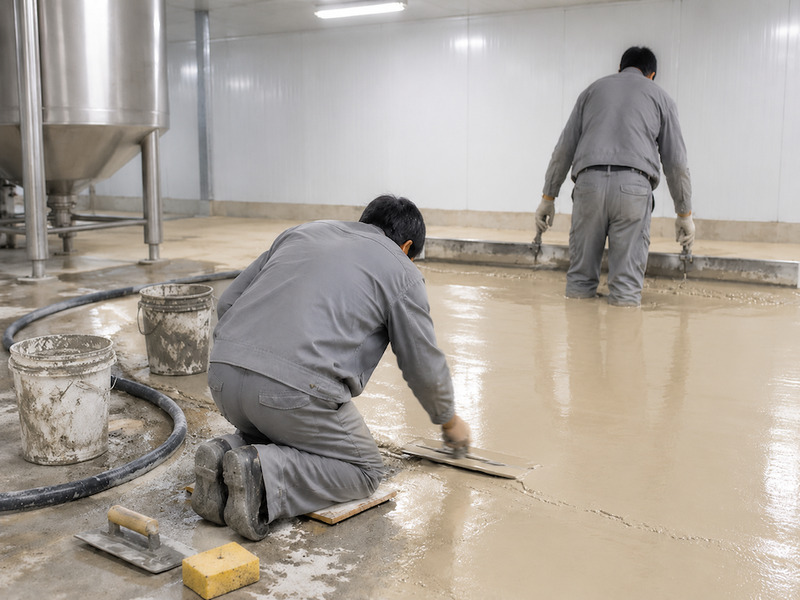
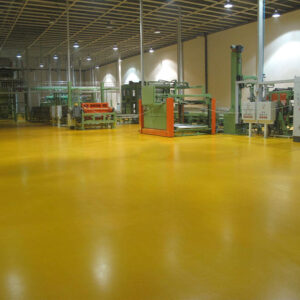
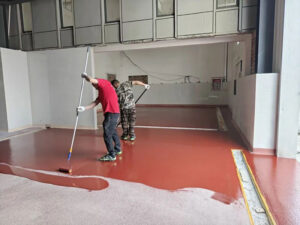
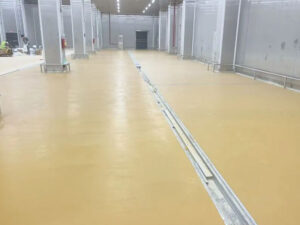
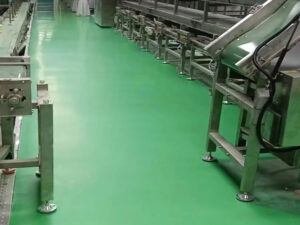
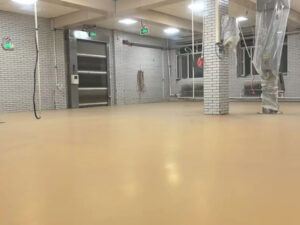
Figure 1: the placement method is what gave the material its concrete name.
Frequently asked questions
Is urethane cement the same as PU concrete?
Yes in most cases. Both describe a cementitious binder modified with polyurethane resin. The first is the chemistry and the second is the trade description.
Is polyurethane mortar the same product?
Usually yes, at a thinner build. A mortar is typically 3 to 6 mm where a concrete build is 6 to 9 mm, and the aggregate is finer.
Which name should a specification use?
Cementitious polyurethane hybrid, followed by thickness, aggregate top size, primer and acceptance tests. That wording is neutral between the trades.
Why do the names matter if the material is the same?
Because a quote that names only the material does not state a thickness, and thickness is where most of the cost and most of the performance sits.
Can a resin contractor install PU concrete?
Yes, if they are equipped for placed material. Mixing, pot life and surface closing are different skills from coating application.
Is a resin screed cheaper than urethane cement?
Per square meter it can be, because a the thinner system may be cheaper. Per year of service the comparison usually reverses in a washdown room.
How do I know which build I have been quoted?
Ask for the thickness in millimeters and the consumption in kilograms per square meter. If the two numbers do not agree, ask again.
Working with Kaida Paint
Kaida Paint supplies cementitious polyurethane systems and states the build in millimeters on every quote, so a urethane cement price can be compared with a PU concrete price on equal terms. Send the three quotes and the room conditions, and we will mark where they differ before you choose.




 English
 Spanish
 Portuguese
 Arabic
 French
 Italian
 Russian
 Indonesian
 Swedish