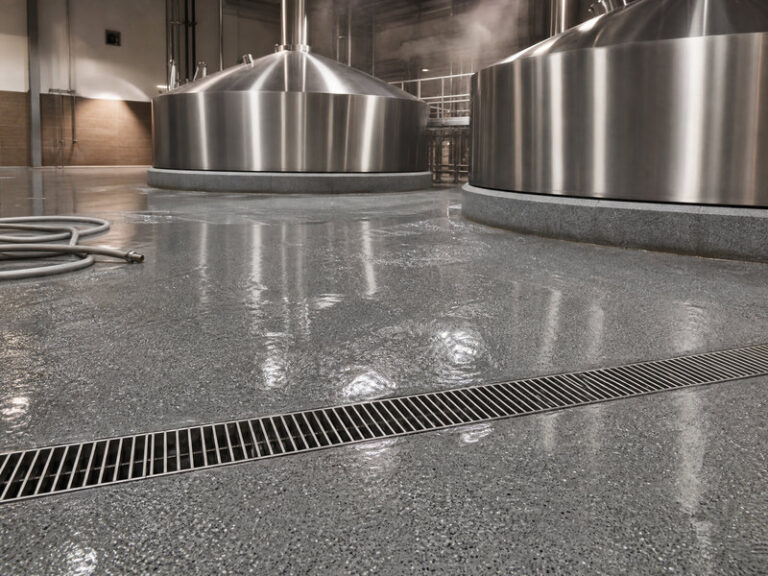
Brewery flooring is specified by zone, not by product name. Cementitious urethane at 6–9 mm covers brewhouse and packaging, polyurethane at 4–6 mm covers fermentation and filtration. A 200 mm trench drain with a solids basket takes the water, falls run 1:80 to 1:100, and washdown areas need R11–R12.
Three exposures decide whether it survives: sugar-rich wort that stays sticky, caustic and acid washdown at temperature, and hot water landing on a cold slab. A coating that handles two of them fails on the third.
The order matters: sugar feeds the film under equipment, acid attacks the binder, and hot water cracks what is left. Below: what each floor faces, how to read the damage, where spent grain blocks a drain, and what the specification should say. Aimed at brewery engineers and maintenance managers.
1. Three things that destroy brewery flooring: sugar, acid and hot water
Wort and sugar residue is the first problem, because it does not look like one. A floor that looks clean can carry a film that holds moisture against the coating and feeds microorganisms between washes. A hose does not shift it: an ATP swab taken after washdown is what separates a surface that passes the eye from one that passes the swab. Lactic acid resistance matters here more than most brewers expect: beer and tank condensate sit in the acid range, and the chemicals that follow are stronger. A binder that softens under acid chalks within a season, so lactic acid resistance is a specification line, not a footnote.
The second is chemistry. A normal CIP cycle puts caustic washdown at 1–3% NaOH and 70–80 °C on the floor. Nitric or phosphoric acid at 0.5–2% comes next, then a peracetic rinse at 0.1–0.5%. Hypochlorite at 100–200 ppm free chlorine appears in some cleaning regimes as well. Each of those is survivable alone; the sequence, at temperature, is what separates a suitable binder from an unsuitable one.
The third is hot water at 80–90 °C landing on a slab at cellar temperature. Thermal shock resistance is a rate property, not a temperature rating: the damaging gradient forms in seconds, and a rigid coating relieves the stress by cracking. That is the short version of why brewery flooring fails at the surface rather than at the joint.
2. Zone by zone: brewhouse, fermentation, packaging, keg washing
A brewery is not one floor. The brewhouse is hot, wet and sugary. Fermentation is cold, wet and chemical-heavy. Packaging is wet, abrasive and busy. Keg washing is a chemical plant in miniature.
Brewhouse flooring carries the worst combination: spillage at the mash tun, wort at the kettle, and washdown water that arrives hot. Vessels sit on plinths and the floor around them collects everything, which is why the perimeter and the drain surrounds fail first.
Fermentation and filtration rooms are cooler, and the main exposures are acid, peracetic acid and condensation that never dries. A flexible polyurethane at 4–6 mm works here, and the detail at tank feet matters more than the field surface.
Specifying one system across all four zones is the most common way a brewery ends up overpaying in one room and under-specifying in another. Brewhouse flooring earns the heavier build; fermentation flooring does not need it.
Packaging halls bring glass, broken crates, pallet trucks and constant water. The floor needs abrasion resistance as much as chemical resistance. Brewery floor slope has to move a large volume of water quickly to the trench drain, without ponding at the filler.
Keg washing and concentrated chemical stores are different again. At full strength, caustic washdown chemicals and acid will find any pinhole. Specify stainless steel containment, or require a written chemical resistance statement for the exact concentration and temperature.
Table 1: Chemical exposure by brewing zone, with the concentration and temperature the floor actually sees.
| Zone | Main chemicals | Concentration and temperature | Exposure pattern |
|---|---|---|---|
| Brewhouse | Wort, sugar, caustic, acid | 1–3% NaOH at 70–80 °C; acid 0.5–2% | Daily washdown plus spillage, hot |
| Fermentation, filtration | Peracetic acid, acid, condensate | Peracetic 0.1–0.5%; acid 0.5–2% | Frequent, cooler, stays wet |
| Packaging | Caustic, detergent, glass, abrasion | 1–2% NaOH at 70–80 °C | Continuous water, mechanical wear |
| Keg washing | Caustic, acid, hypochlorite | Full strength to 3% NaOH; 100–200 ppm chlorine | Splash and spill at full concentration |
| Cold store, dispatch | Condensate, ice, cleaning foam | Cold, low concentration | Freeze-thaw at thresholds |
3. Diagnosing thermal shock before you resurface
Thermal shock damage in brewery flooring has a signature, and the signature tells you whether a new coating will survive where the old one failed.
Look for dishing around drains: the surface sinks slightly toward the drain collar and the coating lifts at the edge. Look for fine crazing under kettles and at the outlet of every hot-water hose point, a pattern like dried mud rather than impact craters. Look for debonding along the perimeter and at plinth edges, where the coating curls away from the substrate with a hollow sound under a tap.
If you see dishing, crazing and perimeter debonding together, the substrate is probably sound and the binder was wrong. If you see impact damage, blistering in the field or widespread delamination, the cause is elsewhere and a chemical-resistant topcoat will not fix it.
A cut sample settles which one you have. Lift a 100 mm square from a damaged area and look at the underside. A clean back with a glossy imprint of the substrate means the bond released at the interface, which points to movement or to contamination left on the surface before the primer. Resin and aggregate still bonded to the concrete means the failure began inside the build, above the bond line.
Thermal shock resistance is often quoted as a temperature, which is misleading. Ask instead how many hot-water cycles the system has survived in service at the concentration you use, and ask for the thickness that was tested. A 4 mm build and a 9 mm build of the same chemistry behave differently under the same gradient.
4. Drainage: keeping spent grain out of the trench
Spent grain is the reason brewery flooring drainage fails. It is heavy, it settles, and it sets like concrete in a line that was sized for water. A 100 mm pipe that carries washdown water perfectly will block within days once grain reaches it.
The answer is a trench drain, not a gully. A brewery floor drain in the brewhouse should be a 200 mm trench. The grating lifts out, and the basket catches grain before it reaches the run. Put a cleanout at every change of direction, and size the outlets for the washdown flow rather than the average.
Brewery floor slope does the rest. Falls run from 1:80 to 1:100, about 1.0–1.25%, across the floor toward the trench. Local wet zones and equipment surrounds can go to 2%, about 1:50, but a whole hall at 2% costs you ceiling height, threshold detail and drain depth.
Three details decide whether those falls work:
- The trench runs perpendicular to the main traffic direction, so pallet trucks cross it rather than travel along it.
- Grating sits flush with the finished floor, in a frame that is set before the resin goes down.
- The trench body has a fall of its own, or a sump outside the room, so liquid does not stand in the channel after washdown.
Where a brewery floor drain meets the resin, form a collar rather than a butt joint, and carry that collar into the drain frame. The collar spreads movement and gives the trowel somewhere to finish, which is why most leaks start at a drain that was cut in afterwards.

Figure 2: The two details that decide whether a trench blocks or leaks: a solids basket that lifts out with the grain, and a formed resin collar at the junction that spreads movement.
Table 2: Drainage detail by brewery area, with the brewery floor drain type and fall that keeps water moving.
| Area | Drainage | Fall | Detail |
|---|---|---|---|
| Brewhouse | 200 mm trench drain with solids basket | 1:80 to 1:100 | Grain caught before the run, cleanout at each turn |
| Fermentation | Slot drain or narrow channel | 1:100 | Collar at tank feet, no ponding under vessels |
| Packaging | Trench across the traffic direction | 1:80 | Flush grating, framed before the resin |
| Keg washing | Channel with sump outside the room | 2% local | Chemical-resistant body, removable grating |
5. System and thickness by area
Cementitious urethane (urethane cement) carries the brewhouse and packaging areas at 6–9 mm. The build absorbs the thermal gradient, and the lactic acid resistance claim is written for that thickness rather than for a thin coat. Polyurethane at 4–6 mm suits fermentation and filtration, where the floor stays wet but the temperature swing is smaller.
Epoxy belongs in dry storage, offices and corridors, where the chemical load is low and the budget is tight. MMA earns its place when the brewery cannot stop long enough for a slower system, at the cost of odor and a short working life in the bucket.
Table 3: Floor system and thickness by brewing area, with the reason for the choice.
| Area | System | Thickness | Why |
|---|---|---|---|
| Brewhouse, mash and kettle surrounds | Urethane cement | 6–9 mm | Hot washdown, wort, thermal shock |
| Packaging hall | Urethane cement | 6–9 mm | Abrasion, caustic, constant water |
| Fermentation, filtration | Polyurethane or urethane cement | 4–6 mm | Acid, peracetic, condensation |
| Keg washing, chemical store | Stainless steel or high-build Novolac-type system | By design | Full-strength chemical splash |
| Dry store, offices, corridors | Epoxy | 2–4 mm | Low chemical load, cost |
| Cold store, dispatch | Polyurethane | 4–6 mm | Freeze-thaw, flexibility at low temperature |
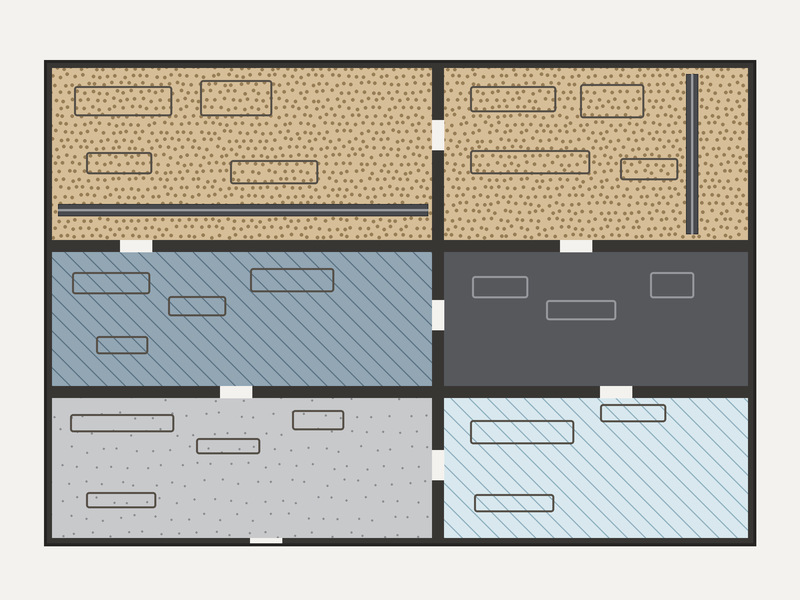
Figure 1: A brewery zone map, with the floor system and thickness each area needs rather than one build for the whole building.
In brewhouse flooring, the 9 mm end of the 6–9 mm range is the one to hold when the tender is value-engineered.
Thickness is not a sales variable; it is a service-life variable. Every extra millimeter buys abrasion and thermal buffer, and costs floor height at every threshold. On a retrofit, the threshold is often the constraint that decides the system.
6. Slope, falls and drain detail
Brewery floor slope is the detail that gets argued about last and matters most. Water that stands after washdown leaves a film, and the film is where the next problem starts. A floor that drains clean on its own is a different asset from one that needs a squeegee.
Specify the brewery floor slope in the drawing, not in the specification text. State the direction, the gradient, the high point and the low point, and require the contractor to verify it with a digital level before the resin is sealed.
Where the floor meets a wall, carry a coving radius of at least 50 mm, and 75–100 mm in the brewhouse. The larger radius lets brushes, squeegees and washdown lances reach the junction without bearing down on a square corner. It removes the shadow line where soil collects, and it is the first thing an auditor looks at after the drains.
Plinths, tank feet and door thresholds belong in the same pre-pour sequence as the drain frames above. Cutting them in afterwards breaks the membrane at the points where liquid collects and nobody looks.
7. Planning the work around the brewing schedule
Planning brewery flooring work around the brewing schedule is a program problem, not a materials problem. A brewery cannot stop for a week, and it should not try. Plan by zone: brewhouse first or last, packaging in a shutdown window, fermentation between tank turns.
Expect 48–72 hours per zone, including grinding, priming, body coat, broadcast, topcoat and cure. A faster system shortens the window rather than the sequence, and it brings an odor that travels through the whole building.
Three practical constraints decide the program:
- Brewhouse access: the brewhouse cannot be isolated for long, so the work usually runs in two halves with the kettle and mash tun protected in place.
- Ventilation: fermentation rooms hold CO2, which displaces air at low level. Forced ventilation and gas monitoring are part of the works plan, not the flooring scope.
- Water: caustic washdown continues in adjacent zones, so containment has to keep water off fresh resin without stopping production.
Order materials against the zone sequence rather than the total area. A delivery that arrives before the zone is ready sits in a corridor and gets wet.
8. What to put in the specification
A brewery flooring specification should read like a chemical compatibility statement with a program attached. Name the system per zone, the thickness, the broadcast rate and the cure window.
Brewhouse and packaging: cementitious urethane, 6–9 mm, aggregate broadcast to R11–R12, coving 75–100 mm. Fermentation and filtration: polyurethane, 4–6 mm. Chemical resistance shall be stated for 3% NaOH at 80 °C, 2% nitric acid, 0.5% peracetic acid and 200 ppm hypochlorite, each at the contact time in the cleaning procedure. Thermal shock resistance shall be demonstrated by a hot-water cycling test on a cured sample at the specified thickness, with the cycle count and water temperature stated in the report. Falls: 1:80 to 1:100 to trench, verified by digital level before sealing.
Add the verification clause that most specifications forget: state who measures the falls, when, and what happens if they are out. On a brewery floor slope, the argument after handover is always about water that stands, and the answer is a number recorded before the topcoat went down.
Frequently asked questions
Why does brewery flooring fail around drains first?
Because that is where hot water, sugar and chemical sit longest, and where the coating is cut to fit a collar. A butt joint at the brewery floor drain concentrates movement and thermal stress in one line. A formed collar, cast before the body coat, spreads that stress and gives the trowel a proper finish.
Is cementitious urethane suitable for a brewhouse?
Yes, and it is the usual choice for brewhouse flooring at 6–9 mm. It tolerates hot washdown, resists lactic acid and sugar, and carries thermal shock without the rigidity of epoxy. Ask for the lactic acid resistance and thermal shock resistance figures at that thickness, not at 4 mm. Confirm the chemical resistance statement covers your caustic concentration and temperature, not a generic claim.
What gradient should brewery flooring have?
Keep the main floor at 1:80 to 1:100 (1.0–1.25%), falling toward the trench. Steeper is allowed where water concentrates: 2%, about 1:50, at equipment surrounds and washdown points. If an existing slab cannot take that fall without lifting thresholds, keep the fall and add a local sump rather than flattening the whole hall.
How do I stop spent grain blocking the trench drain?
Use a 200 mm trench with a removable grating and a solids basket. Grain is caught where it can be lifted out, rather than traveling into a 100 mm run where it sets. If you inherit a 100 mm line, put the basket at the head of the run and plan the trench for the next shutdown instead of upsizing mid-run.
Can the floor be replaced without stopping brewing?
Usually yes, zone by zone. Allow 48–72 hours per zone once cure is counted, and treat a fast-cure system as a shorter clock rather than a shorter job. The real constraint is isolation and ventilation, not the material, and caustic washdown cannot continue over a fresh floor in the same room.
Does thermal shock resistance have a temperature rating?
Not a meaningful one. The damage comes from the rate of change, so ask how many hot-water cycles a system of that thickness has survived in service, and ask to see the report. A temperature rating describes a limit, not the second the water lands.
Which areas need the highest slip class?
The brewhouse and packaging hall need DIN 51130 R11–R12 on the whole washed area. Ramps, dock approaches and the wet threshold where a pallet truck turns need R12–R13. Barefoot areas such as changing rooms are classified under DIN 51097 and should not inherit the brewhouse number.
Why food plants work with Kaida Paint
Kaida Paint formulates and manufactures cementitious urethane, polyurethane, epoxy and MMA systems for brewery flooring, dairies and food plants. We specify by zone because a brewery does not have one floor condition.
- Chemical resistance is stated per concentration and temperature, matched to your CIP procedure rather than a generic acid-and-caustic claim.
- We supply the full build from one formulation family: primer, body coat, broadcast, topcoat and coving, so a failure at a layer boundary is our problem, not a supplier dispute.
- Drain collars, plinth details and coving are part of the system drawing, not an afterthought on site.
- We will tell you when stainless steel is the right answer, which happens more often in keg washing than suppliers admit.
Send your zone list, cleaning chemicals with concentrations and temperatures, and the shutdown window you can offer, and we will return a zone-by-zone system schedule.






 English
 Spanish
 Portuguese
 Arabic
 French
 Italian
 Russian
 Indonesian
 Swedish