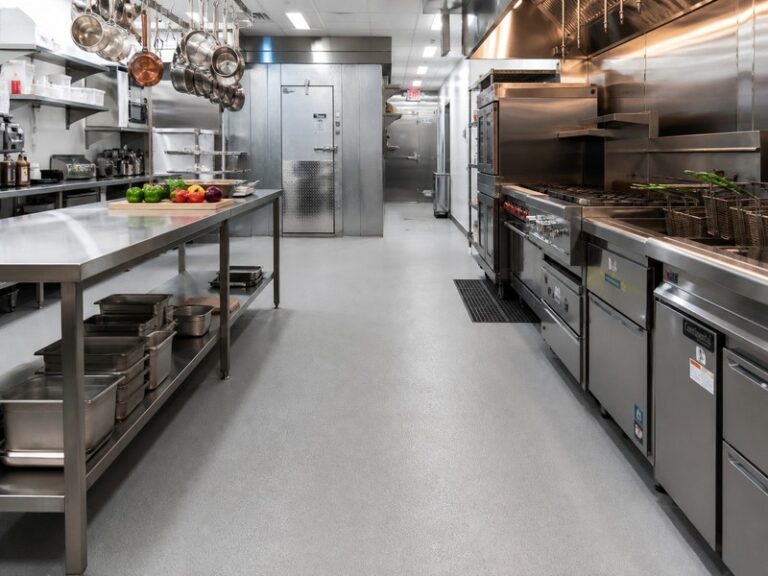
Struggling with slippery surfaces and rapid floor failure? For high-volume commercial kitchens, urethane cement flooring is the only technical solution that guarantees global safety compliance (P5/DCOF ≥0.42) while resisting thermal shock from 120°C (248°F) steam cleaning. This 2026 authoritative guide provides the decision-making framework for specifying systems that eliminate hygiene breaches and maximize 15-year lifecycle ROI.
30-Second Kitchen Flooring Decision Matrix
- IF constant 120°C (248°F) steam cleaning -> THEN Specify 9mm Urethane Cement.
- IF high grease + rapid staff movement -> THEN Specify P5-rated Anti-Slip Aggregate.
- IF sub-zero freezer to hot cooking line transition -> THEN Specify Urethane Cement (matches concrete CTE).
- IF overnight renovation window (<8 hours) -> THEN Specify MMA-Modified Urethane Cement.
1. How to Prevent Thermal Shock Failure in High-Volume Commercial Kitchens?
Commercial kitchens are high-stress environments where moisture, grease, and extreme temperature changes converge. This combination accelerates the failure of ordinary materials like vinyl or quarry tile, primarily through thermal shock.
The Mechanics of Thermal Shock Failure
- Rapid Expansion: When boiling 100°C (212°F) water hits a 15°C (59°F) floor, the surface layer expands instantly.
- Fracture Points: If the flooring material’s expansion rate differs from the concrete, the bond breaks, leading to “tenting” or delamination.
- Kaida Engineering Note: Our 2026 research indicates that Kaida urethane systems achieve a 98% coefficient matching accuracy with C30/35 concrete, significantly reducing micro-fracture risks compared to standard industry mortars.
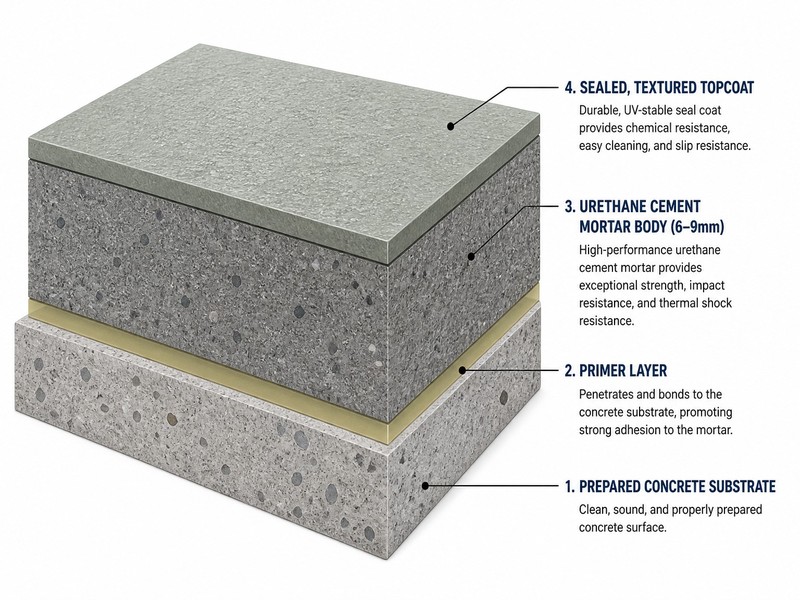
Molecular Logic: High Cross-linking Density (HCD)
Beyond thermal matching, Kaida’s 2026 systems utilize High Cross-linking Density (HCD) technology. At the molecular level, this creates a tightly bound polymer matrix that prevents lactic and acetic acids from penetrating the surface. While standard epoxies have “micro-voids” that allow acidic seepage—leading to bond failure and bacterial reservoirs—our HCD matrix ensures zero-porosity, effectively starving pathogens of the moisture they need to survive.
2. What Global Safety Standards Define 2026 Kitchen Flooring Excellence?
To ensure global compliance, engineering specifications must align with regional safety mandates. Kaida Paint systems are engineered to exceed the most rigorous international benchmarks.
Global Slip Resistance & Safety Matrix
| Region | Standard | Requirement for Kitchens | Kaida Compliance |
|---|---|---|---|
| Australia / NZ | HB198 / AS 4586 | P5 (Wet Pendulum ≥ 55 PTV) | Exceeds P5 |
| USA / Canada | ANSI A326.3 | DCOF ≥ 0.42 (High Traction) | Certified ≥ 0.65 |
| Europe / Germany | DIN 51130 | R11 – R12 (Oil Contamination) | R12 Verified |
3. How to Choose the Right Material for Different Kitchen Stress Zones?
To maximize ROI, flooring must be specified based on the specific “stress zone” of the kitchen.
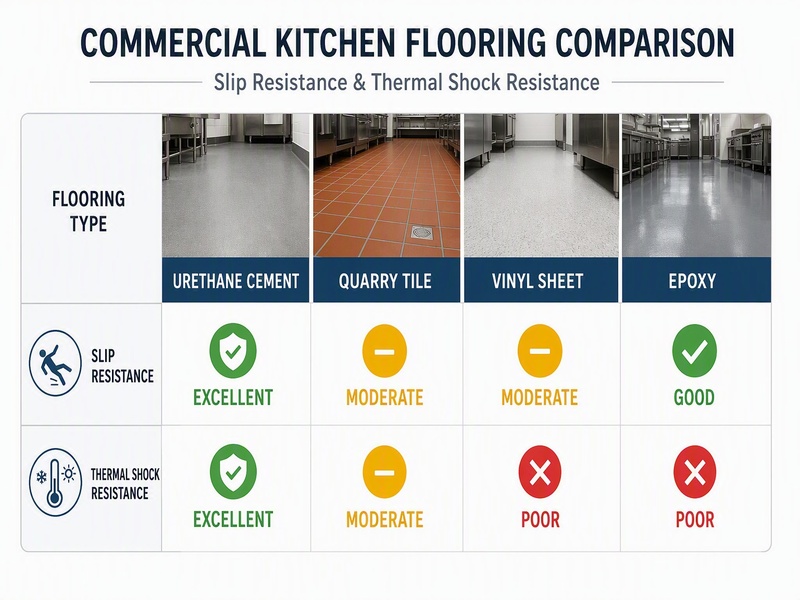
| Material Type | Wet Slip Resistance | Thermal Shock Limits | Hygienic Profile | 2026 ROI Factor |
|---|---|---|---|---|
| Urethane Cement | Excellent (P5) | -40°C to 120°C (-40°F to 248°F) | NSF/ANSI 2 Certified | High (10-15 Years) |
| Epoxy Mortar | Good (P3-P4) | Max 60°C (140°F) | Seamless | Moderate (Dry zones only) |
| Quarry Tile | Moderate | Poor (Grout failure) | Poor (Porous grout) | Low (Frequent repairs) |
4. The Real Cost of Flooring Failure: 15-Year Life Cycle TCO Model
Most facility managers evaluate flooring based on initial installation price, but the Total Cost of Ownership (TCO) is determined by maintenance, hygiene breaches, and downtime.
Downtime Loss Calculation Formula
Downtime Loss = Median Hourly Revenue × Downtime Hours In a high-volume central kitchen generating 15,000/hr,asingle48−hour shutdown for floor repair costs 15,000/hr, asingle48−hour shutdown for floor repair costs 720,000 in lost revenue—far exceeding the total installation cost of a premium Kaida system.
15-Year Cumulative Cost Comparison
| Factor | Kaida Urethane Cement System | Standard Vinyl / Unprotected Tile |
|---|---|---|
| Initial Cost | $$$ (High) | $ (Low) |
| Maintenance Cost (15 yr) | Low (Greenguard Gold surfaces) | Very High (Grout/Joint repair) |
| Replacements Required | 0 | 2 – 3 |
| Total 15-Year TCO | Most Cost-Effective | 250% – 400% Higher than Urethane |
5. Scenario-Based Surface Strategies (2026 Operational Mapping)
To maximize ROI, your flooring strategy must align with your specific user state. Below are the three most common 2026 commercial kitchen scenarios.
Scenario 1: The Chain Fast Food Manager
BLUF: Rapid-cure MMA-modified systems allow for overnight kitchen turnarounds while meeting 100% P5 safety compliance. For chain restaurants where downtime means lost revenue, Kaida Fast-Cure Urethane is the standard. It reaches full anti-slip properties in 4-6 hours, allowing for a Saturday night installation and a Sunday morning reopen.
Scenario 2: The Industrial Food Processing Engineer
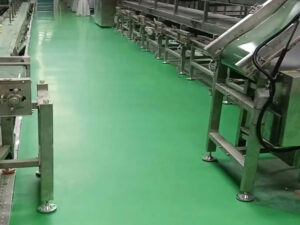
BLUF: Heavy-duty 9mm systems are essential for areas with continuous steam kettles and thermal cycling to prevent delamination. In central kitchens and processing plants, floors must withstand 120°C (248°F) high-pressure washing. Kaida 9mm Urethane Screed provides the thermal mass needed to resist expansion stress. In 2026, our team delivered a 15,000㎡ (≈161,000 sq ft) central kitchen facility achieving zero bond failure under 24/7 steam cleaning.
Scenario 3: The Smart Kitchen & Robotics Developer
BLUF: Achieving FM2 flatness standards with self-leveling urethane cement is critical for zero-drift robotic navigation. The rise of 2026 automated kitchens requires floors that AGVs (Automated Guided Vehicles) can navigate without sensor noise. By combining Kaida SL Urethane with FM2 precision screeding, developers eliminate guidance drift for robotic food runners.
6. How to Prevent Osmotic Blistering Under Steam Kettles?
A kitchen floor is only as good as its bond to the substrate. Correct preparation prevents the common 2026 failure mode of “osmotic blistering.”
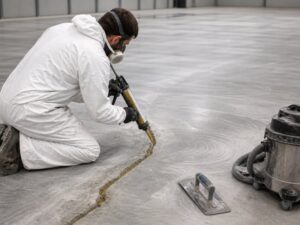
- Substrate Profile: Concrete must be prepared to a CSP 3-4 (Concrete Surface Profile) via mechanical shot-blasting. This profile ensures a mechanical lock critical for distributing thermal expansion stresses.
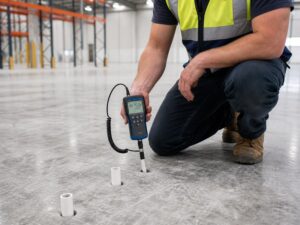
- Moisture Control: Kaida urethane cement is moisture-tolerant, capable of handling MVT up to 25 lbs (11.3 kg), eliminating the need for expensive moisture barriers.
- Cove Base Integration: A 150mm (6 inch) integral cove base creates a “bathtub” effect, ensuring no bacteria can seep into wall-floor junctions.
7. How to Achieve 100% Compliance in HACCP/SQF/BRC Ground Audits?
Ground surfaces are often the first point of failure in global food safety audits. To secure a perfect compliance score, your flooring must address the “Bacterial Reservoir” risk.
- Integral Cove Base Geometry: Traditional 90-degree wall-to-floor junctions are impossible to sterilize. Kaida systems use a 150mm (6-inch) integral cove base with a 50mm radius curve, ensuring that washdown water and debris are channeled away from edges.
- Zero-Porosity Surface: Our HCD technology (High Cross-linking Density) ensures the surface is chemically sealed. This prevents the “pitting” seen in older floors, where organic matter can hide from standard sanitation chemicals.
- Certified NSF/ANSI 2 Compatibility: By using materials that are non-tainting and odourless during and after installation, facilities meet the strictest BRC and SQF air-quality and hygiene requirements.
8. Frequently Asked Questions (FAQ)
Q: Is Kaida urethane cement environmentally safe?
A: Yes. Our 2026 systems are Greenguard Gold and LEED v4.1 compliant, ensuring ultra-low VOC emissions and high indoor air quality for kitchen staff.
Q: What is the required friction coefficient for robotic food runners?
A: For facilities using robotics, a Static Coefficient of Friction (SCOF) of ≥0.60 is recommended. Kaida’s P5-rated surfaces exceed this, providing 24/7 stability for robotics.
Q: How soon can the kitchen return to full service?
A: With our rapid-cure technology, the floor handles foot traffic in 6 hours and full operational loads (heavy equipment) in 12-24 hours at 25°C (77°F).
Q: Is the system NSF certified?
A: Yes, Kaida Urethane Cement is NSF/ANSI 2 certified for use in food zones, guaranteeing a non-tainting, hygienic surface.
9. About Kaida Paint
At Kaida Paint, we recognize that your kitchen floor is a critical production asset. As the leading product manufacturer, Kaida Paint provides high-performance materials tested against 2026 safety standards. We ensures that technical excellence is matched by global strategic operational insight.
Ready to eliminate floor downtime? Contact the Kaida Paint Technical Team today for a customized ROI audit and flooring specification tailored to your facility.


 English
 Spanish
 Portuguese
 Arabic
 French
 Italian
 Russian
 Indonesian
 Swedish