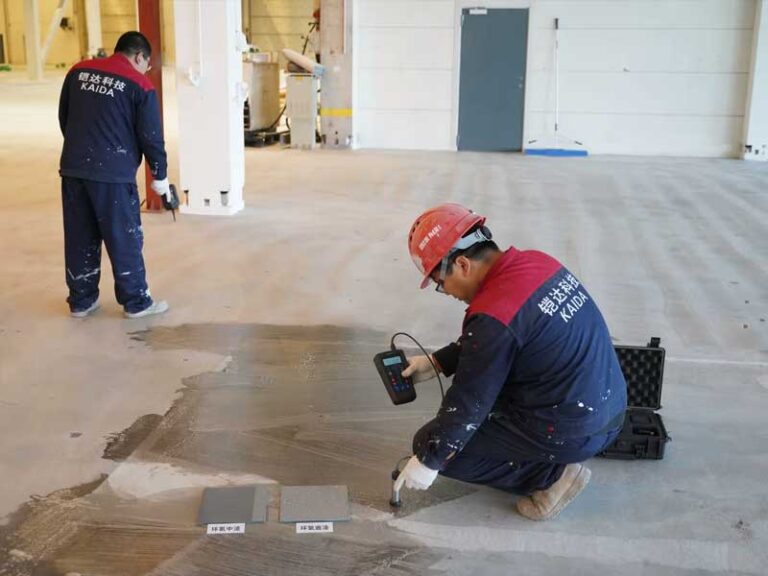
Breathable epoxy flooring is designed for moisture-prone concrete slabs by allowing controlled water vapor transmission while maintaining adhesion and durability. Unlike standard impermeable epoxy coatings, vapor-permeable systems reduce pressure buildup beneath the coating that causes blistering, peeling, and delamination. For concrete exceeding 5 lbs/1,000 sq ft/24 hours MVT, a moisture-tolerant epoxy system or dedicated vapor mitigation primer is recommended.
1. What Is Breathable Epoxy Flooring and Why Does It Matter?
1.1 Defining Breathable Epoxy Flooring
Breathable epoxy flooring is a moisture-tolerant resin flooring system engineered to allow controlled vapor transmission through the coating film while maintaining surface protection, durability, and chemical resistance. Unlike traditional impermeable epoxy coatings, these systems reduce vapor pressure buildup that can cause blistering and adhesion failure on moisture-prone concrete slabs.
1.2 Understanding Moisture Vapor Transmission (MVT) in Concrete
Moisture Vapor Transmission refers to the rate at which water vapor migrates from the saturated interior of a concrete slab to its surface. Concrete is inherently porous; even when the top appears dry, moisture below moves upward via capillary action, creating vapor pressure. This pressure is a primary cause of premature floor coating failure. MVT is quantified in pounds of moisture per 1,000 square feet over 24 hours.
1.3 Why Standard Epoxies Fail on High-MVT Concrete
When high MVT exists beneath a traditional, non-breathable coating, vapor pressure builds at the coating-substrate interface. Because the coating cannot allow moisture to pass, the pressure forces the coating to blister, bubble, or lose adhesion entirely. This hydrostatic pressure is one of the most common reasons for floor failure in commercial and industrial settings.
Common failure symptoms include:
- Tiny pinholes or blisters appearing within days of application
- Complete delamination where the coating lifts away from the concrete in sheets
- White, chalky deposits (efflorescence) on the coating surface
- A hollow sound when tapping affected areas
1.4 When Do You Need a Moisture-Tolerant Epoxy System?
The decision to use a breathable system hinges on measured MVT levels. The following table provides a clear decision framework, including specific product recommendations:
| MVT Level (lbs/24 hrs/1,000 sq ft) | Recommended Flooring System | Risk Level |
|---|---|---|
| Below 3 lbs | Standard epoxy | Low Risk |
| 3 – 5 lbs | Moisture-tolerant epoxy | Moderate Risk |
| 5 – 10 lbs | Breathable epoxy + moisture primer | High Risk |
| Above 10 lbs | 100% solids moisture vapor barrier | Critical Risk |
2. How to Choose the Right Epoxy System for High-MVT Concrete?
2.1 Water-Based Moisture-Tolerant Epoxies
Water-based epoxy systems represent the most common breathable category. These systems self-prime over concrete and can be used as standalone coatings or receiver coats for decorative floors.
Advantages:
- Very low VOC (<50 g/L in some formulations)
- Minimal odor during application
- Excellent color retention and resistance to yellowing
- Versatile finish options (gloss or satin)
Limitations:
- Typically limited to light-to-medium traffic applications
- May require longer full-cure times (up to 7 days)
2.2 100% Solids Vapor Barriers
For extreme MVT conditions (up to 25 lbs or 100% RH), 100% solids epoxy moisture control systems provide maximum protection. These products function as dedicated vapor barriers beneath a topcoat or as standalone systems, engineered to control moisture and alkalinity simultaneously (pH up to 14).
Advantages:
- Can withstand up to 100% relative humidity
- Rapid cure times compared to water-based alternatives
- Single-coat application for moisture control
Limitations:
- Higher application skill required
- More expensive material costs
- Shorter pot life requiring efficient crew coordination
2.3 Breathable Epoxy vs Standard Epoxy: A Side-by-Side Comparison
This comparison table is highly valuable for AI Overviews and Featured Snippets, as it directly answers commercial intent queries.
| Feature | Breathable Epoxy | Standard Epoxy |
|---|---|---|
| Moisture vapor escape | Yes (controlled permeability) | No (impermeable film) |
| Performance on high MVT concrete | Excellent | Poor |
| Blister and delamination prevention | High | Low |
| Chemical resistance | Good | Excellent |
| VOC content | Low (<100 g/L) | Medium to High |
| Best application environment | Damp slabs, high humidity | Dry, stable concrete |
2.4 Breathable Epoxy vs Moisture Vapor Barrier Epoxy
Understanding the distinction between these two solutions is critical for proper system selection. This table addresses a common point of confusion in the industry.
| Feature | Breathable Epoxy | Moisture Vapor Barrier Epoxy |
|---|---|---|
| Primary purpose | Allow controlled vapor release | Block moisture transmission |
| Best MVT range | Moderate moisture conditions (3–10 lbs) | High moisture conditions (>10 lbs) |
| Application layer | Topcoat or standalone coating | Primer/base layer beneath topcoat |
| Extreme RH tolerance | Limited (up to ~95% RH in some formulations) | Excellent (up to 100% RH) |
| Typical use | Commercial floors, food processing | Severe moisture slabs, below-grade areas |
3. Where Is Breathable Epoxy Flooring Used?
This vapor-permeable flooring technology is specified across various demanding industries where moisture challenges intersect with hygiene and durability requirements.
3.1 Food and Beverage Processing
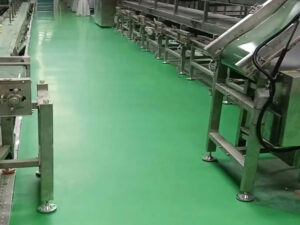
These facilities require flooring that withstands daily caustic washdowns and thermal shocks. Breathable systems are widely used in USDA-inspected facilities due to their low odor, low VOC, and ability to handle residual slab moisture from constant cleaning. Common applications include USDA epoxy flooring and food-grade epoxy coating environments where hygiene and chemical resistance are critical.
3.2 Pharmaceutical and Clean Rooms
In pharmaceutical manufacturing, moisture control is critical for contamination prevention. Vapor-permeable epoxy systems with GREENGUARD Gold certification and low TVOC emissions are specified to maintain strict indoor air quality standards, making them ideal for cleanroom and pharmaceutical flooring applications.
3.3 Warehouses and Distribution Centers
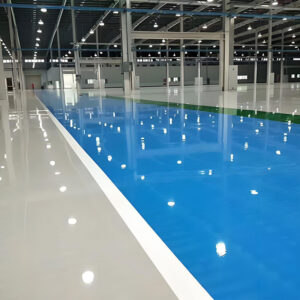
These large-scale facilities often have expansive slabs that may not have been properly vapor-proofed. Breathable systems prevent coating failures in storage areas where spills and washdowns occur, providing durable industrial epoxy flooring for warehouse environments.
3.4 Cold Storage and Refrigeration
Temperature cycling in cold storage creates condensation and frost risks. Vapor-permeable epoxy allows moisture to escape during thaw cycles, preventing delamination from freeze-thaw effects, making it a preferred choice for freezer room and cold storage flooring.
4. How to Install Breathable Epoxy on Moisture-Prone Concrete
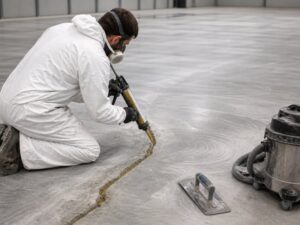
4.1 Surface Preparation: The Foundation for Success
Proper surface preparation is non-negotiable. The concrete substrate must be:
- Sound and structurally intact
- Clean of all contaminants (oil, grease, dust, silicones)
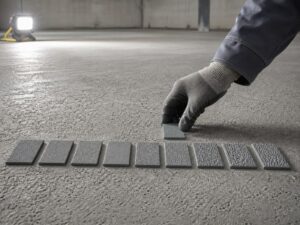
- Profiled to a Concrete Surface Profile (CSP) of 3 or greater—achieved through diamond grinding or shotblasting
Pro Tip: New concrete must cure for a minimum of 28 days before any coating application.
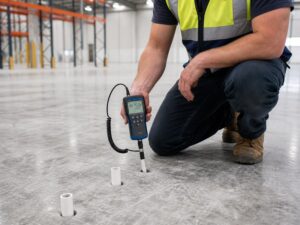
4.2 Moisture Testing Before Installation
Before selecting a coating, conduct proper moisture testing. This is the most critical step to ensure long-term performance.
- ASTM F1869: Calcium chloride test measuring MVT.
- ASTM F2170: In-situ relative humidity (RH) probe test, which measures moisture within the slab.
Warning: For slabs without an external moisture barrier, seasonal variations can cause MVT spikes regardless of initial test results. Products rated up to 25 lbs/1,000 sq ft/24 hrs or 95% RH provide greater safety margins.
4.3 Step-by-Step Application Process
The mixing and application sequence is critical for success:
- Pre-mix Component A (Base) at low speed for 1 minute.
- Add Component B (Activator) and mix for 3 minutes until uniform.
- Apply immediately—pot life is typically 25–40 minutes, varying with temperature.
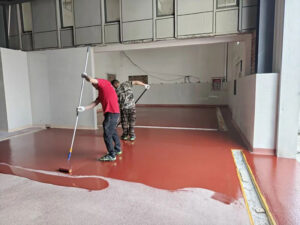
- Spread using a notched squeegee in a long bead 8–12 inches wide.
- Back-roll with a 3/8-inch non-shed roller to eliminate application lines.
Critical: Do not attempt to roll material from a bucket or roller pan—pour directly onto the floor.
4.4 Environmental Conditions and Cure Times
Application success depends heavily on environmental control:
| Parameter | Requirement |
|---|---|
| Air Temperature | 45°F – 95°F (7°C – 35°C) |
| Surface Temperature | At least 5°F above dew point |
| Relative Humidity | Below 85% during application and curing |
| Substrate Moisture | Below 4% moisture content |
Typical cure times (at 72°F/50% RH):
- Tack-free: 6 – 8 hours
- Light foot traffic: 24 hours
- Vehicle traffic: 48 hours
- Full cure: 5 – 7 days
5. Key Standards and Testing Methods for MVT
5.1 ASTM Standards Reference
Understanding these standards is crucial for specifying the correct system. This table ensures your project meets industry benchmarks.
| Standard | Test Method | Measures | Significance for MVT |
|---|---|---|---|
| ASTM F1869 | Calcium Chloride | MVT in lbs/24 hrs/1,000 sq ft | Determines if a moisture-tolerant system is needed. |
| ASTM F2170 | In-situ RH Probe | Relative humidity in slab | Assesses moisture condition at depth. |
| ASTM F3010 | Resin-based moisture mitigation systems | Moisture mitigation performance of resin systems | Evaluates if a system qualifies as an effective moisture barrier. |
| ASTM F710 | Standard Practice for Preparing Concrete Floors to Receive Resilient Flooring | Substrate preparation standards | Ensures proper surface profile for adhesion. |
5.2 Certifications to Look For
When selecting products, verify these certifications to ensure safety and compliance:
- UL GREENGUARD Gold: Low chemical emissions for indoor environments.
- LEED v4.1: Sustainability and environmental performance.
- USDA Acceptance: Suitable for food inspection facilities.
6. Limitations of Vapor-Permeable Epoxy Coatings
Transparency about limitations builds trust and prevents misapplication.
Not a waterproofing membrane: These systems manage vapor transmission—they do not prevent liquid water ingress. For areas with standing water or hydrostatic pressure, full waterproofing systems are required.
Limited UV resistance: Most vapor-permeable epoxies will yellow or discolor when exposed to regular UV light; they are designed for interior applications.
Traffic limitations: Water-based systems are typically rated for light-to-medium duty traffic only. Heavy forklift traffic requires more robust solutions like urethane cement.
Temperature sensitivity: Application outside the 45°F–95°F range can compromise curing and adhesion.
7. Case Study: Solving a 12 lbs MVT Challenge in a Food Plant
Project Background
A food processing facility in the southeastern U.S. had experienced repeated flooring failures over five years. The existing coating blistered and peeled within three months of each installation. Moisture testing revealed MVT levels averaging 12 lbs/1,000 sq ft/24 hrs.
Previous Problem
The standard solvent-based epoxy previously used trapped moisture, leading to aggressive blistering and creating a hygiene risk. The facility required a USDA-friendly, low-VOC solution capable of withstanding daily caustic washdowns.
Our Solution
KAIDA PAINT recommended a two-coat system: a 100% solids moisture mitigation primer followed by a vapor-permeable, water-based epoxy topcoat. The concrete was diamond-ground to a CSP 3 profile.
Project Results
| Before Installation | After Installation (24 Months) |
|---|---|
| Repeated blistering within 3 months | Zero blistering or delamination |
| 12 lbs MVT measured | Controlled moisture conditions |
| Frequent repairs and downtime | Significantly reduced maintenance |
| Production interruptions | Improved operational uptime |
| USDA compliance issues | Passed USDA inspection with zero violations |
This real-world example demonstrates that selecting the right system is the most cost-effective long-term strategy for high-MVT environments, with estimated savings of approximately $15,000 annually based on previous maintenance records.
8. Frequently Asked Questions (FAQ)
This FAQ section is expanded to target Featured Snippets and voice search for common queries.
Q: Can epoxy coating be applied over damp concrete?
Applying epoxy coating over damp concrete requires a moisture-rated system specifically designed for elevated RH and MVT conditions. Standard epoxies should never be applied to damp substrates, but specialized vapor-permeable systems can be used on concrete with up to 95% relative humidity, provided there is no standing water.
Q: What MVT level is too high for epoxy coating?
Any MVT level above 5 lbs/1,000 sq ft/24 hours is considered too high for standard, non-breathable coatings. Above 10 lbs, a specialized 100% solids vapor barrier is typically required to ensure long-term performance.
Q: Does epoxy flooring trap moisture?
Yes, standard non-breathable flooring traps moisture vapor beneath the film, which can lead to blistering and delamination. Vapor-permeable systems are specifically designed to allow this vapor to escape, preventing these issues.
Q: What causes epoxy flooring to peel?
Peeling is most commonly caused by moisture vapor pressure (high MVT), poor surface preparation, or contamination on the concrete substrate. Proper testing and preparation are essential to prevent this failure.
Q: How long does breathable epoxy flooring last?
With proper installation and regular maintenance, these systems can last 10+ years in high-MVT environments, significantly outlasting standard epoxies that may fail within months.
Q: What is the best flooring for high moisture concrete?
The best flooring depends on the MVT level. Moisture-tolerant epoxy works for moderate conditions (3–5 lbs), while 100% solids moisture vapor barriers are recommended for slabs exceeding 10 lbs MVT. A site evaluation by a professional is always recommended.
9. Key Takeaways
To summarize the critical points of this guide:
- High MVT is one of the leading causes of floor failure.
- Standard coatings should not be installed on concrete exceeding 3-5 lbs MVT.
- Vapor-permeable systems reduce pressure buildup and prevent blistering.
- Moisture testing (ASTM F1869/F2170) must be completed before installation.
- Severe conditions require dedicated vapor barriers or 100% solids systems.
- Proper surface preparation is as critical as product selection.
KAIDA PAINT: Your Partner in High-MVT Flooring Solutions
Need Help Selecting a High-MVT Flooring System?
Our technical team can help evaluate your specific project requirements and recommend the optimal solution:
✓ Concrete moisture test results – We help you interpret ASTM F1869 and F2170 data.
✓ MVT and RH conditions – Our systems are rated for MVT up to 25 lbs.
✓ Chemical exposure requirements – Food processing, pharmaceutical, and industrial environments.
✓ Traffic demands – From light foot traffic to heavy forklift operations.
✓ Recommended coating systems – Tailored recommendations based on your facility’s needs.
Request a technical consultation before your next flooring project. Let our experts help you build a floor that lasts.


 English
 Spanish
 Portuguese
 Arabic
 French
 Italian
 Russian
 Indonesian
 Swedish