There are more urethane cement manufacturers in a typical market than there are factories making it, and the gap between those two numbers is the reason a shortlist needs questions rather than brochures.
That gap is a supply chain rather than a scandal. A buyer who understands it can shortlist in a week instead of a quarter.
A manufacturer blends the powder, fills the resin and produces the test data. A repackager buys a finished product, puts it in a different pail and sells it as their own.
That is the practical difference a shortlist should test. A urethane cement manufacturer knows why a product behaves a certain way at eight degrees C; a distributor knows what the brochure says.
Both can supply a good floor, and only one of them can answer a technical question about the chemistry.
Every question below can be answered in a single email by a urethane cement manufacturer, and none of them can be answered convincingly by a brochure.
This article sets out eight questions that separate the two, and what a good answer looks like for each.
The short answer
Ask where the product is made, who signs the test reports, and what happens when a batch goes wrong.
Ask for a batch number on the delivery note, and check it against the label on the pail.
Ask what technical support exists after the order, and whether the person answering has seen a floor placed.
A third party audit is also worth asking about, because it covers the factory rather than the product, and a factory with a current audit is a factory that keeps records.
A supplier who answers all of that in one email is worth a site visit. One who answers with a brochure is not.
Question one: where is it made
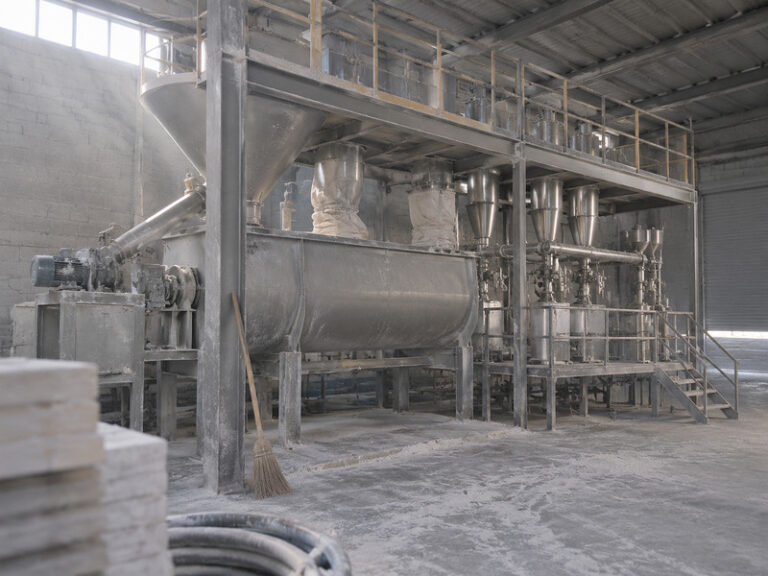
That definition has a physical form you can verify: an address, a blending line and a laboratory that signs its own data.
For a buyer, the practical test of urethane cement manufacturers is simpler than an audit: ask for the address and check it exists and matches the plant named on the test report and the certificate scope.
Ask which plant makes the product you are being quoted, rather than the one in the corporate video.
Where a supplier sources from a third party, that is not automatically a problem. What matters is whether they say so.
A supplier who is vague about the plant is usually vague because they do not control it.
Question two: batch traceability
Every kit should carry a batch number, and that number should link to a production date, a powder lot and a resin lot.
Ask how a batch is traced from the delivery note back to the production record, and how long those records are kept.
A manufacturer will answer in a sentence. A repackager will answer with a promise.
This matters when a floor fails: without traceability, the conversation becomes a negotiation rather than an investigation.
Traceability earns its place at that point. A number that leads to a production record turns an argument into a finding within a day.
Question three: who signs the test reports
Test data should come with a report that names the laboratory, the method and the date.
Ask for the report rather than the summary line, and check whether the laboratory is independent of the supplier.
Where a report is internal, that is acceptable for development data and weak for a specification claim. A summary line without a method describes what the product can do, not what was measured.
The signature matters more than the logo. A report signed by a named technician gives you someone to question; an unsigned table gives you no one.
Question four: third party audit and certification
Certification is a process claim, not a product claim, and the two are often confused in marketing.
An ISO 9001 certificate says the factory has a quality system. It says nothing about the chemical resistance of the product.
A third party audit of the factory and a certificate for the product are two different documents, and a supplier who uses one to imply the other is worth questioning.
Ask which certificate covers which site and which scope, and check the scope statement rather than the logo.
Where a supplier claims a product certification, ask for the certificate number and the standard it is issued against.
Question five: technical support that exists after the order
The test of support is a question the supplier has not heard before, asked on a Friday afternoon.
Ask who answers technical queries, whether that person has visited a site, and what the response time is.
Technical support is also the item that decides whether a specification survives contact with a site. A desk that answers within a day keeps a pour on schedule.
A manufacturer with a technical desk can talk about pot life at 8 degrees C and what to do about it.
A repackager will forward the question to the plant and come back in a week, which is a week after the pour.
Question six: specification support
A useful supplier will read a specification and tell you where it is wrong, including where it is wrong in their own favor.
Ask them to review a draft clause and to mark what they would change. The response shows whether they understand the building or only the drum.
A clause review that comes back marked up is worth more than a folder of literature.
The best urethane cement manufacturers send a marked-up clause before they send a price, and that order of events tells you what they think the job is about.
Ask also for a sample specification and a method statement, and see whether the two agree.
Specification support of that kind is the cheapest insurance a client can buy, and it usually costs nothing beyond the relationship.
Where a supplier will not engage with a specification, the relationship will be transactional.
Question seven: is the applicator approval real
Many suppliers claim an approved applicator network, and the claim means different things.
Applicator approval is the item most often overstated. Ask how many crews are approved in your region, when they were last assessed, and what that assessment covered.
Ask whether the approval is withdrawn if a job fails, and whether you can speak to two of the approved crews.
Applicator approval is only meaningful if it is current. A list that includes crews who have not placed material in two years is a list rather than a network.
A network of three crews that are actively audited is worth more than a list of thirty.
Question eight: delivery and lead time
A urethane cement kit is heavy, has a shelf life and may need temperature control in storage.
Delivery lead time is also the question that separates the two models, because a manufacturer with regional stock can commit to a date and a repackager usually cannot. A lead time quoted in weeks rather than days tells you the product is shipped rather than stocked, which changes what happens when a kit arrives short.
A delivery lead time that assumes a full pallet is different from one that assumes a part kit, and a repair often needs the second.
Ask the delivery lead time for a full kit, the shelf life from production, and how the product is stored in transit.
Ask what happens if a delivery is short on the morning of a pour, because that has happened on every large project we have seen.
That is also why delivery lead time belongs in the technical conversation rather than only in the commercial one. A floor schedule that assumes stock is a schedule that fails on the first shortage.
A manufacturer with stock in the region can answer that question. One shipping from another continent cannot.
Commercial terms worth checking
Ask for the minimum order, the price validity period and whether the powder and resin are priced together.
Ask whether a partial kit is available, because a small repair needs a small quantity.
Ask what the warranty route is, and who pays for a failure investigation.
Those four items decide whether the relationship survives a problem, and they cost nothing to ask.
Red flags worth taking seriously
A data sheet with no revision date. A test report with no laboratory name. A batch number that appears nowhere on the pail.
A technical contact who cannot answer a question about application temperature without checking.
A price that is 40 percent below the market with no explanation of the volume difference.
A warranty that excludes everything except the one thing that never fails.
Each of those is common, and each one is cheap to check before the order rather than after.
How to run a shortlist in a week
Table 1: The eight questions and a good answer.
| Question | Good answer |
|---|---|
| Production site | A named plant and address |
| Batch traceability | Number links to lot records |
| Test reports | Named lab, method, date, signatory |
| Certification | Scope statement and number |
| Technical support | Named desk, stated response time |
| Specification support | Marks up a draft clause |
| Applicator approval | Number of crews, last audit date |
| Delivery | Regional stock, stated lead time |
Send four documents to five suppliers: the room description, the chemical list, the area and the schedule.
Ask for a quotation, a data sheet with a revision date, a test report and two reference sites. Send the documents on a Monday and set a deadline for Friday, because a supplier who needs three weeks to answer a document request will need three weeks to answer a technical query.
Score the replies on completeness rather than on price, and shortlist the three that answered everything.
Then ask the three the eight questions above, and visit the one that answered best.
Most urethane cement manufacturers will engage with a process that asks for documents, because the documents already exist and the process rewards the ones who keep them.
That process takes a week and it replaces a month of reading brochures.
Table 2: Red flags and what they suggest.
| Signal | Suggests |
|---|---|
| No revision date | Document copied, not controlled |
| No lab name | Data not independently produced |
| Vague production site | Repackaged product |
| No partial kits | Product bought in bulk and split |
| Price far below market | Different build or different chemistry |
What a good supplier will ask you
A manufacturer who knows the product will ask about the substrate, the washdown regime, the chemical list and the schedule before quoting.
They will ask what the floor has to survive rather than what color it should be.
They will say when the product is the wrong choice, and they will say it early.
It is also the behavior that distinguishes urethane cement manufacturers from repackagers, because a factory can absorb the loss of one job and a repackager cannot. The test is to ask which recent job they turned down, and why.
Table 3: Documents to request from each supplier.
| Document | What it proves |
|---|---|
| Data sheet with revision date | Product is controlled |
| Test report with signatory | Claims are measured |
| Certificate with scope | System covers the site |
| Method statement | Application is understood |
| Two references | Floors exist in service |
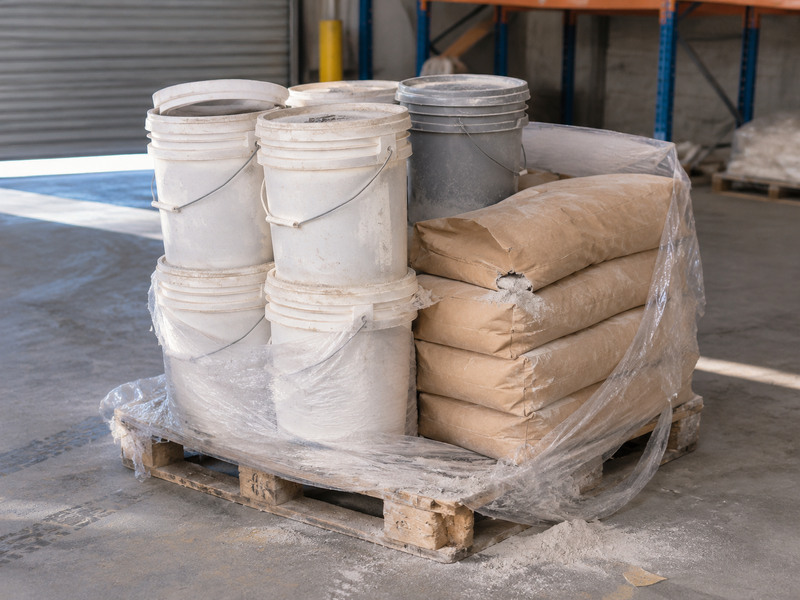
Figure 1: sealed pails and bags stacked on a pallet in a warehouse.
What to do with the answers
Score the answers rather than the brochures, and score completeness rather than price.
A supplier who answers seven of eight and explains the eighth is a better bet than one who answers all eight in marketing language.
Then do the two things that cannot be faked: visit the plant or the reference site, and ask a technical question that is not in the brochure.
The question we suggest is about application temperature, because it forces the supplier to talk about the slab rather than the product.
A manufacturer will answer it in two sentences, with a number and a consequence.
A repackager will promise to come back to you, and the answer will arrive after the pour.
A note on price and specification
The cheapest urethane cement manufacturers are usually cheap for one of three reasons: a thinner recommended build, a lower resin content, or a product bought in bulk and repacked.
None of those is visible in a price per kilogram, and all three are visible in a data sheet with a build range and a resin content figure.
Ask for both, and compare the price per square meter at the same thickness rather than the price per kit.
That comparison takes ten minutes and it usually reorganizes the shortlist. Do it before the site visit, because the visit will confirm what the numbers already suggest. It is also the answer you will need when a cheaper offer arrives after the shortlist is closed.
Frequently asked questions
How many urethane cement manufacturers are there?
Far fewer than the number of brands. Many suppliers are repackagers or distributors, which is not a problem if they say so.
Does ISO 9001 mean the product is good?
No. It means the factory has a quality management system. Product performance is shown by test data, not by a certificate.
What is batch traceability?
The ability to link a delivered kit back to a production date and raw material lots, so a failure can be investigated rather than negotiated.
Why does the production site matter?
Because a manufacturer can change a formulation, answer a technical question and control a batch. A repackager can only pass the question on.
Should I ask for test reports?
Yes, and read the laboratory name, the method and the date. An unsigned summary table is not a report.
What lead time is normal?
Two to four weeks for a full kit from regional stock, and longer where the product is imported.
What is a red flag in a quotation?
A price far below the market with no explanation, and a data sheet with no revision date.
Kaida Paint manufactures urethane cement at a stated production site and issues a batch number, a data sheet with a revision date and signed test reports with every order. Send the room description and the chemical list, and we will send the documents before the price.








 English
 Spanish
 Portuguese
 Arabic
 French
 Italian
 Russian
 Indonesian
 Swedish