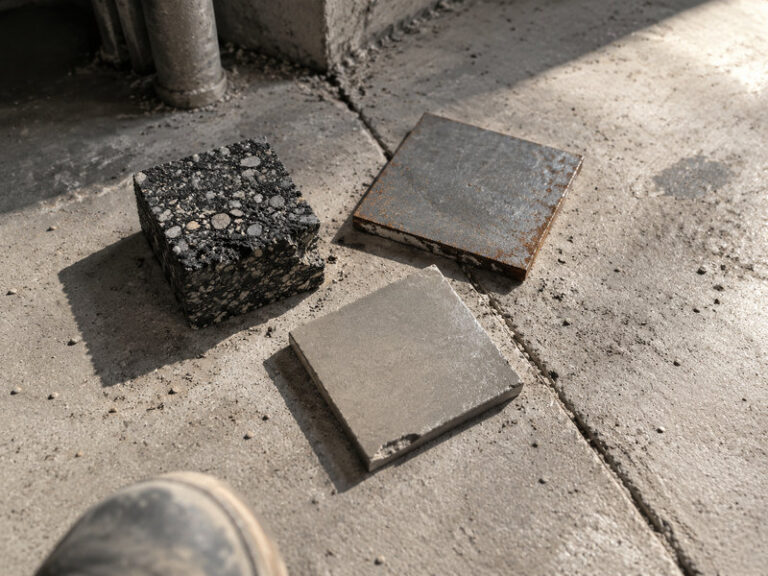
Urethane cement bonds well to concrete and poorly to most other things, and the three substrates that cause the most trouble are asphalt, steel and an old epoxy floor.
Each has a different reason for failing, and each needs a different answer: sometimes preparation, sometimes a primer, and sometimes a polite refusal.
This article sets out where the material stops, what it takes to make each substrate work, and the three tests that answer the question before money is committed.
The short answer
Asphalt is almost always a no. It moves too much, it softens with heat, and it contains oils that migrate into anything placed on top.
Steel is possible with the right primer, and it is rarely worth it except as a detail rather than a floor.
An existing epoxy floor is usually a yes, provided the film is sound, abraded and free of contamination.
Everything else in this article is the reasoning behind those three sentences, and the exceptions that make them worth reading.
Why asphalt usually stops the job
Asphalt movement is the first objection and often the only one that matters. A yard that deflects under a truck deflects far more than a slab, and a bonded floor has no way to follow it.
Asphalt is a flexible pavement, and a floor at 6 mm is rigid by comparison. When the asphalt deflects, the floor above it cracks.
Asphalt also softens at temperatures a floor has to survive. A sunlit yard can reach 60 C at the surface, and the material under the floor becomes plastic.
That migration is why a patch test on asphalt can look perfect for a month and fail in a year. The oils arrive slowly, and the debond follows them.
The bitumen contains oils that migrate upward over time, and those oils are a release agent at the interface.
Asphalt movement also increases with temperature, so a yard that behaves in winter can be unworkable in summer on the same material.
For those three reasons, we treat an asphalt substrate as a bond breaker rather than a base.
The narrow case where asphalt works
There is a version that works: a heavily compacted, aged asphalt in a covered area with no vehicle load and no thermal gain.
Even then, the build is a floating slab rather than a bonded floor, with a separation layer and joints that follow the pavement.
That is a different design, not a coating specification, and it belongs to a structural engineer rather than to a flooring supplier.
A urethane cement floor over asphalt in a covered, unloaded area is sometimes proposed by a contractor who has not walked the yard in summer. Ask them to do so before the order.
Where a client has an asphalt yard and wants a hard floor, the honest answer is a concrete overlay or a different site.
Steel, and why it is a detail rather than a floor
The material will bond to steel with a suitable primer, and the bond can be strong. The problem is what steel does under a rigid floor.
Steel expands more than concrete under the same temperature change, so a floor bonded to a steel plate moves further and faster than the same floor on concrete.
For a plate, a gully surround or a threshold, that is manageable with a small isolated detail and a flexible edge.
A urethane cement floor on steel deck is occasionally specified for mezzanines and platforms. It works only with a floating build and joints that follow the ribs, which is a structural design rather than a coating.
For a whole floor on steel deck, it is not. The differential movement between deck and floor is too large for a cementitious material, and the floor will crack along the deck ribs.
Table 1: Three substrates and the verdict.
| Substrate | Verdict | Motivering |
|---|---|---|
| Betong | Suitable | Similar movement, bondable |
| Asphalt | Almost never | Movement, heat softening, oils |
| Steel plate | Detail only | Thermal expansion mismatch |
| Steel deck | Nej | Rib movement, cracking |
| Sound epoxy | Usually yes | If abraded and clean |
| Failing epoxy | Nej | Inherits the failure |
Preparing steel if you must
Steel preparation is the part that clients underestimate. A plate that looks clean usually carries mill scale and an oil film, and both are bond breakers.
The usual standard is a mechanical or abrasive clean with rust removal to bare metal and no visible staining, agreed against a photograph before the pour.
A steel preparation standard that stops at a stained surface is a standard that produces a floor which lifts at the edges within a season.
Rust removal needs to reach bare metal, not a rust-stained surface. A wire brush on a drill does not do it; blasting or a grinder with a flap disc does.
Where steel preparation is done properly, the bond is usually excellent. The failures we see are almost always preparation, not product.
The primer is specific to steel, and it is not the same primer used on concrete. Using a concrete primer on steel is a common and expensive mistake.
Fasteners and anchors need their own treatment, and the floor has to accommodate the fixing without trapping water around it.
Where a steel plate is embedded in a concrete floor at a drain, the detail is a rebate with a flexible seal, not a butt joint.
Existing epoxy: usually a yes
An epoxy floor is a good substrate for a urethane cement overlay, because epoxy is rigid, chemically resistant to most aqueous industrial chemicals once cured and mechanically strong.
The conditions are the same ones that apply to any recoating: the film must be sound, abraded and free of contamination.
A sound film is one that does not lift under a knife, does not sound hollow under a tap, and has no blistering or crazing across the area.
Where 90 percent of the floor is sound and 10 percent is failing, the failing areas are cut out and repaired, and the rest is overcoated.
That is normal and it is not a reason to abandon the approach.
Epoxy residue and what removal means
Epoxy residue of any kind has to go before a urethane cement overlay is placed, and the water droplet test is the fastest check available on site.
Amine blush is the classic residue on a cured epoxy, and it is a release agent rather than a contaminant.
It forms when amine hardeners react with moisture in the air, and it shows as a waxy film that water beads on.
Removal is a warm detergent wash followed by clean water, and the test is a water droplet that wets out rather than beading.
A stubborn epoxy residue usually sits in the surface profile rather than on top of it, which is why washing alone rarely solves it.
Curing compounds, release agents and silicone contamination are harder, and each needs mechanical removal rather than a wash.
Rust removal and epoxy residue removal are different jobs with different tools, and a crew that treats them as one will leave one of them incomplete.
Where an epoxy has been polished with a silicone-based product, the residue can be in the surface rather than on it, and only grinding will remove it.
Bond breakers and the debond that follows
A bond breaker is anything that stops two materials touching, and on a renovation the common ones are dust, oil, blush and old release agents.
The failure looks the same every time: the new floor lifts in sheets and the underside is clean and glossy.
Where the underside is dusty, the cause is preparation. Where it is wet, the cause is moisture. Where it is glossy and clean, the cause is a bond breaker.
A bond breaker of any kind produces that glossy underside, and the only reliable response is to remove it rather than to prime over it.
Reading the underside is the cheapest diagnosis available, and it tells you which of the three you are dealing with.
Differential movement and thermal expansion
Differential movement between an old floor and a new one is normal and manageable. Differential movement between two materials with very different expansion is not.
Two materials bonded together move together or they separate. The difference between their movement under heat is the stress at the interface.
Concrete and urethane cement are close enough in thermal expansion for a bonded floor to work at normal industrial temperatures.
Steel and urethane cement are not, which is why a steel plate detail needs a flexible edge rather than a bonded one.
Asphalt is not. Neither is a timber deck, or a metal deck whose ribs flex under load.
Framing compatibility as a movement question is useful on site, because movement can be measured and adhesion can only be tested. A client who understands the movement argument usually accepts the verdict.
Substrate compatibility is therefore mostly a question about movement rather than about adhesion.
Substrate compatibility, stated plainly
Compatible: sound concrete, sound screed and cured epoxy, with the preparation for damp concrete, old tile and epoxy with blush set out in Table 2.
Incompatible: asphalt, bitumen, flexible membranes, timber, steel deck and any coating that is failing.
Incompatible without a barrier: slabs where the measured moisture exceeds the figure on the product data sheet for the primer in use.
Substrate compatibility is the first question in every quotation we write, and it is the one that changes the price most.
That list is not exhaustive, but it covers most of the enquiries we receive, and it is the one we check first.
Table 2: Preparation by substrate.
| Substrate | Preparation | Primer |
|---|---|---|
| Betong | Blast or grind, concrete surface profile (CSP) 3-5 | Standard |
| Epoxy, sound | Abrade to matte, wash | Standard |
| Epoxy with blush | Wash, rinse, abrade | Standard |
| Kakel | Key, fill joints | Standard |
| Steel plate | Blast to bright, degrease | Steel-specific |
| Asphalt | Rekommenderas ej | None suitable |
Three tests that settle it
A tap survey tells you whether the existing floor is bonded, and it takes ten minutes on a hundred square meters.
A moisture reading tells you whether the base is dry enough for the primer you intend to use.
A pull-off test on a prepared patch tells you whether the system holds on this particular substrate.
None requires a laboratory, and together they cost less than a square meter of remedial work.
Where a client cannot authorise the tests, the honest answer is a caveat in the quotation rather than a promise.
Where asphalt rules out a bonded floor, the options are a concrete overlay, a different area for the hard floor, or a flexible surfacing designed for pavement.
Where steel deck rules out a bonded floor, the options are a floating screed with movement joints or a different finish.
Where a failing epoxy rules out an overlay, the option is removal, and the cost is demolition rather than coating.
Saying no early is cheaper for everyone, and it is the reason we ask for photographs before we quote. That conversation is worth having before a site visit, and it usually saves one. A short reply with three photographs is often enough to settle it, and it costs nothing to send. Send them before the visit rather than after it, and the visit usually becomes unnecessary.
Table 3: The three tests and what each decides.
| Test | Decides |
|---|---|
| Tap survey | Whether the existing floor is bonded |
| Moisture reading | Whether a barrier is needed |
| Pull-off on a patch | Whether the system holds |
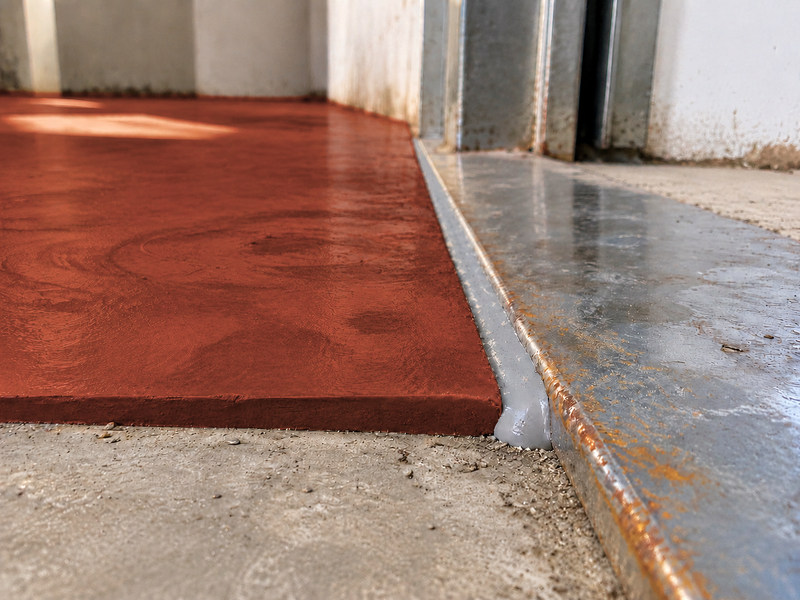
Figure 1: a resin floor meeting a steel plate at a threshold, with a flexible seal along the joint.
When the substrate is mixed
Most real buildings are not one substrate. A production hall might have a concrete floor, a steel plate at a drain, an epoxy patch from a previous repair and an asphalt apron outside the door.
Each of those needs its own preparation and, in two of the four cases, its own verdict.
The sequence is therefore to survey the floor in zones and mark the verdict on a drawing before any material is ordered.
Four zones, four decisions, and one quotation that states which areas are excluded rather than burying them in a note.
That drawing is also what protects the contractor. A client who has signed a plan showing two excluded areas cannot later claim the floor was specified across the whole building.
Asphalt movement, steel preparation and epoxy residue each appear in a different zone, and each has a different cost in labor.
A quotation that averages them into one rate per square meter is a quotation that will be renegotiated.
The same logic applies to a phased renovation. Where a hall is done in three sections, the excluded zones stay excluded in each phase, and the drawing carries forward.
We have seen a client accept a mixed-substrate quotation and then ask for the excluded area to be included at the same rate. The drawing is the answer to that question, and it costs nothing to produce at the start.
Vanliga frågor
Can urethane cement go over asphalt?
Almost never as a bonded floor. Asphalt moves, softens with heat and contains oils that migrate into the interface.
Can it go over steel?
On a plate or a detail, with a steel-specific primer. On a steel deck, no, because the ribs move and the floor cracks along them.
Can it go over an existing epoxy floor?
Usually yes, if the epoxy is sound, abraded to a matte finish and free of amine blush or other contamination.
What if part of the epoxy is failing?
Cut out the failing areas, repair them to the same level and overcoat the rest. A floor that is 10 percent failing is a repair, not a rebuild.
How do I test an epoxy floor before overcoating?
A knife test for bond, a tap survey for hollow areas, and a water droplet test for amine blush.
What is amine blush?
A waxy film that forms on epoxy when amine hardeners meet moisture in the air. It must be washed off before overcoating.
What happens if I overcoat a failing floor?
The new floor inherits the failure and lifts in the same places, usually within the first year.
Kaida Paint supplies urethane cement for concrete and sound epoxy substrates and will say plainly when a floor should not be coated. Send photographs, the substrate history and a moisture reading, and we will tell you which of the three verdicts applies before you order.


 English
 Spanish
 Portuguese
 Arabic
 French
 Italian
 Russian
 Indonesian
 Swedish