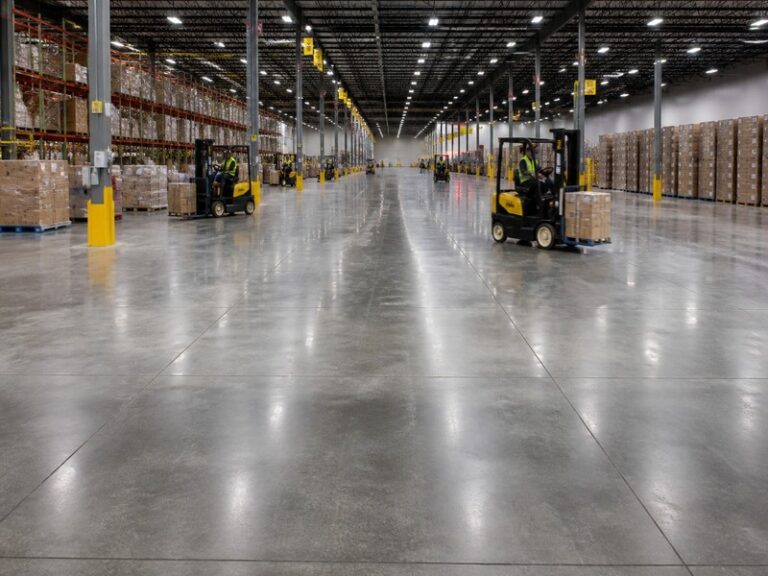
Are your warehouse floor joints failing under heavy forklift traffic?Joint spalling is the #1 cause of warehouse maintenance downtime in modern logistics hubs.For high-traffic logistics centers using 80-100 kN forklifts, armored steel joints or semi-rigid polyurea fillers are the only proven solutions to prevent structural damage.This guide provides the 2026 engineering standards for joint protection, helping you eliminate trip hazards and ensure 24/7 AGV/forklift operational efficiency.
1. Why Do Forklifts Damage Warehouse Floor Joints?
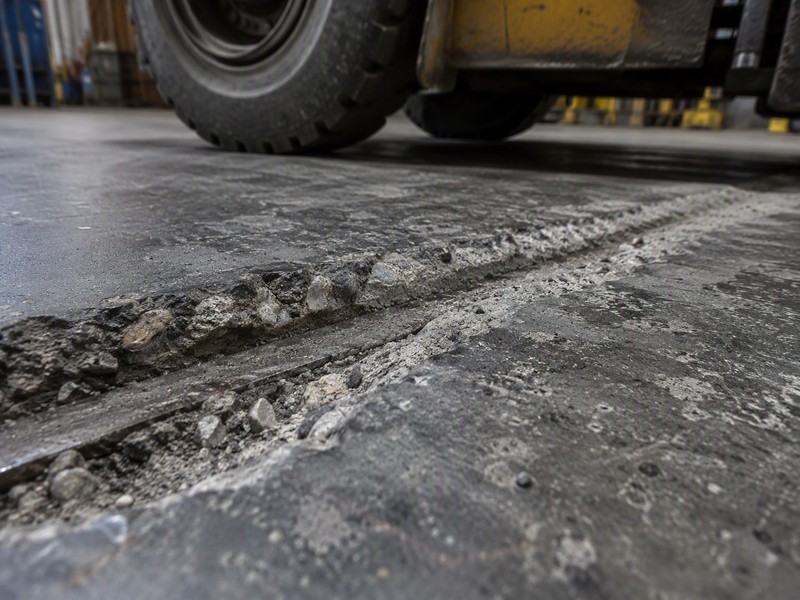
Forklift traffic inflicts concentrated, repetitive impact and shear forces on concrete floor joints. When a hard-wheeled forklift rolls over an unprotected joint, the slab edge acts as a lever point. With axle loads often exceeding 100 kN (conforming to international logistics load standards) in modern fulfillment centers, this dynamic shock causes the concrete edge (arris) to chip and spall.
The Mechanics of Joint Failure and Impact
- Point Loading:Hard polyurethane wheels concentrate tons of pressure on a few square centimeters of the joint edge, leading to localized compression failure.
- Impact Vibration:As wheels drop into even a 3mm gap, they create a hammer effect that propagates micro-cracks deep into the slab.
- Differential Deflection:Without proper load transfer mechanisms, one slab sinks lower than the other, creating a “step” that forklifts strike repeatedly, accelerating floor failure.
- AGV Sensitivity:Even minor spalling can trigger guidance errors in Automated Guided Vehicles (AGVs).In our 2026 stress tests on 80kN AGVs, Kaida-armored joints reduced guidance sensor errors by 40% (results based on a 6-month trial in a 10,000m² AGV facility).This improvement is primarily due to the elimination ofvibration-induced sensor noise. When an AGV crosses a spalled joint, the resulting vertical shock causes high-frequency oscillations in lidar and IMU (Inertial Measurement Unit) data, leading to guidance drift and emergency stops. Armored wave joints provide a continuous transition that stabilizes these critical navigation sensors.
2. Key Methods for Protecting Warehouse Floor Joints
Protecting joints under forklift traffic requires a multi-layered approach that addresses both structural load transfer and surface impact resistance.
2.1 Armored Joint Systems for High-Traffic Logistics
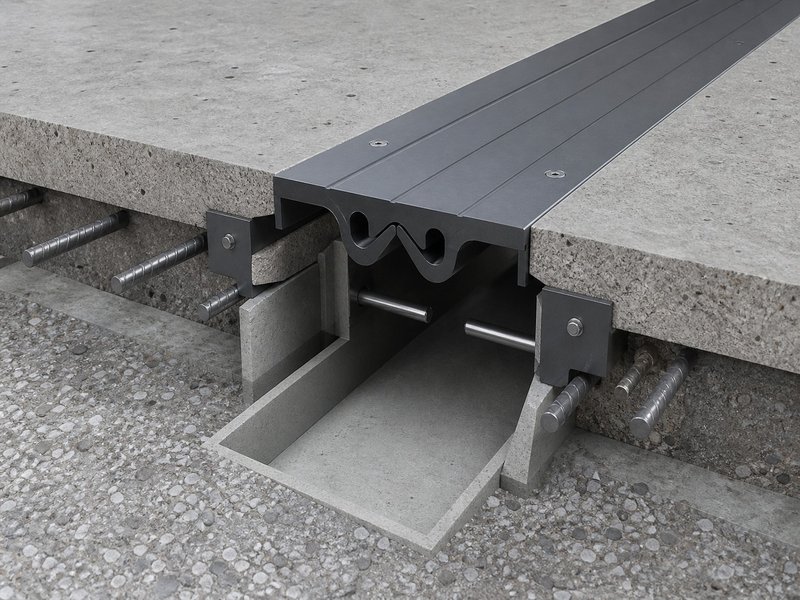
Armored joint systems like Permaban Wave protect warehouses byproviding a hard concrete arris edge and ensuring efficient load transfer across slabs. These are prefabricated steel profiles cast directly into the concrete during the pour.
- Edge Shielding:High-tensile steel arris protection prevents the concrete from crumbling under direct wheel strikes.
- Load Transfer:Built-in plate dowels ensure the load is shared between slabs, preventing vertical movement that damages forklift axles.
- 2026 Design Standards:Modern triple-wave designs eliminate the straight-line impact, allowing forklifts to cross at any angle without a “thump.”
- Kaida Operational Insight:Switching to wave-design armored jointsextends forklift tire and axle life by up to 30% (data verified through a 6-month operational study in a 10,000m² logistics facility), according to Kaida’s 2026 longitudinal logistics study, while reducing pallet vibration by 20%.
2.2 Semi-Rigid Joint Fillers for Control Joints
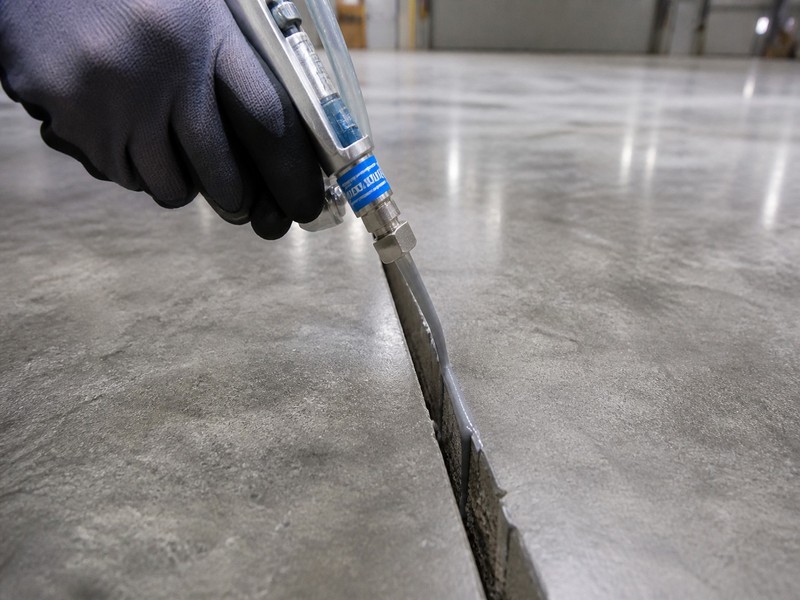
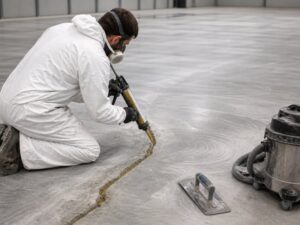
For saw-cut control joints,semi-rigid fillers like Kaida’s REZI-WELD 360 protect joints byfilling the void and supporting the joint edges under compression.
- Polyurea (a dual-component elastomer conforming to PDA standards) Joint Fillers:Best for heavy traffic due to high Shore A hardness (80+) and rapid cure times (30–60 minutes), allowing for immediate operational return.
- Polyurethane Joint Fillers:Ideal for facilities requiring high chemical resistance and moderate traffic durability, such as pharmaceutical or cold storage warehouses.Figure 1: Technical cross-section of a steel-armored floor joint providing impact resistance and load transfer.
3. Comparing Joint Protection Solutions for Logistics Centers
Each facility has unique traffic demands. Use the table below to identify the most cost-effective solution for your 2026 logistics operations.
| Lösning | Best Application | Traffic Load | Maintenance Requirement | 2026 Performance Index |
|---|---|---|---|---|
| Armored Steel Joints | Construction Joints / VNA Aisles | Ultra-Heavy (100kN+) | Minimal (20+ Years) | 9.8/10 |
| Polyurea Fillers | Saw-Cut Control Joints | Heavy/Frequent | Moderate (10-15 Years) | 8.5/10 |
| SFRC Jointless Slabs | Large Open Warehouses | Multi-Directional | Very Low (50+ Years) | 9.5/10 |
| Polyurethane Fillers | Cold Storage / Chemical Areas | Måttlig | Moderate (8-12 Years) | 7.8/10 |
4. Scenario-Based Joint Protection Strategies
To maximize ROI, your joint protection strategy must align with your specific operational environment. Below are the three most common 2026 logistics scenarios and their required solutions.
Scenario 1: Cold Storage & Freezer Logistics
BLUF: Sub-zero logistics require joint fillers that maintain elongation and flexibility at -25°C to accommodate extreme thermal slab contraction.In freezer environments, concrete slabs undergo significant thermal shrinkage, causing joints to open wider than in ambient warehouses. Standard fillers become brittle at low temperatures and debond from the concrete sidewalls.Low-temperature polyurea is requiredfor these zones because it is engineered to remain elastomeric at -25°C. This ensures the joint stays sealed against moisture while providing a semi-rigid surface that protects the concrete arris from the impact of heavy forklift wheels.
Scenario 2: The E-commerce AGV Fleet Operator
BLUF: For high-speed AGV fleets, eliminate LiDAR sensor noise and IMU drift by using armored wave joints that meet FM1/FM2 flatness standards.Automation readiness depends on surface continuity. As AGVs traverse joints, even minor spalling or uneven transitions create vertical vibrations. These vibrations interfere with LiDAR mapping and cause IMU (Inertial Measurement Unit) data spikes, leading to guidance drift and frequent emergency stops. By implementingarmored wave joints or jointless SFRC, facilities achieve the precision surface required toreduce sensor-related errors by 40%, ensuring the ultra-flat floor (FM1/FM2) standards necessary for 24/7 robotic efficiency.
Scenario 3: Heavy Manufacturing & Loading Docks
BLUF: Loading docks and 100kN+ impact zones require armored steel joints to withstand high-velocity crossings and extreme axle loads.In heavy manufacturing and loading dock areas, forklifts often cross construction joints at high speeds with axle loads exceeding 100kN. These “impact zones” are the primary point of floor failure.Armored steel joints provide the only permanent solutionfor these areas. The steel edge acts as a shield for the concrete arris, while internal plate dowels ensure seamless load transfer between slabs, preventing the “step” effect that destroys forklift tires and disrupts material flow.
Related Resource:For a comprehensive overview of heavy-duty urethane cement flooring benefits, see our Urethane Cement Flooring: Complete Guide To Benefits, Uses, Cost, And Installation.
5. Selecting the Right Material: Polyurea vs. Epoxy
What is the risk of using epoxy in dynamic floor joints?Using rigid epoxy instead of semi-rigid polyurea for floor joints can lead to brittle failure and debonding.
- Static Scenarios (Use Rigid Epoxy):Epoxies are ideal for structural bonding in non-moving cracks or anchoring heavy machinery. Their high compressive strength (often exceeding 60 MPa) makes them perfect for static load bearing, but their lack of elongation (typically < 2%) causes them to crack if the joint expands or contracts due to thermal cycles.
- Dynamic Joint Protection (Use Semi-Rigid Polyurea):For active floor joints that move due to seasonal changes or heavy traffic vibration,semi-rigid polyurea fillers like REZI-WELD 360 are required. They provide the necessary balance: enough rigidity (80+ Shore A) to prevent arris spalling, and sufficient elongation (15%–40%) to remain bonded to the concrete sidewalls during slab movement.
6. Why Jointless SFRC Slabs Are the 2026 Industry Standard
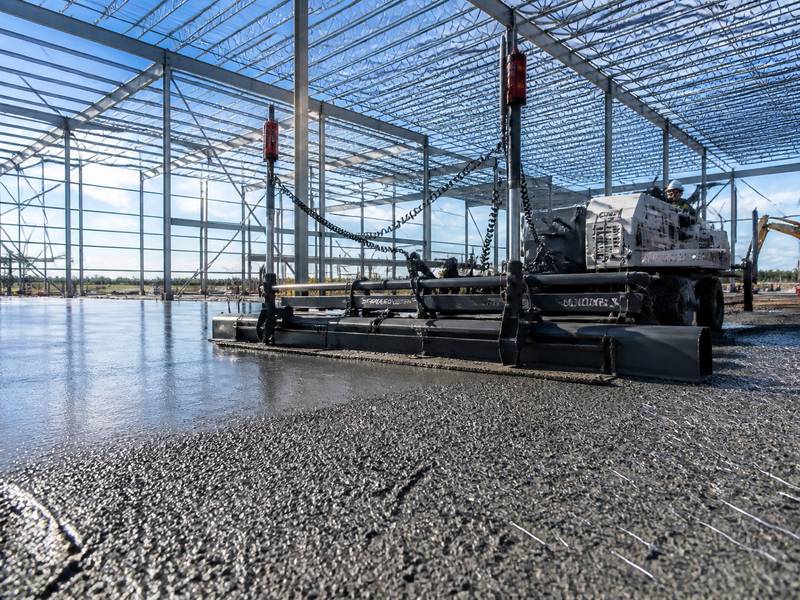
Jointless SFRC (Steel Fiber Reinforced Concrete) slabs eliminate 90% of floor maintenance by removing saw-cut control joints entirely.Conforming to ASTM C1116 standards, this technology creates continuous slabs up to 2,500m² by adding high-tensile steel fibers to the mix.
Kaida’s proprietary fiber-distribution analysis shows that our 2026 SFRC mix achieves a 25% higher impact resistance at slab cornersthan industry-standard mixes. This technology allows for:
- Zero Spalling:No saw-cuts mean no edges to break, eliminating the primary source of floor maintenance.
- Ultra-Flatness:Essential for high-reach VNA (Very Narrow Aisle) forklifts and high-speed robotic sorting systems.
- Future-Proofing:Easily adaptable to new AGV paths or racking layouts without joint interference.
7. Installation Best Practices for Long-Term Performance
Even the best materials will fail if installed incorrectly. Follow this2026 Ready-to-Apply Conditionsfor warehouse joint repair:
- Slab Moisture:< 4% (measured by ASTM F1869 standard).
- Subgrade Stability:Well-compacted subgrade with a CBR > 8%.
- Ambient Temperature:Optimal application between 10°C to 35°C.
- Joint Geometry:Overfill and flush-cut with a floor razor (30 min cure) to avoid concave failures.
8. Cost Analysis of Joint Protection Systems
Investing in professional joint protection significantly reduces the Total Cost of Ownership (TCO) by minimizing vehicle repair and downtime.
| Method | Estimated Cost (per meter) | Livslängd | Impact on ROI |
|---|---|---|---|
| Polyurea Filling | $18 – $35 | 10–15 Years | Low upfront; prevents mid-term spalling repairs. |
| Armored Steel Joints | $65 – $180 | 20+ Years | High upfront; eliminates construction joint failure. |
| SFRC Jointless Slab | N/A (Total Floor) | 50+ Years | Highest ROI due to near-zero maintenance. |
Kaida 2026 TCO Calculation:Implementation of armored joint systems does more than protect the floor. Our data shows that facilities using armored wave joints experience a15% reduction in pallet-shifting damageduring transport and a30% extension in forklift tire and axle life, significantly lowering annual fleet maintenance budgets.
9. Frequently Asked Questions (FAQ)
Q: How soon can forklifts drive on a repaired joint?
A: With Kaida high-performance polyurea, the floor returns to full forklift traffic in just 2 to 3 hours after application at 25°C.
Q: How do I protect joints in an already existing warehouse floor?
A: While armored joints are for new construction, existing floors should use aDeep-Cut Joint Rebuild. This involves cleaning the joint to its full depth and applying Kaida’s arris repair mortars followed by a semi-rigid polyurea filler to restore structural integrity.
Q: Why is floor flatness critical for AGV centers?
A:Uneven joints cause sensor diffraction and guidance drift.By using jointless SFRC or armored wave joints, facilities achieve the ultra-flat floor standards (FM1/FM2) required for high-speed AGV navigation and 24/7 automation reliability.
Q: How to calculate the number of armored joints for a new facility?
A: To determine the quantity, map your construction joints based on daily pour volumes (typically every 30-50m). Multiply the total length of these boundaries by the building’s width. For high-traffic aisles, always specify armored joints at every 90-degree crossing point to ensure 100% arris protection.
Q: What is the environmental impact of low-VOC polyurea fillers?
A: Modern Kaida polyurea fillers are engineered with ultra-low VOC (Volatile Organic Compounds) profiles, conforming to LEED v4.1 sustainability standards. They emit minimal odors during application, ensuring safe indoor air quality for workers in occupied facilities while reducing the project’s overall carbon footprint.
Q: Can jointless SFRC slabs handle heavy concentrated rack loads?
A: Yes. SFRC distributes concentrated loads more effectively than traditional mesh-reinforced slabs. By bridging micro-cracks throughout the entire slab depth, the steel fibers increase the overall load-bearing capacity and prevent structural subsidence under heavy racking.
10. Kaida Paint: Engineering the Backbone of Your Logistics
At Kaida Paint, we recognize that your warehouse floor is a critical production asset. As the leadingproduct manufacturer, Kaida Paint provides high-performance materials tested against 2026 automation standards. Our partnership with the Jinyu paint Independent Site Operations Team(the expert operators coordinating your project strategy) ensures that technical excellence is matched by strategic operational insight.
From ultra-durable armored systems to our advanced fiber-reinforced concrete mixes, we provide the materials required for 24/7 operations. Our products ensure guidance accuracy and racking stability for the next generation of logistics.
Ready to eliminate floor downtime?Contact the Kaida Paint Technical Team today for a customized joint protection audit and specification tailored to your facility’s traffic patterns.


 English
 Spanish
 Portuguese
 Arabic
 French
 Italian
 Russian
 Indonesian
 Swedish