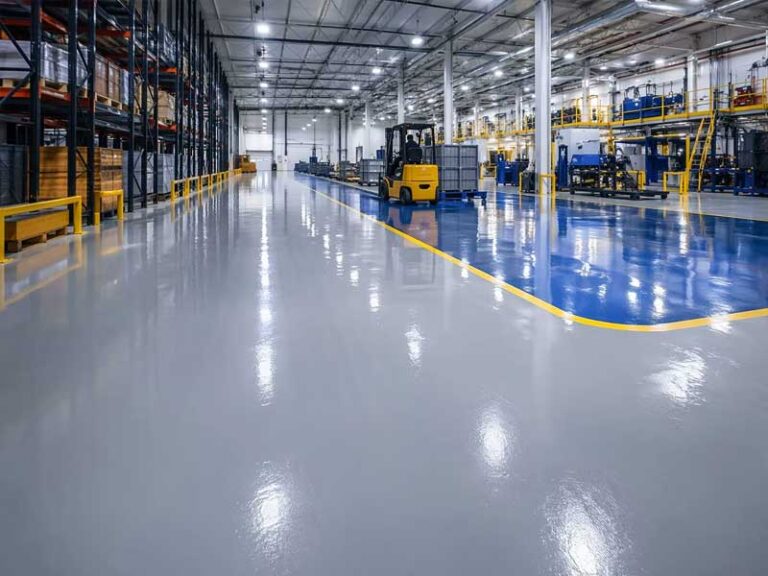
Quick Comparison: 100% Solids Epoxy vs Water-Based Epoxy
| Funktion | 100% Solids Epoxy | Water-Based Epoxy |
|---|---|---|
| Water/Solvent Content | 0% | Contains water carrier |
| Dry Film Thickness Per Coat | 10-20+ mils | 3-5 mils |
| Maximum Build Per Application | Up to ¼ inch | Thin films only |
| Durability Rating | Utmärkt | Måttlig |
| Livslängd | 10-25 years | 3-7 years |
| Kemisk beständighet | Superior | Begränsad |
| Motståndskraft mot nötning | ASTM D4060 compliant | Standard |
| Installation Complexity | Professional installation recommended | DIY-friendly |
| Livet på krukan | 20-40 minutes | 1-2 hours |
| VOC-innehåll | 0-23 g/L | Very low |
| Service Environment | Heavy-duty industrial use | Light-duty residential use |
| Bäst för | Industrial floors, warehouses, automotive facilities, garages | Residential floors, light commercial |
Inledning
100% epoxi med fasta partiklar is more durable than water-based epoxy because it contains no water or solvents and creates a thicker, denser coating after curing. Water-based epoxy is easier to apply and more affordable but provides lower film thickness and shorter service life.
For industrial floors, warehouses, automotive facilities, and high-traffic garages, 100% solids epoxy is generally the preferred choice because it provides greater thickness, chemical resistance, and service life. This fundamental compositional difference drives every other distinction between these two floor coating systems.
This guide examines their chemistry, performance characteristics, application requirements, and cost considerations to help you determine the optimal solution for your specific project environment.
1. What Is 100% Solids Epoxy?
100% solids epoxy is a two-component floor coating system composed of epoxy resin and a curing agent that undergoes a chemical cross-linking reaction without any volatile carrier. When properly mixed, these components react to form an extremely dense, durable polymer film that bonds permanently to properly prepared concrete substrates.
The Chemistry Behind 100% Solids Epoxy
The curing mechanism involves an exothermic polymerization reaction where the epoxide groups in the resin react with amine groups in the hardener. This creates a three-dimensional cross-linked molecular structure that provides exceptional strength, chemical resistance, and adhesion properties.
Why Solids Content Matters
The solids content percentage directly determines:
- The final dry film thickness achievable per coat
- The coating’s density and impermeability
- The level of protection against chemical penetration
- The overall durability and lifespan of the floor
Vanliga tillämpningar
This solvent-free epoxy coating is the preferred choice for demanding environments including:
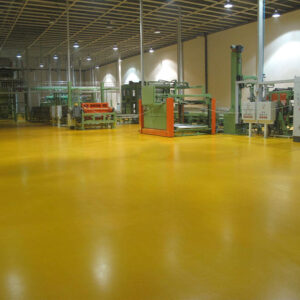
- Manufacturing plants – withstands heavy machinery, constant foot traffic, and chemical spills
- Warehouses and distribution centers – supports forklift traffic and pallet movement
- Automotive garages and dealerships – resists hot tire pickup, oil, and gasoline
- Aircraft hangars – provides smooth, dust-free surfaces for sensitive equipment
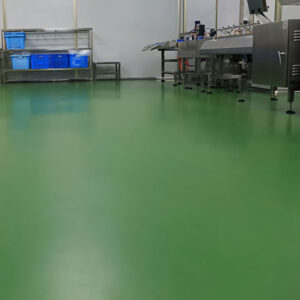
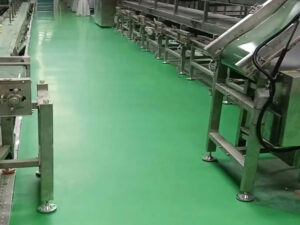
- Food processing facilities – offers seamless, hygienic surfaces
- Chemical processing areas – resists aggressive chemical exposure
- Garage för bostäder – provides long-lasting protection for home workshops
Typical Performance Data
| Testmetod | Parameter | 100% Solids Epoxy Result |
|---|---|---|
| ASTM D4060 | Motståndskraft mot nötning | Excellent (low weight loss) |
| ASTM D4541 | Adhesion Strength | 250-400 psi |
| ASTM D1308 | Kemisk beständighet | Resists acids, alkalis, fuels, salts |
| ASTM D2240 | Hårdhet (Shore D) | 75-85 |
| ASTM D695 | Tryckhållfasthet | 8,000-12,000 psi |
Values shown are typical laboratory results and may vary depending on formulation and application conditions. These metrics confirm that this industrial-grade epoxy system is engineered for heavy-duty applications where standard coatings would fail prematurely.
Application Requirements
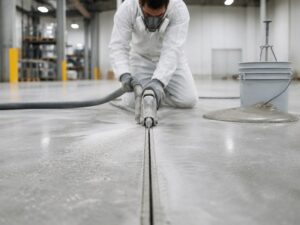
- Surface preparation: Mechanical profiling (shot blasting or diamond grinding) is mandatory to achieve a minimum anchor pattern of 40-80 mils
- Temperature range: 50°F to 85°F (10°C to 29°C) during application and cure
- Relative humidity: Below 85%
- Mix ratio: Precision mixing at 400-600 RPM for 3-5 minutes
- Pot life: 20-40 minutes depending on product formulation and ambient temperature
- Cure to foot traffic: 12-18 hours
- Cure to heavy traffic: 36-72 hours
2. What Is Water-Based Epoxy?
Water-based epoxy is a coating formulation where epoxy resin particles are dispersed as microscopic droplets in a water carrier. The water serves as the delivery vehicle, allowing the product to be applied in thin, even coats before evaporating to leave behind the cured resin film.
The Chemistry Behind Water-Based Epoxy
Water-based epoxies are typically manufactured as two-component systems where one component contains the epoxy resin emulsion and the other contains water-dispersible hardener. When mixed, the resin and hardener particles remain suspended in the water carrier until applied. After application, the water evaporates, allowing the particles to coalesce and cross-link.
This emulsification process enables:
- Lower application viscosity without solvents
- Reduced VOC content
- Easier clean-up with water
- Extended working time
Vanliga tillämpningar
Water-based epoxy suits these environments:
- Residential garages with light usage
- Basement floors
- Showrooms and retail spaces
- Office areas
- Light commercial settings
- Areas with strict VOC regulations
Application Requirements
- Surface preparation: Clean, etch, and repair cracks
- Primer: Epoxy sealer/primer required
- Multiple coats: Typically 2-3 coats needed to achieve adequate thickness
- Working time: 1-2 hours pot life
- Dry to walk: 24-48 hours
- Cure to heavy traffic: 3-7 days
3. Direct Comparison: Detailed Analysis
3.1 Film Thickness and Build
The most significant technical difference between these products is film thickness retention. 100% solids epoxy delivers a dry film thickness equal to its wet application thickness because nothing evaporates. A 10-mil wet coat produces a 10-mil dry film.
Film Thickness Comparison
| Aspekt | 100% Solids Epoxy | Water-Based Epoxy |
|---|---|---|
| Wet-to-Dry Ratio | 1:1 | 2:1 (approximately) |
| Typical Single Coat Dry Film | 10-20 mils | 3-5 mils |
| Total System Build (2 coats) | 20-40+ mils | 6-10 mils |
| Maximum Single Application Build | 250 mils (¼ inch) | 5-7 mils |
This thickness differential directly affects: impact resistance, chemical penetration resistance, wear life, and overall floor performance.
3.2 Field Experience: Real-World Performance
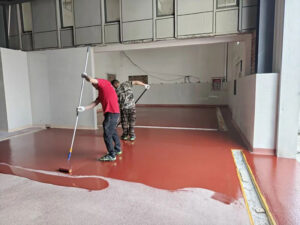
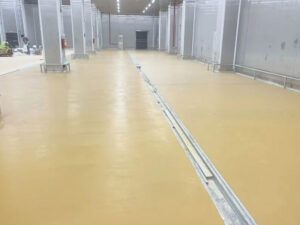
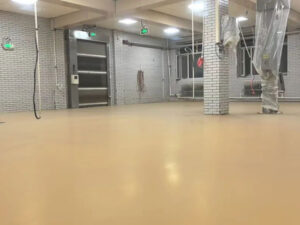
Based on KAIDA PAINT field applications across diverse industrial and commercial settings, high-performance epoxy flooring systems have been successfully installed in automotive workshops, manufacturing plants, and warehouses where floors are exposed to forklifts, chemicals, and continuous traffic.
In high-traffic environments, properly installed industrial epoxy floors typically maintain performance for many years with minimal maintenance. Our installation records show that facilities using 100% solids epoxy systems experience significantly fewer coating failures compared with lower-solids alternatives, particularly in areas subject to:
- Frequent forklift turning and braking
- Hot tire exposure from parked vehicles
- Chemical drip and spillage
- Temperaturvariationer
In automotive service environments, properly installed 100% solids epoxy floors have demonstrated service lives exceeding 10 years when properly maintained. In contrast, comparable facilities using water-based epoxy typically require full replacement within 4-6 years under similar usage conditions.
3.3 Durability and Performance
100% Solids Epoxy
After extensive testing in industrial environments, this solvent-free epoxy coating demonstrates:
- Excellent resistance to abrasion from steel wheels and equipment movement
- Superior chemical resistance to many common industrial chemicals when properly formulated and cured
- Outstanding impact resistance – unaffected by dropped tools or pallet drops
- Stain resistance – resists absorption of oils, grease, and common industrial fluids
- Hot tire pickup resistance – maintains integrity under parked vehicle weight
Water-Based Epoxy
Field experience shows water-based epoxy provides:
- Moderate abrasion resistance suitable for foot traffic
- Limited chemical resistance – light spills must be cleaned promptly
- Standard impact resistance for residential use
- Acceptable stain resistance with timely clean-up
- Potential hot tire pickup issues in vehicle parking applications
3.4 Lifespan and Longevity
The lifespan difference represents a significant value consideration:
| Parameter | 100% Solids Epoxy | Water-Based Epoxy |
|---|---|---|
| Residential Lifespan | 10-25 years | 3-7 years |
| Commercial Lifespan | 8-20 years | 2-5 years |
| Industrial Lifespan | 5-15 years | 1-3 år |
| Warranty Period | 8-15 years typical | 1-5 years typical |
3.5 Chemical Resistance
| Kemisk | 100% Solids Epoxy | Water-Based Epoxy |
|---|---|---|
| Motorolja | Utmärkt | Måttlig |
| Bensin | Utmärkt | Måttlig |
| Transmission Fluid | Utmärkt | Måttlig |
| Brake Fluid | Utmärkt | Bra |
| Battery Acid (dilute) | Utmärkt | Begränsad |
| Hydraulic Fluid | Utmärkt | Begränsad |
| Cleaning Chemicals | Utmärkt | Måttlig |
| Salt Solution | Utmärkt | Bra |
3.6 Application Window and Installation
| Faktor | 100% Solids Epoxy | Water-Based Epoxy |
|---|---|---|
| Pot Life at 70°F | 20-40 minutes | 1-2 hours |
| Pot Life at 90°F | 10-15 minuter | 45-60 minutes |
| Time to Walk | 12-18 hours | 24-48 hours |
| Time to Vehicle | 36-72 hours | 3-7 dagar |
| Installation Skill | Professional installation recommended | DIY-friendly |
| Cost per Sq Ft (Installed) | $3-7 | $1.50-3.50 |
| Cost per Sq Ft (DIY) | Rekommenderas ej | $0.75-1.50 |
4. Which One Should You Choose?
Decision Guide: 100% Solids Epoxy
Choose 100% solids epoxy when:
✔ Forklifts, pallet jacks, or heavy equipment operate on the floor
✔ Vehicles park daily on the surface
✔ Chemical spills occur or are possible
✔ Long-term service life of 10+ years is required
✔ Maximum durability justifies higher initial investment
✔ Professional installation services are available
✔ The floor sees constant foot traffic in commercial settings
✔ Industrial manufacturing or processing occurs in the space
Decision Guide: Water-Based Epoxy
Choose water-based epoxy when:
✔ Light residential garage with occasional use
✔ Budget is the primary constraint
✔ DIY installation is preferred or necessary
✔ Minimal chemical exposure is expected
✔ Lower VOC levels are required by local regulations
✔ The floor sees only occasional foot traffic
✔ Short-term solution acceptable (3-7 years)
5. People Also Ask About 100% Solids Epoxy
Q: Is 100% solids epoxy better than regular epoxy?
Yes. The term “regular epoxy” often refers to solvent-based or water-based products with lower solids content. 100% solids epoxy provides superior film build, durability, and chemical resistance compared with standard epoxy coatings.
Q: What is the difference between 100% solids epoxy and solvent-based epoxy?
100% solids epoxy contains no solvent carrier, allowing maximum film thickness and lower VOC emissions. Solvent-based epoxy contains solvents that evaporate during curing, resulting in reduced film build compared with 100% solids systems. Solvent-based formulations also release higher VOC levels during application.
Q: How many coats of 100% solids epoxy are needed?
Most applications require 1-2 coats. A single coat typically provides 10-20 mils of dry film thickness. For heavy-duty industrial applications, a two-coat system achieving 20-40+ mils total thickness is recommended.
Q: Can 100% solids epoxy be used outdoors?
Direct sunlight exposure causes yellowing in standard 100% solids epoxy formulations. UV-stable versions or clear urethane topcoats are available for outdoor applications or areas with significant sunlight exposure.
Q: How long does 100% solids epoxy take to cure?
Foot traffic is possible after 12-18 hours. Full mechanical strength and chemical resistance develop within 3-7 days, depending on temperature and humidity conditions. Heavy loads should not be placed on the surface for 36-72 hours.
Q: Is 100% solids epoxy the same as high-solids epoxy?
Not exactly. High-solids epoxy typically contains 80-99% solids with some solvent, while 100% solids epoxy contains no carrier. The difference affects film thickness retention, VOC emissions, and maximum achievable build per coat.
Q: Can I install 100% solids epoxy myself?
This is strongly discouraged. The 20-40 minute pot life requires experienced installers who can work efficiently. Without proper temperature control, mixing precision, and application technique, the coating may fail prematurely.
Q: How thick should epoxy flooring be?
For residential garages, 100% solids epoxy systems typically achieve 10-20 mils total thickness. Industrial applications often require 20-40+ mils. Water-based epoxy systems generally achieve 6-10 mils total with multiple coats.
Q: What happens if water-based epoxy is applied to a damp surface?
Water-based epoxy can be applied to slightly damp concrete, which is one of its advantages. However, excessive moisture during application can cause streaking, uneven curing, and adhesion problems.
Q: How can I remove stains from water-based epoxy?
Clean spills immediately. Use mild cleaning agents and avoid aggressive chemicals that may damage the coating. For stubborn stains, professional cleaning products designed for epoxy surfaces are recommended.
Q: Does 100% solids epoxy require special equipment to apply?
Yes. Professional-grade applicators use spike shoes, squeegees, rollers with extension handles, and sometimes special mixing equipment. Temperature monitoring tools are also necessary.
6. Industrial Applications of 100% Solids Epoxy
Produktionsanläggningar
Production environments require flooring that withstands heavy equipment, constant traffic, and chemical exposure. 100% solids epoxy provides:
- Seamless, dust-free surfaces meeting clean room standards
- Chemical resistance to process chemicals
- Mechanical strength for equipment loads
- Easy maintenance and cleaning
Warehouse and Distribution Centers
These facilities benefit from:
- Forklift and pallet truck traffic resistance
- Dust-free surfaces protecting inventory
- High reflectivity improving warehouse lighting efficiency
- Quick installation minimizing operational disruption
Automotive Facilities
Dealerships, repair shops, and garages require:
- Hot tire pickup resistance
- Oil and grease stain resistance
- Slip resistance where required
- Professional appearance
Commercial Facilities
Retail, showroom, and office applications benefit from:
- Attractive, professional appearance
- Enkelt underhåll
- Long-term durability
- Customizable color and finish options
Livsmedels- och dryckesförädling
Food facilities choose 100% solids epoxy for:
- Seamless, hygienic surfaces
- Chemical resistance to cleaning agents
- Compliance with food safety regulations
- Slip-resistant options
Residential Garages
Homeowners select 100% solids epoxy for:
- Long-lasting floor protection (10-25 years)
- Resistance to tire marks and stains
- Professional appearance
- Increased property value
7. Common Installation Mistakes to Avoid
Mistake 1: Inadequate Surface Preparation
Mechanical profiling is essential. Acid etching does not provide sufficient anchor pattern for 100% solids epoxy. Shot blasting or diamond grinding is required to achieve 40-80 mil surface profile.
Mistake 2: Incorrect Mixing Ratio
Precise ratios are critical. Mixing too much or too little hardener prevents proper curing. Always use the manufacturer’s specified mix ratio and mix thoroughly at the recommended speed.
Mistake 3: Wrong Temperature Application
Applying below 50°F slows or stops cure. Above 85°F dramatically reduces pot life and may cause bubbles. Optimal application temperature is 60-75°F.
Mistake 4: Overworking the Material
Excessive rolling causes bubbles and surface defects. Apply the material with squeegee and back-roll only once. Overworking increases trapped air.
Mistake 5: Ignoring Moisture Vapor Transmission
Concrete moisture must be tested. Moisture vapor transmission exceeding 3-5 pounds per 1,000 square feet per 24 hours can cause coating failure regardless of product quality.
Mistake 6: Insufficient Coating Thickness
Applying less than the recommended 10 mils minimum compromises durability. Multiple coats may be required to achieve desired thickness.
Mistake 7: Improper Timing
Waiting too long between coats affects chemical bonding. Follow the recoat window specified by the manufacturer. Applying a second coat beyond the recoat window requires mechanical profiling.
8. Cost Analysis and Long-Term Value
Initial Investment Comparison
| Föremål | 100% Solids Epoxy | Water-Based Epoxy |
|---|---|---|
| Material Cost Per Sq Ft | $1.50-3.50 | $0.50-1.00 |
| Installation Cost Per Sq Ft | $2.00-4.00 | $0.50-1.50 (DIY) |
| Total Installed Cost Per Sq Ft | $3.50-7.50 | $1.00-2.50 |
| Average Residential Garage (400 sq ft) | $1,400-3,000 | $400-1,000 |
Long-Term Value Comparison
| Faktor | 100% Solids Epoxy | Water-Based Epoxy |
|---|---|---|
| Expected Lifespan | 15 years | 5 years |
| Cost Per Year (Installed) | $0.23-0.50/sq ft | $0.20-0.50/sq ft |
| Number of Reapplications (15 years) | 0 | 2-3 |
| Total 15-Year Cost | $3.50-7.50/sq ft | $3.00-7.50/sq ft |
| Maintenance Frequency | Låg | Måttlig |
Actual lifecycle cost depends on substrate condition, traffic level, maintenance schedule, and installation quality.
Value Drivers for 100% Solids Epoxy
- Reduced maintenance – The dense surface repels dirt and resists staining
- Improved safety – Slip-resistant options available
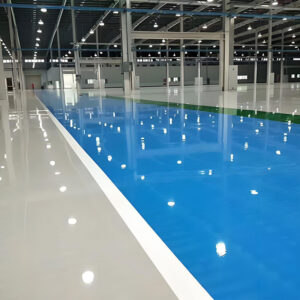
- Enhanced appearance – High-reflectivity surfaces can improve lighting conditions in industrial spaces and create a brighter working environment
- Property value – Professional flooring increases building value
- Operational continuity – Long service life minimizes disruptive replacements
9. Manufacturer Insights: Developing High-Performance 100% Solids Epoxy Systems
As a professional epoxy flooring manufacturer, KAIDA PAINT develops 100% solids epoxy systems for OEM partners, distributors, contractors, and industrial users worldwide. Our premium flooring systems are designed for demanding industrial, commercial, and residential applications.
Our Manufacturing Capability
- Advanced resin technology formulated in ISO-certified facilities
- Proprietary formulations optimized for specific environmental conditions
- Extended pot life formulations providing installers with 45-60 minute working windows
- Custom color matching capabilities
Technical Support
- Comprehensive installation training programs
- Job site technical assistance and troubleshooting
- Application guidance for complex substrate conditions
- Formulation adjustments for regional climate considerations
Kvalitetssäkring
- Consistent batch-to-batch formulation control
- Third-party testing verification (ASTM protocols)
- Extended warranty programs (8-15 years depending on application)
- Documentation and certification for compliance requirements
Global Project Experience
- Industrial manufacturing facilities across multiple continents
- Commercial projects from showrooms to distribution centers
- Residential installations with aesthetic and performance requirements
- Food and pharmaceutical facilities requiring sanitary surfaces
OEM and Private Label Services
- Custom formulation development for specific market requirements
- Private label manufacturing with flexible packaging options
- Technical documentation and regulatory compliance support
- Supply chain reliability with production capacity for large-scale projects
Why Industry Professionals Choose KAIDA PAINT
Our formulations are engineered to address the specific challenges of 100% solids epoxy installation:
- Extended pot life reduces installation stress
- Flow-enhancing additives improve leveling
- Bubble-release technology minimizes pinholes and surface defects
- UV-stable formulations reduce yellowing in residential and retail applications
Contact our technical specialists today for project-specific recommendations, custom color matching, or installation support. Our team provides formulations tailored to your application conditions, performance requirements, and budget.
In summary, 100% solids epoxy provides superior durability, chemical resistance, film build, and lifespan compared with water-based epoxy. Water-based epoxy is suitable for light-duty applications where lower cost and easier installation are priorities. For industrial environments, commercial facilities, and residential garages requiring maximum protection and long-term value, 100% solids epoxy delivers significantly better performance and ROI despite the higher initial investment.


 English
 Spanish
 Portuguese
 Arabic
 French
 Italian
 Russian
 Indonesian
 Swedish