
Description
Acid resistant brick flooring is a lining of vitrified acid-proof bricks bedded and jointed in acid-resistant adhesive over a membrane, and it remains the specification of choice where hot acid, heavy impact and abrasion arrive together. The brick is rated above 99.8% acid resistance with compressive strength above 120 MPa, and stays serviceable from −20 °C to 130 °C (−4 °F to 266 °F). Unlike a resin floor, the wearing surface is ceramic: the brick carries the chemical and mechanical duty, while the membrane beneath it keeps the concrete sealed. This page covers what the brick system is made of, which acids it handles and which two it does not, how it is built, and when a resin floor is the better answer.
| Item | Specification |
|---|---|
| System | Vitrified acid-proof brick lining on an epoxy coal tar membrane |
| Model | ACF-AB |
| Wearing surface | Acid-proof ceramic brick, bedded and jointed in acid-resistant adhesive |
| Membrane | Epoxy coal tar primer, membrane coats, optional glass cloth reinforcement, topcoat |
| Bulk density | 2.31–2.40 g/cm³ |
| Water absorption | ≤ 0.2% |
| Acid resistance | ≥ 99.8% |
| Service temperature | Thermal stability from 130 °C to −20 °C in one cycle without cracking |
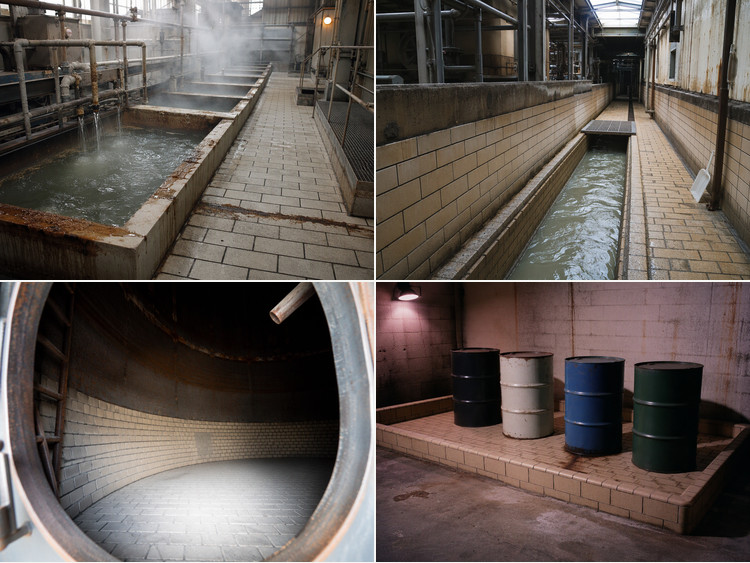
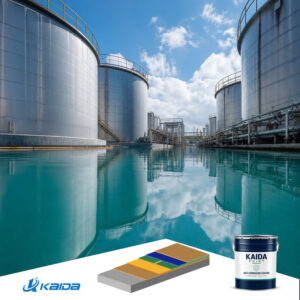
| Application | Towers, pools, tanks, vats, channels, wastewater works, external hardstanding |
What is acid resistant brick flooring made of, and why use ceramic instead of resin?
The brick is fired ceramic with a very low open porosity — under 0.2% water absorption, which is what stops acid from migrating through the tile itself. Its acid resistance is measured above 99.8%, and its compressive strength is above 120 MPa, roughly twice that of a resin mortar. Ceramic also does not soften or degrade at the temperatures where organic resins start to lose properties.
Those numbers explain the use case. A resin floor protects concrete with a continuous film or mortar body that is 0.5–10 mm thick. A brick lining protects it with a bed of ceramic brick on top of a membrane — thickness set per project by the structural and wear design — and the ceramic is not consumed by acid, scratched by dragged loads, or softened by hot liquor. Where a plant washes a floor with hot acid or drags skips across it, brick outlasts resin by a wide margin.
The trade-off is equally real: brick is heavy, it has joints, it needs structural capacity in the slab, and it cannot be applied to complex geometry without cutting.
Which acids does it handle, and which two does it not?
This is the question that decides most projects, and the answer is specific. The lining is suitable for hydrochloric, sulfuric, nitric, phosphoric and acetic acid, and for alkaline solutions at any concentration at ambient temperature. It is not suitable for hydrofluoric acid or hot phosphoric acid.
| Medium | Suitability | Note |
|---|---|---|
| Hydrochloric acid | Suitable | Including concentrated service; for hot acid, the membrane grade is confirmed per project |
| Sulfuric acid | Suitable | Concentrated acid is the classic application |
| Nitric acid | Suitable | Oxidising acid, handled by the ceramic |
| Phosphoric acid | Suitable at ambient | Not for hot phosphoric acid |
| Acetic acid and organic acids | Suitable | Common in food and fermentation plants |
| Alkali, any concentration at ambient | Suitable | Caustic handling areas |
| Hydrofluoric acid | Not suitable | HF attacks silica-based ceramics; use a carbon brick or a vinyl ester system with non-siliceous filler |
| Hot phosphoric acid | Not suitable | Dissolves the ceramic bond |
Being clear about the two exclusions is not a weakness in the sales argument — it is the reason the recommendation can be trusted for everything else. Buyers who have been sold a “universal” acid lining and then watched it fail on an HF line ask this question first.
For the resin floor used where the brick stops, see vinyl ester high-build mortar system.
Where brick is not the answer, the resin alternatives are compared in chemical resistant flooring with brick linings.
What are the physical and mechanical properties?
| Test item | Unit | Result |
|---|---|---|
| Bulk density | g/cm³ | 2.31–2.40 |
| Water absorption | % | ≤ 0.2 |
| Acid resistance | % | ≥ 99.8 |
| Bending strength | MPa | ≥ 55.8 (8,100 psi) |
| Compressive strength | MPa | ≥ 120 (17,400 psi) |
| Thermal stability (130 °C / −20 °C) | cycle | No cracking after one cycle |
| Refractoriness | °C | > 1150 |
| Softening under load (start) | °C | > 1350 |
Water absorption below 0.2% and acid resistance above 99.8% separate acid resistant brick flooring from a decorative tile installation. Refractoriness above 1150 °C and a load-softening point above 1350 °C mean the lining can be used in tower and duct internals, not only on floors — which is why the same material appears in chimney and scrubber linings.
For a seamless resin alternative at lower thickness, see epoxy mortar flooring.
How is the lining built?
The sequence is a membrane followed by a brick bed, and the membrane is the part that must not be compromised.
- Substrate preparation — concrete or steel shell cleaned, ground or blasted; voids and honeycomb repaired; corners formed as a fillet rather than a right angle.
- Primer — epoxy coal tar primer, applied to seal and to bond the membrane.
- Membrane — epoxy coal tar coats, with glass cloth reinforcement where movement or thermal cycling is expected; spark tested where the duty demands it.
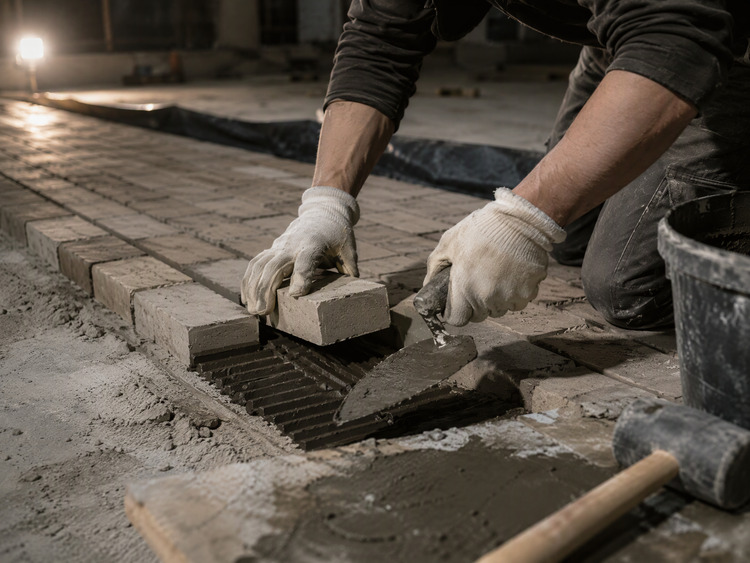
- Brick bedding — acid-resistant adhesive spread to a controlled bed thickness, brick laid and tapped to level, joints kept uniform.
- Jointing — joints filled and pointed with acid-resistant adhesive; joint width and depth are specified, not left to the trowel.
- Curing and acid wash — the lining is cured, then washed or neutralised as the adhesive requires before service.
- Inspection — joint continuity, level, and membrane continuity at edges and penetrations.
Two failure modes account for most brick lining problems: an unbonded or bridged membrane at a detail, and joints that were pointed too thin. Neither is visible from a walkover at handover, which is why membrane testing and joint inspection are separate hold points in our method statement.
The joint decides the lining, not the brick
A brick lining fails at the joints long before the brick wears out, and the joint is the one part of the system nobody can inspect after handover.
Three properties matter. Joint width and depth are specified rather than left to the trowel: a joint pointed too thin loses its chemical resistance before it loses strength, and a joint filled proud of the brick face wears first under dragged loads. Joint continuity is what keeps the membrane covered — a void behind a joint is a path for acid to reach the membrane. And the jointing material has to match the medium that governs, not the medium that is easiest to apply. The manual specifies an acid-resistant adhesive over an epoxy coal tar membrane; where the medium attacks that adhesive, the joint family changes and the brick may stop being the right system at all.
The inspection consequence: membrane testing and joint inspection are separate hold points, because a membrane test says nothing about whether the joints were pointed to depth. Ask for the joint detail on the drawing and the inspection record at handover. A lining accepted on a walkover has not been checked at the one place it fails.

Where is acid resistant brick flooring specified?
- Chemical towers, scrubbers, ducts and stack internals
- Pickling lines and acid storage tank floors and containment curbs
- Reaction vessels, vats and process tanks, as internal lining
- Wastewater treatment works: channels, neutralisation basins, inspection chambers
- Fertiliser, pesticide and dye intermediate plants
- Pharmaceutical and fermentation areas with acid and caustic wash-down
- Paper, textile and electroplating plants
- Smelting and power plant areas with acid drainage and abrasion
- External hardstanding exposed to acid spill and weather
Brick lining or resin flooring — which one?
| Consideration | Acid resistant brick lining | Resin flooring (epoxy / vinyl ester) |
|---|---|---|
| Temperature | High — refractoriness above 1150 °C | Limited by the resin; typically below 60–80 °C in service |
| Abrasion and impact | Excellent — ceramic surface | Good at 6–10 mm; consumed by heavy drag loads |
| Seamless | No — joints throughout | Yes — no joints or seams |
| Weight | High — structural capacity needed | Low to moderate |
| Hydrofluoric acid | Not suitable | Suitable with vinyl ester and non-siliceous filler |
| Installation time | Long — brick laying and jointing | Short — days, not weeks |
| Repair | Local brick replacement and re-jointing | Local patch and re-coat |
Brick wins on heat, impact and abrasion, which is where the decision usually turns. The rule that works in practice: if heat, impact or abrasion is the dominant threat, brick wins; if chemical attack is the dominant threat and the geometry is complex, resin wins; if both are severe, the answer is usually brick on the floor and in the vessel with a resin membrane beneath it — which is exactly how this system is built.
For chemical duty without joints, see vinyl ester flooring.
Cost and specification
Acid resistant brick flooring is priced from area, brick thickness, membrane specification, joint detail and access. It is the most labor-intensive of the lining options, and the labor sits in the brick laying and jointing rather than in the material. For a tank internal, access and ventilation often set the schedule.
A specification that holds up in service states four things: the brick grade, the membrane build with its test requirement, the adhesive and jointing material, and the acceptance criteria for joints. A quotation that lists only “acid-proof brick” and a square meter (sq ft) rate has not specified a lining — it has named a material.
A brick lining is quoted per square meter (sq ft) of laid area, FOB or CIF named port, with brick, membrane and jointing priced as one system rather than three. Minimum order is set by pallet quantities, and lead time is a working-day range from brick grade confirmation.

Frequently asked questions
Can the lining be used in a tank with complex geometry?
Yes, but the brick has to be cut, and cut edges are where joints are least reliable. Nozzles, manholes and pipe penetrations are detailed with cut brick and adhesive fillets, and those details should be drawn rather than left to site.
How is a damaged lining repaired?
The damaged brick is cut out, the bed and jointing adhesive removed back to sound membrane, the membrane inspected and repaired if needed, and new brick bedded and pointed. A repair is a normal maintenance operation; what is not normal is a repair that recurs at the same joint.
Why is hydrofluoric acid excluded?
HF dissolves silica, and acid-proof ceramic brick is silica-based. In HF service the lining is attacked through the ceramic itself, not just at the joints. Carbon brick with a suitable membrane, or a vinyl ester system with a non-siliceous filler, are the correct answers.
Does the lining need a separate waterproofing membrane?
The epoxy coal tar membrane is the waterproofing as well as the bond layer. It must be continuous, and it must be tested where the duty is immersion — a pinhole in the membrane under a brick floor is a leak that only appears once the tank is full.
Why projects specify Kaida Paint for acid resistant brick lining
The specification issued with each project under model ACF-AB states the brick grade, the membrane build, the adhesive and the joint acceptance criteria, and the method statement sets the hold points for membrane testing and joint inspection. Batch records and a material declaration ship with the material.
Kaida Paint supplies the epoxy coal tar primer, membrane and topcoat together with the acid-resistant adhesive and jointing material, so the membrane and the brick bed come from one technical file rather than two suppliers who never speak. That matters most at the joints and at penetrations, where the two systems meet.
Send the medium and concentration, the temperature, the area and the substrate, and we will confirm whether acid resistant brick flooring, resin or a combination is the right specification — and say plainly where the brick system is not suitable.
—
Author: Kaida Paint Technical Team — flooring and lining systems engineering, acid-resistant linings Last updated: 13 November 2026

 English
 Spanish
 Portuguese
 Arabic
 French
 Italian
 Russian
 Indonesian
 Swedish