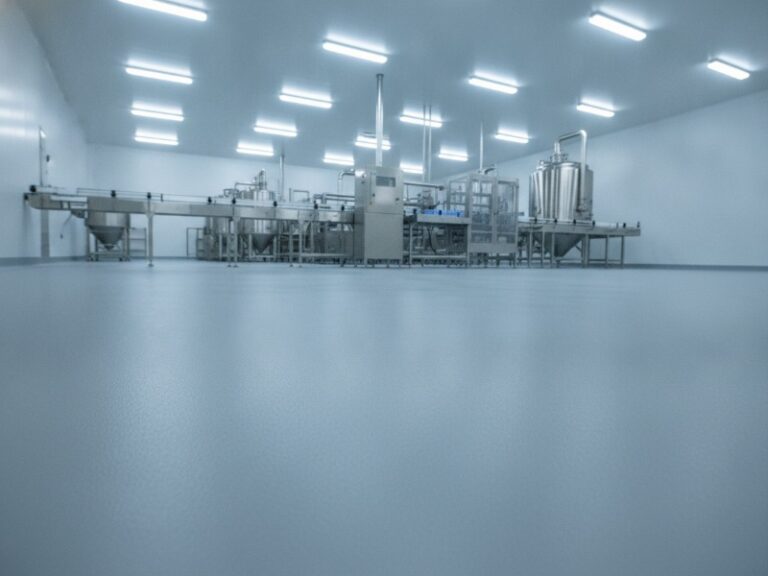
Urethane cement flooring cost per square foot (2026) ranges from $8 to $15 installed for most commercial and industrial projects. Large facilities (50,000+ sq ft) can achieve $4–$8 per sq ft, while small or complex projects may exceed $15 per sq ft depending on system thickness, substrate condition, and installation complexity.
- Typical cost: $8–$15 per sq ft installed
- Large projects (50,000+ sq ft): $4–$8 per sq ft
- Small/complex projects: $12–$18+ per sq ft
Urethane cement flooring is more expensive than epoxy upfront but delivers 25+ years of service life, making it the most cost-effective industrial flooring solution over time.
Urethane cement flooring costs between $8 and $15 per square foot installed for most commercial and industrial projects. Large-scale facilities can see costs as low as $4–$8 per square foot, while small or complex installations may exceed $15 per square foot depending on thickness, substrate condition, and system requirements.
This complete guide breaks down cost by system type, project size, and key cost drivers, including surface preparation, substrate condition, and thermal shock requirements. You will learn the cost differences between light-duty, medium-duty, and heavy-duty systems, how project size affects per-square-foot pricing, the total cost of ownership advantages that make urethane cement the most durable industrial flooring investment, hidden costs that impact budgets, and how to get an accurate estimate for your specific facility.
What Is Urethane Cement Flooring?
Urethane cement flooring (also called uretano cementizio, urethane mortar, o polyurethane concrete flooring) is a heavy-duty resinous flooring system designed for environments with thermal shock, moisture, and chemical exposure. It is a hybrid, monolithic system that combines the flexibility of polyurethane resin with the compressive strength of cementitious mortar. The result is a seamless, high-performance floor applied at thicknesses from 1/8 inch to 3/8 inch that bonds tenaciously to concrete substrates.
Unlike standard epoxy coatings, urethane cement floors are engineered to withstand extreme conditions. The system handles operating temperatures from -40°F to 250°F and absorbs thermal shock differentials exceeding 150°F—the kind of stress generated when hot CIP washdown meets refrigerated zones in food processing facilities.
A properly installed urethane cement system delivers a documented service life of 25+ years in production environments. The installation includes surface preparation to ICRI 310.2 CSP 3-5, substrate moisture verification per ASTM F2170, primer coat, the urethane cement mortar body coat, integral cove base at wall-to-floor transitions, and a system-specific topcoat.
Learn more about the full system structure, benefits, and applications in our Urethane Cement Flooring Complete Guide.
How Much Does Urethane Cement Flooring Cost Per Square Foot?
The installed cost of urethane cement flooring ranges from $8 to $15 per square foot for most commercial projects. However, pricing varies significantly based on system thickness, project size, and substrate condition.
Installed Cost Range by System Type
Different system types directly impact cost and performance:
| Tipo di sistema | Spessore | Cost Per Square Foot | Total Cost for 5,000 sq ft |
|---|---|---|---|
| Light-Duty (SL) | 1/8″ to 3/16″ | $7.00 – $12.00 | $35,000 – $60,000 |
| Medium-Duty (MD) | 3/16″ to 1/4″ | $9.00 – $13.00 | $45,000 – $65,000 |
| Heavy-Duty (HF) | 1/4″ to 3/8″ | $10.00 – $15.00 | $50,000 – $75,000 |
| Decorative Quartz System | Variabile | $15.00 – $20.00 | $75,000 – $100,000 |
Heavy-duty systems cost more but are required for thermal shock and heavy industrial use. Data based on industrial flooring project benchmarks and contractor pricing across North America and international markets.
Size-Tiered Pricing for Commercial Projects
Project size is the single biggest factor affecting urethane cement flooring cost per square foot. Crew mobilization and equipment setup are largely fixed costs. Spread across more square footage, the per-square-foot number drops significantly.
| Project Size | Cost Per Square Foot Installed |
|---|---|
| Under 3,000 sq ft | $11.00 – $14.00 |
| 3,000 – 10,000 sq ft | $8.00 – $12.00 |
| 10,000 – 50,000 sq ft | $5.00 – $9.00 |
| 50,000+ sq ft | $4.00 – $8.00 |
Larger projects achieve significantly lower per-square-foot pricing due to economies of scale. Data based on industrial flooring project benchmarks and contractor pricing across North America and international markets.
Total Project Cost Examples by Facility Size
| Facility Size | Typical Total Investment |
|---|---|
| 5,000 sq ft (small factory/processing area) | $35,000 – $75,000 |
| 10,000 sq ft (mid-size warehouse) | $70,000 – $150,000+ |
| 50,000+ sq ft (large distribution/manufacturing) | $350,000 – $850,000+ |
Based on realistic facility footprints and documented project data.
Urethane Cement Flooring Cost Per M2
For international buyers, urethane cement flooring costs approximately $86 to $161 per square meter installed (based on $8–$15 per sq ft conversion). Large projects may see pricing as low as $43 to $86 per square meter.
Urethane cement flooring cost per m2 in international markets varies depending on labor cost, import duties, and local installation standards. Buyers in the USA, California, Texas, Middle East, and Southeast Asia should consult local installers for region-specific pricing.
Cost Breakdown of Urethane Cement Flooring
Understanding the cost structure helps facility managers evaluate quotes and identify potential savings:
| Cost Component | Percentage of Total |
|---|---|
| Materials (resin, mortar, primer, topcoat) | 40% – 50% |
| Labor (installation crew, skilled applicators) | 30% – 40% |
| Surface preparation (profiling, repair, moisture mitigation) | 10% – 20% |
| Overhead and logistics (mobilization, equipment, shipping) | 5% – 10% |
These percentages are averages based on standard commercial installations. Complex projects may have higher surface preparation costs.
How to Estimate Your Project Cost
Use this formula to build a realistic urethane cement flooring cost estimate for your facility:
Estimated Total Cost = Area × System Price ± Adjustments
Base pricing:
- Light-duty system: $7–$12 per sq ft
- Medium-duty system: $9–$13 per sq ft
- Heavy-duty system: $10–$15 per sq ft
Adjustments to add:
- Heavy substrate repair: +$2–$5 per sq ft
- Complex layouts or multiple drains: +$1–$3 per sq ft
- Heavy-duty thermal systems: +$2–$4 per sq ft
- Decorative quartz finish: +$3–$5 per sq ft
Example estimate:
- 10,000 sq ft × $10 (medium-duty system) = $100,000
- Substrate repair: +$20,000
- Complex layout (production lines, 8 drains): +$10,000
- Total estimated cost: $130,000
What’s Included in the Installed Quote?
A turnkey urethane cement flooring quote typically covers the full installed system:
- Surface preparation to ICRI 310.2 CSP 3-5 (shot blasting or diamond grinding)
- ASTM F2170 in-situ moisture verification
- Primer coat
- Urethane cement mortar at specified thickness
- Integral cove base at wall-to-floor transitions
- System-specific topcoat
- Audit-ready closeout documentation (moisture logs, surface profile verification, cove base documentation)
Items quoted separately when required:
- Substrate repair beyond standard preparation
- Drainage modification
- Equipment relocation and trade coordination
- Specialty topcoats outside the standard system
What Drives Urethane Cement Flooring Cost?
System Thickness and Build
Thickness directly correlates with material volume and labor. A 3/16-inch self-leveling slurry costs less in material and labor than a 3/8-inch trowel-applied mortar built for heavy thermal cycling, point loads, and aggressive chemical exposure. Thicker is not automatically better; it must be matched to the operational load. A dry-goods packaging area does not require the thickness a kill floor or hot CIP washdown zone demands.
Finish and topcoat selection also move the price. Aggregate broadcast changes both grip and cost—quartz broadcast carries higher chemical resistance than sand at higher material cost. Polyurethane, polyaspartic, and novolac topcoats sit at different price points, with novolac offering the highest chemical resistance for aggressive environments.
Substrate Condition
Substrate condition is the most underestimated cost driver in industrial flooring projects. A sound new slab needs only profiling to ICRI 310.2 and moisture verification before installation. A slab carrying a failed epoxy coating requires that coating demolished and removed first, with the concrete underneath assessed and repaired. Demolition of a delaminated floor, spall repair, and crack treatment are real scope items that sit on top of the floor price. Facilities replacing a failed epoxy system should budget substrate work separately from the per-square-foot floor cost.
Project Complexity and Access
The physical layout directly impacts labor productivity. A wide open warehouse with a clear span allows crews to work in large, continuous passes, lowering labor cost per square foot. A facility crowded with production lines, storage racks, processing tanks, and numerous floor drains requires detailed handwork around every obstacle, driving the price upward.
Vertical Application
The vertical the floor serves shifts cost by setting the spec. Food processing floors may carry integral slope-to-drain and chemical-resistant topcoats for organic acid exposure. Commercial kitchens need slip resistance and thermal shock tolerance for hot CIP and oil. Pharmaceutical floors add finish and documentation rigor for cGMP environments.
Installation Time and Downtime
Understanding installation timelines helps facility managers budget for production shutdowns:
Typical installation time:
- 5,000 sq ft: 3–5 days
- 10,000–50,000 sq ft: 5–10 days
- 50,000+ sq ft: 10–14 days
Downtime cost considerations:
- Production shutdown during installation typically ranges from 3 to 14 days
- For a facility generating $50,000 per day in revenue, downtime can add $150,000–$700,000 to the project cost
- Weekend and off-hours installation may reduce downtime impact but increase labor costs
Hidden Costs to Consider
Beyond the installed floor price, several additional costs can impact your total project budget:
- Downtime cost: Production shutdown during installation typically ranges from 3 to 14 days. For a facility generating $50,000 per day in revenue, downtime can add $150,000–$700,000 to the project cost.
- Demolition cost: Removing existing flooring systems adds $2–$5 per sq ft depending on system type and thickness.
- Drainage upgrades: Modifying or adding floor drains typically costs $500–$2,000 per drain.
- Moisture mitigation: Substrates with high moisture vapor emission rates may require additional moisture barriers, adding $2–$4 per sq ft.
- Equipment relocation: Moving production equipment, racks, and machinery adds labor costs that vary by facility layout.
Urethane Cement Flooring Cost by Industry Application
Cost for Food Processing Plants
Food processing facilities require urethane cement flooring with integral slope-to-drain, chemical resistance to organic acids and cleaning agents, and thermal shock tolerance for hot CIP washdown. Installed cost typically ranges from $10 to $15 per square foot for a 1/4-inch medium-duty system with full slope-to-drain.
Based on our experience in industrial flooring projects across food processing, manufacturing, and warehouse facilities, substrate condition and drainage design are the most underestimated cost factors. A 12,000 sq ft food processing facility we supported required a 1/4-inch urethane cement system with slope-to-drain, resulting in a total installed cost of approximately $11.20 per square foot due to heavy substrate repair and drainage upgrades. The investment delivered 25-year performance in a high-temperature, high-hygiene environment.
Cost for Commercial Kitchens
Commercial kitchens demand slip resistance, thermal shock tolerance, and easy cleanability. A 1/8-inch light-duty system typically costs $8 to $12 per square foot. Facilities handling heavy oil and fryer operations may require medium-duty systems at $10 to $13 per square foot.
Cost for Warehouses and Distribution Centers
Warehouse applications generally use lighter systems at 1/8-inch thickness. These floors handle forklift traffic, pallet drops, and occasional spills. Installed cost ranges from $7 to $10 per square foot for standard installations. Large distribution centers exceeding 50,000 sq ft can achieve pricing as low as $4 to $6 per square foot.
Cost for Pharmaceutical Facilities
Pharmaceutical production areas require seamless, non-porous flooring with documented cleanliness and cGMP compliance. Medium to heavy-duty systems with enhanced finish and documentation run $11 to $15 per square foot. The additional cost reflects the rigorous installation standards, testing, and documentation required for regulatory compliance.
Epoxy vs Urethane Cement Flooring Cost Comparison
| Fattore | Pavimentazione epossidica | Urethane Cement Flooring |
|---|---|---|
| Upfront Installed Cost | $4 – $10 per sq ft | $8 – $15 per sq ft |
| Service Life in Production Environments | 12 – 24 months under thermal shock | 25+ years documented |
| Resistenza agli shock termici | Poor (delaminates under rapid temperature change) | Excellent (handles 150°F+ differential) |
| Tolleranza all'umidità | Limited (requires dry substrate) | Excellent (bonds to damp substrate) |
| 25-Year Total Cost of Ownership | Higher (multiple replacements + downtime) | Lower (one installation) |
Urethane cement provides the lower 25-year cost despite the premium initial price. Data based on industrial flooring project benchmarks and contractor pricing across North America and international markets.
Urethane cement is the better choice for environments with thermal shock, moisture, and chemical exposure, while epoxy is suitable for dry, low-impact areas with limited temperature variation.
While epoxy installs at $4 to $10 per square foot, it typically delaminates in 12 to 24 months under thermal shock conditions. A facility that would require two or three epoxy replacements within a 15- to 20-year timeframe may find the higher upfront cost of urethane cement to be the more economical choice when factoring in lost production time from repeated installations.
Urethane Cement vs Epoxy vs Polished Concrete: Cost Comparison
| Tipo di pavimentazione | Installed Cost (per sq ft) | Durata della vita | Manutenzione | Best Use Cases |
|---|---|---|---|---|
| Cemento uretanico | $8 – $15 | 25+ anni | Basso | Food processing, commercial kitchens, chemical plants |
| Epossidico | $4 – $10 | 2 – 5 years (thermal shock shortens to 12-24 months) | Moderato | Warehouses, garages, light manufacturing |
| Calcestruzzo lucidato | $3 – $12 | 10+ anni | Basso | Retail, showrooms, warehouses with light traffic |
Urethane cement offers the highest upfront cost but delivers the longest service life and best thermal shock resistance. For facilities with temperature cycling, moisture exposure, or chemical contact, urethane cement provides superior cost-effectiveness over the full lifecycle..
Cost of Thermal Shock Resistant Flooring
Thermal shock resistant flooring carries a premium over standard industrial floors. Urethane cement is the industry benchmark for thermal shock resistance, handling differentials up to 150°F without delamination. The cost of thermal shock resistant flooring ranges from $10 to $15 per square foot for urethane cement systems. This compares favorably to alternative thermal shock solutions that cost $12 to $18 per square foot but deliver inferior performance and shorter service life.
How to Choose the Right System for Your Facility
Selecting the correct urethane cement flooring system ensures optimal performance and cost-effectiveness:
- Choose Light-Duty (SL) if: Your environment is dry, low-impact, and does not experience thermal shock or chemical exposure. Applications: dry warehouses, light assembly areas, retail backrooms.
- Choose Medium-Duty (MD) for: Food processing, chemical exposure, frequent washdown, and moderate thermal cycling. Applications: commercial kitchens, dairy processing, beverage plants.
- Choose Heavy-Duty (HF) for: Extreme thermal shock, CIP washdown, heavy point loads, and aggressive chemical contact. Applications: meat processing, pharmaceutical manufacturing, chemical plants.
Explore our urethane cement flooring system solutions for tailored system design based on your industry and operating conditions.
How Long Does Urethane Cement Flooring Last?
Urethane cement flooring delivers a documented service life of 25+ years in production environments when properly installed and maintained. The system maintains its integrity through thermal cycling, chemical exposure, and heavy traffic without delamination or degradation. Regular cleaning and periodic recoating of the topcoat can extend service life beyond 30 years.
Is Urethane Cement Flooring Worth the Cost?
Urethane cement flooring offers the lowest lifecycle cost among industrial flooring systems despite its higher upfront price. The ROI analysis should consider:
- Reduced replacement frequency: One urethane cement installation replaces 3 to 5 epoxy installations over 25 years.
- Minimized downtime: Production shutdown for floor replacement costs $50,000+ per day in many facilities. One installation means one downtime event versus multiple replacements.
- Lower maintenance cost: The seamless, non-porous surface reduces cleaning time and chemical consumption.
- Improved safety: Slip-resistant formulations reduce workplace injury risk and related costs.
For dry warehouses without temperature cycling or chemical exposure, lower-cost options may be appropriate. For food processing, commercial kitchens, pharmaceutical manufacturing, and chemical plants, urethane cement delivers compelling ROI.
Can Urethane Cement Be Installed Over Existing Concrete?
Yes, urethane cement flooring can be installed over existing concrete slabs that are structurally sound and properly prepared. The existing substrate must be profiled to ICRI 310.2 CSP 3-5 using shot blasting or diamond grinding. The concrete must be tested for moisture vapor emission rate per ASTM F2170. If moisture exceeds acceptable levels, a moisture mitigation system may be required before urethane cement installation.
What Thickness Do I Need?
Thickness selection depends on the operational environment:
- 1/8 to 3/16 inch (Light-Duty): Commercial kitchens, light processing, warehouses with light forklift traffic
- 3/16 to 1/4 inch (Medium-Duty): Food processing, pharmaceutical production, chemical mixing areas
- 1/4 to 3/8 inch (Heavy-Duty): Heavy manufacturing, extreme thermal cycling, high point loads, aggressive chemical exposure
Consult a flooring specialist to match thickness to your specific operational requirements.
Frequently Asked Questions About Urethane Cement Flooring Cost
How much does urethane cement flooring cost per square foot?
Urethane cement flooring costs $8 to $15 per square foot installed for most commercial projects. Pricing can drop to $4 per square foot for very large installations (50,000+ sq ft) and rise above $15 for small or remote projects.
How much does urethane cement flooring cost per square foot in the USA?
In the USA, urethane cement flooring costs $8 to $15 per square foot installed. Pricing varies by region, with California and Texas typically at the higher end of the range due to labor costs and compliance requirements.
How much does urethane cement flooring cost for a 10,000 sq ft facility?
A 10,000 sq ft facility typically costs $70,000 to $150,000+ installed. The final price depends on system type, substrate condition, and project complexity. Mid-range medium-duty systems with standard substrate conditions typically land between $90,000 and $120,000.
What is the cheapest industrial flooring alternative?
Epoxy flooring is generally the cheapest industrial flooring alternative at $4 to $10 per square foot. However, for facilities with thermal shock or chemical exposure, the long-term cost of epoxy is higher due to frequent replacement. For dry, low-impact environments, polished concrete at $3 to $12 per square foot is also a cost-effective option.
What affects urethane cement flooring cost the most?
Project size is the largest single driver, followed by system thickness, substrate condition, and the vertical application. Mobilization costs spread across more area, larger projects achieve significantly lower per-square-foot pricing.
Is urethane cement flooring more expensive than epoxy?
Yes. Epoxy flooring typically costs $4 to $10 per square foot, while urethane cement runs $8 to $15 per square foot. However, urethane cement delivers 25+ years of service life under thermal shock conditions where epoxy fails within 12 to 24 months.
Why is urethane cement flooring so expensive?
The cost reflects the specialized material chemistry, thicker application (up to 3/8 inch), skilled labor required for installation, and rigorous surface preparation. The value proposition shifts from initial expenditure to total cost of ownership over a 15- to 20-year service life.
What does the installed price include?
The installed quote covers surface preparation to ICRI 310.2 standard, ASTM F2170 moisture verification, primer, urethane cement mortar, integral cove base, topcoat, and audit-ready closeout documentation.
Key Takeaways
- Urethane cement flooring cost: $8–$15 per sq ft installed
- Large projects: as low as $4–$8 per sq ft
- Service life: 25+ years in industrial environments
- Best applications: food processing, commercial kitchens, heavy industry
- Key cost drivers: project size, thickness, substrate condition, complexity
- Hidden costs: downtime, demolition, drainage, moisture mitigation
- ROI: lower total cost than epoxy over 20–25 years
- Cost structure: materials 40–50%, labor 30–40%, surface prep 10–20%, overhead 5–10%
Why Work With KAIDA PAINT
- Experience in industrial flooring projects across food processing, commercial kitchens, pharmaceutical manufacturing, and warehouse facilities
- Support for international projects and export requirements to the USA, California, Texas, Middle East, and Southeast Asia
- System design based on real operating conditions with tailored thickness and finish selection
- Fast response and technical consultation with project-specific estimates within 24 hours
- Factory-direct pricing from an ISO, CE, and RoHS certified manufacturer
- Audit-ready documentation for FDA, USDA, and cGMP compliance
Request a Detailed Urethane Cement Flooring Quote Within 24 Hours
Every project is different. Facility size, industry, substrate condition, and operational requirements all impact the final urethane cement flooring cost.
Share your facility size, industry, and usage conditions to receive a detailed urethane cement flooring cost breakdown tailored to your specific project.
Our team provides system recommendations, cost breakdown, and installation guidance based on your facility conditions.
Request your project-specific quote today – get a comprehensive consultation and pricing within 24 hours.


 English
 Spanish
 Portuguese
 Arabic
 French
 Italian
 Russian
 Indonesian
 Swedish