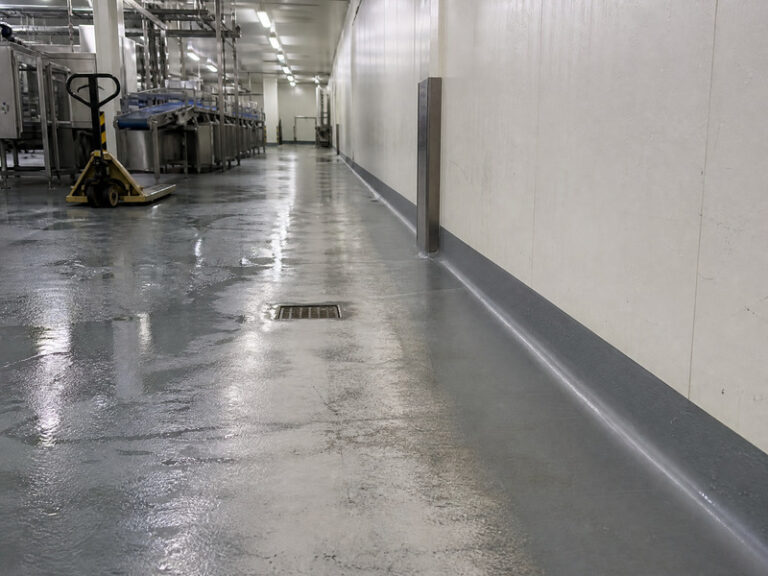
A BRCGS flooring nonconformity is almost never raised because a scheme names a resin. BRCGS, FSSC 22000 and SQF ask whether the floor is cleanable, maintained and documented, and the finding lands under maintenance, hygiene or record-keeping rather than under construction.
Four findings account for most of what we see: a damaged surface in a high-care zone, failed coving and sealant, drains that leave standing water, and no record that anyone has looked at the floor since it was installed.
This article sets out what the three schemes actually require, how an auditor grades severity, what evidence closes each finding, and how to build the floor file that keeps the question short next time.
What the three schemes actually say about floors
None of the three publishes a floor specification. What they publish is a requirement that surfaces be cleanable, in good repair, and maintained under a documented system. How you meet it is left to you.
That is why a food safety audit floor is usually a conversation about condition and evidence rather than about material. The auditor is not testing your resin; the auditor is testing whether you know the state of your floor.
BRCGS, FSSC 22000 flooring and the SQF floor requirement differ in wording and in grading convention, but the practical checklist is nearly the same. If a floor passes under one scheme, it will normally pass under the other two.
The differences that matter are documentation and frequency. One scheme expects a maintenance plan with dates, another expects evidence of monitoring, and a third asks for corrective actions with a root cause.
Read the standard text for your own version before an audit. Versions change, and the clause you memorised two editions ago may have moved or been rewritten into a different section.
Table 1: What each scheme asks of a floor, in practical terms.
| Scheme | Focus | Typical evidence |
|---|---|---|
| BRCGS Food Safety | Condition, maintenance plan, hygiene zones | Maintenance schedule, condition record, photos |
| FSSC 22000 | Prerequisite programmes, monitoring | PRP record, inspection log, repair history |
| SQF | Documented monitoring and correction | Monitoring log, corrective action records |
Nonconformity 1: damaged surface in a high-care zone
This is the most common finding, and the easiest to avoid. A chip at a doorway, a crack at a drain, a worn lane in a packing hall: each is a place where soil can sit and cleaning cannot reach. The finding is not the damage itself. It is that the damage is unrepaired and undocumented. A plant that maps its defects and schedules repairs is in a different position from one that discovers them during the audit walk.
The standard applied in a high-care zone is stricter, because the product is exposed after the barrier. A hygiene zone floor with a broken surface is a direct risk, and an auditor will treat it as such.
The usual audit nonconformity wording is about condition and cleanability, not about a specific defect size. That gives you room: a documented plan with dates and a temporary repair in place is a different answer from an unpainted crack.
Photograph the defect with a scale, log it, and record the decision: repair now, repair in the shutdown window, or monitor. The decision is what the auditor is reading. The surface is only part of the picture in a hygiene zone floor. The cove, the kerb and the drain collar are judged with it, because soil that leaves the field floor collects at the edges. A BRCGS flooring nonconformity that cites a broken cove is usually citing the field floor as well.
Nonconformity 2: failed coving and sealant joints
The floor-to-wall junction is where a BRCGS flooring nonconformity concentrates. A coved junction that has debonded, a sealant that has gone black, a cove that never had a radius: all three are visible at a glance and all three are cited.
Sealant is the usual weak point. A sanitary silicone applied over a damp or dusty surface fails within a year, and mould in the joint reads as a cleaning failure even when cleaning is adequate.
The repair that closes this finding is a formed coved junction rather than a bead of sealant, with the top edge detailed so it can be cleaned. Where a sealant is unavoidable, it should be a food-grade product with a documented cure and a replacement interval.
Auditors increasingly ask for the replacement interval, not just the product name. A joint with a stated service life and a recorded replacement date is a managed detail; one with neither is an open question.
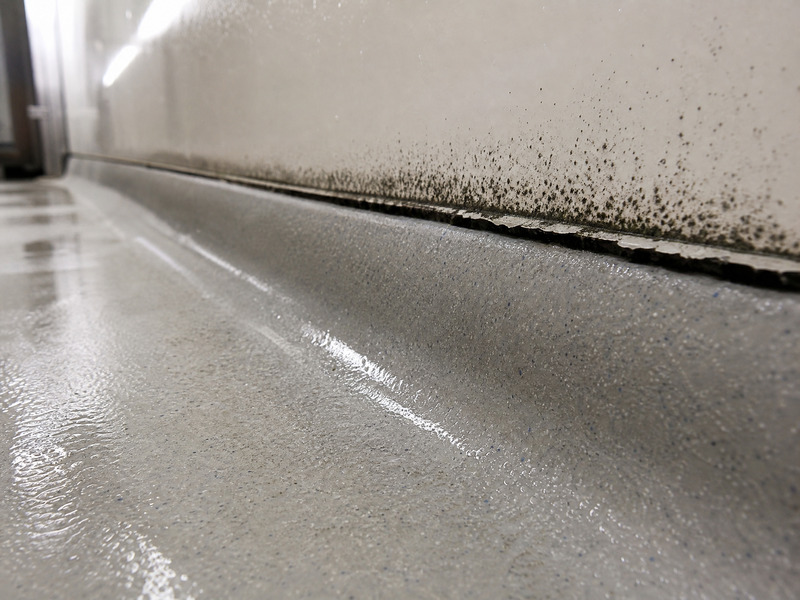
Figure 1: Mould at the top of a cove is a detail failure, not a cleaning failure. Replacing the bead without fixing the detail repeats it.
Nonconformity 3: drains, falls and standing water
Standing water after washdown is a BRCGS flooring nonconformity in every scheme, and a hygiene zone floor finding in most audits, and it is usually a fall problem rather than a drain problem. A floor built at 1:100 to a channel drains; one built flat with a gully in the corner does not.
The relevant numbers are unglamorous: 1:80 to 1:100 across the room, 2 percent locally at drain surrounds and thresholds, and a collar formed around the outlet rather than cut in afterwards.
Ponding in a hygiene zone floor is also a slip risk and a bacterial growth site, so the finding often arrives twice: once under drainage and once under cleaning.
The evidence that closes it is a water test with photographs, taken after the last repair and dated. An auditor who can see the floor draining has no reason to write the finding.
Where the fall cannot be corrected without major work, a temporary measure with a dated plan is a defensible position. Silence is not. A food safety audit floor that shows a dated plan with two open items reads better than one that shows nothing. The auditor is testing control, and a plan is the cheapest evidence of control a plant can produce.
Nonconformity 4: no floor condition records
This finding is about management, and it is the one that turns a small defect into a major nonconformity. If nobody can show when the floor was last inspected, the auditor has to assume it was not.
Floor condition monitoring does not need software. A plan marked with numbered locations, a monthly walk with photographs, and a one-page log with dates and actions is enough for most schemes.
The log should record what was seen, what was decided, and when the decision was verified. Three columns and a signature beat a folder of undated photographs.
Where a defect is monitored rather than repaired, the log needs a review date and a trigger for action. Monitoring without a trigger is how a monitored crack becomes an emergency in the shutdown window.
Table 2: A one-page condition log that satisfies the documentation question.
| Field | Content | Why the auditor wants it |
|---|---|---|
| Location ID | Grid reference on the plan | Shows the floor is known, not guessed |
| Observation | Defect type, size, photograph | Condition evidence |
| Decision | Repair, monitor, replace | Management response |
| Date and owner | Who decided, when | Accountability |
| Verification | Date closed and how checked | Loop closed |
How an auditor grades severity: minor, major, critical
Grading in any BRCGS flooring nonconformity follows risk and system failure, not the size of the defect. The same crack is minor in a dry store and major in a high-care room, so the scheme wording follows the zone rather than the damage. A small chip in a dry store, documented and scheduled, is minor or not raised at all. The same chip in a high-care area with no record can be major.
Critical is reserved for a direct risk to product safety or a systemic failure of control. A floor that is structurally open to the substrate in a ready-to-eat area, with no control in place, is the kind of case that reaches that level.
The pattern to understand is that documentation moves a finding down a grade and its absence moves it up. The physical defect is fixed; the management evidence is what you can still change on the day.
This is why FSSC 22000 flooring audits and SQF floor requirement audits produce similar findings on similar floors. The schemes differ in wording, and they converge on the same question: is this surface controlled?
When an audit nonconformity is raised, ask the auditor which requirement it sits under. The answer tells you what evidence will close it, and it stops the team from fixing the wrong thing.
Where floor condition monitoring already exists, the grading conversation changes. The auditor can see that the defect was known, that a decision was taken and that the decision carries a date.
Corrective action that closes the finding
The action has three parts: containment, correction and prevention. Containment is the temporary measure that makes the area safe today. Correction is the repair. Prevention is the change that stops the recurrence.
Most plants do the second and skip the third, which is why the same finding returns at the next audit. If a cove failed because the sealant was applied over a damp surface, the preventive action is a documented surface check before sealing.
Write the corrective action against the defect, not against the floor. “Repair bay 4 drain collar and change the detail to a formed collar” is verifiable; “improve floor maintenance” is not.
Attach evidence at each stage: photograph before, specification of the repair, photograph after, and the date verified. Auditors accept a documented plan in progress far more readily than an undocumented promise. An audit nonconformity is only closed when the record shows containment, correction and the date the verification was signed.
For repairing or replacing a resin floor during a shutdown, the containment should include a barrier, a cleaning instruction and a review date. That combination is usually enough to keep the finding at its original grade.
For a repeated finding, the SQF floor requirement and the audit nonconformity should be linked in the file. Two records describing the same defect, one raised and one closed, are the strongest evidence a plant can hold.
Table 3: The three parts of a corrective action, and what each one has to leave behind.
| Part | What it does | Evidence left |
|---|---|---|
| Containment | Makes the area safe and cleanable today | Barrier, cleaning instruction, review date |
| Correction | Repairs the defect to the specification | Photographs, material batch, test result |
| Prevention | Changes the step that allowed it | Revised method, briefing record, audit check |
Building a floor file before the audit
A floor file is four documents, and it is the answer to every BRCGS flooring nonconformity: the plan with locations, the condition log, the repair history with specifications, and the current specification for each hygiene zone. Everything else is supporting evidence.

Figure 2: The audit walk is where the floor file is tested. Everything the auditor asks for should already be in the folder.
Build it from the floor condition monitoring you already do informally. The maintenance team knows where the floor fails; the file simply writes it down with dates and locations, which is the difference between knowledge and evidence.
Where a BRCGS flooring nonconformity has been raised before, keep the closure evidence in the same file. A repeated finding with a documented history reads as a managed risk; the same finding with no history reads as neglect.
Review the file before the audit, not during it. A fifteen-minute walk with the plan in hand will find the two defects the auditor would have found, and you can decide what to do about them first.
Finally, align the file with your food safety audit floor schedule. If the audit is annual, the condition log should show at least quarterly entries, so the record demonstrates monitoring rather than a scramble in the week before.
In practice the FSSC 22000 flooring question and the SQF floor requirement question converge on the same file, and a coved junction with a replacement date is already documented.
This is the cheapest insurance in the building. A folder with four documents and a walk every month costs a few hours a year, and it converts most floor findings into closed items before they are written.
Frequently asked questions
Do BRCGS, FSSC 22000 or SQF require a specific flooring product?
No. They require cleanable, maintained surfaces with documented monitoring. Resin, tile or stainless steel can all comply if the condition and the records are there.
What is the most common flooring finding in a food safety audit?
A damaged surface in a high-care zone that has not been repaired or documented. The defect is usually small; the finding is about the absence of a record.
How do I close a flooring nonconformity quickly?
Contain, document, schedule. Put a barrier and a cleaning instruction in place, log the defect with a date, and set a repair date with a named owner. Evidence of control is what closes the item.
Is a crack in a dry store a nonconformity?
It can be, if it holds soil or water and nothing is recorded. In a dry area, a documented crack with a scheduled repair is usually minor; an undocumented one in a wet area is a different grade.
What evidence does an auditor accept for a floor repair?
Before and after photographs with dates, the repair specification, the material batch, and the verification that the repair performs. A corrective action without verification is treated as open.
How often should the floor be inspected?
Monthly for a working plan, quarterly as a minimum for the record. The frequency should match the risk in the zone, and the log should show it was done rather than promised.
Does a failed sealant joint count against hygiene or maintenance?
Either, depending on the scheme and the zone. It is cleaner to treat the coved junction as a detail defect with a replacement interval, because that framing produces a preventable action rather than a cleaning instruction.
Why food plants work with Kaida Paint
Kaida Paint manufactures epoxy, polyurethane, cementitious urethane and MMA systems for food and beverage plants, and supplies them as finished systems or as OEM and private-label production for distributors. Each batch ships with a certificate of analysis and a batch record, and TDS and SDS documents are issued in the buyer’s language. For plants preparing for an audit, our technical team will walk the floor with your plan and produce a condition schedule by hygiene zone, with the repairs ranked by risk and the detail drawings for coves and drains attached.
Send the site plan and the last audit report, and the reply is a condition schedule you can put straight into the BRCGS flooring nonconformity file.


 English
 Spanish
 Portuguese
 Arabic
 French
 Italian
 Russian
 Indonesian
 Swedish