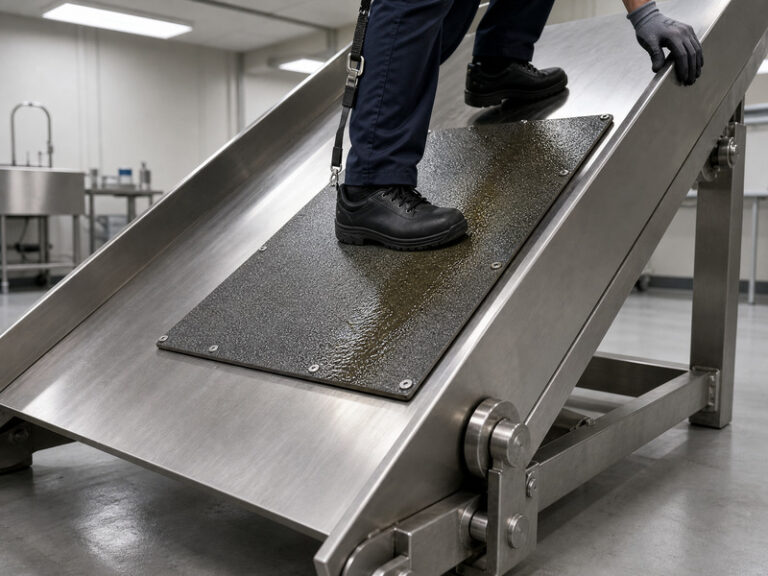
A DIN 51130 R rating is a classification of how slippery a floor is when a person walks on it in oil-wet shoes up an inclined ramp. The minimum that holds in a food plant is R9 in dry storage, R11 slip resistance in wet process rooms that stay wet through the shift and in high-care rooms, and R12 to R13 on ramps and dock levelers.
The class runs from R9 to R13, and each band covers a range of angles rather than one value. Choosing the right class depends on the contaminant in the area, the slope, the traffic and how the floor will be cleaned.
It is written for plant engineers, hygiene managers and specifying consultants who have to defend a slip requirement in front of an auditor, an insurer or a client.
1. What the R rating in DIN 51130 actually measures
The R stands for Rutschhemmung, the German term for slip resistance, and the number expresses a band of slip angles measured on a ramp. The test does not produce a coefficient of friction. It produces the angle at which a standard test person, wearing standard shoes and walking on a surface wetted with motor oil, loses grip.
No conversion factor exists between an R class and a friction value, because the two measurements use different instruments, different contaminants and different contact geometry. A DIN 51130 R rating describes a shod person on an oily surface, which is close to a maintenance walkway in a plant and far from a barefoot operative on a wet changing-room floor.
Because the slip resistance test method depends on a walking person rather than an instrument, the resulting classification describes the surface as built. A laboratory can reproduce that surface; a site cannot.
The class is also a floor classification, not a product classification. The same resin, broadcast at a different rate or sealed with a thicker topcoat, can land in two different classes. Treat the certificate as evidence about a specimen, and the specification as the instruction for the floor you actually build.
2. How the ramp test is run, step by step
The slip resistance test method is deliberately low-tech, which is why it survives in specifications where instrument readings do not.
- A sample of the finished surface is conditioned at laboratory temperature and placed on the ramp.
- The operator applies the test oil across the walking line, so the film is continuous and of consistent depth.
- The test person puts on the standard test shoes and stands on the sample at the lower end.
- The ramp tilts at roughly one degree per second while the person walks up and down the walking line in a defined pattern.
- The angle at which the person slips is recorded, and the run is repeated with the sample rotated and with more than one operator.
- The accepted slip angle for that surface is converted to a DIN 51130 R rating using the bands in section 3.
Because a human decides when grip is lost, repeatability is about one class at a band boundary. A result of 18.9° and a result of 19.3° can sit on opposite sides of the R10 and R11 line, which is why reputable laboratories report the angle as well as the class.
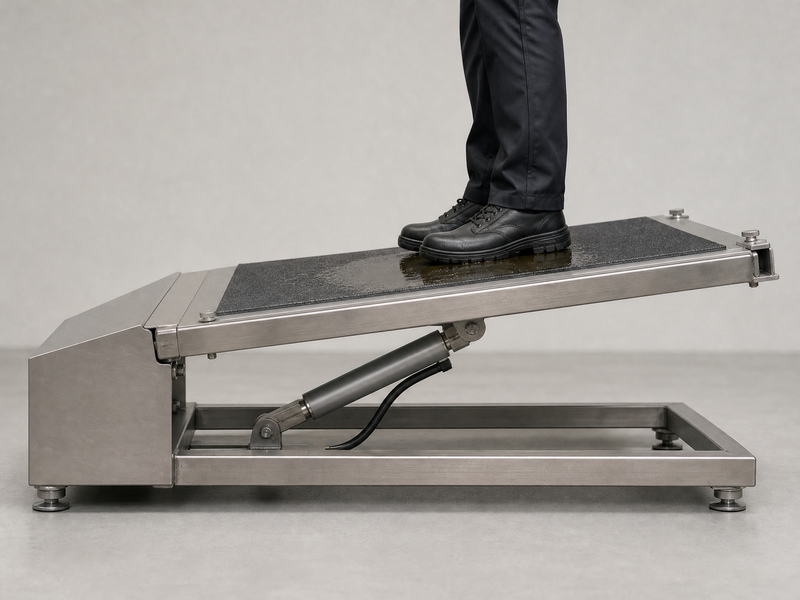
Figure 1: The ramp test records the angle at which the test person slips on an oil-wet sample, not a friction coefficient.
3. R9 to R13: what each class means on a working floor
The bands are wide, and two floors in the same class can feel different underfoot. Use the angle, not only the letter, when two suppliers quote the same class. In the table below, the percentage is the tangent of the test angle, not a floor fall; drainage fall is set separately at 1:80 to 1:100.
Table 1: DIN 51130 class bands, with the test angle and the rise over run that angle implies.
| Class | Slip angle | Rise over run | What it reads like underfoot |
|---|---|---|---|
| R9 | 6° to 10° | about 10.5% to 17.6% | Fine dry, marginal with a film of water or oil |
| R10 | over 10° to 19° | about 17.6% to 34.4% | Light wet contamination, low grease |
| R11 | over 19° to 27° | about 34.4% to 50.9% | Wet process areas, some fat and sugar |
| R12 | over 27° to 35° | about 50.9% to 70.0% | Fat, blood, fish, heavy contamination |
| R13 | over 35° | above 70.0% | Ramps, docks, standing liquid |
A slip resistance classification is read on the working floor, not on the certificate. An R11 slip resistance class suits a room that stays wet with water and detergent through the shift. An R12 floor is what fat, blood and fish waste demand.
Surfaces below 6° are not classified at all. A supplier quoting “R8” is quoting a class that does not exist, and “R9 equivalent” is a claim without a measured angle.
Up to R10, the profile is a texture. From R11 upward, the profile is a structure, and that structure starts to behave like a trap for soil. The choice is therefore never “the highest class available”. It is the lowest class that holds grip in the contaminant you actually have, because everything above that is paid for in cleaning time.
4. Minimum R rating by area in a food plant
Most disputes about this table come from applying one number to a whole building. This table sets a slip resistance classification per area rather than one DIN 51130 R rating for the building, because a food plant has at least four hydraulic regimes.
Table 2: Minimum DIN 51130 R rating by area, with the contaminant that drives the choice.
| Area | Contaminant | Minimum class | Note |
|---|---|---|---|
| Dry store, packaging of dry goods | Dust, occasional water | R9 | Cleaning is dry or damp, profile would trap powder |
| Dry production, corridors, offices | None to light | R9 to R10 | Traffic and cleaning method decide within the band |
| Wet process, vegetable and beverage | Water, detergent, sugar | R10 to R11 | R11 slip resistance where the floor stays wet through the shift |
| Meat, poultry, fish, ready-to-eat | Water, fat, blood, protein | R11 to R12 | R12 where fat or blood reaches the floor daily |
| Rendering, frying, high-fat cooking | Hot oil, fat | R12 | Check chemical and thermal resistance as well |
| Ramps, dock levelers, freezer approaches | Water, ice, condensation | R12 to R13 | Slope adds to the hazard; drainage matters more than class |
| Changing rooms, showers, footbaths | Soap and water, bare feet | DIN 51097 (barefoot) A to C | Different test, different standard; see section 6 |
Two rules keep this table honest. First, the class is set by the worst realistic condition in the area, not by the average day. Second, the class is set at the drain and around equipment, because that is where the liquid sits. A whole-room class applied uniformly usually means the dry corners are over-specified and the wet corner is under-specified. An R12 floor at the drain and an R9 finish in the dry corner is a specification; one class everywhere is a guess. A brewery floor is the standard case: sugar, hot caustic and one fall to the drain in the same room.
Retailer and certification-body audit standards rarely quote an R number directly. They ask for a floor that is “adequate for the conditions” and leave the number to the specification. That is precisely why the number has to be written down by someone, and why it should be written by the party that understands the cleaning regime.
5. How aggregate selection sets the R class
The class is manufactured, not purchased. Three variables decide where a resin floor lands: grit size, broadcast rate and how much topcoat goes over the aggregate.
- Grit size: aluminum oxide or silica in the 0.3 mm to 0.8 mm range covers most food plant work. Finer grit gives a smoother cleanable surface and a lower class. Coarser grit raises the class and raises the cleaning effort.
- Broadcast rate: an aggregate broadcast of about 300 to 600 g/m² covers R10 to R11, and 600 to 1000 g/m² is the usual range for R12. Confirm the rate on the system data sheet rather than assuming it.
- Topcoat: the seal coat binds the grit. Too little and the surface sheds particles into the product stream. Too much and the profile is buried, dropping the floor a class while the certificate still shows the higher one.
An aggregate broadcast that is uneven is worse than one that is slightly light. The rate on the data sheet assumes an even aggregate broadcast, and an uneven one leaves the floor coarse in patches and polished in others. Patches with a thin scatter polish smooth under traffic within months, and the floor then has two slip behaviors in one room.
Verification is where an aggregate broadcast is won or lost. Compare the mock-up with the production floor under raking light, screen both with a pendulum against the R11 slip resistance class of the approved panel, and confirm the DIN 51130 R rating by laboratory report before the main pour. On a large pour, check the broadcast visually under raking light every few square meters, and reject areas where the grit disappears into the resin.
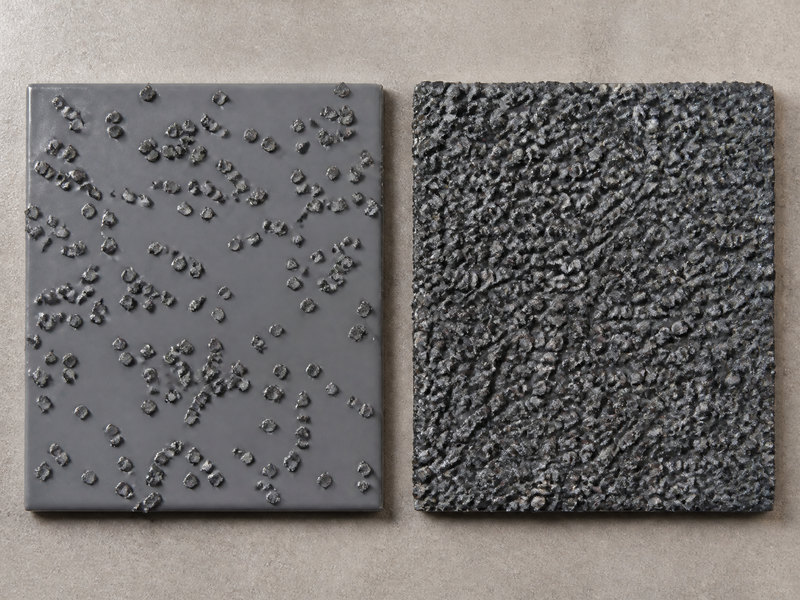
Figure 2: Aggregate broadcast at two rates, showing how topcoat thickness changes the profile that sets the class.
Table 3: DIN 51130 R rating compared with the other slip standards that appear on food projects.
| Standard | Footwear | Contaminant | Risultato | Main market |
|---|---|---|---|---|
| DIN 51130 | Standard test shoes | Motor oil | R9 to R13 | Europe, Middle East, most export specifications |
| DIN 51097 | Bare feet | Soap solution | A, B or C | Changing rooms, showers, barefoot crossings |
| AS 4586 | Standard shoes | Oil and water | P1 to P5 | Australia and New Zealand |
| ANSI A326.3 | Standard shoe sole | Water | DCOF, 0.42 threshold | Stati Uniti |
AS 4586 is the Australian and New Zealand standard behind the P1 to P5 classes, and DGUV Regel 108-003 is the German workplace rule that insurers apply to the same floor. ANSI A326.3 uses a wet DCOF threshold on level interior floors and replaced the earlier DCOF requirement in ANSI A137.1.
R, P and DCOF do not convert into each other, so a schedule that mixes them invites disputes. Name one slip resistance test method per project.
6. Slip resistance versus cleanability: resolving the conflict
Every step up in class costs cleaning time. A coarse profile holds food residue, and a brush that glides over R10 will skip across the tops of the grit on R12. In a high-care area, that residue is an audit finding waiting to happen.
The resolution is zoning, not compromise. Put the aggressive profile where the contaminant is, and keep the smooth surface where the cleaning standard is highest.
- High-care and ready-to-eat rooms: R11 with a fine, well-bonded aggregate and a full seal coat. The profile is enough for a wet floor, shallow enough for a squeegee and a brush. Coved skirting at the floor-to-wall junction is where residue collects.
- Wet low-care areas, kill floors, vegetable washing: an R12 floor, typically a uretano cementizio build that tolerates hot washdown, with drainage designed so water leaves rather than standing on the profile.
- Dry areas: R9, because a profile there collects powder and makes dry cleaning harder for no benefit.
- Barefoot areas: barefoot slip resistance is classified by DIN 51097 as A, B or C, tested with soap solution and bare feet. Class A covers 12° to 18°, B covers more than 18° to 24°, and C covers more than 24°. Do not carry an R number into a shower block and assume it applies.
There is a second conflict that rarely gets written down: the coefficient of friction measured on a dry floor tells you very little about the same floor with a film of chicken fat on it. Wet and contaminated conditions are the design case, and they are the reason the classification exists in the first place. Where a room is also subject to a barefoot slip resistance requirement, the DIN 51097 class replaces the DIN 51130 R rating instead of adding to it.
7. Why a laboratory certificate is not your floor
A DIN 51130 R rating on a certificate describes a specimen prepared by the manufacturer, usually in ideal conditions. The floor in your plant was mixed on site, broadcast by hand, sealed at whatever temperature the building happened to be, and walked on before the topcoat was hard.
Four things move the result between the specimen and the floor:
- Broadcast consistency across a large pour, especially where the crew works ahead of the resin.
- Topcoat thickness, which varies with roller technique and with how much the applicator thins the seal coat.
- Contamination, from dust, from curing residues, or from a primer that was not fully cured.
- Cure temperature, which changes how the aggregate beds into the body coat.
The practical control is a mock-up panel poured on site, in the same conditions, with the same crew, and tested before the main pour starts. Keep the panel. If a dispute arises eighteen months later, the panel is the only physical evidence of what was specified and what was built. Panels tested before the main pour show aggregate loss at the drain.
Ask for the slip resistance test method and the DIN 51130 R rating on the same document, and file both in the acceptance testing record. A report that gives the class without the angle cannot be checked against the panel, and a panel that was never tested cannot settle an argument.
When a floor underperforms, the argument is almost never about the resin. It is about the slip resistance classification, and it is settled by a cut sample tested against the approved panel. Keep both, and keep the test report that states the angle.
8. Writing the slip requirement into a tender document
A tender clause that names only the class invites three quotes that cannot be compared. Name the slip resistance test method, the class per area, the aggregate, the seal and the verification.
Floor slip resistance shall be classified to DIN 51130 by an accredited laboratory on a specimen matching the proposed build. Minimums: R9 in dry storage, R10 to R11 in wet process, R11 to R12 in meat, poultry, fish and ready-to-eat areas, R12 in rendering and high-fat cooking, R12 to R13 on ramps and dock levelers. Aggregate shall be aluminum oxide, 0.3 mm to 0.8 mm, broadcast at the rate on the system data sheet, fully bonded with no loose grit. A site mock-up of at least 10 m² shall be poured, cured and inspected before the main works; loose aggregate, visible topcoat pooling or bare patches shall be rejected.
State the slip resistance classification per area in the schedule, never in a general note at the end of the specification. Where a ramp carries an R12 floor, add the barefoot slip resistance class for the adjacent changing area, and record the measured slip angle of the approved panel as the baseline. A coefficient of friction taken by another method is a trend, not a conversion.
Add two sentences that cost nothing and prevent most arguments. Require the laboratory report to state the measured slip angle, not only the class. Require the contractor to record broadcast rate and topcoat consumption per area, because those two numbers explain most of the cases where a floor underperforms its certificate.
For a mixed portfolio, keep a single schedule with one line per area. Auditors read schedules; they do not read specifications.
Frequently asked questions
What does an R11 slip resistance class mean?
R11 means the surface resisted slipping at an angle of more than 19° and up to 27° in the DIN 51130 ramp test, with motor oil as the contaminant and standard shoes on the test person. It is the usual starting class for a wet food process area where water and light grease reach the floor.
Is a DIN 51130 R rating the same as DCOF 0.42?
No. ANSI A326.3 measures dynamic coefficient of friction with a different instrument on a level, wet surface and sets 0.42 as the threshold for level interior floors. DIN 51130 classifies an inclined, oil-wet surface by the angle of slip. The two cannot be converted into each other, and a specification should name one method per project.
Can the ramp test be repeated on site after handover?
Not reliably. The ramp test needs a controlled specimen, a standard contaminant and a trained operator, so it belongs in a laboratory. On site you can screen with a pendulum, record the reading with its location, and compare it with the same reading taken on the approved mock-up. Treat the pendulum as a trend, and the laboratory report as the classification.
What is the difference between an R rating and barefoot slip resistance?
The R rating is measured with shod feet and oil. Barefoot slip resistance uses DIN 51097, with bare feet and a soap solution, and reports class A, B or C. Changing rooms, showers and some footbath crossings need the barefoot test, because shoes and soap change the contact completely.
Does a higher class always mean a better floor?
No. Above R11 the profile starts to hold soil, and cleaning time, water and chemical consumption rise with it. The slip resistance classification describes grip, not hygiene. In a high-care room, an unnecessarily coarse floor can create a hygiene finding that outweighs the slip benefit. Specify the lowest class that holds grip in the actual contaminant.
How much aggregate does an R12 floor need?
Typical practice is a broadcast of about 600 to 1000 g/m² of aluminum oxide or silica in the 0.3 mm to 0.8 mm range, with a seal coat thin enough to leave the profile visible. Confirm the rate with the system data sheet, and check the cured surface for loose grit before accepting the area.
Which class should a cold room floor have?
R11 to R12 in the room, and R12 on the approach ramp and at the door threshold where condensation and ice form. Below zero, the surface must stay profiled after thermal cycling, so check that the aggregate is fully bonded rather than relying on the class alone.
What R rating does a food factory floor need?
A wet food process area needs R10 to R11, and R11 where the floor stays wet through the shift. A high-care room needs R11 to R12, set in the DIN 51130 R rating scale with motor oil and standard shoes. Dry storage needs R9. Give the class per area, because one number for the whole building is where most slip disputes start.
Why food plants work with Kaida Paint
Kaida Paint formulates and manufactures food processing flooring systems: epoxy, polyurethane, cementitious urethane and MMA for food and beverage plants, commercial kitchens and cold stores. Slip resistance is specified at the system level, not added at the end of the job.
- We state the aggregate type, grit size and broadcast rate for each system in the technical data sheet, so the class can be reproduced rather than approximated.
- We supply the full build from one formulation family: primer, body coat, broadcast, seal coat and coving, which keeps responsibility for a slip failure in one place.
- We support the mock-up stage, including the panel size, the cure conditions and what to inspect before the main pour starts.
- We decline to certify a class the build cannot hold, and we will say so before the material ships rather than after the floor is down.
Send your area schedule, cleaning chemicals and washdown temperatures, and we will return a system recommendation with the class each area can hold.






 English
 Spanish
 Portuguese
 Arabic
 French
 Italian
 Russian
 Indonesian
 Swedish