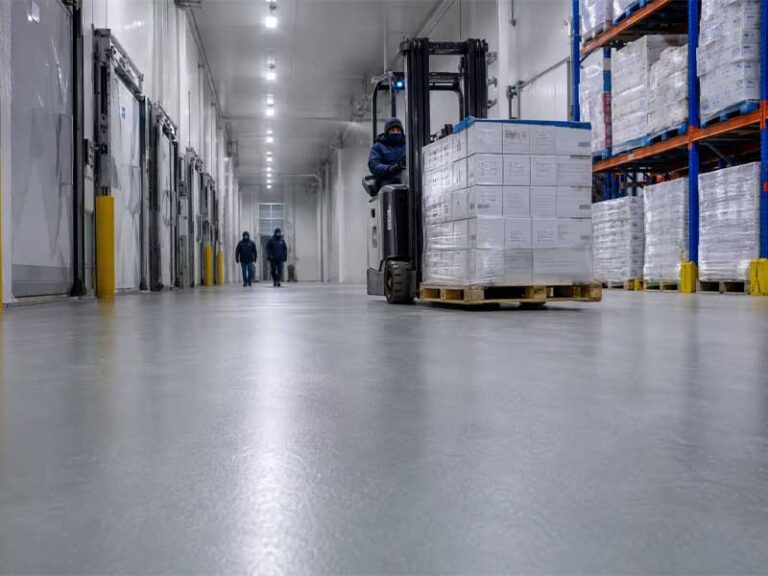
Best Flooring For Cold Storage: Quick Recommendation
| Facility Type | Best Flooring |
|---|---|
| Walk-In Freezer (below -20°C) | MMA |
| Blast Freezer (below -30°C) | MMA |
| Frozen Food Processing Plant | MMA |
| Meat Processing Facility | MMA |
| Pharmaceutical Cold Storage (2°C to 8°C) | MMA |
| Refrigerated Warehouse (0°C to 4°C) | MMA |
| Dry Packaging Area | Epossidico |
| Office / Retail Space | Epossidico |
Sintesi: For most cold storage facilities operating below freezing temperatures, MMA flooring is the preferred system due to its rapid cure, thermal shock resistance, and ability to install without shutting down refrigeration.
What Is The Best Flooring For Cold Storage?
MMA flooring is generally considered the best flooring system for cold storage facilities because it cures at sub-zero temperatures as low as -30°C (-22°F), returns to service within 1–2 hours, and withstands thermal shock from hot washdowns, organic acids from food spills, and aggressive sanitation procedures. Epoxy flooring is typically limited to refrigerated spaces above freezing where longer installation downtime of 3–7 days is acceptable.
MMA Flooring vs Epoxy for Cold Storage:
For cold storage facilities operating below 0°C (32°F), MMA flooring is the better choice because it can cure at temperatures as low as -30°C, returns to service within 1–2 hours, and withstands thermal cycling from hot washdowns.
Epoxy flooring is suitable for dry refrigerated spaces above freezing where extended installation downtime is acceptable. Standard epoxy requires ambient temperatures at or above 10°C for proper cure, and cold-cure variants typically cannot go below 2°C.
Key Differences At A Glance
| Fattore | MMA Flooring | Pavimentazione epossidica |
|---|---|---|
| Tempo di polimerizzazione | 1-2 ore | 24-72 ore |
| Minimum Installation Temperature | -30°C (-22°F) | 10°C (50°F) standard; 2°C cold-cure variant |
| Resistenza agli shock termici | Eccellente | Povero |
| Lifespan in Freezers | 10–20+ years | 3–7 years |
| Return To Service | Same day | Up to 7 days |
| Organic Acid Resistance | Eccellente | Moderato |
| Stabilità UV | Eccellente | Povero |
| ROI Over 10 Years | Più alto | Lower (due to replacement costs) |
1. What Is MMA Flooring And How Does It Work?
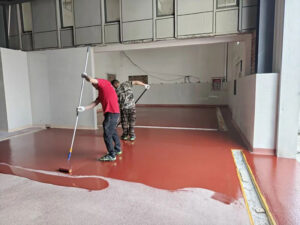
Methyl Methacrylate (MMA) flooring is a high-performance acrylic resin system that cures through a cold-cure polymerization process. A methacrylic ester is combined with an organic peroxide catalyst, triggering rapid polymerization that forms a solid, monolithic mass within minutes.
How The Installation Works
- Primer application: A penetrating primer ensures strong adhesion to the concrete substrate, even in cold or damp conditions.
- Body coat installation: The MMA resin and hardener are mixed with aggregates and troweled or rolled onto the surface to form the main structural layer.
- Topcoat sealing: A seal coat is applied to provide chemical resistance, hygiene, and optional slip-resistant texture.
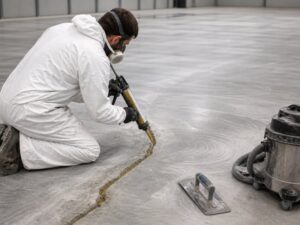
- Chemical bonding: New MMA layers chemically fuse to existing ones—even if applied hours or days apart—enabling seamless repairs and future upgrades without full removal.
The entire system achieves full mechanical and chemical cure within 60 to 120 minutes, even in blast freezers operating at -30°C.
2. What Is Epoxy Flooring And How Does It Perform?
Epoxy flooring is a thermosetting resin system created by mixing epoxy resin with a hardening agent. Once applied, it undergoes an exothermic curing reaction that forms a rigid, durable plastic surface that bonds strongly to properly prepared concrete substrates.
Standard Epoxy Characteristics
- High compressive strength: Epoxy floors can withstand heavy loads from forklifts, machinery, and constant foot traffic.
- Wide aesthetic range: Available in various colors, gloss levels, and decorative finishes including flakes and metallic effects.
- Good general chemical resistance: Resists many oils, solvents, and chemicals commonly found in industrial environments.
Critical Limitations For Cold Storage
- Temperature-sensitive curing: Standard epoxy requires ambient temperatures at or above 10°C (50°F) for proper cure. Cold formulations can cure as low as 2°C (35°F), but this remains above freezing.
- Extended downtime: Epoxy typically requires 24-72 hours to cure, with full strength achieved over 5-7 days.
- Thermal shock vulnerability: Epoxy becomes brittle in freezing conditions and can crack when exposed to rapid temperature changes.
- UV yellowing: Epoxy lacks UV stability and will yellow or chalk when exposed to light.
- Organic acid vulnerability: Food products and beverages can leak organic acids that break down epoxy flooring systems.
3. MMA vs Epoxy For Cold Storage: Complete Performance Comparison
| Caratteristica | MMA Flooring | Pavimentazione epossidica | Cold Storage Impact |
|---|---|---|---|
| Tempo di polimerizzazione | 1-2 ore | 24–72 hours (full strength 5-7 days) | MMA minimizes downtime; epoxy requires extended shutdown |
| Minimum Installation Temperature | -30°C (-22°F) | 10°C (50°F) standard; 2°C cold-cure | MMA installs in operating freezers; epoxy requires temperature control |
| Ritorno in servizio | Same day | 3-7 giorni | MMA enables 24/7 operations; epoxy causes production losses |
| Resistenza agli shock termici | Eccellente | Poor—prone to cracking | MMA withstands hot washdowns; epoxy fails under thermal cycling |
| Resistenza chimica | Excellent against organic acids, alkalis, salts | Moderate—vulnerable to organic acids | MMA resists food acids; epoxy breaks down |
| Flessibilità | Moderate—absorbs thermal expansion/contraction | Low—rigid and brittle in cold | MMA accommodates substrate movement; epoxy cracks |
| Stabilità UV | Excellent—minimal yellowing | Poor—yellows and chalks | MMA suitable for naturally lit areas; epoxy degrades |
| Repairability | Easy—new layers chemically bond to existing | Time-consuming—requires mechanical abrasion | MMA allows quick spot repairs; epoxy repairs cause extended downtime |
| Durata della vita | 10–20+ years with proper maintenance | 3–7 years in demanding environments | MMA provides long-term value; epoxy has shorter lifespan |
| Upfront Cost | Higher ($15-25/sq.ft.) | Lower ($5-15/sq.ft.) | MMA has higher initial investment; epoxy is cost-effective for light-duty applications |
4. Expert Insight: What Flooring Contractors See Most Often
Based on Pavimenti per celle frigorifere projects completed over the last 15 years, the most common causes of floor failure are:
- Thermal shock cracking – Epoxy floors crack when hot washdown water (up to 82°C/180°F) contacts freezing surfaces (as low as -30°C). Only urethane mortar and MMA systems can withstand such severe temperature changes without breaking down.
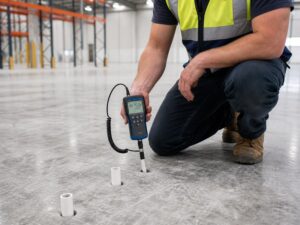
- Delamination due to moisture vapor – Vapor pressure from beneath the slab pushes flooring off the substrate. Moisture vapor transmission must be less than 3 pounds per ASTM F-1869.
- Chemical attack from organic acids – Food acids break down the epoxy polymer matrix.
- Downtime-related installation shortcuts – Contractors rush epoxy installations to reduce shutdown periods, resulting in poor bonding and premature failure.
In facilities operating below freezing, MMA flooring consistently demonstrates longer service life and lower repair frequency than conventional epoxy systems.
5. Why MMA Flooring Is The Superior Choice For Cold Storage
5.1 Ultra-Fast Cure Minimizes Operational Downtime
Cold storage facilities typically operate 24/7 to preserve perishable goods. Extended shutdowns for flooring installation can result in significant product loss and revenue impact.
- MMA advantage: Full cure within 1-2 hours allows operations to resume the same day.
- Epoxy disadvantage: Requires 3-7 days of downtime, often forcing facility owners to relocate inventory or accept product spoilage.
5.2 Cold-Temperature Installation Without Temperature Control
Standard resin floors require warm ambient temperatures for proper cure. Polyurethane flooring requires temperatures at or above 4°C (40°F), and epoxy requires an even higher temperature—at or above 16°C (60°F).
MMA solution: MMA can be installed at temperatures as low as -30°C without additional heating, enabling installation in operating freezers with no temperature adjustment.
5.3 Thermal Cycling And Hot Washdown Resistance
Cold storage environments experience extreme thermal cycling—floors may drop to -30°C and then be exposed to hot water washdowns at 82°C during cleaning procedures.
The problem with epoxy: Epoxy becomes brittle at low temperatures. When hot water contacts the cold surface, the rapid thermal expansion causes stress fractures.
MMA advantage: MMA maintains flexibility across a wide temperature range and resists thermal shock without cracking.
5.4 Superior Resistance To Organic Acids And Chemicals
Food storage environments frequently experience spills of organic acids from meat, dairy, and produce.
- Epoxy vulnerability: Organic acids break down the epoxy polymer matrix, causing surface softening, discoloration, and eventual failure.
- MMA resistance: MMA formulations resist most organic and mineral acids, alkalis, salt solutions, natural oils, and fats commonly found in food processing environments.
5.5 Long-Term Durability And Lifecycle Value
While MMA has higher material costs, it typically lasts 10-20 years with proper maintenance compared to 3-7 years for epoxy in demanding cold storage environments.
Lifecycle cost comparison (10-year horizon):
| Fattore di costo | MMA Flooring | Pavimentazione epossidica |
|---|---|---|
| Initial Installation | Più alto | Lower |
| Installation Downtime Cost | Lower (1 day) | Higher (7 days) |
| Repairs/Recoating | Minimal—spot repairs | Significant—full recoat every 3-7 years |
| Durata della vita | 10-20 anni | 3-7 years |
| 10-Year Total Cost | Lower | Più alto |
6. Example Project: MMA Flooring In A Frozen Food Distribution Center
Facility Details
| Parametro | Detail |
|---|---|
| Facility Type | Frozen Food Warehouse |
| Size | 60,000 sq.ft. |
| Operating Temperature | -20°C |
| Existing Flooring | Epoxy (failed after 4 years) |
The Challenge
The existing epoxy floor developed cracks and delamination after repeated hot-water cleaning procedures. The facility experienced:
- Floor failure covering approximately 15% of the surface
- Safety hazards from loose epoxy fragments
- Production disruptions during repair work
- Unsanitary conditions due to trapped moisture and bacteria
The Solution
A 6 mm MMA flooring system was installed directly in the operating freezer environment without raising the temperature.
The Results
| Metric | Risultato |
|---|---|
| Tempo di installazione | Completed without shutting down refrigeration |
| Ritorno in servizio | Within 2 hours |
| Thermal Shock Cracking | Zero failures after 5 years |
| Maintenance Costs | Reduced by 60% compared to previous epoxy |
| Forklift Traffic Performance | No visible wear after 5 years of daily operations |
7. MMA Flooring vs Other Flooring Systems
MMA vs Urethane Cement Flooring
Urethane cement flooring offers excellent thermal shock resistance and is often used in food processing. However, it typically requires longer curing times and warmer installation conditions than MMA. For operating freezers where rapid return-to-service is critical, MMA provides a faster alternative.
MMA vs Polyurethane Flooring
Polyurethane (PU) flooring is commonly used in food and cold storage environments due to its durability and hygiene properties. However, PU often requires longer curing times and can be more sensitive to sub-zero conditions, leading to extended downtime. MMA offers similar durability with the added benefit of 1-2 hour curing even in freezing conditions.
MMA vs Polyaspartic Flooring
Polyaspartic flooring cures faster than epoxy but typically requires warmer installation temperatures than MMA. For cold storage environments below freezing, MMA remains the more reliable choice.
MMA vs Acrylic Flooring
MMA is a methyl methacrylate acrylic resin, but not all acrylic floors offer the same cold-temperature curing capability. MMA systems are specifically formulated for extreme temperature performance.
8. When Is Epoxy Flooring The Better Choice?
Despite MMA’s superior performance in cold storage, epoxy flooring remains a viable option in specific scenarios:
8.1 Light-Duty Cold Storage With Low Temperature Variation
- Small walk-in coolers used for short-term storage
- Facilities where temperatures remain consistently above freezing
- Environments without hot water washdowns or aggressive cleaning protocols
8.2 Dry Processing Areas
Epoxy systems excel in dry processing environments where moisture and thermal shock are not factors:
- Dry goods warehouses
- Packaging areas
- Office and retail spaces within cold storage facilities
8.3 Budget-Constrained Projects
For facilities with limited capital budgets and the ability to schedule extended downtime, epoxy offers lower upfront costs. However, project owners should carefully evaluate long-term replacement and maintenance costs.
9. How To Choose Between MMA And Epoxy Flooring
Decision Tree
Is the facility below 0°C (32°F)?
├─ Yes → MMA Flooring
└─ No
 ├─ Are hot water washdowns used?
 │ ├─ Yes → MMA Flooring (thermal shock risk)
 │ └─ No
 │
 ├─ Is extended downtime acceptable (3-7 days)?
 │ ├─ Yes → Epoxy Flooring
 │ └─ No → MMA Flooring
 │
 ├─ Are organic acids present (food spills)?
 │ ├─ Yes → MMA Flooring
 │ └─ No → Epoxy Flooring
Facility Type Recommendations
| Facility Type | Recommended Flooring | Rationale |
|---|---|---|
| Walk-in Freezer (-20°C to -30°C) | MMA | Can be installed at operating temperature; resists thermal shock; rapid return-to-service |
| Blast Freezer | MMA | Extreme cold tolerance; withstands rapid temperature fluctuations |
| Meat Processing Plant | MMA | Resists organic acids from meat; withstands hot washdowns |
| Dairy Facility | MMA | Resists lactic acid; withstands thermal cycling |
| Pharmaceutical Cold Storage (2°C to 8°C) | MMA | Hygienic seamless surface; minimal downtime for installation |
| Refrigerated Warehouse (0°C to 4°C) | MMA (preferred) or Cold-Cure Epoxy | MMA for 24/7 operations; epoxy if extended downtime is acceptable |
| Dry Packaging Area | Epossidico | Cost-effective; no thermal shock or organic acid exposure |
| Office Area | Epossidico | Lower cost; decorative options available |
10. Common Cold Storage Flooring Mistakes
Installing Standard Epoxy Inside Freezers
Most epoxy products cannot cure properly below 10°C (50°F). Cold-cure variants exist but typically cannot go below 2°C (35°F). Installing standard epoxy in freezer conditions leads to incomplete cure, poor adhesion, and premature failure.
Ignoring Thermal Shock Exposure
Hot-water washdowns (up to 82°C) in freezing environments are a leading cause of flooring failure. Only MMA and urethane cement systems can withstand such severe temperature changes without breaking down.
Choosing Flooring Based Only On Initial Cost
Downtime and replacement costs often exceed material costs. A lower upfront cost epoxy may cost more over the lifecycle than higher-cost MMA.
Skipping Moisture Vapor Testing
Moisture-related delamination is one of the most common flooring failures. For on-grade or below-grade installations, moisture vapor transmission must be less than 3 pounds per ASTM F-1869 and less than 80% RH per ASTM F-2170.
Failing To Consider Installation Temperature Requirements
Facilities operating at low temperatures cannot afford to raise the temperature for flooring installation. MMA is the only resin system that can be installed below freezing without costly temperature control.
11. Cold Storage Flooring Selection Checklist
Before selecting a flooring system, ask:
- ✓ What is the lowest operating temperature?
- ✓ Are hot-water washdowns used (temperature and frequency)?
- ✓ Is forklift traffic present (load weight and frequency)?
- ✓ What chemicals are used for cleaning?
- ✓ How much downtime is acceptable for installation?
- ✓ Is USDA/FDA compliance required?
- ✓ What is the expected service life?
- ✓ What is the maintenance budget?
- ✓ Is moisture vapor testing required (on-grade slab)?
- ✓ What is the substrate condition (concrete, metal, existing coating)?
12. MMA Flooring Installation Considerations
12.1 Installation Temperature Parameters
MMA flooring can be installed across a wide temperature range from -30°C to 30°C without requiring temperature control. This makes it the only viable resin flooring option for:
- Walk-in freezers and blast freezers
- Unheated construction sites
- Facilities where refrigeration cannot be shut down
12.2 Ventilation And Safety
MMA emits a strong acrid odor during installation due to volatile organic compounds (VOCs). Key safety considerations:
- Requires proper ventilation during application
- Installers must wear appropriate personal protective equipment (PPE)
- The odor dissipates quickly as the material cures within 1-2 hours
- Areas can be safely reoccupied once the odor has cleared
12.3 Substrate Preparation
Proper surface preparation is critical for both MMA and epoxy:
- Concrete substrate must be clean, dry, and free of dirt, waxes, and curing agents
- Mechanical preparation (shot blasting or grinding) ensures optimal bond
- MMA primers enhance adhesion in cold or damp conditions
- Moisture vapor emission testing should be performed per ASTM F-1869
12.4 Trained Installation Required
MMA flooring requires installation by trained professionals experienced with its unique properties. The fast-cure nature means applicators must work quickly and precisely—mixing ratios, application timing, and coverage rates must be carefully controlled.
13. People Also Ask
Is MMA Flooring Worth The Extra Cost For Cold Storage?
Yes. Although MMA flooring costs 30%–100% more initially than epoxy, most cold storage operators recover the investment through reduced downtime, fewer repairs, and longer service life. Over a 10-year period, MMA typically costs less overall than epoxy for facilities operating below freezing.
What Is The Best Flooring For A Walk-In Freezer?
MMA flooring is generally considered the best resin flooring for walk-in freezers because it can be installed and cured below freezing temperatures while resisting thermal shock, organic acids, and ice-related movement. Its 1-2 hour cure time allows same-day return to service.
Can Epoxy Crack In Freezers?
Yes. Standard epoxy becomes increasingly brittle at low temperatures and may crack when exposed to repeated thermal cycling or hot-water sanitation procedures. Thermal shock is one of the most common causes of epoxy failure in cold storage environments.
Which Flooring Lasts Longer In Cold Storage?
MMA flooring typically lasts 10–20 years in freezer environments. Epoxy flooring typically lasts 3–7 years under similar conditions. The difference is primarily due to MMA’s superior thermal shock resistance and flexibility at low temperatures.
Can MMA Flooring Be Installed Over Existing Epoxy?
In most cases, yes. Existing epoxy floors must be properly prepared (cleaned, abraded, and primed) before installing MMA. However, the presence of moisture vapor or delamination in the existing epoxy may require removal of the old floor. A site assessment is recommended.
What Thickness Is Recommended For Freezer Flooring?
For freezer environments, a minimum system thickness of 4–6 mm (3/16″ to 1/4″) is recommended for MMA flooring. This provides adequate protection against thermal shock and heavy forklift traffic.
Does MMA Flooring Require Expansion Joints?
MMA flooring can span minor cracks and accommodate some substrate movement due to its moderate flexibility. However, expansion joints should still be maintained in the substrate and reflected through the flooring system per ACI 302 guidelines.
Is MMA Flooring Suitable For Pharmaceutical Cold Storage?
Yes. MMA flooring offers seamless, hygienic surfaces that meet pharmaceutical industry requirements. It resists cleaning agents used in pharmaceutical facilities and can be installed in temperature-controlled environments without shutting down operations.
What Is The Coefficient Of Thermal Expansion Of MMA Flooring?
MMA flooring has a coefficient of thermal expansion similar to concrete, approximately 2.5–3.5 × 10⁻⁵/°C. This compatibility with concrete substrates helps prevent delamination during temperature changes.
How Often Should MMA Flooring Be Inspected?
Annual inspections are recommended for MMA flooring in cold storage environments. The inspection should check for surface wear, cracks, delamination, and chemical damage. Early detection of issues allows for cost-effective spot repairs.
Can Forklift Traffic Damage MMA Flooring?
MMA flooring is designed to withstand heavy forklift traffic when installed at the correct thickness (4–6 mm). The surface can be enhanced with slip-resistant aggregates for safety. No visible wear was observed after 5 years of daily forklift operations in the example project.
Is MMA Flooring USDA Compliant?
Yes. MMA flooring systems can be formulated to meet USDA and FDA food contact and sanitation requirements for food processing and cold storage facilities. Properly installed MMA floors provide seamless, non-porous surfaces that resist bacterial growth and are easily sanitized.
What Are Industry Standards For MMA Flooring?
MMA flooring systems typically meet or exceed ASTM C884 for thermal shock testing of resin flooring, ASTM F3010 for two-component resin flooring systems, and ASTM D4060 for abrasion resistance. ICRI (International Concrete Repair Institute) and ACI 302 guidelines also apply.
Is MMA Flooring Environmentally Safe?
MMA flooring is non-toxic and extremely low in volatile organic compounds (VOCs). The material does exhibit a distinct odor during installation; however, this is entirely harmless and can be eliminated with proper ventilation.
Can MMA Flooring Be Refreshed?
Yes. A dated MMA floor can be refreshed by layering a new MMA coating on top of the old one. The new layer chemically fuses to the previous floor, creating a monolithic system that will not delaminate. This allows upgrades for a fraction of the cost, time, and disruption of full replacement.
14. MMA Flooring For Food Processing Plants
Why MMA Is Preferred In Food Processing Cold Storage
Food processing plants with integrated cold storage present unique challenges:
- Frequent hot water and chemical sanitation cycles
- Organic acid exposure from food products
- Strict hygiene and bacteria control requirements
- 24/7 operation with limited shutdown windows
MMA flooring addresses all these challenges:
- Resistenza agli shock termici prevents cracking during sanitation
- Resistenza chimica protects against organic acids and cleaning agents Superficie senza cuciture eliminates bacteria harborage points
- Rapid cure enables weekend or overnight installations
Industry Standards Reference
MMA flooring systems for food processing typically meet or exceed:
- ASTM C884 for thermal shock testing of resin flooring
- ASTM F3010 for two-component resin flooring systems
- USDA sanitation requirements for food contact surfaces
- FDA guidance for food facility design
- ICRI and ACI 302 guidelines for resin flooring
15. MMA Flooring For Blast Freezers
Extreme Environment Requirements
Blast freezers operate at temperatures as low as -40°C and experience:
- Extremely rapid temperature fluctuations
- Heavy forklift traffic loading and unloading products
- Ice formation and removal
- Occasional hot water cleaning
MMA Performance In Blast Freezers
- Installation: Can be installed at -30°C without warming the room
- Cura: Full cure within 2 hours at operating temperature
- Thermal performance: Maintains structural integrity through extreme thermal cycling
- Durata: Resists freeze-thaw damage and impact from ice removal
Epoxy is not recommended for blast freezers due to its brittleness at very low temperatures and susceptibility to thermal shock cracking.
16. MMA Flooring vs Epoxy: Cost Analysis And ROI
16.1 Initial Installation Costs
| Cost Component | MMA Flooring | Pavimentazione epossidica |
|---|---|---|
| Costo del materiale | $15-25/sq.ft. | $5-15/sq.ft. |
| Tempo di installazione | 1-2 days | 5-7 giorni |
| Costo del lavoro | Higher (specialized application) | Lower (standard application) |
| Temperature Control | None required | Heating/HVAC may be needed |
| Total Installation Cost | $20-35/sq.ft. | $10-25/sq.ft. |
16.2 Downtime Cost Impact
Formula: Downtime Cost = (Daily Facility Revenue) × (Days of Shutdown)
Example: A 50,000 sq.ft. cold storage warehouse generating $100,000/day in throughput revenue:
| Scenario | MMA | Epossidico |
|---|---|---|
| Installation Days | 1 day | 7 giorni |
| Lost Revenue | $100,000 | $700,000 |
| Additional Cost (product relocation/spoilage) | $0 | $50,000-$200,000 |
16.3 10-Year Total Cost Comparison
Assumptions: 50,000 sq.ft. facility, $100,000/day revenue, moderate traffic
| Expense Item | MMA Flooring | Pavimentazione epossidica |
|---|---|---|
| Initial Installation | $1,250,000 | $750,000 |
| Installation Downtime Loss | $100,000 | $700,000 |
| Maintenance (10 years) | $25,000 | $100,000 |
| Replacement (10 years) | $0 | $750,000 |
| Total 10-Year Cost | $1,375,000 | $2,300,000 |
MMA provides $925,000 cost savings over 10 years for this facility size.
17. Key Takeaways
- MMA flooring can cure at temperatures as low as -30°C (-22°F), making it ideal for operating freezers.
- MMA returns to service within 1–2 hours, minimizing operational downtime.
- MMA resists thermal shock from hot washdowns (up to 82°C) that cause epoxy to crack.
- MMA withstands organic acids from food spills that degrade epoxy.
- MMA lasts 10–20 years in cold storage versus 3–7 years for epoxy.
- Epoxy flooring requires warmer installation temperatures (10°C minimum).
- Epoxy is more economical upfront but often costs more over the total flooring lifecycle.
- MMA is the preferred flooring system for freezers, blast freezers, meat processing, dairy facilities, and pharmaceutical cold storage.
- Epoxy remains suitable for dry refrigerated spaces, packaging areas, and offices where downtime is acceptable.
- Annual inspections and prompt repairs extend the service life of both flooring systems.
18. About KAIDA PAINT
KAIDA PAINT specializes in high-performance resin flooring solutions for demanding industrial environments. With over 15 years of experience in cold storage and food processing facility flooring, our team delivers turnkey solutions including:
- MMA Flooring Systems: Fast-cure, cold-temperature installation for food processing, cold storage, and pharmaceutical facilities. Our MMA systems are engineered to cure in as little as 1-2 hours at temperatures as low as -30°C.
- Epoxy Flooring Systems: Durable, hygienic systems for dry processing and light-duty applications.
- Urethane Cement Flooring: Heavy-duty systems for extreme thermal and chemical exposure.
- Consultazione tecnica: Expert guidance on material selection based on your specific operational requirements, temperature conditions, and traffic loads.
- Professional Installation: Trained applicators ensure proper surface preparation (ASTM F-1869 moisture testing, substrate profiling) and application for maximum durability and performance.
- Maintenance and Repair Services: Fast-response repair services to minimize operational downtime.
Why Facility Owners Choose KAIDA PAINT MMA Flooring
- Installazione più rapida: Return to service in as little as 1–2 hours—even in operating freezers.
- Cold-Temperature Application: Install directly inside operating freezers without costly temperature control.
- Food Industry Expertise: Solutions for meat, dairy, seafood, beverage, and pharmaceutical facilities, with USDA-compliant systems.
- Proven Track Record: Successfully completed cold storage flooring projects across the food and beverage industry.
- Comprehensive Product Portfolio: Covers all resin technologies—MMA, epoxy, polyurethane, and urethane cement—enabling unbiased recommendations based on your specific needs.
- Commitment to Quality: All installations follow ICRI, ASTM, and USDA guidelines, ensuring long-term reliability.
- Global Technical Support: Design assistance, specification support, and installation guidance.
Ready to Discuss Your Cold Storage Flooring Project?
Contact our technical team for a free consultation and site assessment. We provide:
- Site evaluation and substrate testing (including moisture vapor emission testing per ASTM F-1869)
- Material selection recommendations based on your specific temperature and chemical exposure requirements
- Installation planning and scheduling to minimize operational disruption
- Ongoing maintenance support and repair services


 English
 Spanish
 Portuguese
 Arabic
 French
 Italian
 Russian
 Indonesian
 Swedish