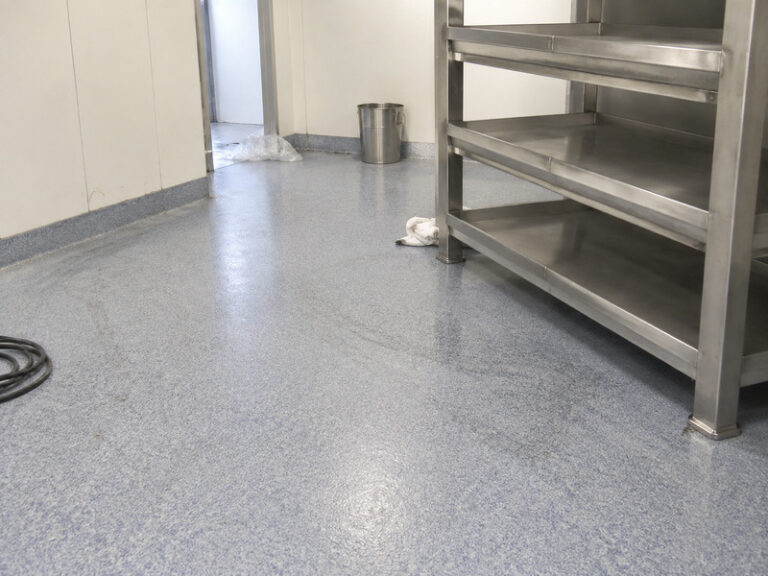
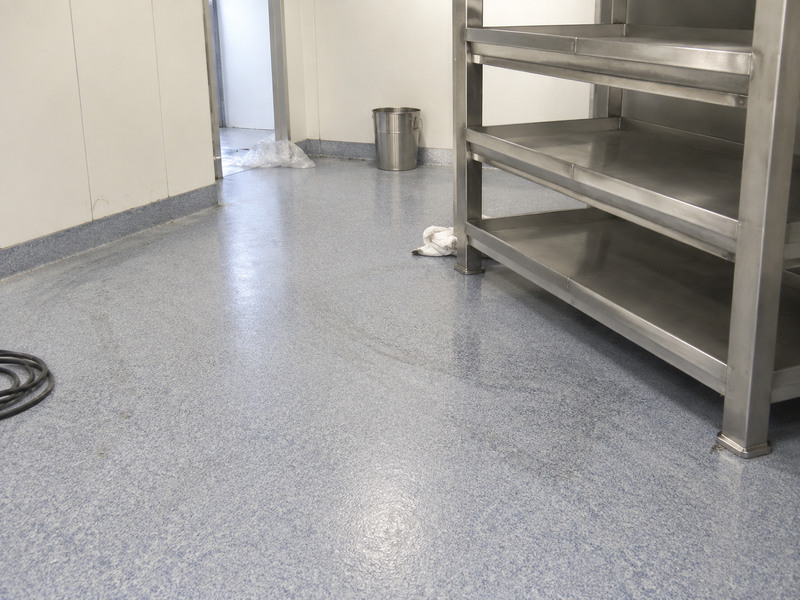
A morgue is five different floors, not one
Mortuary flooring projects go wrong when one system is specified for the whole suite. Morgue flooring in a pathology department is a schedule of five build-ups, not one. A body storage room held at 4 °C is a dry room with static rack loads. An autopsy room is a wet room with a drain per table and a hose reel on the wall.
| Zone | Sistema | Typical build (confirm to product TDS) | Slip class | Cove and junction | Drainage |
|---|---|---|---|---|---|
| Body storage room | Polyurethane screed or flake epoxy | 4–6 mm PU screed; 3–4 mm flake epoxy with an extra body coat | DIN 51130 R10 | 100 mm coved base, sealed to insulated panel | No floor drain; sealed penetrations only |
| Autopsy suite | Cementitious urethane | 6–9 mm | DIN 51130 R11–R12 | 150 mm coved base; table plinth sealed | One drain per table; fall 1.5–2% |
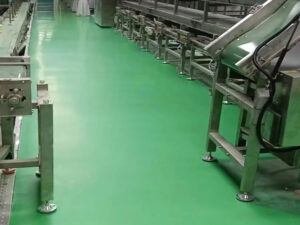
| Washdown and decontamination | Cementitious urethane | 6–9 mm | DIN 51130 R12 | 150 mm coved base; integral curb at door | Trench or slot drain; fall 2% |
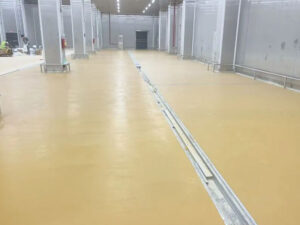
| Trolley corridor | Polyurethane screed or flake epoxy | 4–6 mm PU screed; 3–4 mm epoxy | DIN 51130 R10 | 100 mm coved base at walls and columns | No drain; threshold at cold-room door |
| Equipment and plant room | Epoxy or PU screed | 3–4 mm epoxy; 4–6 mm PU screed | DIN 51130 R10 | 100 mm coved base | Local sump only |

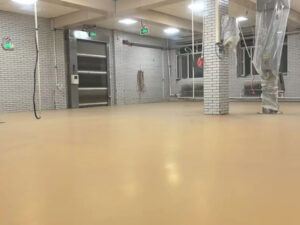
Body storage room flooring is where budgets are usually won or lost. It is the largest area in the suite and the least demanding, so an expensive urethane build there buys nothing except a quieter specification review. Body storage room flooring can also be laid at 4 °C with a cold-grade primer, which shortens the closure.
Autopsy room flooring is the opposite case. It is the smallest wet area in the building, it carries the most aggressive chemistry, and it is the room whose closure stops the service. Autopsy room flooring is priced at R11 as standard and upgraded to R12 wherever a hose is used, and it is built from cementitious urethane systems rather than a thin epoxy. Money belongs here, not in the holding room.
Cold rooms change the failure mode
A room held at 2–8 °C does not fail the way a corridor at 20 °C fails. The slab stays cold, a morgue floor coating sits on a cold substrate, and hot water arriving on that floor acts as a shock rather than a gradual change. Post-mortem room flooring in a basement cold room is the coldest slab in the building, and the least forgiving.
Thermal shock is a rate problem. A 60 °C washdown hitting a 4 °C slab drives a temperature gradient through the full build within seconds. The stress lands at the bond line, and repeated cycles open a joint that passed its pull-off test when the room was warm. Choose a morgue floor coating for the coldest room first and work outward, because that room sets the system for the suite.
Three details follow. Use urethane cement in and around cold rooms, because it builds thicker and moves with the slab. Put a thermal break and a stainless transition at the cold-room door, which carries the sharpest gradient in the building. And bring the slab to service temperature before priming, because a floor installed warm and chilled afterward can debond within a season.

Formaldehyde and glutaraldehyde attack the topcoat
Chemical resistant morgue flooring is usually bought on a data sheet claim about “hospital disinfectants”, which is the wrong test. Autopsy chemistry is aldehyde chemistry, and aldehydes embrittle a topcoat chosen for quaternary ammonium wipes. Autopsy room flooring takes aldehyde splash at the table plinth, where liquid lands and sits instead of draining.
| Agent | Typical concentration | Dwell and frequency | Effect on the floor | System note |
|---|---|---|---|---|
| Formaldehyde | 4–10% embalming solution; 37% stock formalin | Splash wiped within minutes; stock spills occasional | Hazing, hardening and fine cracking over years | Urethane cement; rinse a stock spill within 10 minutes |
| Glutaraldehyde | 2–2.5% | 10–20 minutes around sinks and tray stations | Gloss loss and tackiness on thin epoxy | Urethane or PU topcoat; avoid thin build under sinks |
| Sodium hypochlorite | 5,000 ppm available chlorine | 10 minutes for blood spills; daily in washdown | Yellowing, chalking, topcoat softening in epoxy | Urethane cement with aliphatic topcoat |
| Blood and body fluids | Neat, protein-bearing | Immediate cleanup, then disinfectant | Staining in scratched surfaces; slip film while wet | Seamless build; texture in washdown zones |
| Steam and hot washdown | 100–120 °C at the surface; 50–60 °C water | Daily to weekly | Blistering and delamination at the bond line | Urethane cement, 6–9 mm |
Formaldehyde is an air-quality problem before it is a floor problem. The OSHA permissible exposure limit is 0.75 ppm as an eight-hour average, with a 2 ppm short-term limit. Those numbers are met by ventilation and work practice. A floor that resists the splash protects the slab, and it does not lower room concentration. A morgue floor coating is therefore specified against the agent list, never against a general hospital claim.
Post-mortem room flooring in older buildings often carries a legacy problem: years of formalin spill have left the slab surface acidic and contaminated. Grinding and priming is not enough. Take a pH reading and a contamination swab before specifying, or the new build will delaminate inside two years.
Cleaning is verified, not claimed
A cured resin surface is not a registered antimicrobial product. No additive replaces the cleaning step, and a specification that promises “antimicrobial flooring” tells a pathology manager nothing about the floor after a contaminated case.
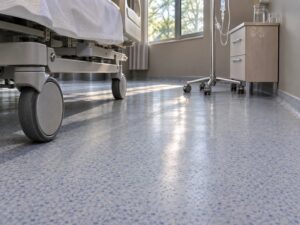
The same logic runs through patient room flooring and every other clinical room in the building. What a seamless build does is remove the places where soil survives: no grout lines, no welded sheet seams, no lifted edge at the door, no square floor-to-wall corner. A seamless resin morgue floor is cleanable because there is nothing to catch, and cleanable is a property you can measure. Morgue flooring that passes ATP twice at the same locations is doing its job; a floor that passes once has been cleaned once.
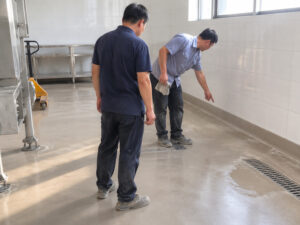
Ask for ATP bioluminescence readings at handover, at fixed locations: beside each table, under the hose reel, at the drain surround, and in the corridor outside the suite. Forensic autopsy room flooring is cleaned between cases rather than between shifts, so keep the ATP set small enough to run inside a turnaround. Adopt the facility’s pass threshold, which many programs set between 150 and 250 relative light units. Then require the same locations to pass twice: at handover and after a month of routine cleaning. Name those locations in the specification, because a mortuary flooring acceptance that names none is a visual inspection with extra steps.
Slip resistance has two standards that do not agree
Morgue floors are specified with both DIN 51130 and ANSI B101.3 on international projects, and the two readings are not interchangeable. The two methods measure different things, and a slip resistant morgue floor has to satisfy both where both are named. DIN 51130 is a ramp test: an operator in safety boots walks an oil-wet incline until slip occurs, and the result is an R class. ANSI B101.3 measures wet dynamic coefficient of friction with a drag sled on a level floor.
The test conditions explain the gap. Oil on a ramp with boots rewards deep, coarse texture. A sled on a wet level floor rewards a fine, uniform profile. ANSI B101.3 supplies the wet DCOF measurement; the 0.42 acceptance figure comes from ANSI A326.3, and the two are normally quoted as a pair. A finish built to R12 will usually clear a 0.42 DCOF. A finish tuned to 0.42 will not necessarily reach R11.
| Zone | DIN 51130 (ramp, oil, boots) | ANSI B101.3 wet DCOF (sled, level) | Practical note |
|---|---|---|---|
| Body storage, corridor | R10 | ≥ 0.42 | Texture tuned for cleaning, not for grip alone |
| Autopsy suite | R11 | ≥ 0.42, target 0.50 | Wet underfoot most of the shift |
| Washdown area | R12 | ≥ 0.42, target 0.55 | Standing water and hose pressure |
| Test method | Ramp angle, oil, shod operator | Sled drag, water film, level floor | Report both; never convert one into the other |
A slip resistant morgue floor is therefore a schedule of classes per room, not one figure, and texture is a broadcast decision rather than a coating choice. A seamless resin morgue floor can reach either class on the same base. Test the installed floor wet at handover and record the reading for each room. A class printed on a data sheet describes the system as supplied, not the floor as laid.
Return to service decides the program
Pathology rarely closes. Installation has to fit between cases, and the constraint is usually body storage capacity rather than cure time, so the program is built around holding-room availability. Hospital morgue flooring programs are sequenced from the holding room outward, not from the front door inward. Price installation and phasing support as a line item rather than an assumption.
| Sistema | Walk-on | Full service load | Odor | Best window |
|---|---|---|---|---|
| MMA, 3–4 mm | 1-2 ore | Next shift | Strong monomer odor; isolate the zone | Single-night room turnaround |
| Polyurethane screed, 4–6 mm | 4–8 hours | 24-48 ore | Low to moderate | Weekend closure of one room |
| Flake epoxy, 3–4 mm (extra body coat) | 12–24 hours | 3–7 days for full chemical cure | Low with solvent-free grades | Planned decant, dry rooms |
| Cementitious urethane, 6–9 mm | 12–24 hours | 3–7 days for full chemical cure | Basso | Suite closure, wet zones |
Confirm the table against the product data sheet at the slab temperature on site; body storage room flooring at 4 °C sits at the slow end of every range. A 4 °C room extends every cure time listed, which is why the cold room is normally scheduled last and released last.

Construction sequence decides whether the numbers hold
Most morgue floor failures are set in the first three days of construction, not in year five, and the causes are procedural. Seven steps separate a floor that reaches its specified build from one that only looks like it did.
Substrate before material. New concrete needs 28 days at 20 °C, or 7 days where the primer is rated for green concrete. Test pull-off at 1.5 N/mm² minimum (ASTM D4541) and moisture per ASTM F2170 before the morgue floor coating is ordered. Blast or scarify to CSP 3–5; an acid-etched surface will delaminate at the first steam cycle.
Contamination before primer in an old morgue. Formalin residue sits in the surface layer of the slab, not on it. Take cores, wipe-test the surface, and set the grind depth from the result before the primer is ordered. A pH reading alone does not show whether the contamination is still there.
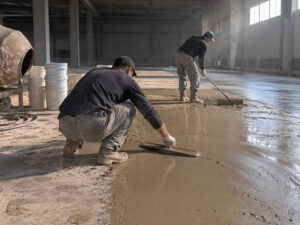
Cold room sequence. Lay the morgue flooring first, stand the insulated panels on the finished surface, then load the racks. Panels fixed first leave a base that cannot be sealed and a joint the resin cannot reach, and the door then bleeds cold air into that joint all year.
Cove formed wet, not glued on. The coved base is the same resin as the floor, formed in one pass with a cove tool at a 38–50 mm radius. A PVC strip glued over a square corner hides a void, and its adhesive line fails first under steam.
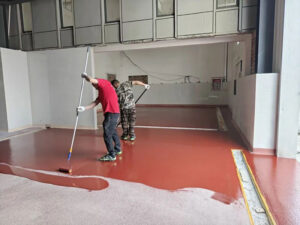
Drain set before the build. Autopsy room flooring takes a clamping ring drain set into the screed before the resin goes down, compressed by the flange, with the 2% fall formed around it. No joint within 300 mm of the drain, and a flood test before the topcoat.
Joints carried through. Structural and saw-cut joints run through the seamless resin morgue floor with a semi-rigid PU filler, and isolation joints go at doorways, column bases and wall perimeters. A joint filled with mortar and coated over will crack directly above itself within a season.
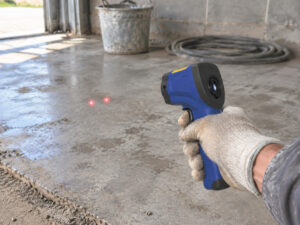
Temperature and aggregate last. At 4 °C use a low-temperature or accelerated grade, hold the substrate 3 °C above dew point, and never chase cure with a hot-air blower, which builds a gradient and shrinkage cracks. R11 and R12 come from broadcast aggregate on a slip resistant morgue floor, not from a roughened topcoat. Recover the excess before sealing, because topcoat thickness and aggregate size together set the DCOF reading.
Morgue flooring fails at five junctions, all of them details
Morgue flooring failures are detailing failures, and they recur in the same five places. Check them at handover and most of the year-two callbacks disappear.
The coved base at the wall. A morgue floor coating formed over a dusty panel or a painted block wall cracks at the radius within a year. Prepare the wall mechanically, prime it with a product compatible with that substrate, and form the radius with a former rather than a trowel edge.
The autopsy table drain. The table outlet passes through the floor, and a rigid connection transmits every bump into the floor around the penetration. Use a flexible coupling and a sealed collar so the pipe is not the only thing holding the waterproofing together. Autopsy room flooring is detailed at that penetration, not merely sealed around it.
The doorway threshold. Water leaves the suite and sits under the floor in the corridor. A 150 mm coved base inside the room, a curb at the door and the same urethane system carried 300 mm past the threshold stop that path.
The trolley impact zone. Stainless trolleys hit the wall base at the same corner every shift. A slip resistant morgue floor does not fix that, but an impact-resistant build and a corner guard do. Specify an impact-resistant build or a corner guard, and keep the cove radius continuous behind it.
The drain flange. Bond failure radiates from the flange when the substrate was damp or the collar was omitted. Dry the substrate, fit a clamping collar, and pull-test at the drain before the topcoat.
Coved skirting is worth one extra sentence in any morgue tender: the term appears in specifications drafted outside the US, and it describes the same 100–150 mm radius. If the two terms are used in one document without a definition, the contractor may price only one of them.
Vinyl and tile are the right morgue flooring in dry rooms
Body storage room flooring is the one place where sheet vinyl wins on merit: the room stays dry, racks are static, and the floor is mopped rather than hosed. It is cheaper, and a welded seam in a dry room is not the risk it becomes in a washdown area.
Ceramic tile belongs in gowning, offices, the viewing room and the chapel, where the floor stays dry and grout can be maintained. Quarry tile has historically been used in washdown areas; it survives the traffic, but its grout is the weak layer under 5,000 ppm hypochlorite, and repointing becomes an annual line item.
| Criterion | Sheet vinyl | Ceramic or quarry tile | Seamless resin |
|---|---|---|---|
| Installed cost | Lowest | Low to moderate | 1.6–3.0× vinyl |
| Body storage room, dry | Correct choice | Acceptable in dry rooms | Correct where racks move |
| Autopsy suite, washdown | Non raccomandato | Grout fails under chlorine | Correct choice |
| Cold room at 2–8 °C | Acceptable with cold-grade adhesive | Thermal movement at joints | Urethane cement preferred |
| Integral coved base | Welded upstand, a seam remains | Cove tile with a grout joint | Formed in the same resin |
| Repair after impact | Replace a sheet section | Replace tiles and regrout | Patch and re-coat |
Mortuary flooring tenders rarely separate the five rooms, and that omission is priced in later. Mortuary flooring in low-acuity rooms is often better bought as vinyl, and saying so is part of a useful specification. A seamless resin morgue floor belongs where the room is hosed, where chlorine runs at 5,000 ppm, where trolleys turn on casters all day, or where the junction has to be integral.
The cost sits in cove, drains and sequencing
Hospital morgue flooring is usually budgeted from a square-meter rate taken from a corridor project, which understates the suite. Morgue flooring is priced by area and bought by detail, which is why two quotes for one suite rarely land within 30% of each other. A morgue is mostly small rooms with long cove runs, several drains and a cold-room sequence.
| Sistema | Index | Main cost driver |
|---|---|---|
| Sheet vinyl, heat-welded, coved | 1.0 | Subfloor smoothing and welded upstand |
| Decorative flake epoxy | 1.6–2.4 | Moisture mitigation and broadcast density |
| Polyurethane screed, 4–6 mm | 2.0–2.8 | Thickness and aggregate |
| Cementitious urethane, 6–9 mm | 2.2–3.0 | Thickness and wet-zone extent |
| MMA, 3–4 mm | 2.0–2.8 | Night-shift labor and short pot life |
Indexed to heat-welded sheet vinyl = 1.0; material and labor only; substrate preparation, drainage and cove length excluded.
Four items move a morgue estimate more than the system choice: cove length, because every meter is hand-worked around tables and racks; drains, because each one carries a collar, a fall and a detail; cold-room sequencing, because the floor goes down before the panels; and phasing, because a single-room night shift costs more per square meter than an empty suite.
A morgue flooring specification is only enforceable if it names seven things
Seven items turn a morgue floor coating specification into something enforceable at handover. Leave any of them out and the argument at the end of the project is about opinion rather than measurement.
- Substrate condition and moisture: slab relative humidity per ASTM F2170, with test locations marked on the drawing.
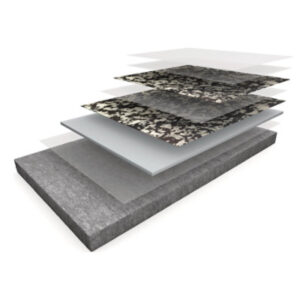
- Build-up by zone: each layer, its thickness and its product type, in the same table as the room schedule.
- Cove detail: 100 mm in dry rooms, 150 mm in wet rooms, radius 38–50 mm formed in the same resin, sealed at the wall finish and at every penetration.
- Slip class per zone: a slip resistant morgue floor is specified as DIN 51130 R class plus the ANSI B101.3 wet DCOF target, both tested at handover.
- Chemical list: formaldehyde, glutaraldehyde and hypochlorite at the facility’s concentrations, with dwell times, and a written chemical resistant morgue flooring statement at those values.
- Drain and threshold details: clamping collars, door curbs and the thermal break at the cold-room door.
- Acceptance tests: adhesion by ASTM D4541 pull-off, abrasion by ASTM D4060, thickness by direct measurement, and a mock-up room agreed before mobilization.
Forensic autopsy room flooring carries one extra requirement that dry rooms do not: the room may be photographed and used as evidence, so the floor has to read clean in a photograph. Ask for chemical resistant morgue flooring data at your own dilutions, not at 10% for 30 minutes. A uniform mid-tone finish with a matte sheen photographs better than a high-gloss dark floor, which shows every scuff.
Domande frequenti
What flooring is used in a morgue?
A seamless resin morgue floor, specified by zone. Urethane cement of 6–9 mm in autopsy suites and washdown areas, polyurethane screed of 4–6 mm or flake epoxy of 3–4 mm with an extra body coat in body storage and corridors, with a 100–150 mm coved base and a graded fall to sealed drains in wet rooms.
Can a morgue floor be installed without closing the suite?
Usually yes: autopsy room flooring is replaced one room at a time. MMA returns a room in a night and polyurethane screed over a weekend. Hospital morgue flooring work is phased around holding capacity, so the first room released is always a dry one. The limit is holding capacity rather than cure time, so the program is built around body storage availability and the cold room is scheduled last.
Is urethane cement better than epoxy for a morgue?
In wet and cold areas, yes, and that is where chemical resistant morgue flooring earns its cost. Urethane cement builds to 6–9 mm, tolerates a cold or damp slab better than a thin epoxy, and holds up under steam and repeated hypochlorite. Epoxy remains reasonable in dry body storage and corridors. For a small mortuary flooring scope, that split is where the saving sits.
What slip rating does an autopsy room floor need?
DIN 51130 R11 in the autopsy suite and R12 in the washdown area, with a wet DCOF of 0.42 or higher where ANSI B101.3 is the reference. Specify by zone, test the installed floor wet at handover, and record each room. A slip resistant morgue floor that reads 0.42 on the drawing and 0.35 on site has a texture problem, not a specification problem.
How do you clean a morgue floor?
Morgue flooring is cleaned with neutral detergent routinely, 5,000 ppm hypochlorite for blood spills with a ten-minute dwell, then a rinse. Verify with ATP readings at fixed locations rather than by eye, and repeat the check after the first month of routine cleaning.
Does a morgue floor need to be antimicrobial?
No. A cured resin floor is not a registered antimicrobial product, and an additive does not replace cleaning. What matters is a seamless cleanable surface, a disinfectant list the floor can survive, and a cleaning process that is verified.
Can resin be laid over existing tile in a mortuary?
Sometimes. Sound, well-bonded tile can be encapsulated when the added height clears door swings and drain falls and adhesion is tested first. Drummy tile, or tile on a damp slab, has to come out before any resin goes down. Post-mortem room flooring over old tile is the most common encapsulation request, and the most common failure.
How long before a morgue room can be used again?
MMA: walk-on in 1–2 hours, next shift for full load. Polyurethane screed: 4–8 hours. Epoxy and urethane cement: 12–24 hours to walk-on, with full chemical resistance at 3–7 days. Cold rooms extend all of them.
Which is better for a body storage room, resin or vinyl?
Body storage room flooring is usually vinyl when the room stays dry and racks never move, because it is cheaper and comfortable underfoot. Specify resin where racks are relocated, where the floor is hosed, or where the cold-room door detail needs an integral cove.
Morgue flooring from Kaida Paint
Kaida Paint manufactures the morgue flooring systems this guide describes: cementitious urethane, polyurethane screed, decorative flake epoxy and MMA, with coved base, drain collar and slip-controlled finishes produced in the same batch as the floor.
- Formulation, batch records, TDS and SDS issued per production lot, so the chemical resistance statement matches the material delivered.
- Urethane cement for autopsy suites, washdown areas and cold rooms; polyurethane screed and flake epoxy for body storage and corridors.
- Color, aggregate blend, texture and sheen agreed on a mock-up room before mobilization.
- Application planning for suites that stay in service, including cold-room sequencing and night-shift phasing.
Send the room schedule, the drain layout and your disinfectant list. We return a zone-by-zone build-up with thickness, slip class and cove detail for every room in the suite.
-

Sistema di pavimentazione epossidica ResuShield™ Terrazzo TG
Per saperne di più -
Sistema di pavimentazione uretanica FlexTop™ SL
Per saperne di più -
Sistema di pavimentazione uretanica cementizia TerraFlex™ AC
Per saperne di più -
CK97 Anti-slip Heavy-Duty Anti-Corrosion Polyurethane Concrete Floor Mortar
Per saperne di più -
CK96 Self-leveling Heavy-Duty Anti-Corrosion Polyurethane Concrete Floor Coating
Per saperne di più -
E8302 Finitura epossidica autolivellante per pavimenti senza solventi
Per saperne di più -
KD-P01 High Gloss Clear Water-Based Polyurethane Floor Finish
Per saperne di più -
KD-P02 Finitura per pavimenti in poliuretano a base acquosa
Per saperne di più






 English
 Spanish
 Portuguese
 Arabic
 French
 Italian
 Russian
 Indonesian
 Swedish