Description
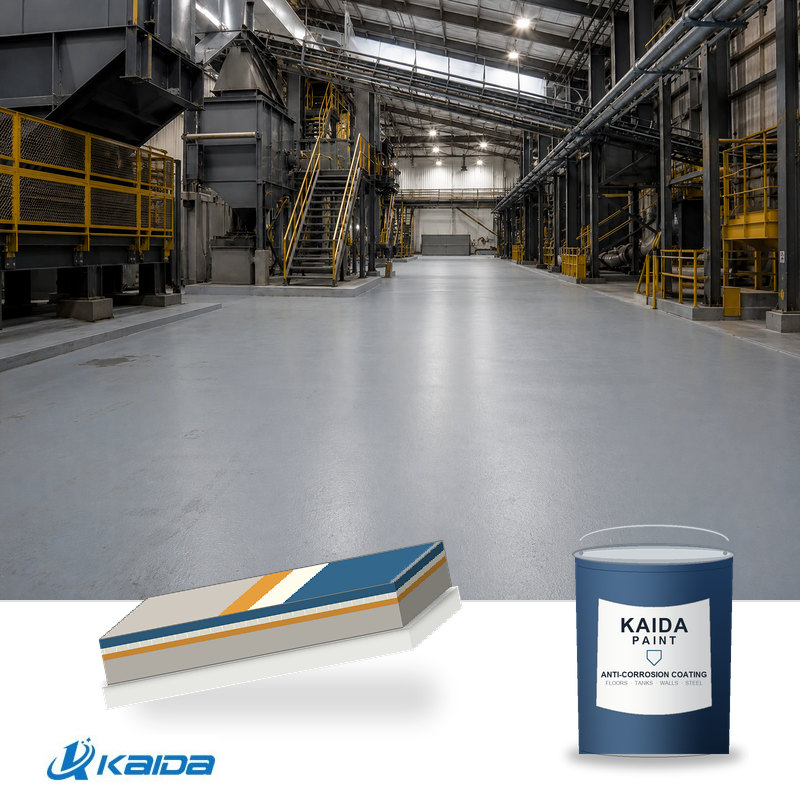
A fiberglass reinforced vinyl ester coating is the build specified when a paint film is too little protection and a three-cloth laminate is more than the job needs. ACF-VE-FR is built at 2–5 mm and declared against 75% sulfuric acid and 35% hydrochloric acid. ACF-VE-FR is a 2–5 mm vinyl ester system — penetrating primer, glass-fiber reinforced mid-coat, rolled topcoat — laid on concrete floors, but also carried up tank walls, over pipework and onto steel where laying fabric is slow. This page gives the medium-by-medium resistance figures, the build sequence, how a reinforced build is verified on site, where the system stops being the right choice, and how it compares with a laminate floor and a mortar floor.
| Item | Specification |
|---|---|
| System | Fiberglass reinforced vinyl ester coating |
| Model | ACF-VE-FR |
| Body | Vinyl ester penetrating primer, vinyl ester mid-coat reinforced with glass fiber |
| Finish | Vinyl ester rolled topcoat; gloss, with an anti-slip grade available |
| Build range | 2–5 mm (0.08–0.20 in) total, primer and reinforcement included |
| Service life quoted | 5–10+ years at 2–5 mm in the duty it was specified for |
| Application method | Roller and spray, ambient cure, no hot work |
| Substrates | Concrete floors, curbed containment areas, tank and vessel shells, pipework, steel |
| Best for | Mixed floor-and-vessel corrosion duty at moderate to heavy severity |
What does a fiberglass reinforced vinyl ester coating actually mean?
In ACF-VE-FR the vinyl ester resin is carried on glass fiber rather than used as a plain film. A plain vinyl ester coating at 0.3–0.5 mm protects by barrier only: it is thin, it is brittle under impact, and any crack that opens in it becomes a path straight to the concrete. Glass reinforcement changes the mechanics. The fiber carries tensile load and arrests a crack before it runs, so the coating behaves as a thin composite rather than as a paint.
The consequence for a specification is that the reinforcement schedule, not the resin alone, sets the duty. A fiberglass reinforced vinyl ester coating is listed at 2–5 mm, and within that band the fiber content and the topcoat are selected per project. Two enquiries for the same acid at the same concentration can therefore receive different builds, and that is deliberate rather than vague.
The second consequence is geometric. Because the mid-coat can be applied as chopped-strand spray, the system follows curves, corners, nozzles and pipe intersections without the cutting and overlapping that fabric lay-up needs. That is why the same system appears on a factory floor and inside a tank: the chemistry is identical, the application method adapts.
Which chemicals does ACF-VE-FR resist, and at what concentration?
The figures below are 7-day immersion results on the cured system with no change. They are the manufacturer’s test values and should be read as a screening band for a single medium, not as a warranty for the mixture that is actually in your sump.
| Medium | Concentration | Result |
|---|---|---|
| Sulfuric acid | 75% | No change after 7 days |
| Hydrochloric acid | 35% | No change after 7 days |
| Nitric acid | 55% | No change after 7 days |
| Acetic acid | 40% | No change after 7 days |
| Sodium hydroxide | 50% | No change after 7 days |
| Hydrofluoric acid | 25% | No change after 7 days |
| Phosphoric acid | 80% | No change after 7 days |
Two numbers in that table decide most enquiries. Sulfuric acid at 75% puts the system in vinyl ester territory rather than epoxy, which is why an epoxy self-leveling floor is not a substitute at this concentration. Hydrofluoric acid at 25% is the ceiling for this build: that figure sits well below what a high-build mortar system reaches, and the filler in the mid-coat is the reason.
Scope and limits. ACF-VE-FR is specified for floors, curbed containment, tank and vessel shells, pipework and steel at the concentrations in the table. Where hydrofluoric acid runs above 25%, or where concentrated acid sits on the floor permanently under heavy abrasion, the correct build is a mortar floor and this coating is the wrong answer. Where the exposure is solvent-rich rather than acid-rich, give the solvent list at enquiry, because aromatic solvents behave differently from the acids tabulated here and are not covered by the table.
Coating, laminate and mortar are compared side by side in chemical resistant flooring and coatings.
How is the 2–5 mm system built up?

- Concrete substrate — ground, structurally sound, moisture and dew point verified. Cracks and moving joints are treated before priming, not bridged by the coating.
- Vinyl ester penetrating primer — seals the slab and anchors the reinforcement. Open or dusty concrete takes a second pass before the mid-coat.
- Glass-fiber reinforced mid-coat — vinyl ester resin carrying glass fiber, applied as chopped-strand spray on tanks, pipes and complex geometry, or as a cloth lay-up on flat floor areas.
- Topcoat — vinyl ester rolled topcoat, pigmented, gloss, with an anti-slip grade for ramps, wash-down bays and walkways.
- Cure and inspection — ambient cure, then a holiday and adhesion check before handover.
The build has no mortar layer, so finished thickness is set by the number of reinforcement passes rather than by trowelling. A 2 mm build is a light-duty floor inside a containment curb; a 5 mm build is a working floor with reinforcement plus a heavier topcoat. Ask for the thickness in the quotation, not just the system name.
How is the thickness of a reinforced coating verified on site?
This is the question that separates a specified fiberglass reinforced vinyl ester coating from a claimed one, and it is worth raising before the order rather than at handover.
A magnetic or ultrasonic dry-film gauge cannot measure this build. The gauge reads the distance to the steel or the concrete, and a glass-reinforced layer is neither uniform nor homogeneous, so a gauge reading through it is close to meaningless. Thickness on a reinforced system is therefore verified by three other means, and a competent contractor will offer all three:
- Wet-film and consumption records — resin and fiber consumed per square meter (sq ft), reconciled against the design build at the end of each bay.
- Lay-up count — the number of reinforcement passes applied is recorded bay by bay, because on this system the pass count, not a gauge reading, is what the designer specified.
- Destructive sampling — a coupon cut from a test panel poured at the start of the works, measured under a microscope or a thickness gauge on a cross-section.
If a quotation promises 5 mm and the method statement offers no verification route, the 5 mm is an intention rather than a specification. On a containment curb or a tank shell, that gap is where a warranty dispute starts two years later.
For the 3-cloth laminate at the same resin, see three cloth vinyl ester flooring.

What mechanical properties does the cured system reach?
| Test item | Unit | Result |
|---|---|---|
| Compressive strength | N/mm² | ≥ 60 (8,700 psi) |
| Pencil hardness | — | ≥ 2H |
| Abrasion loss (750 g / 500 r) | g | ≤ 0.02 |
| Impact resistance | Kg/cm² | ≥ 80 |
Read these as a floor surface, not a structural slab. A 2–5 mm coating does not add load capacity to the concrete and does not stop a crack in the slab from opening; it protects the surface and spreads point loads enough to stop the topcoat being cut through by pallet trucks and drum rims. Where the slab itself is failing, the slab is repaired first — coating over a moving crack is a repair that fails within a season.
Where thickness rather than reinforcement carries the duty, see chemical resistant mortar flooring.
Where is a fiberglass reinforced vinyl ester coating specified?
The system gets specified by four different people for four different reasons, and the specification changes with each.
- A maintenance engineer replacing a failed epoxy floor in a chemical warehouse or drum store — the driver is the acid concentration that beat the previous system, not the floor area.
- An EPC or design office writing a containment curb specification where the containment area, the tank shell and the pipework all fall inside one scope and one subcontract.
- A plant chemist or process engineer holding a solvent and acid list that no standard product data sheet matches, who needs the medium confirmed in writing before the tender closes.
- A flooring contractor who needs one system that can be sprayed up a tank wall in the morning and rolled across the floor in the afternoon, so the crew is not split between trades.
Typical applications: chemical warehouses and drum storage floors including curbed containment, pharmaceutical and biotech production halls needing a washable chemically resistant surface, electronics assembly and clean production areas, food and beverage plants facing acid cleaners and hot wash-down, and tank shells, sumps and pipework in the same plant protected in the same mobilisation.

The practical advantage on a chemical site is mobilisation. A plant that needs a curbed drum store, a tank shell and a run of pipework protected will usually specify one system for all three and one crew to apply it, rather than a floor contractor, a lining contractor and a painter arriving in sequence with three different products and three sets of paperwork.
Coating, laminate or mortar floor — which build fits?
This is the selection question the three vinyl ester systems answer differently, and it is decided by geometry and severity rather than by preference.
| Consideration | 3-cloth laminate floor | Fiberglass reinforced coating | High build mortar floor |
|---|---|---|---|
| Thickness | 3–5 mm | 2–5 mm | 5–20 mm |
| Reinforcement | Woven cloth, multiple layers | Chopped-strand or single cloth | Aggregate filled, no cloth |
| Vertical and complex geometry | Slow, fabric cut and overlapped | Fast, spray follows the shape | Not practical |
| Chemical severity | Acid, alkali, brine, immersion | Acid and alkali to the table above | Concentrated acid, HF, solvent |
| Mechanical duty | Trolleys, foot traffic, wash-down | Trolleys, drums, wash-down | Heavy loads, abrasion, impact |
| Relative cost | Higher on flat areas | Lower, fewer passes | Highest, aggregate volume |
The rule of thumb: a flat floor with severe chemistry and heavy loads takes the mortar. A flat floor with moderate to heavy chemistry takes the laminate, which puts more fiber per square meter into the same thickness. A mixed scope of floor plus tanks plus pipework usually takes this coating, because it wins on schedule even where another system is marginally cheaper per square meter.
For tank and pool interiors, see vinyl ester tank lining.
How is it installed, and how long does it take?
Installation runs in four stages and is gated by substrate moisture and dew point rather than by the calendar.
- Preparation — mechanical grinding, crack and joint treatment, moisture and dew point readings recorded before anything is mixed.
- Priming — vinyl ester primer, a second pass on open substrates, cured inside the specified window.
- Reinforcement and topcoat — mid-coat applied and consolidated, then the rolled topcoat inside the recoat window.
- Cure and handover — ambient cure, holiday and adhesion inspection, maintenance briefing.
A single bay is typically a two to three day cycle including cure, and large areas are planned in bays so that access, not material, sets the schedule. The system is ambient cure with no hot work, which matters where a permit regime restricts flame or grinding in a live plant.

What service life and cost should you plan for?
The manufacturer quotes 5–10+ years at 2–5 mm in the duty the system was specified for. Treat any single service-life number as conditional on three things: the medium and its concentration, whether the surface sees abrasion as well as chemistry, and whether the build was actually applied at the specified thickness — which is the point the verification section above exists to protect.
A fiberglass reinforced vinyl ester coating is priced by area and by reinforcement schedule. Two lines are worth separating in a quotation, because they are the two that move: substrate repair, and the transition details at plinths, drains and pipe penetrations. A price that assumes a sound slab and a simple perimeter is not a low price, it is a partial one.
The manufacturer also rates overall performance at more than 20% above conventional corrosion-resistant coatings. That is a supplier claim rather than a tested comparison, and the useful response is to put your own media list and abrasion duty against it rather than accept the percentage on trust.
Pricing is per square meter (sq ft) of treated surface, with tank shells and pipework measured as developed area, FOB or CIF named port. Minimum order follows crew mobilisation and lead time runs from sample approval.
Frequently asked questions
Is a fiberglass reinforced vinyl ester coating the same as an FRP lining?
No. An FRP lining is a defined laminate built from multiple cloth layers to a structural thickness, and it is specified by laminate schedule. This system is a reinforced coating at 2–5 mm, where the fiber exists to control cracking and add toughness rather than to build structural section. Both are vinyl ester; the difference is thickness, fiber content and how the finished build is verified.
Can it be applied over an existing resin floor?
Only over a sound, well bonded and correctly prepared system that has passed an adhesion test. A 2–5 mm reinforced build cannot bridge a delaminated or chalky existing floor — the new coating will follow the old one off. Where the existing floor is suspect, it is removed and the slab is recommissioned.
Can the same system go inside a tank and on the floor around it?
Yes, and that is its main commercial argument. The chemistry is identical; the application method changes with geometry. Tank shells, sumps and pipework take the sprayed mid-coat, floors take sprayed or cloth reinforcement. The specification should state thickness per area, because a tank shell and a drum-store floor rarely need the same build.
What is the difference between a 2 mm and a 5 mm build?
Two millimetres is a containment lining: containment curbs, secondary containment, light traffic, occasional spillage. Five millimetres is a working floor: reinforcement plus a heavier topcoat, for drum handling, pallet trucks and regular wash-down. The medium does not change between them; the mechanical duty does. Choosing 2 mm for a working floor is the most common false economy on a fiberglass reinforced vinyl ester coating.
Is there a slip-resistant version?
Yes. The standard finish is gloss. An anti-slip topcoat or a broadcast aggregate finish is specified for ramps, wash-down bays, curbed walkways and outdoor yards. Corrosion performance is unchanged; only the surface profile differs.
How is damage repaired?
The damaged area is cut back to sound material, cleaned, primed and rebuilt in the same sequence, with the reinforcement restored across the patch. Because there is no mortar body to match, the repair is thinner and faster than a mortar repair, but the patch edge has to be feathered properly or it becomes the next failure point.
Why projects specify Kaida Paint for fiberglass reinforced vinyl ester coatings
Scope and limits are confirmed in writing before quotation. Where the medium list sits outside the resistance table, we say so and quote the mortar system instead of stretching this one. Each project file records the medium and concentration, the build thickness by area, and the reinforcement schedule supplied; batch records and a material declaration ship with the material.
Kaida Paint supplies the primer, the reinforcement resin and the topcoat as one system, so fiber, resin and topcoat are matched before they reach site rather than combined by a contractor. On a mixed floor-and-vessel scope this matters: the same batch of resin goes onto the containment curb and into the tank, and one method statement covers both.
Send the medium list with concentrations, the areas by type — floor, containment curb, tank shell, pipework — the mechanical duty and the slab condition. We will return a build thickness per area, a reinforcement schedule, a verification method for the thickness and a quotation against those inputs.
—
Author: Kaida Paint Technical Team — flooring systems engineering, vinyl ester flooring systems Last updated: 13 November 2026


 English
 Spanish
 Portuguese
 Arabic
 French
 Italian
 Russian
 Indonesian
 Swedish