Beskrivning
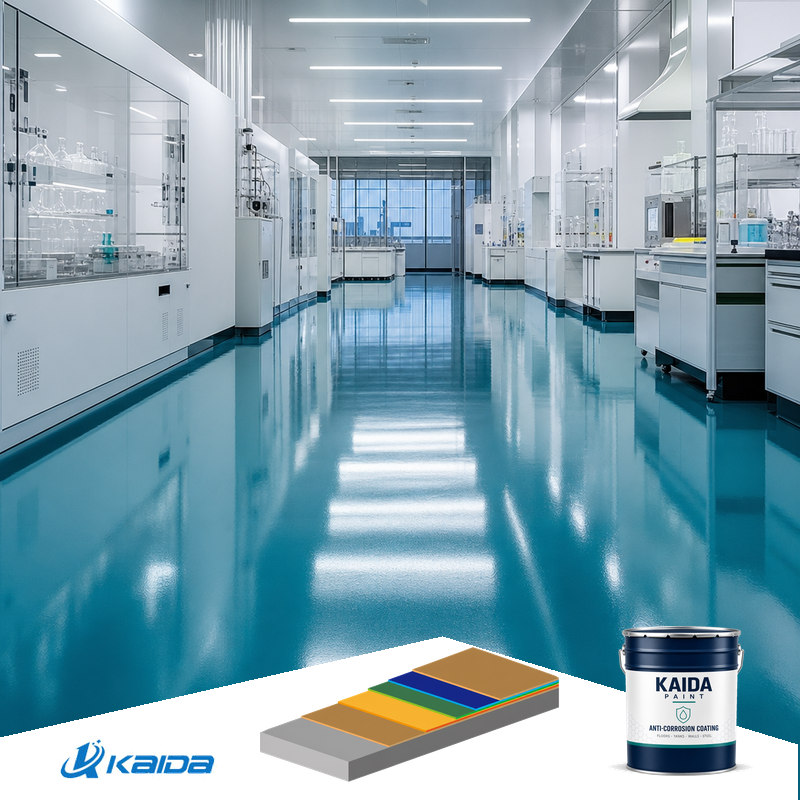
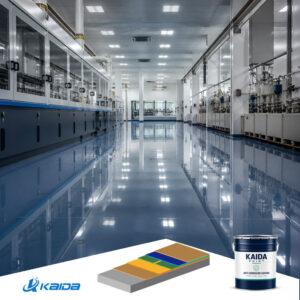
Self leveling vinyl ester flooring is a fiberglass-reinforced vinyl ester system finished with a poured self leveling topcoat, producing a seamless, glossy floor that resists acid, alkali and salt while staying easy to clean and inspect. The poured build is 3–5 mm thick and is declared against 75% sulfuric acid and 40% hydrochloric acid. The ACF-VE-3F5C-SL system bonds three layers of glass fiber cloth into vinyl ester resin, builds the body with mortar and putty, and closes it with a self leveling vinyl ester topcoat at 3–5 mm finished thickness. This page explains how the poured finish differs from a rolled one, what the cured system resists, how the layers are assembled, and how the build is specified for plating, PCB, battery and fine chemical plants.
| Föremål | Specifikation |
|---|---|
| System | 3-cloth 5-coat self leveling vinyl ester corrosion-resistant flooring |
| Model | ACF-VE-3F5C-SL |
| Substrate | Concrete slab, cement screed, sound existing resin floor |
| Förstärkning | 3 layers glass fiber cloth / mat |
| Avsluta | Self leveling, high gloss, seamless; satin and anti-slip grades available |
| Finished thickness | 3–5 mm (0.12–0.20 in) |
| Service life quoted | 5–8+ years under the media and traffic it was specified for |
| Application method | Hand lay-up plus poured self leveling topcoat, ambient cure, no hot work |
What makes self leveling vinyl ester flooring different from a rolled finish?
The difference is in the topcoat, not the resin chemistry. A rolled topcoat follows the texture of the layer beneath it and leaves a directional nap; a self leveling topcoat is poured and spread with a trowel or squeegee, flows to its own level, and cures to a flat, mirror-gloss surface with no lap marks.
That matters for three reasons in a chemical plant. A flat surface drains and dries evenly, so puddles of acid do not sit in roller texture. It is easier to clean and to inspect, because cracks and contamination show up immediately instead of hiding in the grain. And it removes the laps and overlaps that are the usual starting point for coating breakdown on a rolled floor.
The trade-off is honest: a gloss self leveling finish is more slippery when wet than a textured roll-on finish. Where wash-down water, oil or condensate is present, the specification should move to a satin or anti-slip grade rather than accepting the standard gloss.
Term note. Buyers searching for epoxy vinyl ester flooring are looking for this same family: the vinyl ester systems in this catalog are supplied as vinyl ester grades and, depending on the component, epoxy-vinyl ester hybrid grades. The shorter term vinyl ester is used throughout this page.
“Three cloth five oil” counts two different things
The term counts layers of reinforcement and applications of resin separately, which is why a poured build and a rolled build can carry the same model prefix and the same chemical declaration. A self leveling topcoat does not change the cloth count: the pour replaces the last application, not one of the cloth layers.
Three cloth three coat at the same stated thickness is a different floor, because the intermediate resin applications fill the weave and close the pinholes acid finds first. The pour changes the appearance; the coat count changes the service life.
Which chemicals does ACF-VE-3F5C-SL resist?
The system is quoted against seven media, each tested by 7-day immersion with no change to the cured film. Concentration is the number that matters — check it against your process stream rather than reading the chemical name alone.
| Medium | Koncentration | Resultat |
|---|---|---|
| Sulfuric acid | 75% | No change after 7 days |
| Hydrochloric acid | 40% | No change after 7 days |
| Nitric acid | 40% | No change after 7 days |
| Acetic acid | 80% | No change after 7 days |
| Sodium hydroxide | 20% | No change after 7 days |
| Hydrofluoric acid | 20% | No change after 7 days |
| Phosphoric acid | 100% | No change after 7 days |
Plating and PCB plants rarely expose a floor to one clean medium. Drag-out from a plating line is a mixed, dilute, often warm solution, and the wetting and drying cycle is more aggressive than continuous immersion. Where the process includes warm mixed acid, chromic acid or solvent-bearing cleaners, send the bath list — the topcoat grade and the lay-up are confirmed against it before the floor is quoted.
If the pour is only part of the question, the wider comparison sits in corrosion resistant flooring selection.
How is the self leveling vinyl ester system built up?
Six bonded layers do the work, and the self leveling topcoat is only the last of them. The layers beneath decide whether that topcoat stays flat and bonded for its service life.
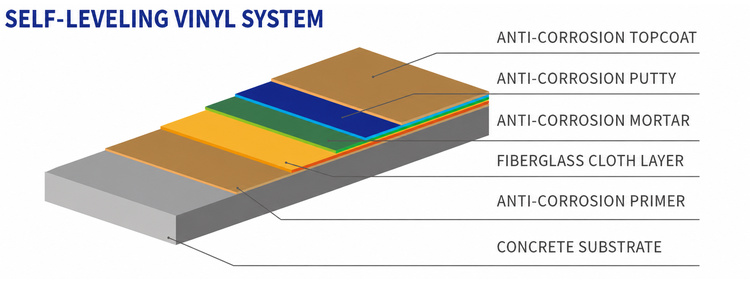
- Concrete substrate — diamond ground, sound, with cracks and voids opened and filled.
- Vinyl ester penetrating primer — anchors the system into the cement matrix.
- Glass fiber cloth × 3 in vinyl ester resin — the structural reinforcement; each cloth fully wetted and de-aired.
- Mortar body — builds thickness and load capacity.
- Putty — closes the weave so the poured topcoat cannot drain into it.
- Self leveling vinyl ester topcoat — poured, spread and de-aired with a spike roller to a uniform gloss.
Step 5 is where most self leveling floors are lost. If the putty does not fully close the laminate, the topcoat drains into the cloth, the finish goes patchy, and the high spots wear through first. Our method statement treats putty as a separate inspection hold point rather than a preparation step.
For the rolled version of the same 3-cloth build, see roll-on vinyl ester flooring.
What are the mechanical properties of the cured system?
| Test item | Unit | Resultat |
|---|---|---|
| Tryckhållfasthet | N/mm² | ≥ 60 (8,700 psi) |
| Pencil hardness | H | ≥ 2H |
| Abrasion loss (750 g / 500 r) | g | ≤ 0.02 |
| Impact resistance | Kg/cm² | ≥ 80 |
For plating and battery plants these values translate into a floor that tolerates trolley traffic, dropped jigs and drum handling without chipping through to the substrate. They do not qualify the system for steel-wheeled forklifts or hot slug impact; those duties belong to a steel mesh reinforced or high-build mortar system.
Where is self leveling vinyl ester flooring specified?
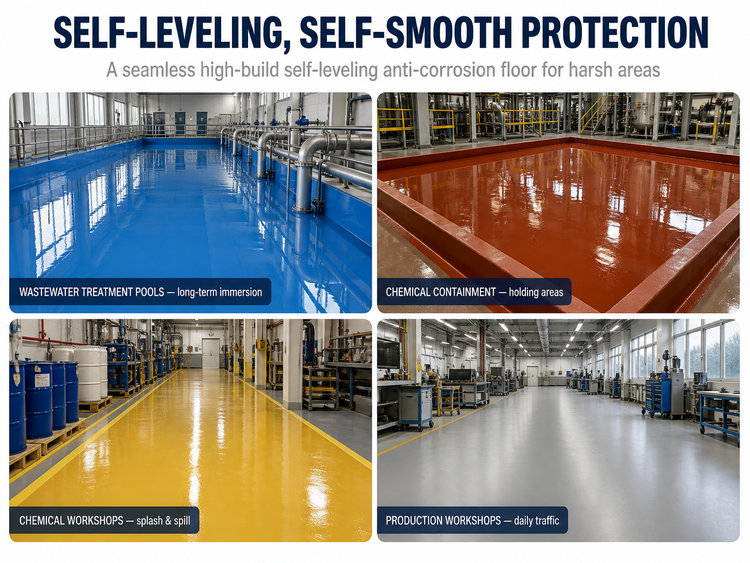
The system is used where corrosion resistance and a clean, inspectable surface are both required:
- Electroplating and anodising lines, including drag-out zones and rinse areas
- PCB and circuit board plants, where acid and alkaline process chemicals meet daily wash-down
- Battery manufacturing, assembly and formation areas
- Fine chemical and pharmaceutical workshops with solvent and acid exposure
- Laboratories and pilot plants, where a spill must be visible and recoverable
- Chemical storage rooms and drum decanting areas
For plants that also need charge dissipation, see anti-static vinyl ester flooring.
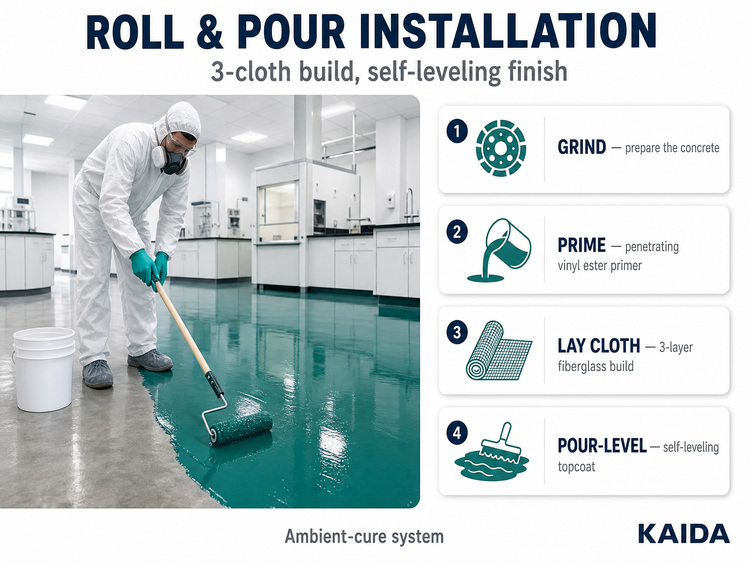
How is self leveling vinyl ester flooring installed?
- Substrate preparation — grinding, crack and void repair, dust removal, moisture check.
- Priming — vinyl ester penetrating primer to saturation.
- Fiberglass lay-up — three cloth layers impregnated and rolled out.
- Grinding — the cured laminate is ground flat and free of laps.
- Mortar and putty — mortar screeded to level, putty applied and inspected for pinholes.
- Self leveling topcoat — poured, spread to the specified thickness, de-aired with a spike roller.
- Cure and handover — dry, off-traffic cure window, then a joint inspection against the specification.
Two site conditions decide the outcome more than the material: slab moisture and dew point. Primer applied to a damp or outgassing slab will not anchor, and a topcoat poured outside the dew-point window will haze or wrinkle regardless of how well it was mixed.
How thick is self leveling vinyl ester flooring, and how long does it last?
The system is built at 3–5 mm with three cloth layers. Thickness is set by the lay-up and the mortar body, and it is confirmed on the specification sheet for each project rather than assumed from the product name.
| Build | Tjocklek | Typical duty |
|---|---|---|
| 1 cloth 3 coats | Specified per project | Light chemical contact, low mechanical load, clean areas |
| 2 cloths 4 coats | Specified per project | Regular acid and alkali contact, medium trolley traffic |
| 3 cloths 5 coats (standard) | 3–5 mm | Immersion and heavy wash-down, plating and battery plant floors |
Quoted service life at the full build is 5–8+ years. That figure assumes the lay-up matches the medium, the substrate was dry and correctly prepared, and the floor is maintained as described at handover. In plating plants the most common cause of early failure is mechanical damage at the line edge or drain collar, not chemical attack in the field.
For immersion duty in pools and tanks, see vinyl ester water tank lining.
What a repair looks like on a poured floor
A poured self leveling floor is repaired by cutting back, priming and re-pouring, and the patch stays visible because the surface reflects light as one plane.
Color batch. A repair poured from a different batch reads as a different tone under grazing light; ordering touch-up material from the main pour batch keeps it discreet.
Sheen. A gloss surface shows a patch through reflection before it shows it through color; a satin topcoat hides it better but softens the whole floor.
For areas repaired repeatedly — pallet drop zones, decanting points — a rolled finish hides repairs better. The choice is a specification decision, and cheaper before the pour.
What does the floor cost, and how is it quoted?
ACF-VE-3F5C-SL is priced from four inputs: measured area, build and thickness, substrate condition, and site access. Without those, a per square meter (sq ft) figure is a guess. Self leveling also carries a cost premium over a rolled finish, because the topcoat is applied thicker and needs tighter thickness control.
Where budgets are tight, the saving should come from reducing the area treated per phase or from phasing the schedule, not from cutting the putty stage or the primer. Cutting those two is the fastest way to a floor that looks correct at handover and fails within two years.
A quotation is per square meter (sq ft) and follows the sample panel rather than preceding it: the panel fixes the color and the sheen, and the price is then built on area, substrate repair and phasing. Minimum order and lead time are confirmed against those inputs, FOB or CIF named port.
Vanliga frågor
Can the floor be laid over an existing epoxy floor?
Sometimes, after assessment. A sound, well-bonded epoxy with no blistering or moisture beneath it can be abraded and used as a substrate. Any coating that is lifting, blistering or trapping moisture must be removed, and we ask for an adhesion test or a core sample before quoting.
How flat does the concrete have to be?
Self leveling refers to the topcoat, not the slab. The finished floor follows the substrate within the tolerance achieved by the mortar layer, so a slab with 5 mm of undulation needs the mortar body to correct it. Very uneven slabs are leveled first, and that shows up in the quotation as substrate repair rather than as a hidden extra.
Is the gloss finish slippery?
Standard gloss is smoother when wet than a textured roll-on finish. For wet-process areas, ramps, and wash-down zones, specify the satin or anti-slip grade; the corrosion performance is unchanged and only the surface profile differs.
How soon can production restart?
Light foot traffic is possible once the topcoat resists marking. Full chemical exposure waits for the complete cure window stated in the method statement, which lengthens in cold weather. Phased overnight work is common so that each zone cures before the next is opened.
Why projects specify Kaida Paint for self leveling vinyl ester flooring
Kaida Paint supplies the whole stack — penetrating primer, laminating resin, mortar, putty and self leveling topcoat — from one formulation line, which is what keeps intercoat adhesion predictable. The self leveling topcoat is supplied with a stated pot life and a stated spread rate per square meter (sq ft) at the specified thickness, so the quantity on site matches the thickness on the drawing instead of being judged by eye.
Each order ships with batch records and a material declaration, and the method statement fixes the substrate moisture limit, the dew-point rule and the cure window before work starts. Those three conditions are what separate a floor that reaches 5–8 years from one that blisters in the first season.
Send the bath list, the area, the substrate condition and the required color, and we will return a build recommendation with a thickness and a quotation against those inputs.
-
Author: Kaida Paint Technical Team — flooring systems engineering, anticorrosive resin flooring Last updated: 13 November 2026

 English
 Spanish
 Portuguese
 Arabic
 French
 Italian
 Russian
 Indonesian
 Swedish