
A polyurethane concrete flooring can be installed on new concrete, but not on concrete that is merely hard. It needs to be dry, neutral enough and past its early shrinkage.
Three numbers decide it: the slab age in days, the pH reading on the surface, and the moisture reading inside the slab. A 28-day strength result alone tells you it is strong, not that it is ready.
In practice the limits are 28 days, a surface pH of 10 or below and 75 per cent relative humidity or less, and each one is measured before any material arrives on site.
The short answer: three tests and two preconditions
Wait at least 28 days, then test moisture and pH, then prepare and prime. A surface film left by the concrete contractor, or a slab below its design strength, stops the work before either test matters.
The order matters. Preparing a slab that is still wet wastes money twice: once on the preparation and again when the coating blisters.
The other mistake is treating a polyurethane concrete flooring specification as a product choice rather than a programme. The product can be right and the date wrong, and the floor still fails.
A green concrete slab is the normal condition of a new building. Treating it as a problem to be solved with a product rather than with time is what produces early failures on otherwise good floors.
A slab that is still green is not a defect. It is a material that has not finished its first job, which is drying and stabilising, and no coating accelerates that.
Table 1: The five gates, in the order they are checked.
| Test | Accept | Action if failed |
|---|---|---|
| Age | 28 days or more | Wait |
| Humidade | Under 75% RH | Dry, or barrier |
| pH | 10 or below | Wait, or tolerant primer |
| Surface | No curing compound | Mechanical removal |
| Força | Design strength | Engineer review |
Read the table as a gate, not a wish list. Any polyurethane concrete flooring project that skips a line is buying a risk that will be paid for later, usually by the party that did not take the reading.
Each line has a test that takes minutes. Together they cost less than a square metre of remedial work, and they are the cheapest part of the project.
Why new concrete is hostile to a coating
Fresh concrete holds far more water than it needs for hydration, and the surplus leaves slowly through the surface for months.
A green concrete slab also holds its water differently from a mature one. The pore structure is still closing, so vapour moves through it at a rate that no surface reading captures properly.
It is also alkaline. Cement hydration produces calcium hydroxide, which pushes the surface pH towards 12 or 13 while the slab is young.
A green slab also releases heat while it hydrates, and the surface can be several °C warmer than the room for the first days. Coating during that window is a bet on the weather.
Every green concrete pour carries more water than the cement needs. How fast it leaves depends on thickness, temperature and whether the building is ventilated, and none of those are coating decisions.
And it moves. Early shrinkage produces curling at edges and cracking at restraints, and a rigid coating applied over a moving slab will crack with it.
A resin floor can tolerate all three, but only if the design accounts for them. The commonest failure we inspect is a floor applied at 14 days to a schedule rather than to a test.
Is 28-day slab age the same as a dry slab?
Twenty-eight days is the age at which concrete is normally assumed to have reached its design strength. It is a strength milestone, not a drying milestone.
A 100 mm slab may be dry enough at eight weeks. A 200 mm slab in a cool building may take six months, and a slab on a sealed membrane can take longer still.
That is why the 28-day strength figure should be read as a start line rather than a finish. It says the concrete is strong; it does not say the slab is dry.
The 28-day strength certificate is worth keeping, but read it as a concrete property. It says nothing about the curing compound, the moisture or the surface, and those three decide whether a coating bonds.
Where a programme is driven by a handover date, the age is usually the first thing compressed. It is also the one compression that cannot be recovered later.
Where a single building has several pours, the slab age varies by bay and the floor has to follow the slowest one. A polyurethane concrete flooring contract written around the first pour date will be wrong for half the hall.
Ask for the pour date on every bay, not just the first. Slabs are placed in sequence, and a floor that is ready at one end may not be ready at the other.
What does a pH reading above 10 do to a coating?
A pH reading is taken by wetting the surface and pressing a pH strip or a drop of indicator onto it. Values above 10 indicate active alkalinity at the interface.
Alkalinity attacks the bond line. It saponifies some resins and embrittles others, and the result is a floor that delaminates in patches with no traffic to explain it.
Epoxy is more sensitive than polyurethane, which is one reason a polyurethane concrete flooring system is often specified on a young slab. The binder tolerates a marginally alkaline interface that would lift a rigid epoxy in a season.
Take the pH reading at several points rather than one, and take the moisture reading at the same time. The two together describe the interface, and either one alone can mislead.
Where the reading is high, the options are to wait, to use a primer rated for the condition, or to apply a moisture and alkali barrier. Waiting is free and usually right.
Table 2: What the readings mean for a coating decision.
| Reading | Estado | Decision |
|---|---|---|
| pH 8-9 | Mature, neutral | Standard primer |
| pH 10 | Marginally alkaline | Tolerant primer |
| pH 11-12 | Young or damp | Wait or barrier |
| Under 75% RH | Dry enough | Proceed |
| 85% RH or above | Wet | Barrier only |
Moisture, and why the surface reading lies
A moisture reading taken with a hand-held meter reads the top few mm. That layer dries first, so a slab can look dry while the body is still wet.
A reading taken in a cold building in February will be lower than the same slab in July, so record the temperature alongside the figure. That single note explains most discrepancies between two surveys.
The reliable method is an in-situ probe at 40 per cent of the depth, left to equilibrate, or a calcium chloride test under a sealed dome. Both measure the slab rather than the skin.
The usual acceptance limit for a coating is 75 per cent relative humidity, with some primers accepting more. Above 85 per cent, only a barrier system is defensible.
Table 3: Three ways to read a new slab, and what each one misses.
| Método | Reads | Misses |
|---|---|---|
| Hand-held meter | Top few mm | The wet body |
| Plastic sheet test | That vapour moves | How much |
| In-situ probe | Slab at depth | Surface condition |
Where a slab has been covered with plastic sheeting for a week, condensation under the sheet is a warning rather than a test. It tells you water is moving, not how much.
Curing compounds: the invisible barrier
A curing compound is applied to slow evaporation and help the concrete reach strength. It works by forming a film, which is exactly what a coating cannot tolerate.
Sodium silicate, resin emulsion and wax-based products all behave the same way at the interface: the primer bonds to the compound, and the compound bonds to nothing.
Detection is simple. Grind a small patch and drop water on it. If the water beads, something is still on the surface; if it soaks in within a minute, the concrete is open.
Removal is mechanical. Blasting or coarse grinding sets the surface profile CSP and takes the film off, and a chemical stripper adds a residue problem rather than solving one.
Ask the concrete contractor which product was used, in writing. That single question prevents a class of failure that no amount of primer will fix.
Shrinkage cracks and what to do about them
A shrinkage crack appears in the first weeks as the slab loses water. Some are cosmetic, some are structural, and the difference matters to the floor above them.
Cracks that are still moving must be treated as joints. Filling them rigidly transfers the movement into the coating, which then cracks along the same line.
Record every shrinkage crack on a plan before treatment, with a note of whether it is live. That record goes into the handover file, and it is what protects both parties when a crack reappears in the same place a year later.
Cracks that have stabilised can be routed, cleaned and filled with a flexible resin before the body coat. That is a five-minute repair per metre and a permanent one.
A shrinkage crack that appears in the first month is usually plastic or drying shrinkage and is often cosmetic. One that appears in the third month is telling you something about the mix or the curing, and it should be investigated before it is covered.
Where a slab shows a pattern of cracks rather than one or two, the cause is usually mix design, curing or restraint. Coating over it hides the symptom and not the cause.
What a trial area proves
A trial area is two or three square metres coated exactly as the full job would be, then inspected after cure. It is the only test that includes the actual slab.
It answers the questions a lab report cannot: does the primer wet this surface, does the film bond, does the finish match the sample, and does anything blush or bubble.
Leave it for a week, then try to lift an edge with a knife. If the film tears rather than peeling, the system works on this slab.
Photograph the trial area at handover and keep the photograph with the readings. A polyurethane concrete flooring that was proved on a trial is much easier to defend than one that was proved by argument.
On a project with several pours or two concrete suppliers, take a trial on each. Slabs from different batches can behave differently under the same primer.

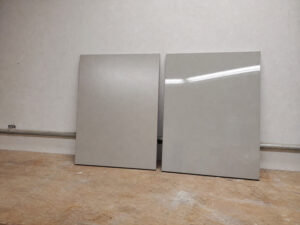
Figure 1: a taped trial patch beside the untreated slab, with the edge of the coating visible.
In what order should the gates be checked?
Test age, then moisture, then pH, then the surface film, then the strength certificate. Each is a gate: a failure stops the sequence rather than being averaged with the others.
Only when all five pass does preparation start. Preparing early is the most common waste on a new-build floor, because the slab keeps changing after the work is done.
Record the readings with locations. A single figure for a 2,000 square metre slab describes one square metre, and the bays that fail are rarely the ones that were tested.
Where a client wants a single date, give a date range and the conditions that would move it. A fixed date on a slab that is still drying is a promise nobody can keep.
When the programme cannot wait
There are three honest options: heat and ventilation to dry the slab faster, a moisture-tolerant primer used within its stated limit, or a barrier system.
A polyurethane concrete flooring system with a barrier beneath it is the third option and the most reliable one, because it removes the slab from the equation rather than hoping the slab behaves. A moisture cure sealer is not a barrier: it cures from the air, not from the slab.
What does not work is a thicker coat, a faster product or a promise from the concrete contractor. None of those change the vapour pressure behind the film.
On a fast-track project, a polyurethane concrete flooring system with a moisture-tolerant primer is often the difference between opening on time and opening twice.
Even then, the tolerance has a number. A primer that accepts 85 per cent will not accept 92, and the test decides rather than the schedule.

Figure 2: dehumidifiers and air movers on the slab, with ducting running to a door.
What to write into the specification
A specification should name the tests, the limits and the evidence. Age in days, moisture in per cent, pH as a number, and a statement that no curing compound is present.
It should also say who takes the readings and who pays for a retest. On most disputes, the readings were taken by someone with an interest in the answer.
Finally, name the trial area as a hold point. Two square metres of trial is a small price for certainty on a slab nobody has coated before.
Written that way, the specification protects the client from a premature floor and the contractor from a slab they did not pour.
Perguntas frequentes
How long after pouring can a PU coating go on new concrete?
At least 28 days, and longer if the slab is thick or the building is cool. Age is necessary but not sufficient; moisture and pH decide.
What pH is acceptable before coating?
Ten or below for most systems. Above that, wait or use an alkali-tolerant primer, and record the reading.
How do I know if a curing compound is present?
Water beading on a freshly ground patch means a film is present, and a film has to come off mechanically rather than be primed over.
Can I coat concrete at 14 days if it looks dry?
It will look dry at the surface while the body is still wet. A surface meter reads the top 2 mm and is not a moisture test.
Do shrinkage cracks need repair before coating?
Yes if they are still moving, and they should be routed and filled flexibly rather than bridged rigidly.
What moisture level is too high for a coating?
Above 85 per cent relative humidity only a barrier system is defensible; between 75 and 85 per cent depends on the primer.
Is a trial area worth it on a new slab?
Yes, and it is the cheapest evidence you will buy: a few hours of work against a replacement floor.
Por que razão as fábricas de produtos alimentares trabalham com a Kaida Paint
Kaida Paint supplies primers with stated moisture and alkali tolerance, and we ask for the readings before quoting a polyurethane concrete flooring system for a new slab. Send the pour dates, the slab thickness and the test results, and we will say whether a standard primer is enough, or whether the floor needs a barrier and a later date.


 English
 Spanish
 Portuguese
 Arabic
 French
 Italian
 Russian
 Indonesian
 Swedish