
A polyurethane floor is walkable in eight to twelve hours. A polyaspartic coating is walkable in two to four. That single difference decides most of the projects where the two are compared, and it is the only difference that cannot be designed around.
The speed of cure sets the programme, the working life sets how many people and mixes you need, and the ultraviolet resistance decides whether the colour survives the first summer.
This article gives measured numbers for all three, says plainly where the chemistries differ and where they do not, and ends with a four-question test for choosing between them.
The short answer, before the detail
If the floor must be back in service inside one shift, use a polyaspartic coating. If it must survive hot washdown, thermal shock or a chemical spill, use a polyurethane screed and plan the downtime.
That is the honest split. Polyaspartic is a coating, not a heavy-duty screed, and its advantage is speed rather than chemical resistance.
Everything below explains why those two sentences hold, and where a project can legitimately fall between them.
A third option is often forgotten: a polyurethane screed built with a fast hardener. It is not as quick as a polyaspartic coating, and it is far more resistant than either coating at half a millimetre.
One warning first: comparing the two by brand name tells you nothing. Both chemistries are sold under the same trade names by the same distributors, and the datasheet is the only reliable guide.
What polyaspartic actually is
A polyaspartic coating is a polyurea-urethane hybrid. The resin is a polyaspartic ester reacted with an aliphatic isocyanate, usually HDI, and the reaction is fast because the ester is only lightly hindered.
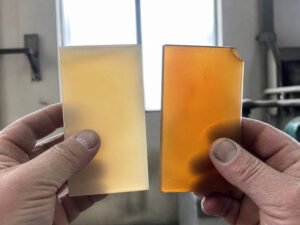
The aliphatic isocyanate is why the product is inherently light stable. There is no aromatic ring to absorb ultraviolet light, so the film does not amber in the way an aromatic polyurethane does.
What it is not is a thick system. Most products are applied at 300 to 600 microns per coat, and the total build on a normal job is under a millimetre.
That matters for the comparison, because a 6 millimetre polyurethane screed and a 0.5 millimetre polyaspartic coating are not competitors. They are answers to different questions.
Table 1: Two chemistries, side by side.
| Propriété | Polyuréthane | Polyaspartique |
|---|---|---|
| Reliure | Polyol plus isocyanate | Polyaspartic ester plus HDI |
| Typical build | 0.5-9 mm | 0.3-0.8 mm |
| Walk-on at 20 °C | 8-12 hours | 2-4 hours |
| Full chemical cure | 7 jours | 24-48 hours |
| Light stability | Aliphatic only | Inherent |
| Best use | Washdown, chemicals | Speed, thin build |
Cure speed: measured, not claimed
At 20 °C and 50 per cent humidity, a standard polyurethane screed takes eight to twelve hours to accept foot traffic. A polyaspartic coating takes two to four.
Cure speed roughly doubles for every 10 °C lost. Below 10 °C the polyurethane reaction nearly stops, while polyaspartic keeps enough reactivity to cure overnight, which is why winter programmes favour it.
Above 30 °C the advantage reverses into a problem. A product that gels in fifteen minutes at 20 °C will gel in six or seven at 32 °C, and a crew that has not planned for it will lose the batch.
Table 2: Cure milestones at three temperatures, thin build.
| Milestone | 10 °C | 20 °C | 30 °C |
|---|---|---|---|
| Polyurethane walk-on | 24-30 h | 8-12 h | 5-7 h |
| Polyaspartic walk-on | 6-8 h | 2-4 h | 1-2 h |
| Polyurethane full cure | 10-14 d | 7 d | 4-5 d |
| Polyaspartic full cure | 3-4 d | 24-48 h | 16-24 h |
Cure is measured rather than felt. A floor that feels hard may still be releasing solvent, and a polyaspartic coating that passes a thumb test can still fail a solvent rub. Use a Shore D reading or a solvent wipe before handing an area back.
One more number belongs next to those: the recoat interval printed on the drum. It is the only figure that tells a crew whether they can finish a hall in one visit or must return the next morning, and it varies more between products than between chemistries.
Read that table as a programme rather than a property. The difference between eight hours and three is the difference between two shifts and one, and that is where the money is.
Pot life is the constraint nobody prices
Pot life, called working life on some datasheets, is 20 to 40 minutes for a polyurethane screed and 10 to 20 for a polyaspartic coating.
Two things shorten it. Heat is the obvious one. Batch size is the one that catches crews out, because a larger mix generates more exothermic heat and the reaction accelerates itself.
A 20 kilogram mix that behaves well can gel in half the time at 40 kilograms. That is why the same product behaves differently on a small repair and on a full hall.
The practical controls are unglamorous and they work:
- Mix in batches sized to what one applicator can place in ten minutes.
- Keep resin and hardener at the same temperature before mixing.
- Use a wide, shallow container rather than a tall bucket.
- Never add solvent to extend working life. It ruins the film.
On a fast product, the number of mixes per hour becomes a labour calculation. A 500 square metre hall at 400 microns needs roughly 200 kilograms of mixed material, which is ten to twenty mixes, which is one or two extra people on the job.
Gel time and the overcoating window
Gel time is when the film stops flowing on the floor. It is a different number from pot life, which describes the mix in the bucket, and a product can have a short gel time and still be workable under the trowel.
The overcoating window is the interval in which the next coat will still bond chemically. For polyurethane that is typically 12 to 48 hours; for polyaspartic, 6 to 24. The full chemical cure arrives a week later on polyurethane, which is the point most programmes miss.
Missing the window is the most common cause of delamination on fast systems. The surface has cured past the point where the next coat can cross-link, and it must be abraded before overcoating.
That is a schedule risk, not a product fault. A fast cure buys you a one-shift turnaround and then punishes anyone who does not come back within a day.

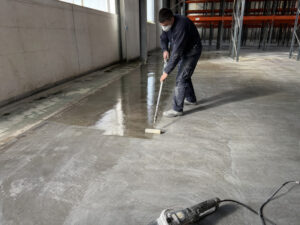
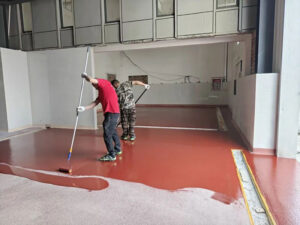
Figure 1: the tape is still in place on the left panel and the roller has been lifted clear of it, so the fresh edge stays visible.
Do both resist ultraviolet light?
Yes, if both are aliphatic. Ultraviolet resistance comes from the isocyanate rather than from the chemistry family, and an aromatic polyurethane will amber while a polyaspartic will not. The choice between aromatic or aliphatic binders is a cost and colour decision, and it sits alongside the chemistry choice rather than replacing it.
Polyaspartic has an advantage in gloss rather than in colour. Its films hold sheen longer under daylight, which matters on a decorative floor and hardly at all in a warehouse.
Neither is a substitute for a UV-stable topcoat in a fully exterior location. Both chemistries degrade under permanent sun and weather, and polyaspartic degrades more slowly rather than not at all.
Clear sealers are where the distinction is visible to a client. A clear coat over flakes will look new for years in polyaspartic and will amber within one in an aromatic polyurethane.
Return to service, and what downtime actually costs
Return to service is where the comparison becomes a financial one. A bottling line that stops for a shift loses more than the floor costs, and a warehouse that reroutes pickers for two days loses throughput rather than production.
Put the two numbers side by side before choosing. Eight hours of saved downtime on a plant with a high hourly cost will pay for the premium several times over; on a yard with slack capacity it will not.
There is a second gate that the datasheet does not show. Solvent content and odour matter in a food plant, and a fast cure does not waive the solvent content limits for the destination market.
That is why a fast cure product is often specified in the warehouse and refused in the filling hall, even though both are the same building and the same client.
Write the return to service time into the programme as a hard gate, not an intention. A fast product that is walked on two hours early is a floor with a footprint in it, and the repair costs more than the hours saved.

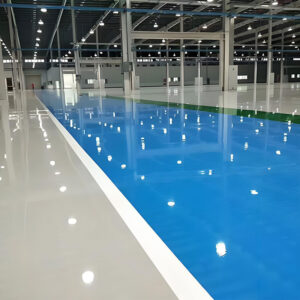
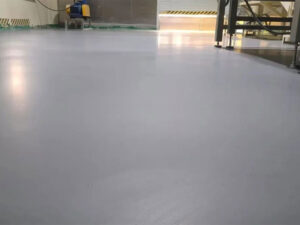
Figure 2: the work lights are on, and the only light on the floor comes from above.
Where polyurethane still wins
Heavy chemical exposure, hot washdown and thermal shock all favour a polyurethane screed. A 6 to 9 millimetre trowelled body in a heavy-duty specification tolerates things a 0.5 millimetre film cannot, whatever the binder.
Thickness is the reason, and it is not a chemistry argument. A polyaspartic at 6 millimetres would be an expensive experiment; a polyurethane at 0.5 millimetres would fail in the same service.
Slip resistance is the second reason. Aggregate broadcast into a screed stays put; aggregate in a thin coating is limited to what the film can hold.
The overlap in the middle is where most projects actually sit, and that is where a polyaspartic coating is most often mis-sold. A light manufacturing floor at 400 microns does not need a screed, and a washdown room does not need a coating.
So the honest position is that the two products overlap in the middle of the market and diverge at both ends. Thin, fast and decorative is polyaspartic. Thick, aggressive and structural is polyurethane.
Mixing ratio and application discipline
Both products are two-component and both are sensitive to the mixing ratio. Polyaspartic is usually 2:1 or 3:1 by volume and is less forgiving of a guess than a screed, because there is no filler to absorb the error.
A ratio that is off by ten per cent produces a film that stays tacky, or one that cures with a patchy gloss, or one that never reaches its chemical resistance. None of those shows up on the day.
Use calibrated pumps or graduated containers, and never top up a part-used kit. The short pot life of these products means a mistake is discovered within the hour, but only if someone is watching.
Plural-component spray equipment removes the ratio risk and adds a cleaning burden. Hand mixing keeps it simple and puts the discipline on the applicator.
How to choose in four questions
Four questions decide the choice, and only the first can rule a product out on its own.
First: how many hours can the area be closed? Under eight, the answer is the fast product. Over twenty-four, chemistry decides instead of schedule.
Second: what will be spilled on it? Hot water, lactic acid, caustic and solvents all point to a screed, and no amount of cure speed compensates.
Third: is colour part of the brief? Both can be light stable, but only if the correct grade is specified, and a clear sealer makes the difference obvious.
Fourth: who is applying it? A crew that has not used a short pot life product before will lose a batch on the first warm day. That is a training cost, and it belongs in the comparison.
Table 3: Which system fits which brief.
| Brief | Recommandation | Reason |
|---|---|---|
| One-shift turnaround | Polyaspartique | 2-4 hour walk-on |
| Hot washdown, chemicals | PU screed | Thickness and resistance |
| Decorative, clear sealer | Polyaspartique | Colour and gloss |
| Cold store at 5 °C | Polyaspartique | Cures at low temperature |
| Heavy forklift wear | PU screed | Wear layer depth |
Where a project needs both, split it. A fast coating in the office and canteen, a screed in the production hall, and one specification document that names both.
Reading the two datasheets side by side
Two numbers matter more than the marketing: walk-on time at 20 °C, and the working life at the same temperature. A datasheet that gives only the first is describing a best case rather than a product.
Ask for the mixing ratio and its tolerance. A 2:1 product mixed at 2.2:1 cures differently, and nobody notices until the second coat fails to bond.
Ask what the return to service time is after full chemical cure rather than after walk-on. On polyurethane those two milestones are a week apart, and a client who plans to the first will be disappointed by the second.
For a polyaspartic coating, also ask how the product behaves at 30 °C. A five-minute pot life is not a defect, but it is a constraint on crew size and on how much area one mix can cover.
Finally, ask which grade it is. Ultraviolet resistance is a property of the isocyanate, so a datasheet claiming UV stability without naming the chemistry is telling you little about the film you will receive.
Those four questions take ten minutes and they separate two products that look identical on a brochure page. Most of the disputes we are asked to arbitrate would not have happened if someone had asked them before the order.
Foire aux questions
Is polyaspartic better than polyurethane?
No, it is faster and thinner. It wins on turnaround and loses on chemical resistance and wear depth at equal thickness.
How long before a polyaspartic floor can take traffic?
Two to four hours at 20 °C. At 10 °C expect six to eight, and at 30 °C as little as one hour.
Can polyaspartic be applied over polyurethane?
Yes, within the overcoating window and after abrading. Outside the window the surface must be keyed before the next coat.
Does polyaspartic yellow?
Not when it is aliphatic, which most products are. It holds colour and gloss far better than an aromatic polyurethane.
Why is polyaspartic pot life so short?
The ester is only lightly hindered, so the reaction is fast. Heat and large batches shorten it further.
Can polyaspartic be used in a food plant?
As a thin coating in dry areas, yes. In washdown rooms the thickness is the limiting factor, not the chemistry.
Is polyaspartic more expensive?
Per kilogram yes, per square metre often close, and per project sometimes cheaper once downtime is counted.
Pourquoi les entreprises agroalimentaires font confiance à Kaida Paint
Kaida Paint supplies both systems and states the cure time and working life on the datasheet at 20 °C, rather than leaving a client to find out on site. Send the area, the service temperature and the hours you can close the room, and we will say which of the two we would put in it, including the cases where the answer is neither.



 English
 Spanish
 Portuguese
 Arabic
 French
 Italian
 Russian
 Indonesian
 Swedish