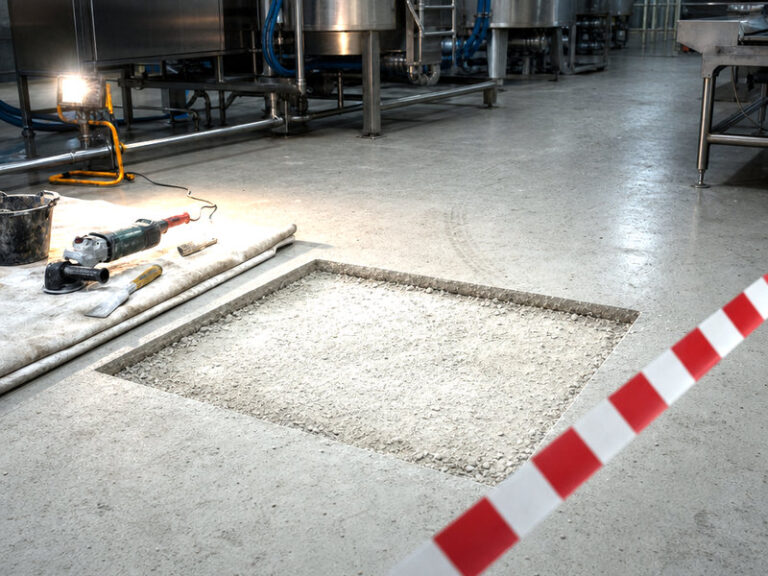
A food plant floor repair without a full shutdown is a scheduling problem before it is a materials problem. The material matters, and the clock matters more. The floor is the same; the constraint is that the room has to be handed back clean, dry and ready for production within a window you do not control.
That constraint changes the method, the material and the sequence. It also changes what a good outcome looks like: not a floor that looks new, but one that is sound, cleanable and documented until the next planned closure.
This article covers the decisions before the work, the four-hour repair and its limits, temporary measures, dust and access, cure time, colour, and the register that turns a series of patches into a plan.
What the window actually allows
A weekend gives two nights and one day, a night shift gives eight hours, and a holiday closure gives whatever the production plan says. Each window supports a different class of emergency floor repair.
The first question is not which product cures fastest, but how much time is left after preparation. Grinding, cleaning and priming take longer than most people expect, and they cannot be compressed by choosing a faster resin.
The second question is what has to happen after the repair: washing, a swab, a line start. A overnight repair that finishes at 05:00 and needs a wash at 06:00 has a different specification from one that finishes at 05:00 and needs nothing until Monday.
Write the window down in hours, from handover to handback, and subtract preparation and cleaning. What remains is the time available for the patch itself, and it is usually less than half the window.
That arithmetic is the whole discipline of a food plant floor repair, and it is where most overnight works are lost. Most failed overnight works fail because the window was estimated from the shift length rather than from the sequence.
Where the arithmetic does not work, the honest answer is a temporary patch tonight and a planned closure later. That is a better outcome than a repair that fails on Tuesday, and it is easier to explain to a production manager than a floor that has to be closed twice.
Patch tonight, or plan a closure
A patch flooring food is worth doing when the defect is local, the substrate is sound and the cause is known. It is worth deferring when the defect is spreading, when water is under the film, or when the cause has not been identified.
For food plant floor repair, the decision to patch or to wait is the one that gets revisited. The distinction matters because a patch over an active cause fails quickly and takes the surrounding floor with it. A lifted area at a drain collar will lift again unless the collar is reformed, whatever material is used.
A useful test is the tap test: sound floor rings, a void sounds dull. Map the dull areas with a marker before any cutting, and the extent of the repair becomes visible in ten minutes.
Where the dull area is more than a few square metres, the repair is no longer a patch. That is the point at which a emergency floor repair becomes a planned closure with a proper build-up.
Document the decision either way, because the next person will ask why a two-hour job became a three-day one. A photograph and a date answer that question better than a memory.
The same logic applies to repeats. A patch in the same place twice in a year is a signal that the detail, not the material, is the problem.
The four-hour repair, and its limits
An MMA patch is the standard answer for a fast repair in a food plant. It cures in one to two hours at 15 °C and can be walked on within four, which is what makes an overnight repair possible at all.
The material has limits that are worth stating. It has a strong odour, a short working life and a cure that is sensitive to substrate temperature; a fast-cure patch applied to a slab at 5 °C will not behave like the data sheet.
A food plant floor repair that relies on a four-hour material in a caustic room is a decision to return later. It is also not a universal chemical barrier. An MMA patch in a hot caustic washdown area will perform differently from a cementitious urethane, and the cure time is only the first question to ask.
The sequence for a small repair is: cut back to sound material, grind the perimeter, clean and prime, place the patch, broadcast, and finish. Each step has a minimum time, and skipping one is how a patch fails.
Where the patch is deeper than a few millimetres, build it in one pour rather than in layers. Layers trap air and create a delamination plane, and the cure time between layers is not the same as the cure of the whole.
Keep the batch record and the mix ratio. A fast-cure mix at the wrong ratio may still cure, and it will not have the properties the repair needed.
Temporary patches that hold for a season
A temporary patch is not a failure of planning; it is a legitimate tool when the window is too short or the cause is unresolved. The mistake is calling it a repair and forgetting it.
A good temporary measure keeps water out, keeps the surface cleanable and does not spread the defect. A bead of sealant around a lifted edge does none of those things, and it hides the problem from the next inspection.
A better temporary measure is a cut-back to sound material with a fast-set compound and a broadcast finish, even if the colour does not match. It is honest, cleanable and removable.
Mark temporary work on the drawing and in the register, with a review date. Temporary work that is reviewed in three months becomes a plan; one that is not becomes a permanent feature nobody owns.
Where the area is in a high-care room, a temporary measure should be agreed with quality before it is installed, not after. The conversation is short and it prevents a finding.
Treat the temporary work as a decision with an owner and a date, and it will be replaced on time. Treat it as a fix, and it will be rediscovered during an audit.
Working in a live area
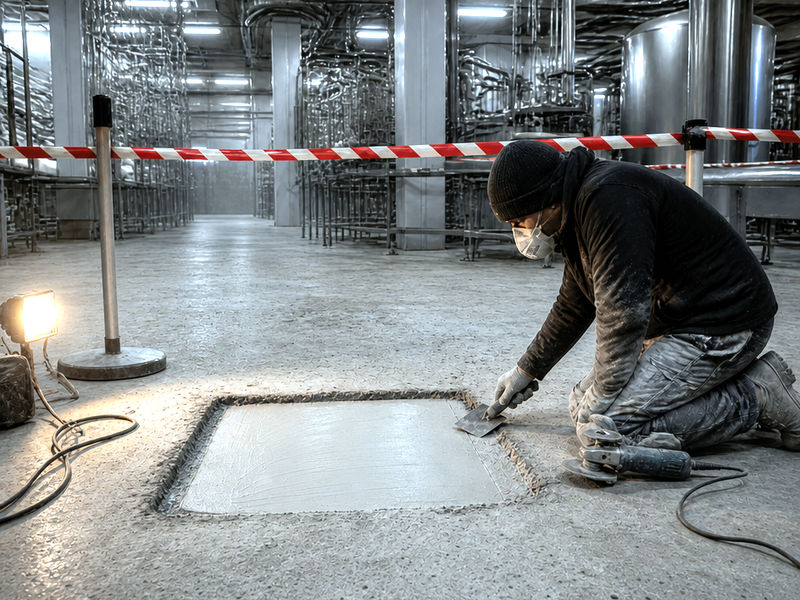
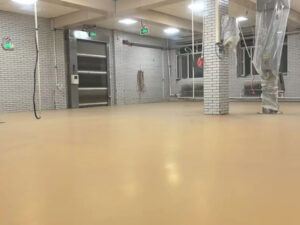
Figure 1: The barrier line is agreed before the shift, not drawn when the grinder starts.
In a live building, a food plant floor repair is judged as much on containment as on finish. Dust is the first control. Grinding in a production building needs a shroud and a vacuum rated for the material, and a barrier that is taped rather than stood in place.
Noise and access come second. A grinder in a tiled corridor is heard three rooms away, and a contractor who needs a forklift at 02:00 needs it booked rather than requested.
Tool control matters more than it sounds. A blade left in a drain is a foreign body finding, and a emergency floor repair that ends with a missing tool is a repair that created a bigger problem.
Agree the barrier line, the route and the cleaning method before the shift starts. A patch flooring food that leaves dust on a packing line has cost more than the floor it fixed.
Waste goes out the same way it came in, bagged and counted. Resin waste in a food waste stream is a compliance issue, and it is the kind of detail that gets remembered.
Finally, agree who signs the area back to production. A named person and a checklist turn a handover into a decision rather than a conversation at the door.
Cure time, and when the bay can be washed
In a food plant floor repair, curing is usually quoted as a walk-on time, which is not the same as a wash-down time. A floor that can be walked on at four hours may need twelve before it can take a hose and a chemical.
For an MMA patch, walk-on at two to four hours and washdown at eight to twelve is a reasonable planning assumption at 15 °C. At 8 °C both figures move out, and in a cold room they move out again.
Chemical resistance develops later than hardness. A patch that is hard enough to walk on can still be softened by a caustic wash on the same day, and the curing window quoted for the material rarely covers that.
Write the wash restriction into the handover note, and put it on the door. A restriction that lives in a conversation is a restriction that gets ignored by the night shift.
Where production cannot wait, choose a material whose washdown time fits the window rather than one whose walk-on time does. That is the single most useful selection criterion in an overnight repair.
Test before handback if there is any doubt: a small area washed with the process chemical will show softening in minutes, and it is better to know at 05:00 than at 08:00.
Colour, and the expectations around it
Colour match is the part of a patch flooring food that clients notice and specifications rarely define. A patch that is sound but visibly different will be reported as a defect by somebody who has not read the drawing.
Perfect colour matching is difficult because pigments settle, batches vary and age changes the original. The realistic target is a patch that reads as a repair rather than as damage.
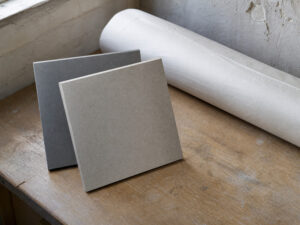
A colour match conversation is easier with the original label in hand. Where the system is known, use the original product and batch if it is still available. Where it is not, ask for the nearest standard colour and show a sample before the shift starts.
In a high-care room, a contrasting patch can be an advantage: it shows the repair on a drawing and makes the next inspection easier. That is a case where colour match should deliberately not be perfect.
Agree the expectation in writing, with a photograph of the finished area. A sentence in the handover note prevents a conversation in six months about a floor that was always going to look repaired.
Where appearance matters more than speed, the answer is a planned closure rather than a night shift. An emergency floor repair done at 02:00 is done for function, not for finish.
The register that turns patches into a plan
A repair register is the most useful document a maintenance team can keep about a floor. It records what failed, where, when and with what, and it turns a series of patch flooring food into evidence about the building.
A repair register only earns its keep if it is filled in on the night, not the following week. The minimum entry is a date, a location, a cause, a material and a photograph. Five fields, one line on a spreadsheet, and the pattern appears within a year.
The pattern is what changes a budget conversation. Three repairs at the same drain collar in two years is an argument for reforming the collar, not for another temporary patch.
The register also supports warranty claims, because it shows the floor was maintained rather than neglected. A supplier is more likely to honour a claim when the history is legible.
A food plant floor repair budget drawn from the register is easier to defend than one drawn from complaints. Review it before the annual capital round, and use it to decide which rooms get a planned closure. A food plant floor repair programme built on the register is cheaper than one built on complaints.
Finally, keep the register with the drawings rather than in a maintenance system nobody opens. A document that is hard to find is a document that will be recreated from memory.
Table 1: Window, method and what it can achieve.
| Window | Method | Realistic outcome |
|---|---|---|
| 8 heures | MMA resin | Local repair, walk-on by handback |
| 24 heures | MMA or fast PU | Repair plus washdown time |
| Weekend | Urethane patch | Detail rebuilt, colour matched |
| Closure | Full build-up | Room returned to specification |
Table 2: Cure and wash times to plan with, at 15 °C.
| Matériau | Walk-on | Washdown |
|---|---|---|
| MMA | 2 to 4 h | 8 to 12 h |
| Fast polyurethane | 8 h | 24 h |
| Cementitious urethane | 12 h | 48 to 72 h |
Table 3: What the register should capture.
| Field | Why it matters |
|---|---|
| Date and location | Shows repeats |
| Cause | Separates detail from material |
| Material and batch | Supports warranty claims |
| Photograph | Answers the next question |
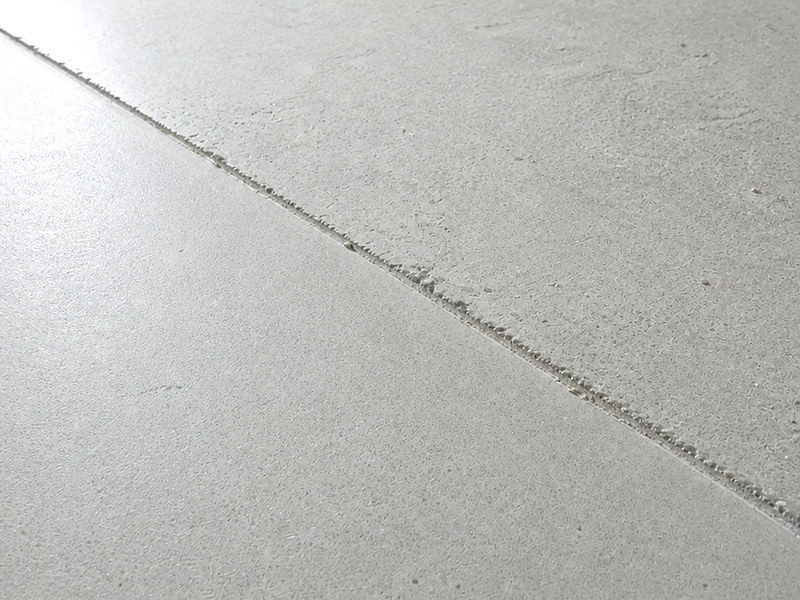
Figure 2: A repair that reads as a repair is a success; a repair that pretends to be invisible is a future argument.
Frequently asked questions
Can a food plant floor be repaired without stopping production?
Yes, in a defined area with a barrier, dust control and a material that cures inside the window. The constraint is the handback time, not the resin, and preparation usually takes longer than the patch itself.
How fast can a floor patch be walked on?
An MMA patch can be walked on in two to four hours at 15 °C, and washed after eight to twelve. A fast polyurethane needs about eight hours to walk and twenty-four to wash.
Is a temporary patch acceptable in a high-care room?
It can be, if quality agrees it before installation and it is recorded with a review date. A temporary measure that is cleanable, cut back to sound material and documented is defensible; a bead of sealant over a lifted edge is not.
Why do patches fail in the same place?
Because the detail, not the material, is usually the cause. A repair at a drain collar will fail again unless the collar is reformed, and a repair at a door frame will fail again unless the frame detail changes.
Does colour matching matter?
For function, no; for perception, yes. Perfect matching is difficult because pigments settle and the original floor ages, so agree the expectation in writing with a photograph of the finished area.
What should a repair register contain?
Date, location, cause, material and a photograph, one line per event. Within a year the pattern shows whether you have a maintenance issue or a design issue.
How long does a proper repair take?
A local patch with preparation, priming, broadcast and finish takes six to eight hours of elapsed time, of which about three are hands-on. Anything faster is a temporary measure.
Why food plants work with Kaida Paint
Kaida Paint supplies fast-cure and standard systems for repairs, and we will say which one the window supports rather than which one is fastest. Send a photograph, the room and the hours you have between handover and handback, and the reply is a method with the cure time stated for walk-on and for washdown. Where the honest answer is a temporary patch now and a closure later, we will say that too.



 English
 Spanish
 Portuguese
 Arabic
 French
 Italian
 Russian
 Indonesian
 Swedish