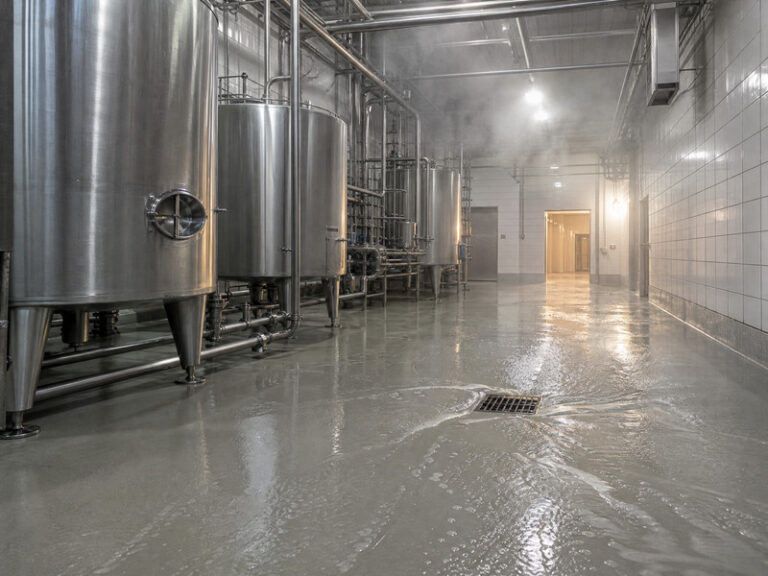
Dairy flooring fails earlier than most wet process floors because it meets three attacks at once. Lactic acid arrives from product and cleaning, a protein film never fully dries, and the CIP cycle delivers hot water several times a day.
The failure is rarely the surface. It starts at the drain collar, under the filler, or along a wall junction where liquid stands after the wash. Those three places decide whether the system lasts five years or fifteen.
This article separates the three attacks, maps them to the receiving, processing and packing areas, and sets out the details that carry most of the risk.
Why dairy floors fail faster than other wet process floors
A brewery floor meets sugar and caustic; a meat plant meets fat and hot water. A dairy meets an acid that stays on the surface, a sugar that feeds bacteria, and a cleaning cycle hot enough to stress the bond line.
That combination is why dairy flooring is a separate specification rather than a variation on a general wet process system. The chemistry is milder than a rendering plant and the exposure is more continuous.
Continuous exposure matters because most resins fail by cumulative damage. One hot wash is a test; four hot washes a day, every day, is a service condition that only some binders are built for.
A dairy plant floor that looks sound at handover can still fail within two years if the binder was chosen for chemical resistance under CIP conditions and not for acid plus heat. The wet processing environment is what separates the two cases.
There is also a hygiene penalty that other plants do not carry. Any film left on the floor is a growth medium, so cleaning frequency rises exactly where the floor is least able to take it.
Lactic acid, whey and lactose: three different attacks
In dairy flooring, lactic acid attacks the binder. It forms in product residue and in cleaning, it sits in the same low points every day, and it hydrolyses amine-cured epoxy at the surface until the film chalks and loses its profile.
A lactic acid resistant floor therefore has to be a urethane rather than a standard epoxy. The same conclusion applies to acetic acid from yogurt and to the mixed organic acids in fermented product: the family of exposure is the same.
Whey is a different problem. It leaves a protein and sugar film that holds water against the surface, feeds bacteria, and turns a small scratch into a persistent soil trap. The resin choice matters less than the fall and the cleaning routine.
Where whey is warm and concentrated, as at a cheese vat drain, the film is thick enough to keep the surface wet between shifts. That is the point where a lactic acid resistant floor earns its cost, because the exposure is continuous rather than intermittent.
Lactose is the third and quietest attack. It crystallises in joints and at kerbs, and it is abrasive when traffic grinds it. Most of the damage attributed to lactose is really damage from a joint that let it in.
CIP washdown: concentration, temperature and time
A CIP circuit returns the same caustic to the floor at every rinse, so the exposure is a duty cycle rather than an event. The sequence runs caustic, rinse, acid, sanitizer, and the floor sees the spills, the rinse water and the return flow.
Three variables decide the damage: concentration, temperature and time. A CIP washdown that spills 1 percent caustic at 75 °C twice a shift is a harder duty than a stronger solution at ambient, because heat moves the polymer.
The floor also sees the transitions. A hot caustic spill followed by a cold rinse creates a thermal gradient across the film, and that gradient repeats at the same location every day until the bond line gives up.
This is the practical reason thermal shock resistance matters in a dairy more than in a dry plant: the cleaning cycle, not the product, supplies most of the thermal load.
Time is the variable plants forget. A spill rinsed within a minute is a different exposure from one that sits under a pallet until the end of the shift, and the second one is what a specification should describe.
Table 1: Typical dairy cleaning loads and what each one demands of the floor.
| Stage | Concentration | Température | Demand on the floor |
|---|---|---|---|
| Caustic wash | 1-2% NaOH | 70-80 °C | Alkali plus heat at drains |
| Acid wash | 0.5-2% nitric or phosphoric | ambient-60 °C | Acid attack at the surface |
| Rinse | water | ambient-40 °C | Thermal gradient, no chemistry |
| Sanitizer | 0.1-0.5% peracetic | ambient | Oxidiser, mainly at joints |
Receiving, processing and packing need different systems
A dairy is at least three floors. Receiving is wet, heavy and cold; processing is hot, wet and chemically aggressive; packing is often dry but sees product spill and washdown at shift end.
Each area answers a different question: what load it carries, what chemistry reaches it, and how long it can be out of service.
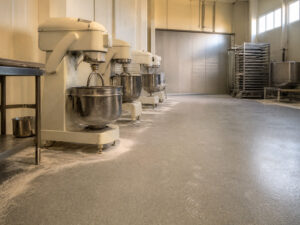
Receiving needs load capacity and drainage more than chemical resistance. A dairy plant floor here is usually a thicker system with a fall to a trench, because milk spills are large and frequent and the area takes tanker traffic.
Processing is the zone that justifies the higher specification. Wet processing in this area combines CIP washdown at temperature with product residue, and it is where a thermal shock resistance requirement belongs in the tender rather than in a general note.
Packing can often use a lighter system, provided the joints and coves are detailed the same way. The mistake is to specify one system for the whole building, which overprices packing and underprices processing.
On one plant we surveyed, the packing hall had been specified to the processing standard and the processing room had not, because the two areas were tendered separately and the schedule was copied across.
Where the plant runs a single specification across all three areas, the processing room sets the standard and the other two pay for it. Splitting the schedule by area is usually the cheapest decision in the project.
Drains, falls and kerbs in a dairy
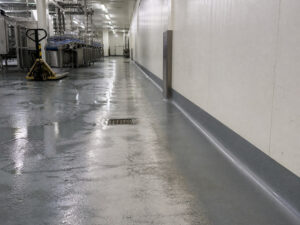
Most dairy flooring failures start at a detail, not in the field. The drain collar, the wall junction and the kerb at a door threshold are where liquid stands, where cleaning is hardest, and where the film is thinnest.
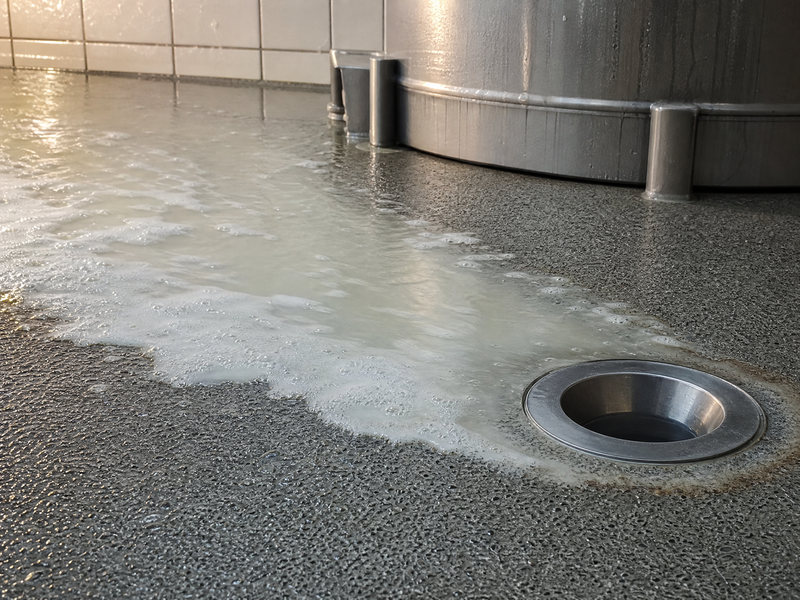
Figure 1: The drain collar sees the hottest liquid at the highest concentration. It is the first detail to fail and the first to inspect.
The floor fall should be 1:80 to 1:100 across the room, with 2 percent only at local wet areas and drain surrounds. Steeper falls cost headroom at the drain and make tanker and pallet movement awkward.
Check the fall with a digital level on a grid before the resin goes down, because correcting it afterwards means removing the floor you have just paid for.
A stainless kerb at wall junctions and door thresholds gives the resin a termination that can be cleaned and replaced. It also protects the coved base from impact, which is where most damage in a receiving bay begins.
Where a stainless kerb is used, the resin should finish against it with a sealed joint rather than a butt joint. That single detail decides whether water reaches the wall substrate during washdown.
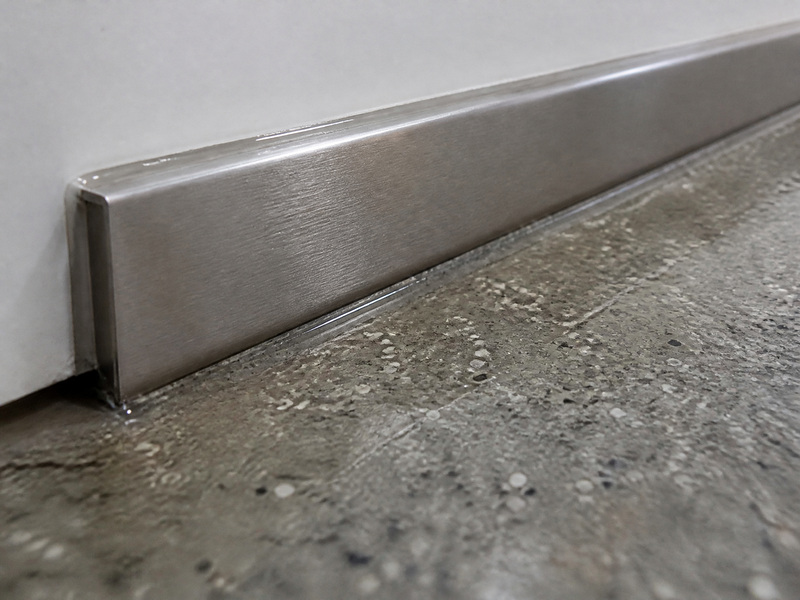
Figure 2: A kerb gives the resin somewhere to finish. Without it, the cove becomes the impact point and the leak path.
Drain collars should be formed in resin around the frame, not cut in afterwards. A collar formed after the field coat is a patch, and a patch at the wettest point of the floor is a future repair.
At handover, run water at the drain for ten minutes and watch where it stops; a collar that holds a film of water is already a cleaning problem.
Table 2: Detail requirements by area, which carry more risk than the field coating.
| Zone | Fall | Detail |
|---|---|---|
| Receiving | 1:80 to trench | Stainless kerb at doors, collar at each outlet |
| Processing | 1:100 to channel | Formed collars, coves 100 mm, no joints in wash zone |
| Packing | 1:100 to gully | Cove 75 mm, kerb at wall base |
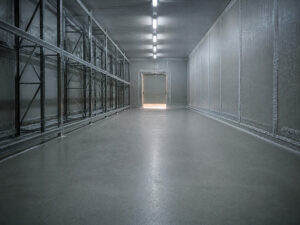
| Cold store | 1:100, heated threshold | Insulated panel junction detail |
Thermal shock at pasteurisers and fillers
Hot water and hot product do not fail dairy flooring by themselves; the rate of change does. A pasteuriser that drains 85 °C water onto a floor at 10 °C creates a gradient the film cannot absorb if it is rigid.
Thermal shock resistance is therefore a rate property, not a temperature rating. Two systems can both be rated to 90 °C and behave completely differently when the water arrives in a surge rather than a slow flow.
The places to inspect are the base of the pasteuriser, the filler drip tray, and the floor immediately around the drain that takes the first flush. Those three locations tell you whether the system was specified for the duty.
Where a lactic acid resistant floor is specified, check that the thermal claim is supported by a cycling test rather than a static temperature. A static rating is easy to publish and hard to rely on.
Where the floor has already failed in those places, the repair is a detail repair, not a field recoat. Cutting out a collar and forming a new one costs a shift; recoating over it costs a season and then the same shift.
System and thickness by area
For dairy flooring, the system choice is short once the exposure is mapped. Cementitious urethane at 6 to 9 mm covers the processing and receiving areas; polyurethane at 3 to 4 mm covers cold rooms and lighter wet areas; epoxy is limited to dry packing and storage.
Thickness follows the thermal and mechanical load, not the traffic count alone. A dairy plant floor in a receiving bay that takes tankers needs more build-up than a packing hall with the same square metres.
Between 6 mm and 9 mm, the difference is service life at the drain and under equipment, not chemical resistance. Both resist the same chemistry; the thicker one lasts longer where heat cycles.
Table 3: Dairy flooring by area, with the build-up and detail that usually applies.
| Zone | Système | Épaisseur | Slip |
|---|---|---|---|
| Receiving, tanker bay | Cementitious urethane | 9 mm | R12 |
| Processing, wet | Cementitious urethane | 6-9 mm | R11-R12 |
| Cheese and whey area | Cementitious urethane | 9 mm | R12 |
| Cold store | Polyurethane or MMA | 3-4 mm | R10-R11 |
| Dry packing | Epoxy | 1.0-1.5 mm | R9-R10 |
Where the floor fall has to serve two areas with different systems, put the transition at a doorway or a kerb, not in the middle of a wet zone. A joint between systems in a washdown area is a leak waiting for its first winter.
Specification lines that prevent the usual failure
Five lines do most of the work. Name the chemistry and its temperature per area; name the build-up in millimetres; name the details, including collars and kerbs; name the fall; and name the acceptance tests.
For a dairy flooring specification, the chemistry line should read like a cleaning schedule rather than a product category: caustic 2 percent at 75 °C daily, nitric 1 percent at 55 °C weekly, peracetic 0.2 percent at ambient.
The detail line should require formed collars, 100 mm coves in processing and a stainless kerb where the floor meets a wall or a door frame. Those are the items that appear in every repair estimate we see.
Acceptance testing for a dairy floor should require pull-off tests at a stated rate and a floor fall check with a digital level, not a visual assessment. Anything measured only by eye will be argued about later.
Keep the schedule to one page per room. A document that runs to forty pages is read by nobody, and the four numbers that matter are buried by page ten.
Finally, require the handover file to include the batch records and the SDS in the local language. A dairy plant floor without that file is harder to defend in an audit than one with a slightly higher price and complete documentation.
Frequently asked questions
Why does dairy flooring fail at the drain first?
Check the collar at handover with a pull-off test at the flange and a 2 m straightedge run to the drain. A collar that reads hollow is already open at the back, whatever the surface looks like. If it was patched in rather than formed, water reaches the substrate at the wettest point on the floor.
Is epoxy suitable for a dairy plant floor?
Only in dry packing and storage. Lactic acid plus 70 to 80 °C caustic breaks down amine-cured epoxy at the surface within a couple of years, and the repair usually costs more than the difference in first cost.
What is a lactic acid resistant floor made of?
A urethane binder, usually cementitious urethane at 6 to 9 mm or a polyurethane screed. The chemistry is what matters: the binder must not hydrolyse under organic acid at temperature.
How hot can CIP washdown be before it damages the floor?
Most food plant systems are built for caustic duty at 70 to 80 °C and a strength of 1 to 2 percent. Above that, the limiting factor is usually thermal shock at the drain rather than the chemical itself, which is why cycling tests matter more than a static rating.
Does whey damage resin floors?
Not chemically in the way acid does, but it leaves a film that holds water and feeds bacteria. That film keeps the surface wet between shifts and turns any scratch into a soil trap, so drainage and cleaning matter as much as the resin.
Do I need stainless kerbs in a dairy?
At wall junctions and door thresholds, they help. A kerb gives the resin a clean termination, protects the cove from impact and can be replaced without removing the field floor.
How do I check the fall before accepting the floor?
Use a digital level on a grid and a straightedge at the low points, then run water. A floor can pass a straightedge check and still pond, because a 2 mm dip holds water across a large area. Record the readings by grid reference.
Why food plants work with Kaida Paint
Kaida Paint manufactures cementitious urethane, polyurethane, epoxy and MMA systems for dairy and beverage plants, and supplies them as finished systems or as OEM and private-label production for distributors. Each batch ships with a certificate of analysis and a batch record, and TDS and SDS documents are issued in the buyer’s language. Our technical team reviews the cleaning schedule and the area plan before recommending a build-up for dairy flooring, and will quote the drain collars and kerbs as separate line items so they cannot be dropped.
Send the room list with the CIP concentrations and temperatures, and the reply is a system table by area with the detail schedule attached, including collars and kerbs.



 English
 Spanish
 Portuguese
 Arabic
 French
 Italian
 Russian
 Indonesian
 Swedish