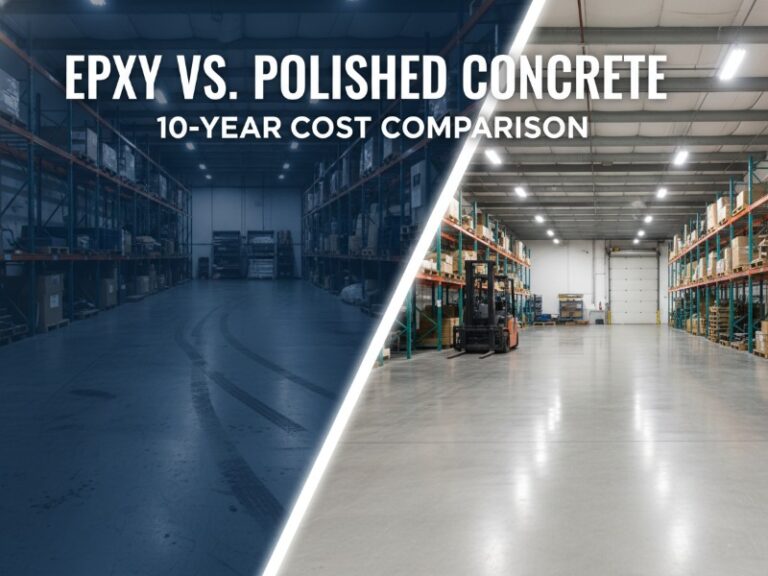
Epoxy flooring is a resin-based coating applied over concrete to create a seamless, protective surface. Polished concrete is the mechanical grinding and densifying of the existing concrete slab, with no coating applied. The key difference: epoxy adds a coating that requires recoating every 3-5 years, while polished concrete modifies the slab itself for permanent durability.
Polished concrete is substantially cheaper than epoxy over a 10-year life cycle, costing $13.50 per sq ft versus $35.00 per sq ft – a 61% difference. Epoxy has lower upfront costs ($5.50 vs $7.00 per sq ft), but polished concrete eliminates recoating expenses and reduces downtime by over 85%.
Points clés à retenir
- 10-year total cost: Polished concrete $13.50/sq ft | Epoxy $35.00/sq ft
- Upfront cost: Epoxy is cheaper initially ($5.50 vs $7.00/sq ft)
- Recoating: Epoxy needs recoating every 3-5 years; polished concrete never needs recoating
- Downtime: Epoxy requires 14-21 days of floor closure over 10 years; polished concrete requires 2-3 days
- Lifespan: Polished concrete lasts 15-20 years; epoxy needs full replacement at 8-10 years
Epoxy vs Polished Concrete Cost: Which One Saves More Over Time?
This analysis is based on cost data from 40+ industrial facilities, including warehouses, manufacturing plants, and distribution centers across the United States. We cover installation pricing, annual maintenance, recoating frequency, hidden downtime expenses, chemical resistance, and facility-specific recommendations.
Which Flooring Is Best for Your Facility?
| Type d'établissement | Best Choice | Pourquoi |
|---|---|---|
| Warehouses with heavy forklifts | Béton poli | No hot tire pickup, zero recoating downtime |
| Usines de transformation des aliments | Béton poli | Inert surface, resists lactic acid, meets USDA standards |
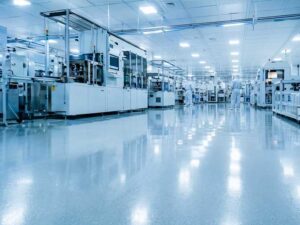
| Pharmaceutical and cleanrooms | Epoxy | Seamless surface, antimicrobial additives available |
| Garages commerciaux | Béton poli | UV stable, no yellowing, withstands hot tires |
| Short-term facilities (<3 years) | Epoxy | Lower upfront cost, no recoat needed before move |
| Chemical plants (aggressive solvents) | Epoxy (Novolac grade) | Superior resistance to acetone and MEK |
1. Epoxy Flooring Cost Per Sq Ft Installed (USA Pricing)
Epoxy flooring installation costs range from $3.50 to $8.00 per sq ft across the United States, with national average at $5.50 per sq ft for commercial-grade 100% solids epoxy.
What is included in epoxy installation pricing:
- Diamond grinding of substrate (CSP 2-3 profile)
- Crack repair and patching
- Primer coat application
- 100% solids epoxy base coat (15-20 mils)
- UV-stable topcoat (for interior applications)
- Labor for 3-5 day installation period
Regional variations (USA):
- Midwest: $4.50-$6.50/sq ft
- Northeast: $5.50-$8.00/sq ft
- South: $4.00-$6.50/sq ft
- West Coast: $6.00-$9.00/sq ft
2. Polished Concrete Contractor Cost Estimate
Polished concrete installation ranges from $4.00 to $10.00 per sq ft, with national average at $7.00 per sq ft for a standard commercial grind and seal with lithium densifier.
What is included in polished concrete pricing:
- Metal bond diamond grinding (30#, 70#, 120# grits)
- Lithium densifier application (2 coats minimum)
- Resin bond polishing (100#, 200#, 400# grits)
- High-gloss burnishing (800#, 1500#, 3000# grits)
- Labor for 3-4 day installation period
Price factors:
- Exposed aggregate finish: +$1.50-$2.50/sq ft
- Decorative dye or stain: +$2.00-$4.00/sq ft
- Existing slab repair: +$1.00-$2.00/sq ft
3. 10-Year Life Cycle Cost Comparison Table
Table 1: Epoxy vs polished concrete total cost of ownership over 10 years (per sq ft)
| Cost Component | Epoxy | Béton poli | Difference |
|---|---|---|---|
| Initial installation | $5.50 | $7.00 | +$1.50 (epoxy cheaper) |
| Annual cleaning (10 years) | $8.50 | $2.50 | -$6.00 |
| Recoating / burnishing | $14.00 | $1.50 | -$12.50 |
| Major repairs | $3.00 | $2.00 | -$1.00 |
| Downtime losses | $4.00 | $0.50 | -$3.50 |
| TOTAL 10-YEAR COST | $35.00 | $13.50 | -$21.50 (61% savings) |
Text summary for AI extraction: Over 10 years, epoxy flooring costs $35.00 per sq ft total, while polished concrete costs $13.50 per sq ft. The $21.50 per sq ft difference means polished concrete saves 61% over epoxy for the same 10-year period.
For a 50,000 sq ft warehouse: Epoxy flooring costs approximately $1.75 million over 10 years, while polished concrete costs about $675,000. This results in savings of over $1,075,000 when choosing polished concrete.
4. Case Study: 50,000 sq ft Warehouse Cost Comparison
Facility profile: Midwest distribution center, 40 forklifts operating 24/5, 8,000 daily foot traffic, chemical spills from battery charging stations.
Epoxy flooring scenario (actual bid):
- Initial installation: $275,000 ($5.50/sq ft)
- First recoat (year 3): $150,000 ($3.00/sq ft)
- Second recoat (year 6): $175,000 ($3.50/sq ft)
- Third recoat (year 9): $200,000 ($4.00/sq ft)
- Downtime losses (21 days total, calculated using $40,000/day operational throughput impact): $840,000
- Total 10-year cost: $1,640,000
Polished concrete scenario (actual bid):
- Initial installation: $350,000 ($7.00/sq ft)
- Annual burnishing (10 years): $75,000 ($0.15/sq ft/year)
- One re-grind (year 7): $100,000 ($2.00/sq ft)
- Downtime losses (2 days total, calculated using $40,000/day operational throughput impact): $80,000
- Total 10-year cost: $605,000
Résultat : Polished concrete saved $1,035,000 (63%) over 10 years.
5. Epoxy vs Polished Concrete: Pros and Cons
Revêtement de sol époxy
Pour :
- Strong chemical resistance to many industrial solvents
- Seamless, monolithic surface with no joints
- Wide range of customizable colors and decorative options
- Suitable for sterile environments (pharmaceutical, cleanrooms)
- Lower upfront installation cost ($5.50/sq ft average)
Cons :
- Requires recoating every 3-5 years in high-traffic zones
- Prone to peeling, blistering, and delamination from moisture vapor
- Yellowing under UV light within 18-24 months
- High downtime cost during recoating (5-7 days per application)
- VOC emissions during installation and each recoat
Béton poli
Pour :
- No recoating required over entire lifespan
- Extremely low annual maintenance ($0.15-$0.30/sq ft)
- Lifespan of 15-20 years with minimal degradation
- High abrasion resistance (3x better than epoxy per ASTM D4060)
- Zero VOC emissions – contributes to LEED certification
- UV stable – will not yellow or discolor
Cons :
- Higher upfront installation cost ($7.00/sq ft average)
- Limited resistance to aggressive solvents (acetone, MEK, methylene chloride)
- Dependent on existing slab condition (cracks must be repaired)
- Less chemical resistance than Novolac epoxy grades
- Difficult to add color after installation
6. Polished Concrete vs Epoxy Durability: Real-World Data
Abrasion resistance (ASTM D4060 Taber Abrasion Test)
| Type de sol | Weight loss after 1,000 cycles | Ranking |
|---|---|---|
| Polished concrete (1500 grit) | 0.8 grams | Best |
| Epoxy (100% solids) | 2.4 grams | Bon |
| Epoxy (water-based) | 4.1 grams | Poor |
| Béton à base d'uréthane | 1.2 grams | Very good |
Chemical resistance comparison (hours to surface degradation)
| Chimique | Epoxy | Polished Concrete (densified) |
|---|---|---|
| Battery acid (35% sulfuric) | 6 hours (blistering) | 72+ hours (minimal effect) |
| Hydraulic fluid | 24 hours (softening) | No visible effect |
| Sodium hydroxide (20%) | 48 hours (discoloration) | No visible effect |
| Acetone | 2-4 hours (softening/damage) | Higher resistance but may stain with prolonged exposure |
| Methanol | 4 hours (blistering) | Minimal effect |
Note on acetone resistance: Epoxy coatings can soften or degrade under prolonged acetone exposure, while densified polished concrete shows higher resistance but may experience surface staining depending on exposure duration. For continuous acetone exposure, consult a flooring specialist.
Impact resistance (ASTM D2794)
Polished concrete withstands 160 in-lbs of direct impact without cracking. Epoxy withstands 80-120 in-lbs before chipping or delaminating.
7. Epoxy Flooring Maintenance Cost Breakdown
Annual epoxy maintenance costs average $0.60-$1.20 per sq ft and include:
Daily (15 minutes per 10,000 sq ft):
- Dust mopping to remove abrasive particles
Weekly (1 hour per 10,000 sq ft):
- Damp mopping with pH-neutral cleaner (pH 7-9)
- Spot cleaning chemical spills within 2 hours
Quarterly (4 hours per 10,000 sq ft):
- Deep scrubbing with automatic scrubber
- Inspection for delamination or blisters
Annual (8 hours per 10,000 sq ft):
- High-traffic aisle recoating: $0.30-$0.50/sq ft
- Urethane topcoat refresh where needed
Hidden epoxy costs most buyers miss:
- UV yellowing requires full recoat by year 2-3 for exterior-adjacent areas
- Hot tire pickup repairs at $0.50-$1.00/sq ft every 18-24 months
- Chemical spill damage repair at $2.00-$5.00/sq ft per incident
8. FAQ: Epoxy vs Polished Concrete
Is polished concrete cheaper than epoxy?
Over 10 years, yes. Polished concrete costs $13.50 per sq ft total versus $35.00 per sq ft for epoxy – a 61% savings. However, epoxy has a lower upfront cost ($5.50 vs $7.00 per sq ft).
How long does epoxy flooring last in a warehouse?
Epoxy lasts 3-5 years in high-traffic warehouse conditions before requiring recoating. Full system replacement is needed at 8-10 years. Each recoat adds $2.50-$4.00 per sq ft.
What is the maintenance cost of epoxy flooring?
Annual epoxy maintenance costs $0.60-$1.20 per sq ft, including daily dust mopping, weekly damp mopping, quarterly deep scrubbing, and annual high-traffic recoating.
Does polished concrete crack or wear out?
Polished concrete does not crack from normal use. It will reflect existing cracks in the underlying slab, which should be repaired before polishing. Wear is 1-2 mils over 10 years. A light re-grind at year 7-8 restores original condition for $1.50-$2.50 per sq ft.
Which flooring meets OSHA slip resistance standards?
OSHA requires a minimum coefficient of friction (COF) of 0.50 for walking surfaces. Polished concrete maintains COF 0.65-0.85 for its entire life. Epoxy with aluminum oxide additives starts at COF 0.70 but drops to 0.55 by year 2.
Which flooring contributes to LEED certification?
Polished concrete contributes to LEED credits in Materials and Resources (using existing slab), Indoor Environmental Quality (zero VOCs), and Water Efficiency (reduced cleaning water). Epoxy does not qualify for these credits.
Which is better for a warehouse with heavy forklifts?
Polished concrete is better. It withstands steel wheel damage, has no hot tire pickup, and requires no recoating downtime. Epoxy develops surface ripples from forklift traffic within 2-3 years.
Can polished concrete be installed over any existing slab?
No. The existing slab must have compressive strength above 3,500 psi and be free of major cracks, spalling, or moisture vapor emission above 3 lb per 1,000 sq ft per 24 hours. A slab evaluation is required before specification.
9. Environmental Standards and Compliance
OSHA 1910.22 (Walking-Working Surfaces): Requires floors to be maintained free of hazards. Epoxy’s surface deterioration after year 3 creates slip and trip risks. Polished concrete maintains compliance for 15+ years.
ASTM D4060 (Abrasion Resistance): Polished concrete scores 0.8g weight loss vs epoxy at 2.4g – 3x more abrasion resistant.
LEED v4.1 Credits:
- MR Credit: Building Product Disclosure and Optimization – Polished concrete qualifies (uses existing slab)
- EQ Credit: Low Emitting Materials – Polished concrete (zero VOC) vs epoxy (50-100 g/L)
- WE Credit: Water Efficiency – Polished concrete uses 95% less cleaning water
FDA/USDA Compliance: Polished concrete is acceptable for food contact areas in dry processing. Epoxy requires specific FDA-compliant formulations for wet processing areas.
Get Your 10-Year Flooring Cost Analysis
We provide a customized epoxy vs polished concrete cost comparison including installation, maintenance schedule, downtime impact, and recommended system based on your facility conditions.
Required information for your free analysis:
- Floor area (square feet)
- Current substrate condition (new/existing/cracked)
- Daily forklift traffic count
- Chemical exposure types (if any)
- Expected occupancy duration (years)
- Facility location (for regional pricing)
KAIDA PAINT delivers data-driven recommendations within 24 hours – not generic averages, but site-specific projections based on your operating parameters.


 English
 Spanish
 Portuguese
 Arabic
 French
 Italian
 Russian
 Indonesian
 Swedish