1. Which Resin Survives Your Acid? All 13 Systems Compared
Every figure below is the concentration the system is declared against after a 7-day immersion test, taken from the product data sheet. Declared resistance is a laboratory envelope, not a warranty of continuous service at that concentration.
| النظام | Resin base | Build (mm) | Declared acid ceiling | Quoted life | Fits |
|---|
| Vinyl Ester Roll-On Flooring | vinyl ester | 1–5 | 75% sulfuric acid | 5–8+ years | Large areas, moderate chemical duty, tight budget |
| Self Leveling Vinyl Ester Flooring | vinyl ester | 3–5 | 75% sulfuric / 40% hydrochloric | 5–8+ years | Seamless gloss finish, plating and PCB plants |
| Vinyl Ester Colored Sand Flooring | vinyl ester | on its base build | same envelope as its base build | quoted per project | Food, pharmaceutical and laboratory areas where the finish is visible |
| Anti Static Vinyl Ester Flooring | vinyl ester | 3–5 | 75% sulfuric / 40% hydrochloric | 5–8+ years | ESD control on an acid-resistant base, copper foil earthing |
| Fiberglass Reinforced Vinyl Ester Coating | vinyl ester + glass | 2–5 | 75% sulfuric / 35% hydrochloric, 25% HF | 5–10+ years | Floors, tank interiors and pipe exteriors; spray or hand lay-up |
| Vinyl Ester Tank Lining | vinyl ester | 2–5 | 75% sulfuric / 40% hydrochloric | quoted per project | Concrete pools and tanks, acid and brine service |
| Chemical Resistant Mortar Flooring | vinyl ester | 5–20 | 95% sulfuric / 35% hydrochloric, 55% HF | quoted per project | Concentrated acid, heavy duty, where a thin film would be permeated in a season |
| أرضيات الإيبوكسي هاون | الإيبوكسي | 2–10 | 65% sulfuric / 35% hydrochloric | 5–10+ years | Acid below 65%, alkalis, and load where vinyl ester is not required |
| Fiberglass Reinforced Epoxy Flooring | الإيبوكسي | 2–5 | 35% sulfuric / 25% hydrochloric | 5–8+ years | Milder acid exposure at a lower material cost |
| FRP Flooring | polyester | 2–5 | 75% sulfuric / 40% hydrochloric | 3–5+ years | Medium duty where the lowest cost per m² decides |
| Polyester Mortar Flooring | polyester | 1–5 | about 10% acid | 5–8+ years | Light duty, low-odour water-based primer, occupied buildings |
| Heavy Duty Anti Static Flooring | epoxy body, vinyl ester topcoat | 8–12 | 75% sulfuric / 40% hydrochloric | أكثر من 15 عاماً | Forklifts, impact, abrasion and ESD in the same bay |
| Acid Resistant Brick Flooring | vitrified ceramic | tile lining | 99.8% acid resistance | quoted per project | Hot acid, impact and abrasion, −20 °C to 130 °C |
2. The Four Resin Families, and Where Each One Stops
Vinyl ester reaches 75% sulfuric acid as a laminate and 95% as an aggregate mortar. The epoxy backbone gives it hydrolytic stability; the methacrylate ends give it a high crosslink density. That combination is why it holds strong oxidising acids and hypochlorite where an amine-cured epoxy will blister. Above 95% — oleum, fuming acid — vinyl ester stops being the answer and ceramic brick takes over.
Epoxy reaches 65% sulfuric acid as a mortar and 35% as a glass laminate. It is the better choice for alkalis, for solvents below its declared list, and for load-bearing floors in that envelope. It is not the cheaper vinyl ester: below 35% it is the correct specification, and specifying vinyl ester there is overspend.
Polyester is the lowest-cost chemistry and the shortest-lived. A thin polyester mortar is declared to about 10%. A glass-reinforced polyester laminate reaches 75% sulfuric acid, but quoted life drops to 3–5 years, roughly half of the vinyl ester equivalent. It is a decision about replacement cycles, not about chemistry.
Ceramic brick is a lining, not a coating. At 99.8% acid resistance, above 120 MPa compressive strength and 0.2% water absorption, it is the only one of the four that also takes impact and temperature to 130 °C. It needs a membrane underneath and a bedding layer, so it is a construction sequence rather than a coating application.
3. Thickness Decides Service Life More Than the Resin Does
Two systems with the same resin and the same declared resistance behave differently at 2 mm and at 12 mm. Thin builds rely on the concrete for strength and fail first at joints, cracks and impact points. Thick builds spread load and buy time.
| Build | Typical systems | What it handles | Plan for |
|---|
| 1–5 mm | roll-on, polyester mortar | Foot traffic, spillage, washdown | 5–8 years, recoat at first wear-through |
| 2–5 mm | FR vinyl ester, FR epoxy, FRP, tank lining | Standard chemical floor, trolley traffic, tank interiors | 3–10 years depending on resin |
| 3–5 mm | self levelling, colored sand, anti-static | Seamless and ESD finishes at standard chemical duty | 5-8 سنوات |
| 5–20 mm | chemical resistant mortar | Concentrated acid, heavy load, thermal mass | quoted per project |
| 8–12 mm | steel mesh anti-static | Forklifts, impact, abrasion, ESD | أكثر من 15 عاماً |
| Tile lining | acid resistant brick | Hot acid, impact, abrasion | quoted per project |
A 4 mm mortar under a forklift aisle is a false economy. A 10 mm mortar in a foot-traffic corridor is overspend. The thickness should follow the load path, not the quotation template.
4. Five Groups of Systems: Which One Fits Your Asset
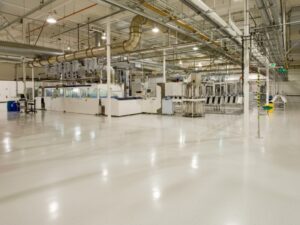
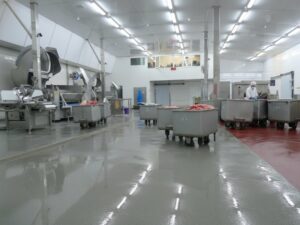
Floors with chemical spillage. Start with Self Leveling Vinyl Ester Flooring at 3–5 mm for a seamless finish, or Vinyl Ester Roll-On Flooring at 1–5 mm where area and budget dominate. Move to Chemical Resistant Mortar Flooring at 5–20 mm once the acid passes 75% or the traffic includes pallet trucks.
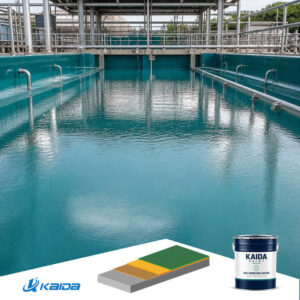
Tanks, pools and containment. Vinyl Ester Tank Lining is a 2–5 mm three-cloth build with two topcoats, declared against 75% sulfuric acid and 40% hydrochloric acid, and used for acid and brine service. Depth changes the project more than area does: a 2 m open pool and a 6 m tank entered through a 600 mm manhole are different jobs at the same square metreage.
Equipment, pipe and steelwork. Fiberglass Reinforced Vinyl Ester Coating is a 2–5 mm system applied by spray or hand lay-up, for floors, tank interiors and pipe exteriors. It is the same chemistry as the floor systems, detailed for vertical and overhead work.
ESD plus chemical resistance. Anti Static Vinyl Ester Flooring puts a static-dissipative topcoat over a copper foil earthing network at 3–5 mm. Where forklifts also run, Heavy Duty Anti Static Flooring raises the body to an 8–12 mm steel-mesh-reinforced epoxy mortar under the same vinyl ester topcoat.
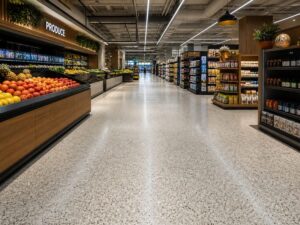
Visible, decorative floors that still resist chemicals. Vinyl Ester Colored Sand Flooring broadcasts quartz aggregate into a vinyl ester base, so the finish is seamless and the corrosion resistance is unchanged. It is the grade specified for food, pharmaceutical and laboratory areas where the floor is part of the presentation.
5. Where These Systems Stop
These systems are specified for concrete substrates, applied within the cure window stated on its data sheet, on a sound, dry, prepared slab. Four limits are worth stating plainly, each with the alternative:
- Hydrofluoric acid above 55% moves to Acid Resistant Brick Flooring or a PTFE lining. Resin systems are declared to 55% HF in the vinyl ester mortar and 25% in the FR coating; beyond that the chemistry changes, not the thickness.
- Sulfuric acid above 95%, including oleum, moves to ceramic or carbon brick. Vinyl ester is declared to 95% and no further.
- Solvent streams outside the declared list need an immersion trial on a sample before any floor is quoted. A resistance table is a starting point, not a clearance.
- Live cracks and moving joints are detailed as joints with a flexible sealant. A thicker coating does not bridge movement; it cracks with it.
Temperature is the second limit. The brick lining is declared from −20 °C to 130 °C; resin systems are declared per product, and a hot spill above the declared range needs the brick option rather than a heavier topcoat.
6. What We Need From You to Specify It
Five inputs decide the system, and none of them can be guessed from a photo:
- The medium, with concentration — for example 30% sulfuric acid, not “acid”.
- The temperature of the spill and of washdown water.
- Mechanical duty — foot traffic, pallet truck, forklift, or impact.
- Substrate condition — new slab, existing coating to be removed, or a failed floor.
- Area, and whether the work is a new build or a renovation in an operating plant.
Send those five and you get a system recommendation with a build-up, a thickness and a declared resistance line, not a generic price per square metre.
7. الأسئلة المتداولة
What concentration of sulfuric acid can vinyl ester flooring handle? 75% in a 2–5 mm glass-reinforced laminate, and 95% in a 5–20 mm mortar. Above 95%, including oleum, ceramic brick is the specification.
Is vinyl ester better than epoxy for acid? For sulfuric acid above 35%, yes. Epoxy is declared to 35% as a laminate and 65% as a mortar; vinyl ester reaches 75% and 95% on the same build logic. Below 35%, epoxy is the correct and cheaper specification.
How thick should the floor be? It follows the load rather than the chemistry. 1–5 mm for foot traffic and washdown, 2–5 mm for a standard chemical floor, 5–20 mm for concentrated acid and heavy duty, 8–12 mm with steel mesh where forklifts run.
Can a floor be anti-static and acid resistant at the same time? Yes. Anti Static Vinyl Ester Flooring is a 3–5 mm build with copper foil earthing and a static-dissipative topcoat, declared against 75% sulfuric acid. Where forklift traffic is also present, the 8–12 mm steel-mesh version carries the same topcoat.
Can the same system line a tank or a pool? Vinyl Ester Tank Lining is a 2–5 mm three-cloth build with two topcoats, used for concrete pools and tanks in acid and brine service. Depth and access decide the method statement more than the surface area.
How long does vinyl ester flooring last? Quoted life runs from 3–5+ years for a polyester FRP build to 15+ years for the 8–12 mm steel-mesh system. Within the vinyl ester family the range is 5–8+ years for a 3–5 mm floor and 5–10+ years for the 2–5 mm reinforced coating.
Is vinyl ester flooring the same as vinyl flooring? No. Vinyl flooring means PVC sheet or luxury vinyl tile, a resilient covering. Vinyl ester flooring is a thermoset resin system, applied in layers with glass reinforcement and cured in place. The two share a word and nothing else.
Tell us the medium, the concentration and the traffic — we will name the system.
Send the five inputs above and we will reply with the system, the build-up, the finished thickness and the declared resistance for your medium. Samples of the cured topcoat are available for immersion testing before you commit a bay.






 English
 Spanish
 Portuguese
 Arabic
 French
 Italian
 Russian
 Indonesian
 Swedish