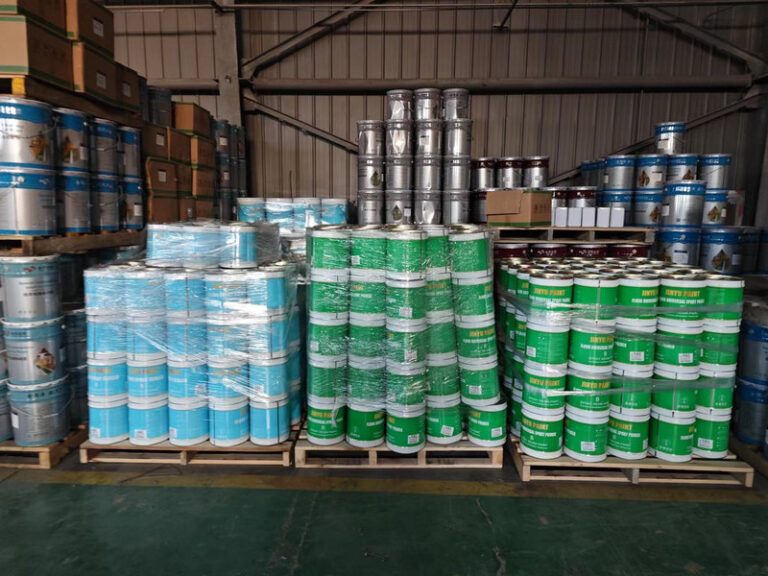
The pallet plan decides what arrives intact.
Four numbers decide a first polyurethane floor coating order: the minimum quantity, the delivery time, what a sample costs, and how much fits in a container. Only one of them is negotiable.
The one that moves is delivery time, and only when a slot is booked against a deposit.
This article explains where each number comes from, what starts the clock on production, how a courier sample differs from a production sample, and what a pallet configuration plan should show before you pay.
The four numbers, and which one moves
A flooring MOQ is set by the reactor, the lead time by the queue behind it, the sample by the courier, and the container by physics. Buyers spend most of their time on the one that cannot change.
That is worth knowing before a negotiation. A factory can split a batch, prioritise a slot and absorb a courier cost. It cannot make two tonnes fit in one tonne of reactor capacity.
It also cannot create stock where none exists. A flooring MOQ below one pallet is only fast when the factory is holding the product already, which is why distributors with stock beat factories on urgent repairs.
That is not a defect in the model, it is a difference in service. A factory sells production and a distributor sells availability, and the price gap between them is the cost of holding stock in your market rather than in theirs. That explains most of the difference a buyer sees between a factory quotation and a local stockist.
The useful conversation is therefore about sequence: which of the four is binding for your project, and what would have to change for it not to be.
Most first orders are constrained by the flooring MOQ, most repeat orders by the delivery date, and most urgent repairs by neither, because they are bought from stock somewhere.
Table 1: The four numbers, and what changes each one.
| Number | Set by | Can it move |
|---|---|---|
| Minimum quantity | Batch size and pack | Only with a longer wait or a shared batch |
| Delivery time | Queue and approvals | Yes, by booking a slot |
| Sample terms | Courier and lab time | Yes, by paying freight |
| Container fill | Physics and pack | لا يوجد |
Why small first orders are normal at Kaida Paint
A flooring MOQ is not a policy, it is arithmetic. A two-tonne batch needs two tonnes of raw material, a cleaning cycle and a quality release, and those costs are the same whether the batch is sold to one buyer or four.
The practical consequence is that small orders are repacked rather than produced, and the arithmetic behind private label minimums governs private label runs with a custom formulation. A supplier offering 200 kilograms without a repacking charge is either selling old stock or losing money on the order.
Ask what the batch size is, and what the minimum would be if you accepted a longer delivery. Some factories will hold your material until a batch fills, which lowers the price and lengthens the wait.
Where a project can be phased, the phased quantities should be stated at the start. A polyurethane floor coating order split into two releases costs less in total than two separate orders, and the factory can plan both into one batch.
For a first order, resist the temptation to split by pack size. A single pack simplifies the label, the pallet plan and the customs description, and the saving on material is smaller than the administrative cost.
Table 2: How pack size changes the practical minimum.
| Pack | Units per pallet | الوزن | Typical minimum |
|---|---|---|---|
| 5 kg pail | 120 | 600 kg | 1 pallet |
| 20 kg pail | 36 | 720 kg | 1 pallet |
| 25 kg drum | 32 | 800 kg | 1 pallet |
| 220 kg drum | 4 | 880 kg | 3 pallets |
Delivery time: the clock starts at the deposit, not the enquiry
A lead time quoted as four weeks usually means four weeks from the deposit clearing, not from the email. Buyers who plan from the enquiry date are late before production starts.
Ask what the clock is measured from, and what pauses it. Four events pause it in practice: a label proof waiting on hazard text, a balance that clears late, a dangerous goods declaration that has to be reissued, and a pallet plan still unsigned when the trucker is booked. Each one adds days to the end date rather than to the stage it interrupted. A missing label approval or an unpaid balance will stop a batch, and the delay lands on the delivery date rather than on the paperwork.
Where a project has a fixed start date, work backwards: freight, container loading, production, raw material. The number that comes out is usually longer than the quoted figure, and it is the one to plan against.
Six stages sit between a deposit and a working floor: label approval, raw material, production, loading, sailing and clearance. Label approval is the one buyers forget, because it waits on the destination’s hazard text rather than on the factory. Read the schedule backwards from the pour date, and book the production slot against the deposit rather than against the purchase order.
Table 3: Six stages between a deposit and a working floor, two of them in parallel.
| Stage | Clock starts (parallel) | Example duration | What it waits on |
|---|---|---|---|
| Label approval | Artwork proof issued | 1 to 2 weeks | Hazard text for the destination |
| Raw material | Deposit cleared | 1 to 2 weeks | Resin and hardener availability |
| Production | Slot confirmed | 2 to 4 weeks | Reactor queue and batch size |
| Loading | Release test signed | 2 to 3 days | Trucker booking and pallet plan |
| Sailing | Container on board | 3 to 6 weeks | Routing and transhipment |
| Clearance | Vessel arrival | 3 to 7 days | Documents and duty payment |
A delivery time of four weeks quoted in isolation describes the production stage and ignores the five to eleven weeks either side of it.
Repeat orders are faster because the label and the formulation are settled. A second order from an approved specification can often halve the lead time, which is worth remembering when planning a phased project.
That is also the argument for approving the label early. The second order is only fast if the artwork, the specification and the container loading plan were settled the first time.
Sample types: courier, laboratory and production
Three sample types answer three different questions: a courier sample answers the colour, a laboratory batch answers the formulation, and a production sample answers what you were actually sent. The tin is a litre or two, and it says nothing about how a production batch behaves in a container.
A courier sample is nevertheless worth ordering before a first project, because it proves the colour and the packing. It is a communication tool rather than a quality record.
Which is why a first project should always carry a production sample as well. The courier tin answers what the product is, and the production sample answers whether the batch matches the panel.
A production sample is drawn from the batch you will receive, or from the batch before it. Ask for 500 grams from the actual mix, with the batch number on the label.

Figure 1: a sample without a batch number is a souvenir.
The difference matters when a floor fails. A retained production sample settles the question in a day; a courier sample from six months earlier answers a different question.
Container loading and the pallet plan
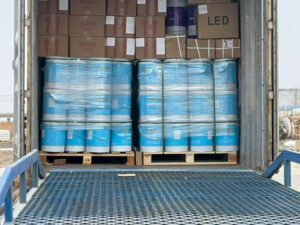
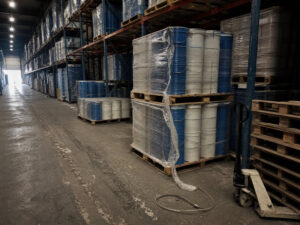
Container loading decides how much arrives undamaged, and buying and shipping from China is mostly a packing decision rather than a chemical one. Loaded pallets are heavy and the sea is not gentle, so bracing and stacking matter more than the number of units on the plan. A container loading plan drawn before the order costs nothing; a damage claim after it costs a season.
Where a container is loaded with mixed pack sizes, ask for the heaviest pallets to sit over the axles. A pallet configuration that puts 220 kilogram drums at the door is a plan drawn by somebody who has never opened one.
A pallet configuration should be agreed before the order, not at the dock. It fixes the count, the weight distribution and whether the load can be forklifted at destination.
Ask for the plan drawing and one photograph before the doors close. Those two documents settle most damage claims, and neither costs anything to produce.
Mixed loads are where counts go wrong, so choosing between the seven systems before the pallet plan is drawn saves a rebuild at the dock. Where a container carries three systems, ask for each pallet to be single-SKU and labelled, so a shortage is visible before the pallet is opened.
Photograph the load before the doors close, and again at destination before unloading. The pair of images answers the only question a claim needs: did the damage happen before or after the seal.
A twenty foot container takes about eighteen to twenty tonnes of packaged resin, and a forty foot high cube about twenty-four to twenty-six. The figure that binds is usually the axle limit at destination rather than the volume, which is why the road leg belongs in the plan.
Table 4: Container types, indicative payload and the limit that usually binds.
| Container | Indicative payload | What usually limits it |
|---|---|---|
| 20 foot general purpose | 18 to 20 tonnes | Axle limit on the inland leg |
| 40 foot high cube | 24 to 26 tonnes | Pallet height and stacking |
| 20 foot with mixed pallets | 16 to 18 tonnes | Floor area lost to part pallets |
A pallet configuration that fits the door but not the forklift is a pallet that gets hand-balled, and hand-balling is where a pack arrives dented.

Figure 2: a plan that shows weights is a plan that survives loading.
Booking capacity, not a date
A production slot is the unit of capacity in a factory, not a tonne. A plant with four reactors can run four batches a day, and a small order occupies one of them for the same duration as a large one.
Which is why a production slot is worth booking in writing rather than noting in an email. A slot that nobody wrote down is a preference, and preferences move.
Where the order depends on a production slot, ask for the date to appear on the proforma rather than in an email. That one line converts a courtesy into a commitment the factory has to plan around.
The same applies to the sample timeline. A polyurethane floor coating project that depends on a panel approval should book the slot before the panel is cured, because the cure takes longer than the decision.
That is why a polyurethane floor coating order booked late is slow. It is not deprioritised out of spite; it waits for a gap that fits its batch size without disrupting a full run.
Where a project date is fixed, ask for the slot to be reserved against a deposit. A factory that will hold a slot has capacity; one that will not has told you something useful.
Ask as well what happens if raw material is late. A factory that holds a production slot for a batch it cannot make is being optimistic on your behalf, and the delay will arrive after your crew is mobilised.
Proforma invoice, payment and what it should show
A proforma invoice is the commercial document that starts everything. It should show the product, the pack, the quantity, the price, the terms, the bank details and the delivery basis.
Check the description against the specification rather than the price. A polyurethane floor coating ordered as a primer and invoiced as a topcoat is a discovery made at the mixing stage.
Payment terms are usually a deposit and a balance against documents. Ask what happens if the balance clears late, and whether the batch is held or released.
Bank details should be confirmed by a second channel every time. Invoice fraud is common in this trade, and a verification call costs a minute.
A proforma invoice should also state who pays the bank charges and which party arranges insurance. Two small lines that decide whether a claim is worth making when a pallet arrives short.
Keep the proforma invoice with the shipping documents rather than only in the accounts system. When a shipment is disputed, the document that shows what was ordered is the first thing a forwarder asks for.
Sample terms that prevent arguments
A written sample agreement does four things: states what a sample costs, what it contains, how long it takes and what it commits the factory to. Most policies state only the first.
The commitment is the useful part. If a sample is approved, the production batch should match it within a stated tolerance, and that tolerance should appear on the datasheet.
Retained samples belong in the same document. Two years of storage, labelled by batch, is a small cost that converts a dispute into a measurement.
The sample policy should be signed by both sides at approval, with the panel or tin labelled and dated. An approval that lives only in an email is an opinion, and opinions differ under pressure.
The signed sample policy also fixes the tolerance. Colour between two batches is never identical, and a policy that promises an exact match is a policy that will be breached by the second order.
Write the tolerance as a number where the datasheet allows it, and as a method where it does not. A colour range checked against a retained panel is more useful than a written promise of an identical shade.
Three failures are worth writing into the agreement. A colour that arrives outside the agreed range is settled against the retained panel rather than a photograph. A batch that fails the release test is not shipped, and the customer is told the date that changes rather than the reason. A proforma that does not match the packing list is corrected before the deposit is paid, because after payment the correction costs a week.
Table 5: What a sample policy should state, and the default if it does not.
| البند | Should say | If silent |
|---|---|---|
| التكلفة | Free, charged, or credited on order | Assume charged |
| Size | Volume and pack | Assume laboratory quantity |
| Turnaround | Days from approval | Assume two weeks |
| Batch link | Production or laboratory | Assume laboratory |
| Tolerance | Colour and viscosity range | Assume no commitment |
What to write in the purchase order
The purchase order is the document that decides what happens when something goes wrong. It should restate the four numbers rather than refer to an email thread.
Six lines are enough: product and pack, quantity, price and term, delivery basis, lead time measured from the deposit, and the tolerance against the approved sample.
Add the pallet configuration if the order is a full container, and the label approval date if the order carries your brand. Both are dates the factory can plan against.
Where a buyer cannot produce that document, the supplier will use their own, and the polyurethane floor coating terms will be the ones most convenient to the seller.
That is not a reason to distrust a supplier. It is a reason to send the polyurethane floor coating order in a form that both systems can read: product, pack, quantity, price, delivery basis and the date the clock starts.
Send the polyurethane floor coating order as a document rather than a message, and ask for it to be countersigned. A countersigned order is the difference between a request and a contract when a sample policy is later disputed.
Frequently asked questions
What is the minimum order for polyurethane flooring?
Usually one pallet, which is 600 to 900 kilograms depending on pack size. A full batch is typically two tonnes, and orders below a pallet are repacked from stock.
How long does a first order take?
Four to six weeks from deposit and label approval, plus three to six weeks of sea freight. Repeat orders from an approved specification are often faster.
Are samples free?
Courier samples are usually free with freight paid, or credited against the first order. A production sample from a specific batch is normally charged.
What is the difference between a laboratory sample and a production one?
A courier sample comes from a laboratory batch and shows colour and cure. A production sample comes from the batch you receive and is the only useful evidence in a dispute.
How much fits in a 20 foot container?
Eighteen to twenty tonnes of resin, depending on pack size and pallet height. The exact figure belongs on the pallet plan, not in an email.
Can capacity be reserved before the order is final?
Many factories will hold a slot against a deposit. It is the only reliable way to secure a date in a busy quarter.
What should a proforma invoice include?
Product, pack, quantity, price, payment terms, bank details and delivery basis. Confirm the bank details through a second channel every time.
Why small first orders are normal at Kaida Paint
A first order is usually one pallet, and we quote it from the real batch size rather than from a minimum that sounds impressive. The batch size, the pallet plan and the sample terms go out before a polyurethane floor coating order is placed, so the four numbers in this article are visible rather than discovered. Where a project date is fixed, the slot date goes on the proforma, not in a covering message.



 English
 Spanish
 Portuguese
 Arabic
 French
 Italian
 Russian
 Indonesian
 Swedish