Polyurea vs Polyaspartic vs Epoxy: Which Cures Fastest?
Chemistries compared. Figures in the polyurea and polyaspartic columns are the declared values for products in this category; the epoxy column is the general industry comparison, not a product specification from this site.| الممتلكات | Polyurea (2- and 3-coat kits) | Polyaspartic (coating and topcoat) | Epoxy (reference) |
|---|
| How it cures | Reacts on mixing; no solvent to evaporate | Reacts on mixing; two-component | Reacts, but the cure window is longer |
|---|
| حياة الوعاء | Effectively unlimited on the 2- and 3-coat kits, so there is no rush in the bucket | 20–25 min (FortiFlex 4850), 45 min (FortiFlex 5), 45–60 min (ArmorSeal PXT Clear) | Typically shorter, and shortens further in warm conditions |
|---|
| Working time | No roller marks from a set-up mix | 15 min on FortiFlex 4850, which is why it is specified on large floors | Working time is the tight constraint |
|---|
| Foot traffic | One day — the kit pages position these as a one-day project | 5 h at 77 °F / 25 °C (FortiFlex 5); 6 h (FortiFlex 4850) | Usually next day or later |
|---|
| Tack-free | - | 1 h at 75 °F / 50% RH (ArmorSeal PXT Clear) | Longer |
|---|
| Full cure | - | 24 h at 75 °F / 50% RH (ArmorSeal PXT Clear) | Typically several days |
|---|
| مقاومة الأشعة فوق البنفسجية | Stated UV-stable; resists yellowing | Aliphatic, so it keeps its colour; gloss retention is a stated benefit of FortiFlex 5 | Chalks and yellows in daylight |
|---|
| التمهيدي | Not needed on the 2- and 3-coat polyurea kits | Topcoats go over a prepared and primed base coat | Primer is normally required |
|---|
| Best used for | Garage and workshop floors built up in flake or solid colour | Clear or tinted protective coats over an existing base, on large or fast-turnaround floors | Indoor floors with no UV exposure and time for a multi-day schedule |
|---|
Cure speed is where these products separate from epoxy, and it has nothing to do with the brand. Polyurea and polyaspartic films react to full strength within hours; an epoxy needs a longer, temperature-sensitive window between coats. If a floor has to be coated and back in use the same day, that difference decides the system.
Polyaspartic is the aliphatic branch of the polyurea family. “Aliphatic” is the technical word for the backbone that does not yellow in daylight, which is why polyaspartic topcoats are specified where a clear or tinted finish has to stay that way: garage floors, showrooms, warehouse aisles and food processing areas. A polyurea base coat under a polyaspartic topcoat is the standard combination, and two of the kits in this category ship exactly that way.
Where polyurea wins, and where polyaspartic wins. Use the polyurea kits for a full floor build-up: they need no primer, they are stated to penetrate deeper than epoxy, and they carry the thickness that resists hot tyre pick-up. Use the polyaspartic coatings where the job is a clear protective coat over a coloured or flake base, where the floor is large enough that a 15-minute working time matters, or where UV exposure would chalk an epoxy.
Polyurethane is a different chemistry again. If your requirement is a water-based polyurethane floor finish rather than a polyaspartic or polyurea system, tell us the substrate and the load and we will point you at the right family.
Which Polyaspartic or Polyurea Coating Do You Need?
Start from the finish you want, then pick the build. All nine systems below are for concrete floors; each one links to its own page with the full kit contents and options.
A full floor build-up with colour and flake, done yourself
– Polyurea 2-Coat Garage Floor Coating Kits: 10-12 mil total, no primer needed, flake and anti-skid additive included, unlimited pot life. The entry point when the concrete is sound and you want a thick, uniform finish.
– Polyurea 3-Coat Full Broadcast Garage Floor Coating Kit: 15-18 mil, full broadcast of 1/4 in flake to hide surface imperfections. The thickest build in the range.
– Polyurea Lite Residential DIY Garage Floor Coating Kit: the same logic at a lower build cost, with the option of adding an epoxy base coat underneath.
Sealing or refreshing a sound concrete floor
– Etch & Seal DIY Clear Polyurea Garage Floor Coating & Sealer Kit: a clear polyurea sealer at 3-4 mil in one coat or 6-8 mil in two, with the etch and the anti-skid additive in the box. Specify this one when the slab is sound and you want protection and a glossy finish rather than a rebuild.
A clear protective coat over an existing base
– ArmorSeal PXT Clear High-Performance Polyaspartic Topcoat: an aliphatic polyaspartic topcoat at 1:1 by volume, 88% volume solids, covering 200 ft² per gallon. This is the one to specify over a decorative or coloured base when the finish has to stay clear.
Large floors and fast turnarounds
– FortiFlex 4850 Polyaspartic Floor Coating: 94% volume solids, 2:1 mix, 106-162 ft² per gallon at 10-15 mil wet film, and a 15-minute working time for squeegee work on big areas.
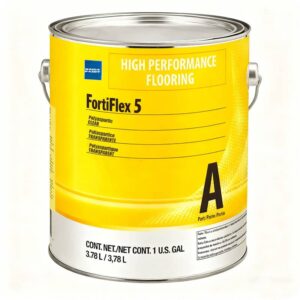
– FortiFlex 5 Polyaspartic Coating Floor Finish: 1:1 by volume, 68.7% weight solids, field-tintable, covering 100-400 ft² per gallon per coat.
– FortiFlex 4850 and FortiFlex 5 both reach foot traffic in hours, so they suit floors that cannot be closed for days.
Where these coatings are used. The applications below are the ones these nine systems are specified for: concrete floors in garages and workshops, warehouse and logistics aisles, light manufacturing and assembly areas, automotive maintenance bays, food processing rooms, and pool decks, balconies and parking decks where the clear topcoat has to hold its colour outside.
Where they are not the right choice. Floors carrying thermal shock, live steam wash-down or full chemical immersion are specified as a mortar or cementitious urethane system instead, because a 10-18 mil coating is not built for that duty. Tell us the chemical, the temperature and the wash-down routine and we will confirm which family applies.
Coverage, Kit Sizes and Film Thickness
Declared film build, coverage and mix ratio for the nine systems. “Not published” means the figure is not stated on that product page — ask us and we will confirm it in the quotation.| أطقم طلاء أرضيات المرآب بطبقتين من البوليوريا 2 - طلاء أرضيات المرآب | 10–12 mil total | 100 / 250 / 500 / 750 / 1,000 ft²; 1 gal per 200 ft² per coat |
|---|
| طقم طلاء أرضيات المرآب من البوليوريا 3 طبقات طلاء أرضيات المرآب كامل البث | 15–18 mil total | 200 ft² per gallon |
|---|
| طقم طلاء أرضيات المرآب من البوليوريا ثلاثي الطبقات | 15–18 mil total | 200 ft² per gallon |
|---|
| Etch & Seal DIY Clear Polyurea Coating & Sealer Kit | 3–4 mil (1 coat) / 6–8 mil (2 coats) | 200 / 400 / 600 / 800 / 1,000 ft² |
|---|
| طلاء أرضيات المرآب الخرسانية المصنوعة من البوليوريا | Not published | 1 qt = 50 ft²/coat; 1 gal = 200 ft²/coat; 5 gal = 1,000 ft²/coat |
|---|
| طقم طلاء أرضيات المرآب السكني من البوليوريا لايت | Not published | 300 / 600 / 900 / 1,200 ft² |
|---|
| ArmorSeal PXT Clear Polyaspartic Topcoat | Not published | 200 ft²/gallon (18.5 m²/3.78 L) |
|---|
| طلاء الأرضيات FortiFlex 4850 بولي أسبارتيك | 10–15 mil wet film | 106–162 ft²/gallon |
|---|
| طلاء الأرضيات بطبقة طلاء الأرضية FortiFlex 5 Polyaspartic | Not published | 100–400 ft²/gallon per coat |
|---|
Film thickness decides how long the floor lasts, so it is worth reading before you compare prices. A 3-4 mil clear sealer protects a sound slab; a 15-18 mil three-coat polyurea build carries abrasive traffic, hot tyres and the impact of dropped tools. Two products can look identical on a price list and differ by a factor of four in film build.
Read the coverage figure as film build, not as area. A kit quoted at 200 ft² per gallon is not “thin” – it is formulated so that each gallon builds the stated thickness. A competitor quoting 300 ft² per gallon from the same size container is spreading the same material thinner. That is why the kits here are described as thicker per coat rather than cheaper per square foot.
How to size a kit. Measure the floor, then pick the coverage band that matches or exceeds it: 100, 250, 500, 750 or 1,000 ft² on the two-coat kit; 200 to 1,000 ft² on the clear sealer; 300, 600, 900 or 1,200 ft² on Polyurea Lite. Where a job sits between two bands, take the larger one: the extra material allows for a porous slab and for cut-in waste.
Published price bands. The two-coat polyurea kit range is listed at $228.99 to $1,814.99 and Polyurea Lite at $429.99 to $2,202.99, both depending on coverage and options. The remaining systems are quoted per project – send us the area and the option set and we will price it.
Where a figure is missing. Where the table says “not published”, the product page does not state it. We will confirm the mix ratio, the film build or the pack size in the quotation rather than leave you to guess from a competitor’s listing.
Application Conditions for Polyaspartic and Polyurea Coatings
Temperature. FortiFlex 4850 is declared for a substrate and ambient range of 35 °F (1.7 °C) to 120 °F (49 °C). That low end is what makes this family suitable for unheated garages and for cool-season work, where a standard epoxy schedule has to wait.
Humidity. FortiFlex 4850 is declared for relative humidity up to 85%. The polyaspartic topcoats are described as insensitive to moisture, which is a real advantage in humid or coastal work.
Pot life and working time. These are two different numbers and both matter. FortiFlex 4850 has a pot life of 20-25 minutes and a working time of 15 minutes. FortiFlex 5 has a pot life of 45 minutes. ArmorSeal PXT Clear has a pot life of 45-60 minutes. The polyurea kits are supplied with a virtually unlimited pot life, so a DIY installer can work at their own pace without the mix thickening in the bucket.
Cure and re-coat windows. ArmorSeal PXT Clear reaches tack-free in 1 hour and full cure in 24 hours at 75 °F and 50% RH. FortiFlex 5 takes foot traffic in as little as 5 hours at 77 °F (25 °C). FortiFlex 4850 takes foot traffic in 6 hours and wheeled traffic in 24 hours. Plan the re-coat inside the window stated for the specific product, not the window of a different one.
Substrate preparation. The polyurea sealer kit includes an etch to open the concrete surface before coating, and the two- and three-coat polyurea kits are specified without a primer because the material is stated to penetrate deeper than epoxy. For a topcoat over an existing floor, the base must be sound, clean and compatible.
Substrate moisture. Every coating in this category needs a concrete slab that is dry enough to coat. We do not publish a single threshold that covers all nine systems, because it varies with the system and the slab. Send us the moisture reading or the age of the slab and we will tell you whether it is ready or what prep it needs first.
What to send with an enquiry. The floor area in square feet or square metres, indoor or outdoor, the substrate (new concrete, old concrete, existing epoxy or flake floor), the traffic it will carry, and the finish you want. With those four answers we can name the system, the number of kits and the price.
Polyaspartic and Polyurea Coatings: Frequently Asked Questions
Q: What is the difference between polyurea and polyaspartic?
A: They are the same chemistry family. Polyurea is the wider group of fast-reacting coatings; polyaspartic is the aliphatic branch used for floor and topcoat work. “Aliphatic” means the cured film does not yellow under UV light, which is why polyaspartic is the one specified for clear and tinted finishes. Both react to full strength in hours rather than days.
Q: Is polyaspartic better than epoxy for a floor?
A: Polyaspartic cures faster and holds its colour outdoors; epoxy is slower and chalks and yellows in daylight. Epoxy remains a sound base coat, which is why a polyurea or polyaspartic topcoat over an epoxy base is a common build. If the floor sees daylight or has to go back into service quickly, the topcoat is the part to change.
Q: How thick is a polyaspartic or polyurea coating?
A: Between 3-4 mil for a single-coat clear sealer and 15-18 mil for a three-coat full-broadcast polyurea system. That is 0.08 mm to 0.46 mm of solid material. Film buildup is chosen from the traffic the floor carries, not from the size of the room.
Q: Can I apply these over an existing epoxy floor?
A: Yes, where the existing floor is sound and clean. A sound epoxy or flake base is a common substrate for a clear polyaspartic topcoat, and prepare-and-coat over an intact base is a standard way to refresh a worn floor. A failing or lifting coating has to be removed first, and we will ask for photographs before advising.
Q: Do I need a primer?
A: The two- and three-coat polyurea kits are specified without a primer, because the material is stated to penetrate deeper than epoxy. The clear polyurea sealer kit includes an etch to prepare the surface. Polyaspartic topcoats go over a prepared and primed base coat rather than straight onto bare concrete.
Q: How soon can I walk on it or park on it?
A: FortiFlex 5 takes foot traffic in as little as 5 hours at 77 Fahrenheit, and FortiFlex 4850 in 6 hours, with wheeled traffic after 24 hours. ArmorSeal PXT Clear reaches tack-free in 1 hour and full cure in 24 hours at 75 Fahrenheit and 50 percent relative humidity. The polyurea kits are positioned as a one-day install.
Q: How much do polyaspartic and polyurea coatings cost?
A: The listed ranges on this site are $228.99 to $1,814.99 for the two-coat polyurea kit, and $429.99 to $2,202.99 for Polyurea Lite, depending on coverage and options. The rest are quoted per project. Because price tracks film build, the meaningful comparison is cost per square foot at a stated thickness, not price per container – send us the area and we will quote both.
Ordering Polyaspartic and Polyurea Coatings
Send the floor area, whether it is indoors or outdoors, what the substrate is, what traffic it will carry, and the finish or colour you want. We will come back with the system, the film build, the number of kits and the price, and issue the technical data sheet and the safety data sheet with the quotation.
If you are comparing this family against epoxy or polyurethane, tell us that too – we supply all three and will say plainly which one the floor needs.








 English
 Spanish
 Portuguese
 Arabic
 French
 Italian
 Russian
 Indonesian
 Swedish