
الوصف
Vinyl ester flooring is a fiberglass-reinforced resin floor system applied directly onto prepared concrete, and it is the specification normally chosen where a floor has to live with acid, alkali, brine or permanent immersion rather than occasional spills. ACF-VE-3F5C is declared against 75% sulfuric acid and 40% hydrochloric acid for seven-day immersion, with a quoted service life of 5–10+ years in the duty it was specified for. Choose vinyl ester over epoxy when the medium is concentrated acid, solvent or permanent immersion; stay with epoxy when the acid is dilute and the budget is the constraint. The ACF-VE-3F5C system builds three layers of fiberglass cloth into vinyl ester resin, adds a mortar and putty body, and seals everything under a roll-on vinyl ester topcoat at a finished thickness of 1–5 mm. This page covers what the resin actually is, which media the system resists and at what concentration, how the layers are built, how the floor is installed over an existing slab, and how to specify the right lay-up for your duty.
| البند | المواصفات |
|---|---|
| النظام | 3-cloth 5-coat vinyl ester corrosion-resistant flooring |
| Model | ACF-VE-3F5C |
| الركيزة | Concrete slab, cement screed, repaired existing floor |
| التعزيز | 3 layers glass fiber cloth / mat |
| Build-up | Penetrating primer, fiberglass laminate, mortar, putty, roll-on topcoat |
| Finished thickness | 1–5 mm (0.04–0.20 in) depending on lay-up |
| Service life quoted | 5–8+ years at 1–5 mm, under the media and traffic it was specified for |
| Application method | Roller coating and hand lay-up, ambient cure, no hot work |
| Alternative lay-ups | 1 cloth 3 coats, 2 cloths 4 coats, 3 cloths 5 coats |
| اللون | Pigmented topcoat, color matched to the project schedule |
What is vinyl ester flooring and why is it used instead of epoxy?
Vinyl ester resin is an epoxy backbone that has been reacted with methacrylic acid so the molecule ends carry unsaturated groups that cross-link with styrene. That structure keeps the mechanical toughness of epoxy while reducing the number of ester linkages that acid and water attack, which is why vinyl ester flooring holds up in immersion service where standard epoxy coatings soften, blister or chalk.
The practical difference on a project is not a laboratory number but a failure mode. Epoxy fails by losing bond at the concrete interface once moisture and acid reach the substrate; a vinyl ester laminate fails, if it fails at all, at the surface, and stays repairable. For a floor that will be washed down daily with acid or sit under brine, that difference decides whether the slab is protected for five years or replaced.
Term note. Buyers searching for epoxy vinyl ester flooring are looking for this same family: the vinyl ester systems in this catalog are supplied as vinyl ester grades and, depending on the component, epoxy-vinyl ester hybrid grades. The shorter term vinyl ester is used throughout this page.
What “three cloth five oil” actually means
The Chinese trade term for this build translates literally as three cloth, five oil. The oil is not oil: 油 is the historical word for a resin coat, from the period when binders were tung-oil based, and in a modern specification it means one application of resin. Three cloth five oil is three layers of glass cloth and five resin applications — a laminate build, not a coating with a thick topcoat.
The distinction matters when quotations are compared. A supplier offering three cloth three coat is describing a thinner build behind a similar headline; the coat count is what fills the weave, seals the pinholes and builds the barrier. On a floor that meets acid daily, the gap between three and five resin applications is the gap between reaching the quoted service life and missing it.
Which chemicals does ACF-VE-3F5C resist, and at what concentration?
The system is quoted against seven aggressive media, each tested by 7-day immersion with no change to the cured film. Concentration matters more than the chemical name, so the figures below are the ones to check against your process rather than a general claim of acid resistance.
| متوسط | Concentration | النتيجة |
|---|---|---|
| Sulfuric acid | 75% | No change after 7 days |
| Hydrochloric acid | 40% | No change after 7 days |
| Nitric acid | 40% | No change after 7 days |
| Acetic acid | 80% | No change after 7 days |
| Sodium hydroxide | 20% | No change after 7 days |
| Hydrofluoric acid | 20% | No change after 7 days |
| Phosphoric acid | 100% | No change after 7 days |
Two boundaries are worth stating plainly. A 7-day immersion result is a screening test in the format of ISO 2812 and ASTM D543, not a service-life guarantee for a hot, concentrated or solvent-loaded stream. Where a process runs above roughly 40 °C, carries solvents, or alternates between acid and caustic, the lay-up and the topcoat grade have to be reviewed before the floor is priced — that review is part of the quotation, not an afterthought.
Where the medium list runs past what one resin can carry, compare the options in corrosion resistant flooring by chemical duty before the system is fixed.
How is the 3-cloth 5-coat vinyl ester flooring built up?
Each layer has one job, and the sequence is what turns a coating into a monolithic lining: the primer anchors to the concrete, the laminate carries load and bridges cracks, the mortar and putty build thickness and smooth the surface, and the topcoat becomes the chemical barrier.
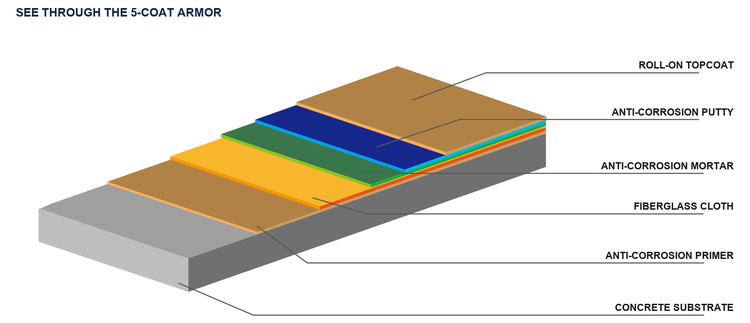
- Concrete substrate — mechanically ground, dust-free, sound, with voids and cracks opened and filled before priming.
- Vinyl ester penetrating primer — low-viscosity resin that soaks into the cement matrix and anchors the whole system; bond strength at this interface governs the life of the floor.
- Glass fiber cloth × 3, bonded in vinyl ester resin — the structural layer. Three layers are laid wet-on-wet or wet-on-cured according to the lay-up, with each cloth fully wetted out and rolled free of air.
- Mortar body — resin and graded aggregate that adds thickness, compressive capacity and impact resistance.
- Putty — closes the weave and pinholes so the topcoat is applied to a continuous surface.
- Vinyl ester roll-on topcoat — the chemical barrier, pigmented and uniform, applied in two passes to a sealed, dust-free finish.
Because every layer is chemically bonded rather than laid as separate sheets, there are no joints or seams. That is the reason the system is used on containment areas and tank floors, where a single failed joint would defeat the whole lining.
What are the mechanical properties of the cured system?
| Test item | Unit | النتيجة |
|---|---|---|
| قوة الانضغاط | N/mm² | ≥ 60 (8,700 psi) |
| Pencil hardness | H | ≥ 2H |
| Abrasion loss (750 g / 500 r) | g | ≤ 0.02 |
| مقاومة الصدمات | Kg/cm² | ≥ 80 |
For a floor slab these numbers mean the system carries foot traffic, pallet trucks, drum handling and wash-down equipment without the surface breaking down. They do not make it a structural wearing course for steel-wheeled forklifts or drop-forging areas; where that duty exists, the high-build mortar system is the correct specification instead.
For battery, electronics and solvent areas that need a conductive floor, see anti-static vinyl ester flooring.
Where is vinyl ester flooring specified?
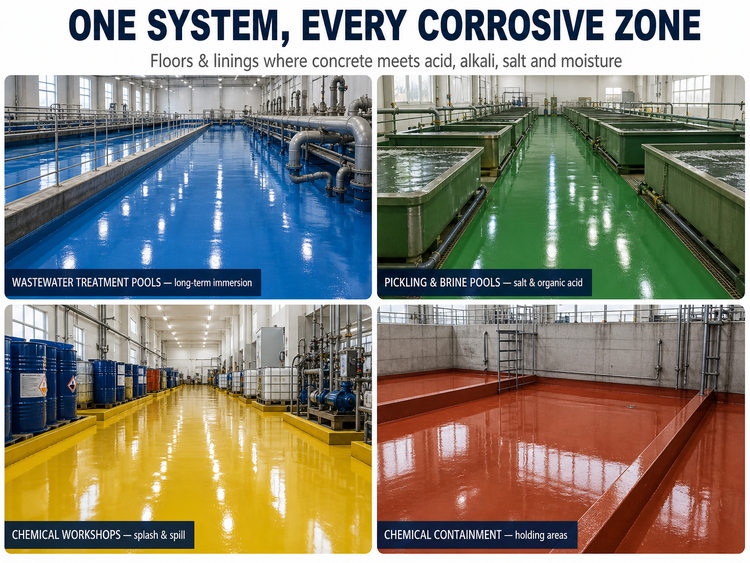
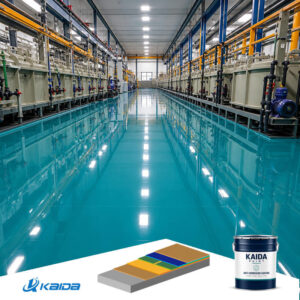
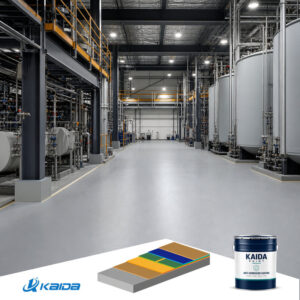
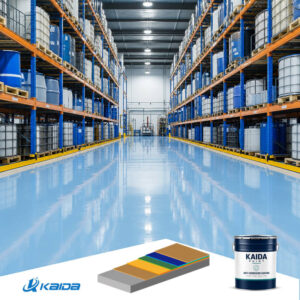
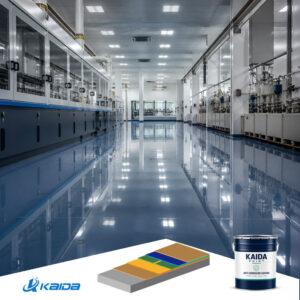
The system is used wherever concrete meets aggressive liquid and the floor cannot be allowed to leak:
- Industrial and municipal wastewater treatment pools and channels
- Pickle, brine and vegetable processing tanks, where salt and acetic acid act together
- General chemical workshops and production halls with acid spill risk
- Chemical emergency containment pools and curbed containment areas
- Electroplating, PCB and battery plant floors
- Pump rooms, dosing areas and tank farm aprons
How is the floor installed over an existing concrete slab?
The sequence is cold-applied and does not need demolition, cutting or welding, which is why the system is often chosen for live plants where production cannot stop for a long shutdown.
- تحضير السطح — diamond grinding to expose aggregate and remove contamination, laitance and old coatings; edges, plinths and drains cut back square.
- Penetrating primer — applied to saturation, with a second coat on porous or dry slabs.
- Fiberglass lay-up — glass cloth laid and impregnated with vinyl ester resin, three passes for the standard build.
- Grinding of the laminate — the cured cloth layer is ground to remove laps and high spots before the body coats.
- Mortar and putty — mortar screeded to level, then putty applied to close the surface.
- طلاء علوي — vinyl ester roll-on topcoat in two passes, with a non-slip grade available for wet areas and ramps.
- Cure and handover — the floor is kept dry and off-traffic for the cure window agreed in the method statement, then inspected and signed off.

A detail that decides the outcome more often than the resin: moisture in the slab. New concrete has to be dry enough for the primer to penetrate rather than sit on a vapor layer, and a slab without a damp-proof membrane needs the moisture checked before the specification is fixed.
Where the topcoat has to be poured rather than rolled, see self leveling vinyl ester flooring.
How thick should the system be, and how long will it last?
Three standard lay-ups cover most enquiries, and the choice is driven by the aggressiveness of the medium and the mechanical load rather than by budget alone.
| Lay-up | Build range | Typical duty |
|---|---|---|
| 1 cloth 3 coats | Approx. 1–2 mm | Light chemical exposure, wash-down areas, secondary containment with low mechanical load |
| 2 cloths 4 coats | Approx. 2–3 mm | Regular acid and alkali contact, medium traffic, workshop floors and channels |
| 3 cloths 5 coats | Approx. 3–5 mm | Immersion service, tanks and pools, heavy wash-down, high mechanical load |
The quoted service life at the full build is 5–8+ years. Read that figure as conditional: it assumes the correct lay-up for the medium, a properly prepared and dry substrate, and the maintenance regime in the handover document. Floors that fail early almost always fail at the substrate interface or at an untreated detail such as a drain collar, not in the middle of the field.
For pools, tanks and curbed containment, see vinyl ester water tank lining.
What does vinyl ester flooring cost, and how is a quotation built?
Pricing a vinyl ester floor is a function of area, lay-up, substrate condition and access, so a per square meter (sq ft) figure without those four inputs is not a real number. A quotation from us is built from the measured area, the specified lay-up, the number of details (drains, curbs, plinths, joints) and the site schedule.
Cost is driven most by three things: cloth count (each added layer adds material and labor), substrate repair volume (the single most common source of variation against a budget), and access — working inside a tank or a congested plant costs more per square meter (sq ft) than an open hall. Where the budget is tight, reducing the lay-up is the wrong saving; repairing the substrate properly is what protects the investment.
Quotations are issued per square meter (sq ft) of finished floor area, FOB or CIF against a named port. Lead time is quoted as a working-day range counted from approved sample and substrate sign-off, and the minimum order is the smallest area that justifies mobilising a full crew.
Frequently asked questions
Can vinyl ester flooring be applied over an existing epoxy floor?
Only after the existing coating is assessed. Sound, well-bonded epoxy can sometimes be abraded and used as a substrate, but any coating with blistering, delamination or moisture under it has to be removed first. We ask for a core sample or an adhesion test before quoting a renovation.
Is vinyl ester flooring safe to install while the plant is running?
The material is cold-applied and does not involve hot work, so there is no welding or flame risk. The real constraint is odor and styrene emission during cure, plus the need to keep the area dry and off-traffic. Most projects are phased overnight or zone by zone, with temporary screens and extraction.
How soon can the floor be walked on and put back into service?
Light foot traffic is normally possible after the topcoat has cured enough to resist marking, and full chemical service after the full cure window stated in the method statement. The window depends on temperature: cold sites cure considerably slower, and that has to be planned into the schedule rather than discovered at handover.
What is the difference between vinyl ester flooring and a vinyl ester coating?
A coating is a film — typically 0.3–1 mm — that relies on the concrete surface for strength. A flooring system carries fiberglass reinforcement and a mortar body, so it spans cracks, resists impact and can be built to 5 mm. Coatings are cheaper and suitable for light exposure; flooring is used where the slab would otherwise be attacked.
Can the floor be repaired locally if it is damaged?
Yes. A damaged area is cut back to sound material, the edges are feathered, and the laminate and topcoat are rebuilt in the same sequence. Because the system is bonded layer by layer rather than being a factory sheet, a local repair is a normal maintenance operation rather than a replacement.
Why projects specify Kaida Paint for vinyl ester flooring
The technical file for each project states the media, the concentration, the lay-up and the finished thickness, so the floor can be checked at handover against the specification it was priced on. Batch records and a material declaration are issued with the delivery, and the installation method statement covers substrate moisture, dew point and cure windows — the three conditions that decide whether a vinyl ester floor reaches its quoted service life.
Kaida Paint supplies the full layer stack as one system: vinyl ester penetrating primer, vinyl ester laminating resin, mortar, putty, and pigmented roll-on or self-leveling topcoat. Supplying the resin and the aggregate from one source is what keeps the layers chemically compatible — mixing a laminate from one supplier with a topcoat from another is a common cause of intercoat delamination.
If you are specifying a floor for acid, alkali, brine or immersion service, send the medium, the concentration, the area and the substrate condition. We will return a lay-up recommendation and a quotation against those inputs.
-
المؤلف: Kaida Paint Technical Team — flooring systems engineering, anticorrosive resin flooring Last updated: 13 November 2026

 English
 Spanish
 Portuguese
 Arabic
 French
 Italian
 Russian
 Indonesian
 Swedish