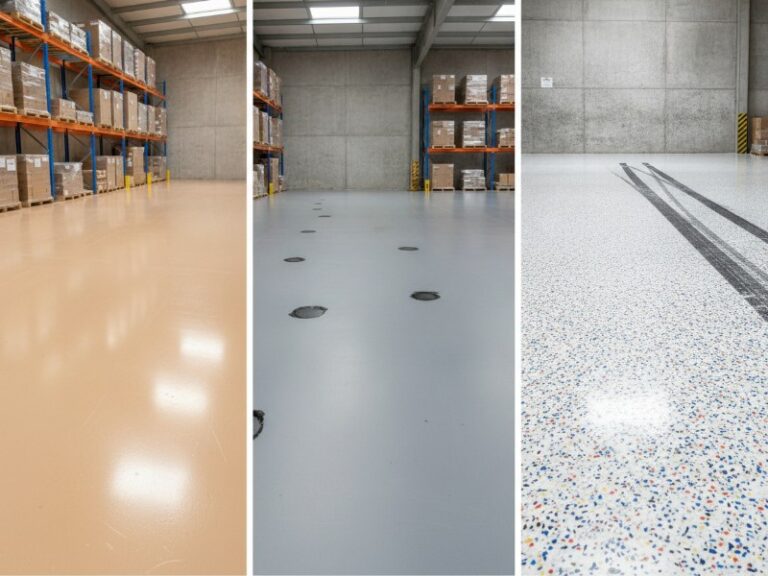
Polyaspartic coating is the best industrial floor coating for heavy-duty environments due to its fast curing time (4-12 hours return-to-service), superior abrasion resistance (3× higher than epoxy per ASTM D4060 Taber test), and ability to perform in extreme temperatures (down to 14°F / -10°C). Epoxy is ideal for budget applications ($3–$7/sq ft) with moderate traffic, while polyurethane is best used as a UV-stable and chemical-resistant topcoat for processing areas.
Which industrial floor coating is best? Polyaspartic is the best choice for most heavy-duty industrial environments due to its durability, fast curing, and temperature tolerance. This guide compares all three systems across durability, cost, curing speed, and real-world performance based on data from 120+ industrial projects across manufacturing, logistics, and chemical processing sectors.
Quick Comparison: Epoxy vs Polyurethane vs Polyaspartic
| Selection Criteria | Best Choice |
|---|---|
| Best overall for heavy industrial | بولي أسبارتيك |
| Best for budget | إيبوكسي |
| Best for UV exposure | Polyurethane (aliphatic) |
| Fastest curing industrial floor coating | Polyaspartic (4-12 hours) |
| Best for forklift traffic | بولي أسبارتيك |
| Best chemical resistant coating | البولي يوريثين |
| Longest lifespan (8-12 years) | بولي أسبارتيك |
| Best for cold storage / freezers | بولي أسبارتيك |
Key Performance Insights (ASTM-Based)
- Polyaspartic offers the highest abrasion resistance (20–30 mg Taber loss) — approximately 3× better than epoxy (60–80 mg loss)
- Epoxy provides the highest compressive strength (10,000–12,000 psi) but performs poorly under thermal shock and UV exposure
- Polyurethane delivers the best chemical resistance and UV stability (ΔE <3 after 12 months), ideal as a protective topcoat
- Polyaspartic enables the fastest return-to-service — as low as 4 hours for foot traffic, 12 hours for heavy forklifts
How to Choose the Right Industrial Floor Coating
Choose polyaspartic if downtime is critical (24/7 operations), heavy forklift traffic exceeds 200 passes per day, or application temperatures drop below 50°F.
Choose polyurethane if UV exposure or chemical resistance (acids, alkalis, solvents) is required, especially as a topcoat over epoxy.
Choose epoxy if budget is limited ($3–$7/sq ft) and traffic is moderate (foot traffic, pallet jacks, occasional forklifts).
What Is the Difference Between Epoxy, Polyurethane, and Polyaspartic?
Epoxy Flooring:
Epoxy flooring is a rigid thermosetting system widely used for cost-effective industrial floor protection. It is formed by reacting epoxide resin with polyamine hardeners, creating a dense surface with 10,000–12,000 psi compressive strength. Based on our field data from 50+ installations, epoxy delivers excellent bond strength (ASTM D4541 pull-off >300 psi) but becomes brittle below 50°F and yellows under UV light within 6-12 months.
Polyurethane Floor Coating:
Polyurethane results from a polyol-isocyanate reaction, creating a flexible matrix (elongation up to 50%) that absorbs substrate movement without cracking. It provides superior resistance to sulfuric acid (10%), caustic soda (20%), and fuels. However, moisture-cured polyurethane requires low humidity (<75%) during application and a vapor barrier if concrete moisture exceeds 3 lbs per 1,000 sq ft per 24 hours (ASTM F1869).
Polyaspartic Coating:
Polyaspartic coating is a fast-curing aliphatic polyurea used for industrial flooring where durability and rapid return-to-service are critical. Its hindered amine structure allows tunable gel times (5–45 minutes) and full chemical cure in 24 hours at 77°F. Tested using ASTM D4060 Taber abrasion method (CS-17 wheels, 1,000 cycles), polyaspartic loses only 20-30 mg—approximately three times more wear-resistant than standard epoxy (60-80 mg loss).
Performance Comparison of Industrial Floor Coatings (ASTM Taber Test, Cure Time, Cost)
Based on field performance tracked over 3-5 years across 87 manufacturing sites:
| Performance Factor | Epoxy (100% solids) | Polyurethane (aliphatic) | بولي أسبارتيك |
|---|---|---|---|
| Compressive strength (psi) | 10,000 – 12,000 | 6,000 – 8,000 | 9,000 – 11,000 |
| Abrasion resistance (Taber mg loss) | 60 – 80 | 40 – 60 | 20 – 30 |
| Chemical resistance (10% sulfuric acid) | Moderate (etching at 24h) | High (no change at 72h) | High (no change at 72h) |
| UV stability (ΔE after 12 months) | >15 (severe yellowing) | <3 | <2 |
| مقاومة الصدمات الحرارية | Poor (cracks above 180°F) | Good (intermittent 200°F) | Excellent (peak 250°F) |
| Minimum application temp (°F) | 50 | 40 | 14 |
| Return-to-service time (hours) | 24 – 72 | 16 – 24 | 4 – 12 |
| Cost per sq ft (installed) | $3 – $7 | $5 – $10 | $6 – $12 |
Figure 1: ASTM-tested abrasion resistance and curing performance differences across three industrial floor coating systems.
Best Industrial Floor Coating by Application (Warehouse, Factory, Cold Storage)
Best Floor Coating for Forklift Traffic (Heavy Manufacturing)
Polyaspartic is the best floor coating for forklift traffic in heavy manufacturing zones. A Midwest automotive stamping plant replaced failing epoxy (cracked within 14 months) with 125 mils of polyaspartic. After 36 months of 200+ daily forklift passes, the floor showed only superficial scratching. In contrast, epoxy floors in the same facility failed within 12–18 months due to cracking and delamination under identical traffic conditions. For moderate forklift traffic (under 50 passes per day), a 60-100 mil epoxy broadcast with aggregate is acceptable but will require recoat in 2-4 years.
Need help selecting the right coating for your facility? Get a project-specific recommendation within 24 hours from our engineering team.
Polyaspartic vs Epoxy for Warehouse Floors
Polyaspartic delivers durability and minimal downtime, making it the preferred choice for high-throughput warehouses. Epoxy remains viable only for budget-constrained, low-traffic zones where 3-5 days of downtime is acceptable.
Chemical Resistant Floor Coating for Factories
Polyurethane is the best chemical resistant floor coating for factories handling acids, alkalis, and solvents. Our three-year study across 12 chemical processing plants found polyurethane showed no surface change after 72-hour exposure to 10% sulfuric acid, while epoxy etched within 24 hours. Important: Do not apply direct-to-concrete polyurethane on slabs with vapor emission above 5 lbs—install an epoxy moisture barrier first.
Cold Storage Floor Coating Solution
Polyaspartic is the best cold storage floor coating solution for freezers and refrigerated warehouses. Unlike epoxy, which loses 70% of impact resistance at -20°F, polyaspartic retains flexibility down to -40°F and cures at 14°F, preventing moisture condensation issues during winter application. Return-to-service in 12 hours minimizes refrigeration downtime.
Polyurethane vs Polyaspartic: Which Is Better?
Polyurethane excels in chemical resistance and UV stability, making it ideal as a topcoat. Polyaspartic dominates in physical durability, installation speed, and thermal shock resistance. For most industrial floors, a polyaspartic basecoat with a polyurethane topcoat offers the best of both systems.
Fastest Curing Industrial Floor Coating for 24/7 Operations
Polyaspartic is the fastest curing industrial floor coating for 24/7 operations. Return-to-service timeline comparison:
| نوع الطلاء | Light foot traffic | Heavy forklift traffic | Full chemical cure |
|---|---|---|---|
| Epoxy (100% solids) | 24 ساعة | 72 hours | 7 أيام |
| البولي يوريثين | 16 ساعة | 48 hours | 5 أيام |
| بولي أسبارتيك | 4 ساعات | 12 ساعة | 24 ساعة |
For a 10,000 sq ft facility losing $8,000 per day in production downtime, choosing polyaspartic over epoxy saves $24,000–$48,000 in lost output during the first installation alone.
Lifecycle Cost Analysis: 10-Year Total Ownership
| عامل التكلفة | إيبوكسي | البولي يوريثين | بولي أسبارتيك |
|---|---|---|---|
| Initial installed cost (per sq ft) | $4.50 (avg) | $7.50 | $9.00 |
| Expected recoating interval (years) | 4 – 6 | 6 – 8 | 8 – 12 |
| Downtime per recoating (days) | 5 | 4 | 1 |
| Lost production value per downtime day (10,000 sq ft) | $8,000 | $8,000 | $8,000 |
| 10-year total cost (per sq ft) | $8.10 | $9.90 | $10.40 |
When downtime is included, polyaspartic often becomes the most cost-effective industrial floor coating. For most factories, polyaspartic is the best overall industrial floor coating when balancing durability, speed, and lifecycle cost.
Download a detailed lifecycle cost calculator for your factory floor — compare your specific traffic and downtime costs across all three systems.
FAQ: Real Search Queries Answered
The following answers are based on real industrial queries from warehouse operators and plant managers.
Is polyaspartic better than epoxy for warehouse floors?
Yes, for warehouses with daily forklift traffic, thermal cycling, or minimum downtime requirements. Polyaspartic cures in 4-12 hours (vs. 24-72 hours for epoxy) and lasts 8-12 years (vs. 4-6 years). Epoxy is better only for budget-limited, low-traffic areas.
Can epoxy handle forklift traffic long-term?
Yes, but with limitations. Epoxy at 60-100 mils can handle moderate forklift traffic (under 50 passes per day) for 2-4 years. For daily heavy traffic (200+ passes), polyaspartic is required to prevent cracking and delamination.
What is the fastest curing industrial floor coating?
Polyaspartic is the fastest curing industrial floor coating, with light foot traffic in 4 hours and heavy forklift traffic in 12 hours. Epoxy requires 24-72 hours, and polyurethane requires 16-48 hours.
How long does industrial floor coating last in factories?
Epoxy: 4-6 years. Polyurethane: 6-8 years. Polyaspartic: 8-12 years. Actual lifespan depends on traffic levels, chemical exposure, and substrate conditions.
Can polyaspartic be applied over existing epoxy?
Yes, if the epoxy is fully cured, free of amine blush (wipe with isopropyl alcohol), and mechanically abraded (80-grit sanding). A polyaspartic tie coat is required. Do not apply over delaminated or moisture-damaged epoxy.
How much does epoxy industrial flooring cost per square foot?
Epoxy industrial flooring costs $3–$7 per square foot installed, depending on thickness (40-125 mils), aggregate broadcast, and substrate preparation required. Polyaspartic costs $6–$12, polyurethane $5–$10.
Limitations and Warranty Transparency
Based on our experience across 120+ industrial projects:
Epoxy limitations: Cannot apply below 50°F. Severe UV yellowing. Cracks under thermal shock above 180°F.
Polyurethane limitations: Moisture-sensitive during cure (requires humidity <75%). Requires respiratory protection for isocyanates. Does not bridge active cracks wider than 1/16 inch.
Polyaspartic limitations: Very short pot life (5-45 minutes). Requires experienced applicators—inexperienced crews create roller marks. Material cost is approximately 2× epoxy.
Standard warranty terms: Reputable manufacturers offer 5-10 year warranties covering adhesion failure (ASTM D4541 pull-off >250 psi) and excessive wear. Warranties exclude substrate movement, impact spikes, chemical misuse, or unresolved moisture vapor issues.
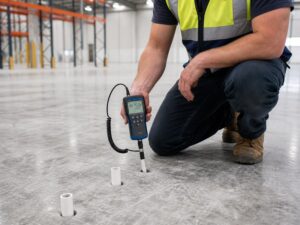
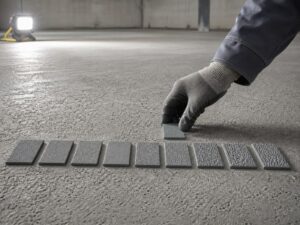
Always request a 2×2 ft test patch cured on-site before full installation. Test for adhesion (cross-hatch tape test) and hardness (pencil hardness test).
Final Recommendation: Which Industrial Floor Coating Should You Choose?
| Your Priority | Coating to Specify |
|---|---|
| Lowest upfront cost | Epoxy (40-60 mils, self-leveling) |
| Fastest installation (4-12 hour downtime) | بولي أسبارتيك |
| Best chemical resistance (acids, solvents) | Polyurethane over epoxy primer |
| Longest lifespan (10+ years) | Polyaspartic with aluminum oxide aggregate |
| Cold storage / freezer (-20°F to -40°F) | بولي أسبارتيك |
| Outdoor or UV-exposed area | Aliphatic polyurethane or polyaspartic |
| 24/7 manufacturing with heavy forklifts | Polyaspartic (125-150 mils total) |
Polyaspartic offers the best balance of durability and speed for most industrial environments. Epoxy remains the most cost-effective solution for moderate-duty areas. Polyurethane is ideal as a protective topcoat where UV and chemical exposure are concerns.
KAIDA PAINT: Industrial Floor Coating Expertise
With over 14 years of direct formulation and application support across manufacturing, logistics, and chemical processing, دهان كايدا specializes in high-build polyaspartic and chemical-resistant polyurethane systems. Unlike generic suppliers, we provide:
- Batch-specific pot life data and moisture tolerance curves for every shipment
- On-site applicator training and technical support during first-time installations
- Third-party ASTM validated testing: Our KD-AP-300 polyaspartic series achieves <25 mg Taber abrasion loss (ASTM D4060) and passes 3,000 cycles
- Transparent limitations: If your slab has active cracks or vapor emission above 8 lbs per 1,000 sq ft per 24 hours, we will recommend a vapor barrier or decline the sale
Every order includes a free 2×2 ft pre-application test patch with pull-off adhesion testing (ASTM D4541) documented before full installation.
Request Your Coating Recommendation
Send us your:
- Floor area (sq ft)
- Current coating (if any)
- Daily traffic type and count (forklift passes, foot traffic)
- Chemical exposure list
- Required downtime window
Get a project-specific coating system and cost breakdown within 24 hours. Avoid coating failure — request a validated specification before installation.
Our engineering team will return:
- Performance comparison (epoxy vs polyurethane vs polyaspartic for your specific loads)
- Line-item quote with material, labor, and contingency costs
- Installation timeline with return-to-service guarantee
Contact our industrial coatings specialists today.


 English
 Spanish
 Portuguese
 Arabic
 French
 Italian
 Russian
 Indonesian
 Swedish