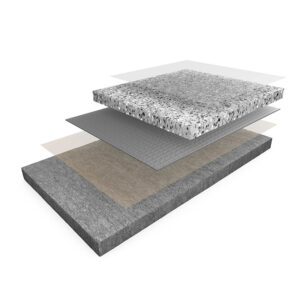
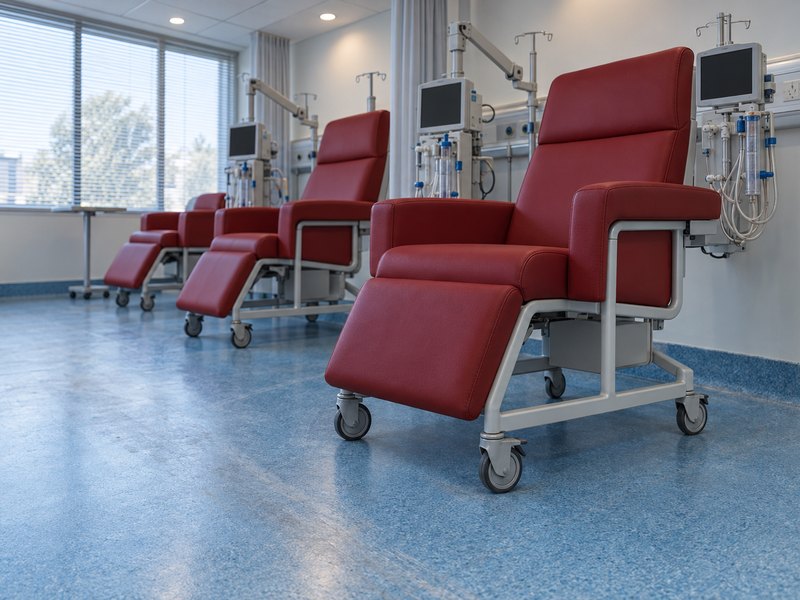
Dialysis area flooring has to survive blood, dialysate, hypochlorite and four casters on a floor that is cleaned daily and never closes. None does it alone: a treatment bay, an isolation room and a water treatment room fail in different ways. The default is a seamless cementitious urethane at 3/16 in (4.8 mm) with a coved base. Washdown rooms take a urethane mortar of 4 to 6 mm, and a bay that must return the same shift takes MMA (methyl methacrylate) acrylic.
Easy-to-Clean and Hygienic Flooring Solutions for Dialysis Areas in Healthcare Facilities
Durable and Chemical Resistant Dialysis Area Flooring
Durability in a dialysis area flooring specification is a chemical question before it is a mechanical one. Floors here do not wear out from footfall; they fail where cleaning chemistry sits against a bond line that water has already reached.
Water is the first failure mechanism. A cementitious urethane build takes water into its cure, so a slab still drying does not lift the floor, and vapor from below does not blister it. That is why the family is specified in food plants and pharmaceutical suites.
Point load comes second: a chair carries its mass through four small casters, so each wheel takes far more than its share. A 3/16 in (4.8 mm) cementitious body carries that pressure; a 0.3 mm film passes it into the concrete.
Chemical resistant flooring is specified from the cleaning list, not the resin name. Sodium hypochlorite at the concentration your cleaning policy sets, and peracetic acid at use dilution, are different duties. A topcoat rated for one is not rated for the other.
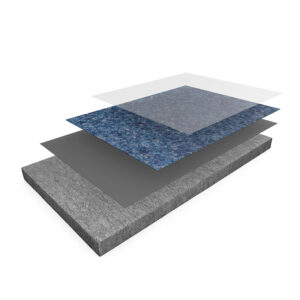
Den epoxy flooring range is the lower-cost substitute where the slab is dry, and the system that blisters first when a slab runs wet. The moisture test comes before the price.
On our Ure-Crete™ SLB system, compressive strength is above 9,000 psi to ASTM C579, water absorption is 0.04% to ASTM D-570, and VOC is 0 g/L. Abrasion loss is 30 mg to ASTM D-4060 with the CS-17 wheel, the figure to quote for cart traffic. Those figures cover load, water and indoor air; chemistry is the topcoat list.
What a Dialysis Floor Is Actually Asked to Survive
Nine exposures decide a chemical resistant flooring specification, and each one forces a different question in the tender.
Table 1. Nine exposures, how each one fails the floor, and the question the specification must answer
Exposure
How the floor fails
What the specification must answer
Blood and blood products
Protein dries into a worn topcoat and stains it
Stain resistance; can the wear layer be renewed
Dialysate and reverse osmosis (RO) water
Water reaches the bond line and the film lifts
Moisture tolerance at the slab, measured water absorption
Sodium hypochlorite
Chalking and color loss, worst at the cove
Concentration and contact time the topcoat is rated for
Peracetic acid
Softening and blistering, starting at seams
Dilution and dwell time, with test data at that dilution
Citric acid descaling
Dulling of the wear layer, attack at drains
Acid strength, temperature and the rinse routine
Chair and machine casters
Point-load crushing and star cracking
Build thickness and compressive strength, both stated
Carts, scales, machines on wheels
Abrasion tracks between bays
Abrasion loss to ASTM D-4060 with the CS-17 wheel
Hot water and detergent at terminal clean
Topcoat dulling and chalking, worst at the cove
Topcoat resistance to hot water at that dilution
Povidone-iodine and alcohol
Staining of a porous or worn surface
Stain resistance; can it be re-sealed instead
Citric acid descaling and povidone-iodine rarely appear in supplier literature. Both are routine, and both attack a hospital flooring system sold as chemically resistant.
Dialysate is not one chemistry. Acid concentrate is a buffered acidic solution; bicarbonate dialysate is mixed on site and leaves a mineral film as it dries. The topcoat must take a mild acid and an alkaline descale in the same week, and release that film rather than hold it.
Which Build for Which Zone of a Dialysis Unit
No single dialysis unit flooring build fits eight zones. The table gives nominal thickness, walk-on and light-duty figures, and the works window the phasing allows.
Table 2. Zone, build, thickness, walk-on, light duty, works window
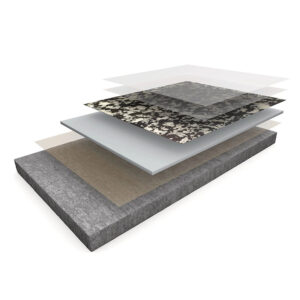
Wet zones get trowel-applied polyurethane floor coating systems. Where healthcare flooring must hand back same day, a fast-cure acrylic is the answer.
Isolation rooms get their own line: heavier cleaning. Seamless flooring, fully coved, with sealed penetrations matters more than color or gloss. An open joint holds spill.
Slip Resistance Where the Floor Is Never Dry
Slip resistance on dialysis area flooring is a wet-number question for any medical flooring brief, and it belongs to infection control because a fall breaks skin. Most slips happen within a step of a chair, on a floor that looks dry.
Our Ure-Crete™ SLB measures above 0.6 static coefficient of friction (COF), dry, to ANSI B101.1, and above 0.42 dynamic wet to ANSI A326.3. The wet figure matters at chair side.
A hemodialysis flooring specification should require that number, not a class alone. Texture comes from aggregate broadcast into the body coat, and it survives only if the seal coat leaves the profile standing. A heavy seal fills it, and the floor reads as slip resistant on paper.
Table 3. Recommended slip class by zone: ramp test R-class and barefoot wet class
Zone
Skick
R class (DIN 51130)
Wet barefoot class (DIN 51097)
Treatment bay, chair access side
Damp from cleaning, dry underfoot
R10
Not applicable
Around machines, drains, chair bases
Frequent drips and spills
R11
Not applicable
Reuse, drain and dirty utility
Standing water, washdown
R12
Not applicable
Corridor and waiting area
Dry, trolley traffic
R10
Not applicable
Storage and plant
Dry, occasional spill
R10
Not applicable
Table 3 gives hospital flooring recommendations by zone, not a certificate. The 0.42 figure is the datasheet value. On site we verify by wet pendulum, BS 7976-2 or ASTM E303, zone by zone, with the stations marked on the as-built drawing.
Every zone in Table 3 is a footwear area, so DIN 51130 governs the unit. DIN 51097 Class C applies only where patients stand barefoot, such as a shower room, and never replaces an R class.
Seams, Coving and the Water That Leaves the Machine
Seamless flooring removes the joint where spill and residue collect. That is the argument for a resin build over sheet vinyl: not the resin, the missing seam.
A coved base is formed, not glued on. Mortar is shaped with a radius trowel, cured, ground, then coated with the same topcoat as the floor. A bonded strip puts a bond line where the mop arrives.
Figure 2. The cove and the drain collar: one continuous build, no joint where the mop arrives.
Infection control at this detail is geometry, not chemistry. The coved base stands 100 mm (4 in) high and follows the wall finish line. What matters is a continuous radius, wrapped by the topcoat.
Table 4. Substrate acceptance before any build goes down
Requirement
Värde
Why it is checked
Concrete grade
C30 minimum
A weak slab fails under point load first
Tryckhållfasthet
Above 30 MPa at 28 days
Confirms the grade in practice
Surface tensile strength
Above 2 MPa pull-off
The bond is only as strong as the top layer
Slab moisture content
Epoxy below 8%; MMA and cementitious urethane accept damp slabs
Decides which chemistry fits the slab, not whether a floor can be laid
Surface profile
Concrete surface profile (CSP) 3 to 4
The profile the bond figures assume
Perimeter detail
Anchor groove 1.5 to 2 times build thickness
Stops the floor lifting at the wall
The anchor groove is the detail most often skipped, and the first place a floor lifts. Drains are set into the build, not cut in later. Without fall, a 3/16 in build holds water, so falls belong in the substrate.
Re-flooring a Unit That Cannot Close
A unit rarely closes, so a dialysis area flooring program hands back bays, not a building. Resin flooring work is planned around cure windows fixed before the contractor mobilizes.
Table 5. Cure, walk-on, light duty, works window
Chemistry
Cure per coat
Walk-on / light duty
Works window
MMA acrylic
45 to 60 min at 68 °F (20 °C)
Same shift
Mid-week bay swap, screened and ventilated
Cementitious urethane
Recoat inside the overcoat window; past it, abrade
Walk-on 8 to 24 h; light duty 24 to 48 h
Weekend: strip Friday, walk on Monday
Epoxi
Multi-coat; full build over consecutive nights
Typically 24 h
Dry-slab areas only, one night per bay
Urethane mortar
Base trowel and topcoat on separate visits
Next shift after the topcoat
Wet rooms, scheduled with the drain works
Those figures assume a 20 °C slab. A single bay fits a weekend: strip Friday, walk on Monday. No hypochlorite washdown for the first week, or the surface dulls permanently.
MMA cures at 45 to 60 minutes per coat, so a three-coat system is walkable the same shift. Every system needs the slab 3 °C above dew point. Epoxy needs above 10 °C, MMA from 2 °C, the cementitious system 5 to 35 °C, held for the first day. Where dialysis flooring cannot be isolated and ventilated, MMA is the wrong choice.
Where the contract requires it, the work zone is sealed off from live bays by barriers under negative pressure, with one entry. Debris leaves in sealed bags, and barriers come down after the final clean-down. A service method, not a certification; our installation crews work to it.
Phasing decides whether the unit stays open: one bay cluster at a time, machines moved to the next, rebuild, hand back. Water and power are isolated and locked off, because hospital flooring cannot be built around a live drain.
Where Resin Flooring Is the Wrong Specification
Resin flooring is right for most of a dialysis center flooring brief and wrong for part of it.
Comfort and noise come first. A hard dialysis flooring build has no resilient layer, so a brief asking for softness or less impact sound needs a resilient sheet.
Open halls rule out MMA. Where healthcare flooring cannot be isolated and ventilated for a shift, a waterborne product is the answer. Floors that must be re-graded are a mortar or screed job, because a self-leveling build follows the substrate.
Epoxy on a slab above 8% moisture will blister; a tight budget does not change the chemistry. Where the slab is dry and the duty light, sheet vinyl costs less upfront for dialysis flooring, but it brings back the seam at the cove.
Produktfunktioner
Seven values a dialysis area flooring specification can check at handover.
Monolithic build at 3/16 in (4.8 mm). No seam, no open joint at the cove.
Compressive strength above 9,000 psi to ASTM C579. The figure that answers caster point load.
Water absorption of 0.04% to ASTM D-570. Chemistry stays on the surface.
Abrasion loss of 30 mg to ASTM D-4060 (CS-17). The figure for cart traffic.
Wet dynamic COF above 0.42 to ANSI A326.3. Verified on site by wet pendulum.
0 g/L VOC and CA 01350 compliance. Relevant when patients return the same week.
Service range of −40 °C to 115 °C at 9 mm on the mortar build. Long-term service rating at the stated thickness.
Thermal shock resistance comes from the cement binder, not the topcoat.
Vanliga frågor och svar
What flooring is best for a dialysis unit?
A seamless cementitious urethane build of about 3/16 in (4.8 mm), with quartz broadcast for wet slip and a coved base at every wall. It tolerates slab moisture, resists hypochlorite and peracetic acid at cleaning dilution, and reaches walk-on in 8 to 24 hours. Epoxy is cheaper on a dry slab.
Is epoxy flooring suitable for dialysis clinics?
Epoxy flooring works in dialysis clinics only on a dry slab: it needs a working damp-proof membrane and typically 24 hours before foot traffic. Where the slab is damp, newly poured or has already lifted a coating, a moisture-tolerant build is safer.
What happens when blood or dialysate spills on the floor?
Nothing structural, if the build is sealed and coved. The spill stays on a closed seamless flooring surface. The risk is the bond line, where repeated water reaches an open joint or an unsealed sleeve. Sealed penetrations keep the spill where infection control can deal with it.
Can a dialysis unit be re-floored without closing it?
A dialysis unit can be re-floored without closing: work is phased by bay cluster, with machines moved to the adjacent cluster and the floor handed back before the next starts. MMA cures in 45 to 60 minutes per coat and returns the same shift, but the odor needs isolation. A cementitious build suits a single-bay weekend.
How long before chairs and machines can go back on the floor?
Walk-on is normally allowed after 8 to 24 hours at a 20 °C slab. Chairs and machines concentrate load on small casters, so point loads wait until day three. Protective board under machine feet is cheap insurance. Full chemical resistance takes about a week.
Does a dialysis floor need to be anti-static?
A dialysis treatment floor has no routine requirement for conductive flooring. Specify anti-static only where the equipment plan or the electrical design calls for it, and take the resistance value from that document rather than a datasheet claim. Where required, the anti-static epoxy floor range is the starting point.
Can resin flooring go over the existing vinyl or tile?
Only where the existing floor is proven sound and well bonded. Loose vinyl, hollow tile and adhesive residue have to come off, and the slab is prepared to a CSP 3 to 4 profile. Epoxy flooring over a failing substrate is why new floors lift within a year.
What slip rating does a dialysis treatment floor need?
The slip rating depends on the zone: treatment bays usually sit at R10 to R11, and reuse, drain and utility areas at R12. Those are recommended values, not a certificate. The installed floor is verified by wet pendulum test, with the stations marked on the as-built drawing.
Specify the floor zone by zone. Send four things and the answer comes back as a dialysis area flooring specification, zone by zone. We need the dialysis positions, the drain and machine layout, the cleaning list with dilution and dwell time, and an in-situ RH reading to ASTM F2170. Add the handover constraint, and the cure window is set against it. Browse the flooring systems
Inuti KAIDA PAINT-fabriken: där precision möter prestanda. Från råmaterialinspektion till automatiserad fyllning och rigorös kvalitetskontroll - varje parti testas för att uppfylla globala standarder. Det är här som förtroende skapas.
KAIDA PAINT: Mer än en tillverkare - din partner. Från leverans till applicering stöder vi globala agenter och entreprenörer med kvalitetsbeläggningar, pålitlig service och delad framgång. Tillsammans bygger vi upp ett förtroende som varar.
Från mottagning till lager såg våra globala partners med egna ögon kvaliteten bakom varje burk. På KAIDA PAINT är precisionstillverkning och rigorösa tester inte bara löften - de är bevisade. Tack för att du besöker oss, litar på oss och bygger med oss.
KAIDA PAINT i Sverige: levererar hållbara ytbehandlingar och sömlös applicering på plats. Från industrianläggningar till arkitektoniska projekt, våra lösningar fungerar - även under de tuffaste nordiska förhållandena. Betrodda av svenska entreprenörer. Beprövade på plats.
I tid, varje gång. KAIDA PAINT-leveranser på väg till globala partner - omsorgsfullt förpackade och redo för leverans. Pålitlig leveranskedja, konsekvent kvalitet och engagemang som du kan räkna med. Din order är på väg.







 English
 Spanish
 Portuguese
 Arabic
 French
 Italian
 Russian
 Indonesian
 Swedish