Descrição
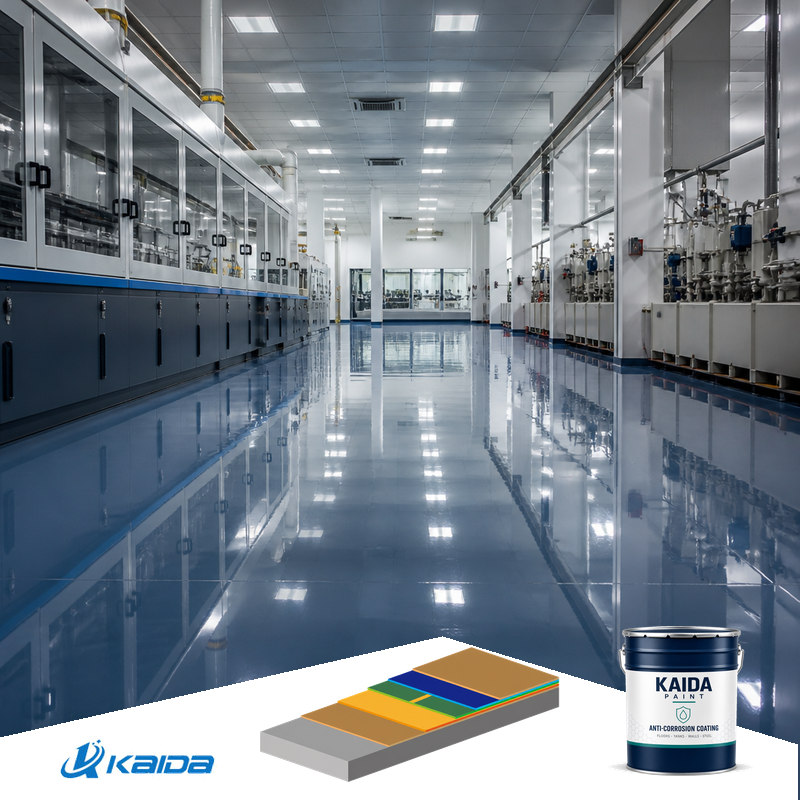
Epoxy mortar flooring is a resin-bound aggregate floor built thick — typically 2 to 10 mm — so it absorbs the chemical attack and the mechanical abuse that would destroy a coating. ACF-EP-MR is declared against 65% sulfuric acid and 35% hydrochloric acid at a build of 2 mm to 10 mm. Choose a mortar floor where thickness rather than resin is the lever, and choose the aggregate before the resin. The ACF-EP-MR system uses an epoxy primer, an epoxy mortar body and an epoxy self leveling topcoat, and it is specified where a floor has to carry loads and resist spills at the same time. This page explains why thickness changes chemical performance as well as strength, what the system is declared against, how it is installed, and how to choose between 2 mm and 10 mm.
| Item | Especificação |
|---|---|
| Sistema | Pavimento de argamassa epóxi |
| Model | ACF-EP-MR |
| Build | Epoxy penetrating primer, epoxy mortar body, epoxy putty, epoxy self leveling topcoat |
| Finished thickness | 2–10 mm (0.08–0.39 in), mortar and high-build mortar variants |
| Acabamento | High gloss self leveling; matte mortar finish under thin topcoats |
| Service life quoted | 5–10+ years in the duty it was specified for |
| Application method | Trowel-applied mortar, ambient cure, no hot work |
What is epoxy mortar flooring, and why does thickness matter chemically?
Epoxy mortar flooring is epoxy resin mixed with graded aggregate and trowelled onto the slab, then sealed with a resin topcoat. The aggregate does two jobs: it gives the floor compressive strength and abrasion resistance, and it reduces the amount of resin in the build, which is why a mortar floor costs less per millimetre than a poured self leveling system.
Why the aggregate, not the resin, sets the duty
A mortar floor is a composite: the graded aggregate carries load and the resin glues it together and seals it. Three consequences are decided on the specification sheet, not at the mixing station.
Grading decides density. A well-graded blend packs to a dense body with less resin between grains; an under-graded blend leaves voids that resin has to fill, which raises resin demand and lowers abrasion and chemical resistance per millimetre.
The aggregate decides which chemicals reach the resin. Silica aggregate is the default because it is hard and inexpensive, and it is also why a silica mortar cannot be offered for hydrofluoric acid — HF attacks silica directly, so the acid reaches the binder through the filler. Where HF governs, the grading switches to a non-siliceous aggregate before the resin is discussed.
Thickness follows the grading, not the reverse. The 2 mm to 10 mm range of ACF-EP-MR is not one mix poured at different depths: the coarse end needs a coarser aggregate and a trowel-applied body, while the thin end behaves as a reinforced screed. Specifying 10 mm with a fine aggregate buys thickness without the load path the thickness was paid for.
Practical test: ask for the aggregate grading and the filler type in writing. A quotation that states only “epoxy mortar” has not yet said what the floor is made of.
Which media is ACF-EP-MR declared against?
The values below are the manufacturer’s declared 7-day immersion results for the cured system.
| Médio | Concentração | Resultado |
|---|---|---|
| Sulfuric acid | 65% | No change after 7 days |
| Hydrochloric acid | 35% | No change after 7 days |
| Nitric acid | 25% | No change after 7 days |
| Acetic acid | 10% | No change after 7 days |
| Sodium hydroxide | 50% | No change after 7 days |
| Hydrofluoric acid | 35% | No change after 7 days |
| Phosphoric acid | 80% | No change after 7 days |
One engineering caveat belongs with the hydrofluoric acid figure. HF attacks silica, and most epoxy mortar aggregates are silica-based — so HF performance depends on the filler as much as on the resin. Where HF is the governing medium, confirm the aggregate grade before the specification is issued; we supply a non-siliceous filler grade for that duty, and the topcoat is selected with it rather than separately.
The other caveat is temperature. Immersion data is quoted at ambient; a hot process stream changes the kinetics of diffusion and the resistance of the topcoat. Where a floor sees hot process liquor, the topcoat grade is reviewed against the service temperature before pricing.
For the cloth-reinforced version on the same resin, see fiberglass reinforced epoxy flooring.
Aggregate grade decides more than resin in some duties, and the full comparison is in chemical resistant flooring by aggregate grade.
How is the mortar floor built up?

- Concrete substrate — diamond ground, sound; cracks and joints treated before the mortar goes down.
- Epoxy penetrating primer — anchors the mortar; a scratch coat is added on rough or porous slabs.
- Argamassa epoxídica — resin and graded aggregate, trowelled to the specified thickness in one or more passes.
- Grinding — the cured mortar is ground to plane, removing trowel marks and opening the surface.
- Epoxy putty — a fill pass where the mortar has surface porosity.
- Epoxy self leveling topcoat — the barrier and wearing surface, poured and de-aired.
The step that is most often skipped on site is step 4. A mortar floor that is not ground before the topcoat leaves high spots that wear first and low spots that pool liquid.
What are the mechanical properties?
| Test item | Unit | Resultado |
|---|---|---|
| Resistência à compressão | N/mm² | ≥ 60 (8,700 psi) |
| Pencil hardness | H | ≥ 2H |
| Abrasion loss (750 g / 500 r) | g | ≤ 0.02 |
| Resistência ao impacto | Kg/cm² | ≥ 80 |
At 6–10 mm these values give a floor that takes drum handling, pallet trucks, racking legs and scraping without wearing into the substrate. At 2 mm the same material behaves as a reinforced screed rather than a structural wearing course, so thickness has to be chosen against the actual wheel loads — not from a catalog default.
For the vinyl ester mortar that carries HF duty, see vinyl ester high-build mortar flooring.
Where is epoxy mortar flooring specified?
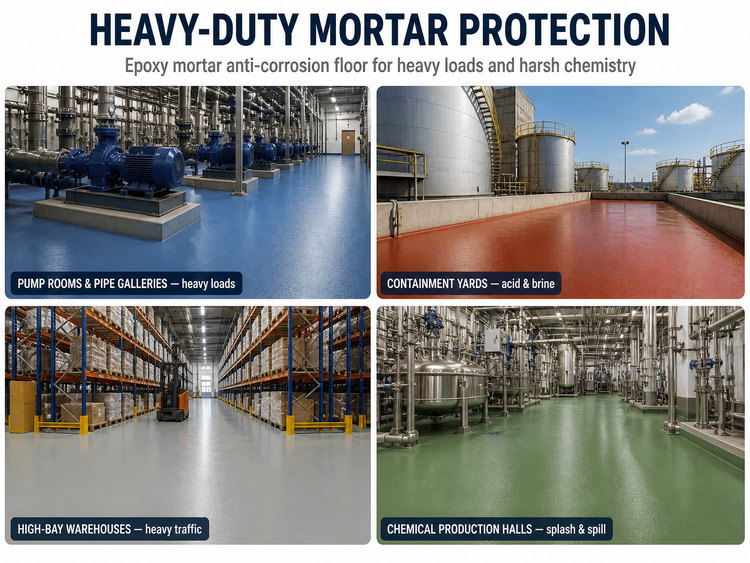
- Etching machine areas and chemical process floors with spill and load together
- Hazardous chemical workshops and drum storage rooms
- Chemical warehouses, including racking aisles and decanting bays
- Chemical tank farm floors and curbed zones
- Pump rooms and pipe galleries with chemical drainage
- Heavy-duty production halls and high-bay warehouses requiring a seamless, washable floor
- Food and beverage filling lines where a mortar body is needed for thermal and mechanical duty
How is it installed?
- Preparação — grinding, structural repair, joint treatment, moisture and dew-point check.
- Preparação — epoxy penetrating primer, with a scratch coat where the slab is open.
- Argamassa — trowelled to thickness between edge forms set to the specified level.
- Grinding — after cure, ground to plane.
- Putty and topcoat — fill pass, then epoxy self leveling topcoat.
- Cure and handover — cure window, inspection against the specification, maintenance briefing.
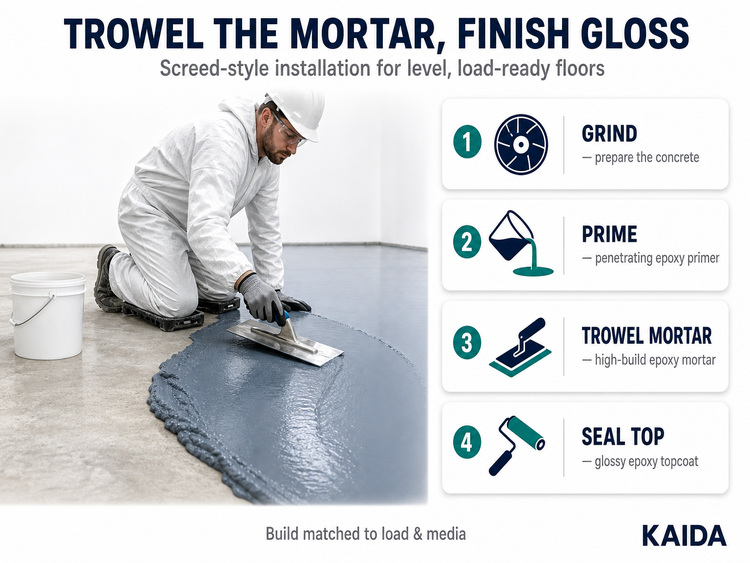
A mortar floor is installed in bays because each layer needs to cure and be ground before the next. On a large area the schedule is set by access dates rather than by material supply, which is why the phasing plan matters as much as the specification.
Thickness, service life, and how to choose
Quoted service life is 5–10+ years. That range is wide because it tracks thickness and duty: a 2 mm mortar in a light warehouse aisle and a 10 mm mortar in a chemical plant aisle are not the same product in service terms, even though the materials are identical.
| Build | Typical duty |
|---|---|
| 2–3 mm mortar | Light chemical contact, foot traffic, occasional pallet truck |
| 4–6 mm mortar | Regular chemical spill, racking and drum handling, wash-down |
| 8–10 mm high-build mortar | Heavy point loads, abrasion, concentrated spill, long service window |
| Cloth-reinforced epoxy (3-cloth) | Where crack-bridging matters more than thickness |
The choice is not only about load. Where the slab is jointed and moving, a cloth-reinforced build bridges better than a mortar; where the slab is sound and the load is the issue, mortar wins. Both answers are legitimate and they cost differently.
For the glass-reinforced polyester alternative at lower cost, see FRP glass reinforced flooring.
What does epoxy mortar flooring cost, and how is it quoted?
Epoxy mortar flooring is priced from measured area, thickness, substrate condition, joint and detail count, and access. Thickness drives cost close to linearly because aggregate and resin volume both scale with it.
Two lines in a quotation deserve to be read carefully: substrate repair (the largest source of variation against a budget) and joint treatment. A quotation that assumes a perfect slab and then finds 30% of the area needs repair was never cheap — it was incomplete.
A quotation is per square meter (sq ft) and depends on the aggregate grade specified as much as on area, FOB or CIF named port. Minimum order and lead time are confirmed with the grading, because a special blend carries its own supply window.
Perguntas frequentes
Is epoxy mortar flooring the same as epoxy self leveling?
No. Self leveling is a poured resin film, typically 2–3 mm, with no aggregate body. Mortar contains graded aggregate and is trowelled, so it carries load and resists abrasion at a level a self leveling film cannot reach. Many projects use both: mortar in the aisles, self leveling in the clean rooms.
How thick should it be for forklift traffic?
That depends on wheel type, load per wheel and the slab beneath — three inputs we ask for before recommending a thickness. A 4 mm mortar under a heavy forklift aisle is a false economy, and a 10 mm mortar in a foot-traffic area is overspend.
Can it be laid over an existing floor?
Over a sound, well-bonded resin floor in some cases, and over a prepared slab in most. It cannot bridge a delaminated coating or a slab with active moisture, because the load finds the weak layer. Adhesion and moisture are tested before a renovation is quoted.
Does it resist hydrofluoric acid?
The declared data covers 35% HF, but the filler matters: HF attacks silica, so a non-siliceous aggregate must be specified for that duty. Where HF, hot acid or solvent is the governing medium, say so at enquiry — the aggregate and topcoat are then selected together rather than from a standard build.
Why projects specify Kaida Paint for epoxy mortar flooring
Kaida Paint supplies the primer, the mortar resin and aggregate, and the self leveling topcoat as one system, so the aggregate grading and the resin are matched rather than combined on site. For HF or concentrated acid duty, the filler selection is confirmed in writing against the medium before the order is accepted.
Each project file records the medium, the thickness installed and the aggregate grade supplied, so the floor can be checked at handover against what was specified. Batch records and a material declaration ship with the material, and the method statement fixes substrate moisture, dew point, joint treatment and the cure interval between mortar and topcoat.
Send the chemical list with concentrations, the area, the wheel loads and the slab condition. We will return a thickness recommendation, an aggregate grade and a quotation against those inputs.
—
Autor: Kaida Paint Technical Team — flooring systems engineering, heavy duty anticorrosive flooring Last updated: 13 November 2026

 English
 Spanish
 Portuguese
 Arabic
 French
 Italian
 Russian
 Indonesian
 Swedish