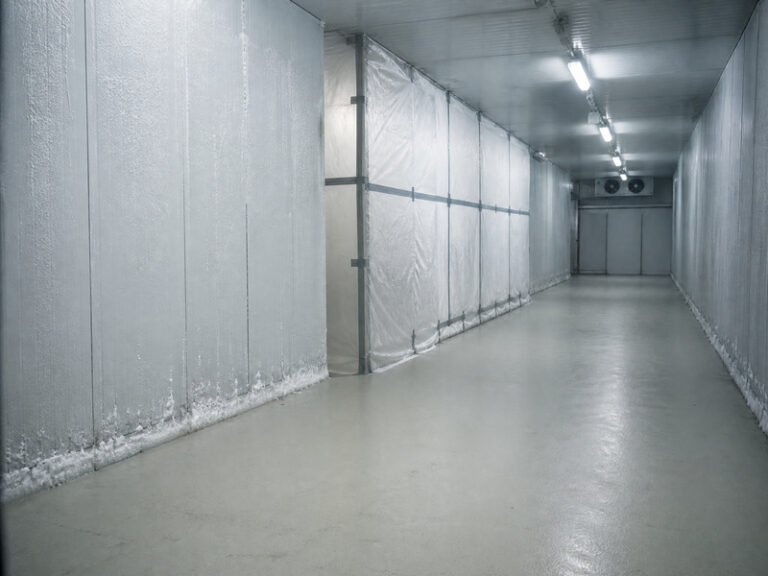
A freezer floor replacement usually happens because the store cannot be emptied: the product inside is worth more than the floor, and the lease or the customer contract will not allow a shutdown. The work is therefore designed around a room that stays at temperature.
Four things decide whether it works: the system cures at the room temperature, the substrate can be dried or isolated, the bay can be sealed against warm air, and the return to temperature is controlled rather than abrupt.
This article covers the physics, the systems, the isolation, the ice, the ramp back to temperature, and the hour-by-hour shape of a typical programme.
Why freezer floors get repaired live
A cold store floor fails for the usual reasons: ice, thermal cycling, pallet damage and drainage. What makes it different is that the failure is invisible until it is serious, because ice fills the defect and hides it.
A cold store floor repair live is therefore reactive by nature. The call usually comes after a pallet has broken through, a door track has lifted, or an auditor has photographed a crack that is now 20 mm wide.
The commercial driver in a cold store floor repair live is stock value, and the question is usually whether a bay can be spared rather than whether the floor can be fixed. Emptying a freezer means moving product, paying for temporary storage and accepting a temperature excursion on every pallet, and that usually costs more than doing the work cold.
A cold store floor repair live usually starts as a photograph and a question about whether the store has to close. The answer depends less on the damage than on the bay layout: a store with wide aisles and spare racking can give up a bay; one that is full to the doors cannot.
A freezer floor replacement in a blast freezer is harder again, because the room works at -35 °C and the defrost swings are wider. The same method applies, with a shorter window and a lower cure temperature.
A freezer floor replacement is also a programme problem rather than a materials problem. The material has to suit the temperature you cannot change, and the programme has to suit the store you cannot empty.
Table 1: Two routes, and what each one costs.
| Item | Empty the store | Work cold |
|---|---|---|
| Product handling | Move out and back | Relocate within the store |
| System choice | Any standard system | Must cure at room temperature |
| Programme | Short and total | Long and phased |
| Risk | Temperature excursion | Condensation and ice |
The physics: ice, condensation and cure at -20 °C
Three physical facts govern the work. Water in the substrate is ice, warm air entering the room condenses on every cold surface, and resin chemistry slows or stops as temperature falls.
Ice contamination is the first problem. Ice in a crack expands and lifts the floor, and any repair placed over it will fail at the first defrost. The ice has to be removed, not covered.
Ice contamination also hides the extent of the problem. Ice fills a crack flush with the surface, so the defect looks smaller than it is until the scarifier opens it, and the scope grows on the first morning.
The cure temperature sets the schedule. A low temperature installation at -20 °C needs a system that reacts without ambient heat, and the bay has to stay sealed long enough for that reaction to finish.
Condensation control is the second. Moist air drawn into an isolated bay will condense on the slab, on tools and on a freshly primed surface, and a primer applied over a wet film will not bond.
The third is the cure. A standard epoxy needs about 10 °C to react; at -20 °C it simply does not. Low temperature installation is therefore not a preference but the only workable route in an operating freezer. The -20 °C figure is a construction window, not a service temperature limit: a blast freezer at -35 °C is floored with MMA only after the room is brought into that window.

Figure 1: Ice in the substrate is the cause, not the symptom. It has to come out before anything is placed.
Systems that cure below zero
Both are applied cold and both need the substrate at the same temperature as the room, which is why a PU screed cold in a chilled bay behaves differently from the same product in a freezer twenty metres away.
Two families work cold. MMA cures by a chemical reaction that does not depend on ambient temperature, and some polyurethane systems are formulated for low-temperature application with acceptable strength gain.
A PU screed cold is the usual choice where a flexible finish is wanted at a moderate thickness: 3 to 4 mm, applied in one pass, walkable within hours and able to take a pallet truck after a controlled ramp.
A PU screed cold suits a bay where the finish has to flex with the slab and the thickness can stay modest. It is slower than MMA, and it tolerates a slightly damp substrate better than a rigid system.
Where the bay has to stay in service for longer than a shift, the system choice moves towards a low temperature installation that can be left overnight without a full seal. Those systems trade speed for tolerance, and the programme absorbs the difference.
MMA is faster and harder, and it is the system of choice where the bay has to be back in service within a shift. The trade is odour, which in a sealed freezer is a real constraint rather than a nuisance.
A blast freezer at -35 °C is at the edge of what any system handles, and a temporary insulation wall has to be thicker there to stop the door zone sweating. The floor there needs the same chemistry plus a thicker build at the door and a detail that allows the slab to move without cracking the surface.
Table 2: Systems for cold installation, and where each one fits.
| Sistema | Cure temperature | Walk-on | Where it fits |
|---|---|---|---|
| MMA | Down to about -20 °C (installation window) | 1-2 hours | Fast return, sealed bay |
| Low-temp PU | Down to about -10 °C | 8-12 hours | Flexible finish, moderate cold |
| PU screed, cold grade | Down to about -5 °C | 12-24 horas | Chilled rooms and thresholds |
Isolating a bay without losing the store
The isolation is the engineering, and for a cold store floor repair live it is the only thing standing between the work and the stock. A temporary wall has to hold back warm air, carry insulation, and allow a person and a machine through without leaving a gap open for longer than a moment.
Temporary insulation panels are the practical answer: rigid insulation faced both sides, taped at every joint, with a zipped or curtained doorway. The target is a surface that does not sweat when the bay is worked in.
A cold store floor repair live in a busy store also needs a traffic plan. Forklifts keep working in the adjacent aisle, and a barrier that blocks the aisle will be moved by the first driver who is behind schedule.
The temporary wall also carries the extraction. A condensation control strategy that stops at the wall will fail the moment a tool is started inside, so the duct has to pass through the insulation without breaking its seal.
Budget for more than one set of temporary insulation. The first wall is usually reused, the second is usually damaged during stripping, and a store that plans for one set ends up working with a curtain in place of a panel.
Plan the bay size around the cure time, not around the drawing. A bay that is too large cannot be finished in the window, and a bay that is too small multiplies mobilisations and door openings.
Removing ice and keeping the substrate dry
Removal is mechanical: scarify, break out the failed material, and take the ice with it. Heat is the wrong tool, because melting ice puts water into the slab that you then have to remove again.
Ice contamination is not only in the cracks. It sits in the pores of the slab and in the layer under a failed coating, and a primer applied over it will trap it until the next defrost pushes the new floor off.
Once the substrate is exposed, the question is whether it can be dried. In a freezer it usually cannot, so the answer is a system that tolerates a damp substrate plus a primer designed for it.
Where the slab is saturated, a phased defrost is the only honest route: take the bay out of service, let it come up towards zero under controlled conditions, dry it, and rebuild.
Record the moisture before the primer, and treat any ice contamination found at that stage as a reason to stop rather than a detail to prime over. A reading taken at -20 °C is not a substitute for a reading taken at a workable temperature, and the two should be taken at the same locations.
Restoring temperature without cracking the new floor
The ramp back to service temperature is where good work is lost. Bringing a room from -2 °C to -25 °C in a few hours creates a gradient through a green floor that it cannot absorb.

Figure 2: A staged return to temperature is agreed before the work starts. A store manager who reloads and drops the set point the same afternoon undoes it.
A condensation control plan should include the door openings as well as the set point. Every time the curtain is opened, warm air enters, and the surface temperature at the threshold drops below the rest of the bay within minutes.
The practical approach is to hold the room at the installation temperature for the specified cure period, then step the set point down in increments, allowing the floor to stabilise at each step.
A blast freezer is the hardest case for temporary insulation, because the panels have to be thick enough to stop the door zone sweating, because the door zone sees the full swing every time it opens. A thicker build at the threshold and a movement detail at the panel line are what keep it intact.
Write the ramp into the phased defrost handover, with the set points and the times, and sign it. A store manager who reloads the bay and drops the set point on the same afternoon is undoing a week of careful work.
Acceptance testing in a cold room
A freezer floor replacement that is signed off on a visual inspection alone leaves the store manager with no baseline. Two photographs at each collar and one pull-off per bay are enough to show the floor was sound when it was handed over.
Acceptance testing in a cold room needs its own protocol. Pull-off tests taken on a floor at -20 °C read differently from those at 20 °C, and a result without the temperature is not comparable with anything.
For a PU screed cold finish, the practical set is adhesion at three locations per bay, a thickness reading, a visual acceptance at the door and around collars, and a fall check with water once the room is at temperature.
Water is the honest test for the fall, and it is also the test that reveals a drain collar that was not formed properly. Run it before the pallets go back, not after.
Record the temperature at each test. A freezer floor replacement file that shows the test conditions is defensible; one that shows only the results invites the question of how they were obtained.
What the programme looks like hour by hour
Table 3: Hour-by-hour shape of a three-day bay.
| Day | Work | Risk to manage |
|---|---|---|
| 1 | Isolate, strip, remove ice | Warm air entering the bay |
| 2 | Substrate, primer, body coat | Condensation on a cold slab |
| 3 | Topcoat, cure, ramp, handover | Returning temperature too fast |
For a freezer floor replacement, the first day is the one that decides the programme. If the isolation is not sealed, the ice not removed and the primer not protected, the second day starts behind and the third day is a negotiation.
A bay of about 150 m² in an operating freezer typically runs over three days: isolation and stripping on day one, substrate and primer on day two, system and ramp on day three.
The first four hours are the ones that decide the rest. If the isolation is not sealed and the ice is not out, every later step is compromised, and the programme is already lost.
A phased defrost shifts the whole sequence and should be planned as a separate phase of the cold store programme. Trying to combine a defrost with a freezer floor replacement is how a two-day job becomes a two-week closure.
Where the store cannot give three days, the condensation control plan has to be tightened rather than the seal dropped. MMA and a small bay can compress the work to a single shift per bay, at the cost of odour and a tighter supervision requirement.
Frequently asked questions
Can a freezer floor be replaced without emptying the store?
Yes, in isolated bays. The system must cure at the room temperature, the bay must hold its own air, and the room has to come back down over days rather than hours.
What temperature can resin be installed at?
MMA systems are installed down to about -20 °C as a construction window, some polyurethanes to about -10 °C, and cold-grade screeds to about -5 °C. All three serve well below those figures once the room is back at temperature. Standard epoxy needs roughly 10 °C and cannot be used in an operating freezer.
Why do freezer floor repairs fail so quickly?
Almost always because ice or water was left in the substrate. The repair sits on a layer that expands at the next defrost, and it lifts from underneath.
How long does a bay take?
About three days for 150 m² in a live store, including isolation, stripping, substrate work, the system and the temperature ramp. A single-shift version is possible with MMA in a small bay.
Do I need to defrost the room?
Only where the slab is saturated and cannot be dried in place. A phased defrost is a separate project and should not be combined with a repair programme.
How is the floor tested in a cold room?
Adhesion at three locations per bay, thickness, a visual check at doors and collars, and a water test for the fall once the room is back at temperature. Record the temperature at each test.
What is the biggest risk during the work?
Condensation. Warm moist air entering an isolated bay condenses on cold surfaces, including a freshly primed floor, and a wet primer does not bond.
Why food plants work with Kaida Paint
Kaida Paint manufactures MMA, polyurethane, cementitious urethane and epoxy systems for cold stores and food plants, and supplies them as finished systems or as OEM and private-label production for distributors. Each batch ships with a certificate of analysis and a batch record, and TDS and SDS documents are issued in the buyer’s language. For a freezer floor replacement, we will state the cure temperature the product needs rather than the temperature the room happens to be, and we will price the isolation, the ice removal and the ramp as separate lines.
Send the room schedule with temperatures and the defrost pattern, and the reply is a bay plan with the system and the cure time for each step.


 English
 Spanish
 Portuguese
 Arabic
 French
 Italian
 Russian
 Indonesian
 Swedish