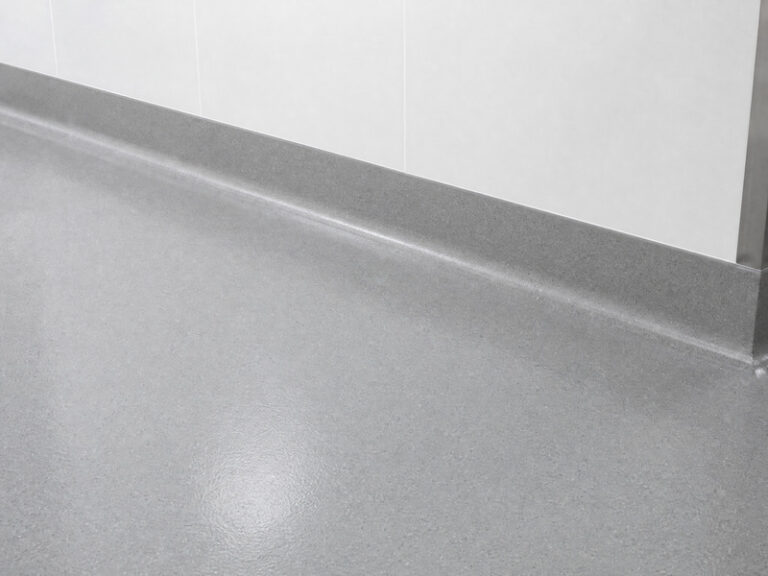
Food grade flooring is not a certificate and not a product family. It is a set of five properties, each of which can be tested, and a floor is food grade when the test results support the claim for the room it serves.
The five properties are cleanability, chemical resistance at the real concentration and temperature, mechanical integrity under load and thermal shock, slip resistance matched to the contaminant, and documented material safety. A supplier who cannot evidence one of them has not finished the job.
This article defines each property, shows the test behind it, explains what a test result does and does not prove, and ends with five clauses a contractor can price.
Food grade is a set of testable properties, not a badge
Buyers often ask which certificate makes food grade flooring acceptable to an auditor. The honest answer is that no single document does. Regulators and schemes require a floor that is cleanable, maintained and documented; they do not name a resin.
That is why the food grade flooring question is not “is this product approved” but “which properties does this floor have, and what evidence shows it”. Once the question changes, the conversation moves from logos to numbers, and numbers can be checked.
A hygienic design approach helps here. If the floor is designed so that soil cannot accumulate, the property you need to prove becomes smaller and cheaper to test. If it is not, no test result will keep it clean in service.
The same logic separates open profile from a sealed surface. An open texture can improve grip and reduce slip, and it can also trap soil. The choice between the two is a cleaning decision before it is a materials decision.
Table 1: The five properties that make up the claim, and the evidence that supports each one.
| Imóveis | What it answers | Evidence |
|---|---|---|
| Cleanability | Can soil be removed from the surface and the details? | Profile measurement, radius and joint schedule, cleaning trial |
| Resistência química | Does the binder survive the wash cycle? | Immersion report at stated concentration and temperature |
| Mechanical integrity | Does it stay bonded under load and heat? | Pull-off, hardness, thermal cycling |
| Resistência ao deslizamento | Is the surface safe when contaminated? | Ramp test, barefoot classification, site screening |
| Material safety | Is the cured material suitable for contact? | Declaration, SDS, migration statement |
Property 1: cleanability and surface profile
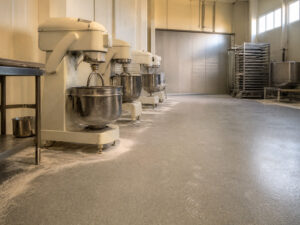
Cleanability in food grade flooring is geometry more than chemistry. A floor with a 100 mm cove, no open joints and a controlled profile cleans in a fraction of the time of a floor with the same resin and a 6 mm grout line.
A cleanability test therefore looks at three numbers: profile depth, radius at the floor-to-wall junction, and the number of interruptions such as drains, plinths and door frames. Those three predict cleaning time better than any brochure claim.
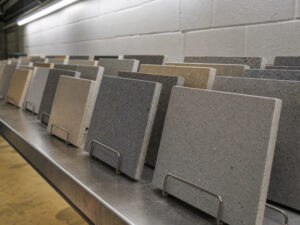
Profile depth is where open profile becomes a trade-off. A coarse broadcast gives grip and holds soil; a fine one cleans easily and can be slippery when wet. The usual answer is a mid-range profile in wet areas and a smoother finish where the floor stays dry.
At this step the failure we see most often on site is a floor that meets the profile number and fails at the door frame, where the radius was cut rather than formed.
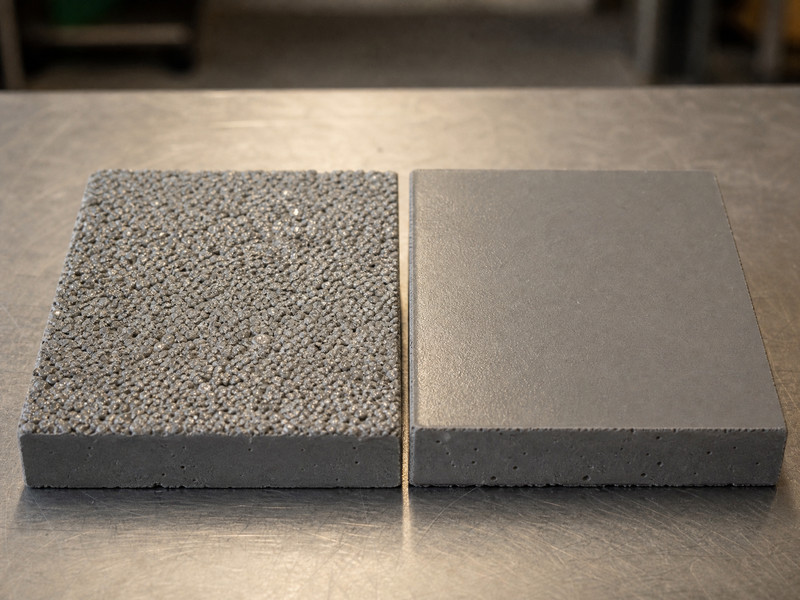
Figure 1: Profile depth is the number that decides both grip and cleaning time. It should be chosen per room, not per product.
Practical food safe flooring targets we see specified in food plants:
- Cove radius of 50 mm minimum in dry areas, and 75 to 100 mm where hoses are used daily.
- No joints inside the washdown zone, including under equipment plinths.
- A profile that can be cleaned with the brush and chemical the plant actually uses.
Property 2: chemical resistance at use concentration and temperature
Resistance is not a property of a resin in general; it is a property of a resin against a medium at a concentration and a temperature. A chart entry without both numbers describes a different exposure from the one in your plant.
In food plants the common loads are modest but repeated: 1 to 3 percent caustic at 70 to 80 °C, 0.5 to 2 percent nitric or phosphoric acid, 0.1 to 0.5 percent peracetic acid, and lactic acid in dairy work. Repetition matters more than peak concentration.
A chemical resistance test should report the medium, the concentration, the temperature, the duration and the observed effect. Mass change, hardness change and blistering are useful; the word “resistant” on its own is not.
Where the exposure is unusual, a trial panel in the room settles it. Pour one square metre, run the real wash cycle for a month, then inspect the edges where the film is thinnest and the drain collar where liquid stands.
This is also where food safe flooring and HACCP compliant flooring claims usually break down. A floor described as suitable for food contact may still be the wrong choice under 2 percent caustic at 70 °C, because suitability for contact and resistance to cleaning are separate questions.
Property 3: mechanical integrity under load and thermal shock
A floor that is cleanable and chemically suitable can still fail mechanically. Pallet trucks, racking feet, dropped knives and hot washdown all load the film, and the failure appears at the bond line rather than on the face.
Three tests cover most of it: pull-off adhesion, surface hardness after full cure, and a thermal cycling check on a sample. A pull-off value below 1.5 MPa, or a failure inside the concrete, points to preparation rather than to the resin.
Thermal shock is the load that food plants underestimate. Hot water on a cold slab, or a cold rinse on a warm floor, moves the film and stresses the bond. Systems built for it are thicker and more flexible, and they cost more for a reason that shows up in year three.
In our own repair work, bond loss along a pallet truck lane almost always starts at a patch edge that was ground but not primed.
Where the specification calls for a food grade flooring system in a hot washdown area, thickness is part of the property. A cementitious urethane flooring system at 6 mm and a 0.5 mm coating can carry the same chemistry and behave completely differently under the same thermal load.
Property 4: slip resistance matched to the contaminant
Slip is the food grade flooring property most often specified by a single number and most often wrong in service, because the test contaminant rarely matches the real one. Water, oil, blood, fat and sugar each produce a different result on the same surface.
A slip resistance classification should name the standard, the footwear and the contaminant. In practice that means DIN 51130 with shoes and oil for R9 to R13, DIN 51097 barefoot with soap for classes A, B and C, or ANSI A326.3 with a wet DCOF threshold of 0.42 in North America.
In any slip resistance classification for a wet process room with fats, R12 is a common requirement; a dry packing hall is often R9 or R10. Ramps and dock levellers need more, and a barefoot changing area needs a different standard altogether rather than a higher R number.
The practical sequence is to decide the contaminant first, then the class, then the open profile or fine surface that delivers it. Doing it in the other order, by choosing a profile and hoping the class follows, is how floors end up both slippery and hard to clean.
Property 5: documented material safety and migration status
The last food grade flooring property is documentation rather than performance, and it is the one auditors ask for. It covers what the cured material is, what it may contact, and what the supplier declares about it.
For a floor, the relevant documents are an SDS in the language of the destination market, a statement of composition for the cured film, and, where direct or indirect contact is claimed, a migration statement. Migration testing belongs to the supplier’s file, not to the installer’s.
Be precise about what a migration statement covers. It usually addresses a defined set of conditions and a defined contact type, and it does not extend to a different temperature, a different foodstuff or a different layer of the system.
This is also the point where food safe flooring and HACCP compliant flooring claims need care. HACCP is a management system owned by the plant; a floor cannot be HACCP compliant on its own. What a supplier can provide is evidence that supports the plant’s own hazard analysis.
Testing each property: what to ask for and what it proves
Each food grade flooring property has a test that fits it, and each test has a limit. Knowing the limit is what stops a specification from resting on a document that proves less than it appears to.
A cleanability test on a sample proves the geometry of that sample. It does not prove the installed floor, because profile, radius and joint count are installation outcomes. Check them at floor acceptance testing with a profile gauge and a radius gauge.
A chemical resistance test on a cured coupon proves the binder’s behaviour under one set of conditions. It does not predict service life under a daily cycle, which is why a trial panel is worth more than a longer immersion test at the wrong temperature.
On a handover file we reviewed this year, a two-page immersion report answered every line except the temperature the floor would actually run at.
A HACCP compliant flooring claim needs hygienic design evidence, and that evidence is a drawing review rather than a laboratory test. Look for coves at every wall, kerbs at plinths, drain collars formed rather than butted, and no joints inside the wash zone. If those are missing, the material cannot compensate.
Table 2: What each test proves, and what it leaves open.
| Test | Proves | Leaves open |
|---|---|---|
| Profile and radius measurement | The geometry as built | Cleaning method and frequency |
| Immersion resistance report | Binder behaviour at stated conditions | Service life under cycling |
| Pull-off adhesion | Bond at the tested locations | Bond elsewhere on the slab |
| Ramp slip test | Class for the tested contaminant | Behaviour with a different contaminant |
| Migration statement | Status under defined contact | Other foods, temperatures or layers |
Writing the five properties into a specification
A food grade flooring specification that says “food grade epoxy” gives a contractor nothing to price and an auditor nothing to check. Five clauses, each with a number, are how hygienic design becomes a scope.
Clause one: cleanability, the subject of any cleanability test, expressed as a minimum cove radius, a maximum joint count in the wash zone, and a profile range. Clause two: chemical exposure, the chemical resistance test set, listed as medium, concentration and temperature per room.
Clause three: mechanical, with a pull-off minimum, a hardness value after full cure and a thermal cycling requirement where hot washdown occurs. Clause four: slip, with the slip resistance classification standard, the class and the contaminant.
Clause five: documentation, listing the SDS language, the migration testing statement and the batch records required at handover. A supplier who cannot meet clause five has not understood the open profile logic behind the other four.
Table 3: A clause set that can be priced, tested and handed over.
| Clause | Text | Verified by |
|---|---|---|
| 1 Cleanability | Cove 75 mm, no joints in wet zone, profile 0.4-0.8 mm | Radius gauge, visual, profile gauge |
| 2 Chemical | Caustic 2% at 75 °C daily; nitric 1% at 55 °C | Immersion report at those conditions |
| 3 Mechanical | Pull-off 1.5 MPa minimum, Shore D 75 after 7 days | Pull-off tests, hardness readings |
| 4 Slip | DIN 51130 R12 in wet process, R10 in dry areas | Test report, site screening |
| 5 Documents | SDS in local language, migration statement, batch COA | Handover pack review |

Figure 2: Five clauses, each with a number that can be checked at handover. This is what makes the claim enforceable.
Written this way, food safe flooring becomes a statement about evidence rather than a marketing phrase, and HACCP compliant flooring becomes something the plant can defend in an audit, because the floor file matches the specification clause by clause.
It also makes comparison fair. Two quotes against these five clauses are comparable on price; two quotes against the words “food grade epoxy” are not comparable at all, and the difference usually appears as a variation after the floor is removed.
Frequently asked questions
Is there a certificate that makes a floor food grade?
No. Regulators and food safety schemes require cleanable, maintained and documented floors; they do not certify a resin. What you can hold is a set of test results and declarations that support the claim for a defined room.
What is the difference between food grade and food safe?
In practice the terms overlap, and both are marketing shorthand. The useful distinction is between a material declared suitable for a contact type and a floor that is cleanable, resistant and documented in service. Ask which of the five properties a supplier is evidencing.
How is cleanability actually tested?
Geometry is measured: profile depth, cove radius and the number of joints in the wash zone. Cleaning is then trialled with the plant’s own chemical and brush, and the result checked visually and with a swab. A cleanability test that only reports a material name has not tested cleanability.
What must a chemical resistance test state to be useful?
The medium, its concentration, the temperature, the exposure time and the effect observed. Without all five, the result describes a different exposure from yours, and the gap is usually where a floor fails early.
Which slip class does a food grade floor need?
It depends on the contaminant. A slip resistance classification for a wet process area with fats usually lands at R12; a dry packing hall at R9 or R10. Barefoot areas use DIN 51097 classes A, B or C instead of an R number.
Do I need migration testing for a floor?
If the floor is claimed to be in direct or indirect contact with food, a migration statement belongs in the file. For a floor that only contacts cleaning water and air, the relevant documents are the SDS and the composition statement. Either way, migration testing is the supplier’s responsibility, not the installer’s.
Can a floor be food grade in a dry area with no washdown?
Yes, and the properties shift. Cleanability still matters for dust and crumbs, chemical resistance matters less, and slip becomes the dominant requirement. Specifying a heavy wet-process system in a dry store buys nothing you need.
Why food plants work with Kaida Paint
Kaida Paint manufactures epoxy, polyurethane, cementitious urethane and MMA systems for food and beverage plants, and supplies them as finished systems or as OEM and private-label production for distributors. Each batch ships with a certificate of analysis and a batch record, and TDS and SDS documents are issued in the buyer’s language. Our technical team will map your five clauses to a system and return the evidence file that supports food grade flooring, including profile targets, pull-off values and the migration statement where contact is claimed.
Send the room list with the cleaning chemicals and temperatures, and the reply is a clause-by-clause response rather than a product name.


 English
 Spanish
 Portuguese
 Arabic
 French
 Italian
 Russian
 Indonesian
 Swedish