
A polyurethane floor coating for warehouse is specified by the load it carries, not by the colour of the finish. Solid-tyre forklifts and rack legs decide the thickness, and the aisle layout decides where it fails first.
This article covers what actually wears a warehouse floor, how point load and rack leg load differ, why VNA aisle flooring is the most demanding strip in the building, and what to state in a specification.
What does a warehouse floor actually experience?
A warehouse floor sees three loads that a production floor rarely combines: high pressure at the wheel, stationary load at the rack leg, and abrasion from grit that the trucks bring in.
It also sees very little water, which changes the specification. A warehouse PU floor in a dry distribution centre is chosen for wear and colour, not for chemical resistance or thermal cycling.
That is why a floor that performs well in a food plant can disappoint in a warehouse. The mechanisms are different, and the thickness that protects against one is not the thickness that protects against the other.
The useful starting point is a traffic survey: vehicle type, wheel material, aisle width, turning points and rack layout. Everything below follows from those five facts.

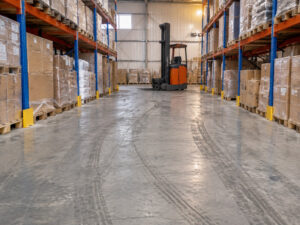
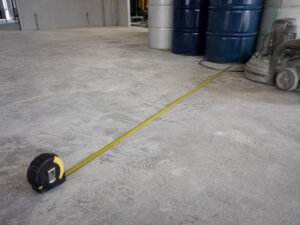
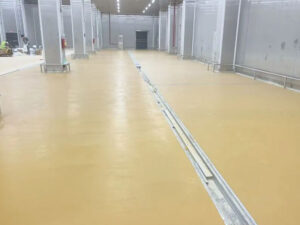
Figure 1: the wear ring names the vehicle before the survey does.
One more factor is worth recording at survey stage: how the building is used after hours. A floor that is swept nightly behaves very differently from one where grit sits on the surface until the weekend.
Sweeping frequency is the cheapest variable a client controls. A floor swept twice a day can outlast an identical floor swept weekly by several years, and no specification clause captures that. It is also the first thing to check when a client reports that a floor is wearing faster than expected in a building where nothing has changed, and how the build-up is specified is the second.
What does forklift abrasion do to a floor?
Forklift abrasion is rarely caused by the wheel alone. Most wear is a three-body process: grit on the surface, pressure from the wheel, and a sliding motion at every turn.
That is why wear appears first at turning circles and at the entrance, where trucks bring in grit from the yard. Straight aisles usually outlast the corners by years.
Tyres matter as much as the surface. Solid tyres concentrate forklift abrasion at a much smaller contact patch than pneumatics, and a fleet change from one to the other can shorten a floor life by half without anyone touching the floor.
The practical consequence is that a uniform thickness across the building is a compromise. Where the budget is tight, spend it on the corners and the doors rather than spreading it evenly.
Surface texture matters too. A very smooth finish shows scratches and polishes quickly; a light texture holds a film of dust that acts as a lubricant and wears the surface more slowly.
What do point load and rack leg load do to a film?
Point load is a force applied over a small area. A pallet truck wheel, a stillage foot or a rack levelling plate all concentrate load far beyond what the slab sees in general.
Rack leg load is the static version, and it is the one that crushes a thin coating over months. A loaded rack leg can apply 10 to 25 newtons per square millimetre at the plate edge.
Turn the point load from a rack leg into a number you can check. Divide the loaded leg force by the area of its levelling plate to get the pressure the film must carry. A leg on a small plate can reach the top of the band a wide plate reaches only at its edge, so plate size belongs on the drawing.
If the racking is not yet bought, plate size is still yours to specify. A wider plate costs less than the extra millimetre of mortar it replaces, and it is the cheapest load-spreading decision in the building. A jointless floor changes impact damage, not rack leg pressure, so the two belong in different rows of the same table.
A rigid film under that pressure does not flex; it creeps, and the creep shows as a polished ring or a shallow depression that collects water and dust.
The remedy is either thickness or a load-spreading plate. A 6 mm mortar spreads the pressure over an area a 1 mm coating cannot, which is why racking areas are specified separately in most warehouses.
A jointless floor does not change that arithmetic. Removing mid-aisle joints reduces impact damage, but it does not spread a rack leg load, and the two problems are often confused in a tender.
Traffic categories and what they imply
A traffic category is a shorthand for wheel type, load and frequency. It is useful for comparison and dangerous as a substitute for a site survey, because two buildings in the same category can differ in aisle width by a metre.
Table 1: Traffic categories and the build each one needs.
| Categoria | Typical vehicle | Minimum build | Watch for |
|---|---|---|---|
| Light | Pallet truck, foot traffic | 2 mm self-smoothing | Dragged pallets, grit at doors |
| Médio | Counterbalance, pneumatic | 3 to 4 mm | Braking zones |
| Pesado | Counterbalance, solid tyre | 6 mm mortar | Heat at the wheel, turning circles |
| Very heavy | Reach truck, VNA, container handler | 6 to 9 mm plus plates | Rack leg load, joint edges |
The category should be recorded per zone rather than per building. Most warehouses have at least three, and the aisles are usually not the zone that gets the attention.
Where a polyurethane floor coating for warehouse is priced from a single rate, the client is usually paying for the heaviest zone applied everywhere, or discovering later that the light rate was used in a heavy aisle.
Why is VNA aisle flooring the most demanding strip?
VNA aisle flooring carries the highest wheel loads in the building on the narrowest strip. A very narrow aisle truck runs within millimetres of the racking, so the wheels track the same line thousands of times a week.
That repetition matters more than the load. A floor that would last a decade under general traffic can show a polished groove in a VNA aisle within 2 years.
The usual specification is a 6 mm mortar with a plate or a wider rack base, plus a flatness tolerance tight enough that the truck’s mast does not correct constantly. Flatness is not cosmetic in a VNA; it is a maintenance cost.
Where the slab cannot meet the tolerance, a warehouse PU floor system can be built up to correct it locally, but the correction has to be designed before the racking is installed, not after.
The measurement is worth commissioning early, and the grip class under a truck is worth specifying in the same document, because a polished aisle and a slippery aisle are the same wear problem. A flatness survey costs a fraction of a VNA aisle flooring installation, and it can move the racking line by a few centimetres before anything is ordered.

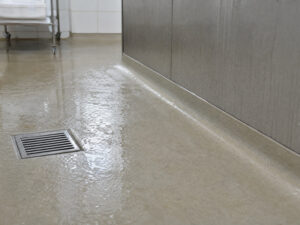
Figure 2: flatness in a VNA aisle is a maintenance budget line.
Jointless floors and why they matter here
A jointless floor removes the construction joints that would otherwise sit in the middle of an aisle. Joints are where wheels impact, where edges spall and where cleaning water collects.
Removing them entirely is rarely possible on a large slab, so the practical aim is to move them out of the wheel path. A joint under racking is harmless; a joint along a VNA guide line is not.
Where a joint must stay in traffic, the detail matters more than the filler. An armoured arris on both edges costs a little more at installation and prevents the spalling that turns a joint into a pothole.
Where joints must stay, they need an arris-protected edge and a filler that carries load. A soft sealant in a forklift aisle is a maintenance item, not a detail.
Where a joint has to stay in a trafficked area, an armoured edge on both sides plus a filler rated for the wheel load is the only version that survives. The alternative is a repair every 18 months, which is more expensive than the detail.
Where a joint must stay in a wheel path, the detail worth pricing is the arris, not the filler. An armoured edge cast on both sides carries the load across it, and a soft sealant alone does not. That sealant becomes an annual maintenance item on a route with real traffic, while the arris is paid for once.
Table 2: Joint treatment by location.
| Localização | Treatment | Consequence if wrong |
|---|---|---|
| Under racking | Filled, sealed, no arris | Low risk, rarely trafficked |
| Between aisles | Saw cut, semi-rigid filler | Edge spalling within a year |
| In a VNA aisle | Avoid, or relocate to the guide line | Groove and mast correction |
| At door thresholds | Armoured edge, cast detail | Breakout at the busiest point |
Line marking and colour as a working tool
Line marking is part of the floor specification in a warehouse, not an afterthought. Painted lines wear off in months; lines cast into the resin wear with the floor.
The practical approach is to mark aisles, pedestrian routes and loading zones in a contrasting colour during the coating operation, so the line is part of the system rather than a layer on top.
Colour also affects lighting. A light grey floor raises measured lux at the same fixture count, which matters in a tall racking building where lights are expensive to add later.
For line marking on a dark floor, contrast is the constraint rather than colour. A yellow line on a mid-grey floor is visible; the same yellow on a dark grey floor reads as texture from a distance.
Where the client expects to re-rack within a few years, cast lines become a liability. In that case a plain floor and removable marking is the better answer, and it is worth saying so.
Where racks are expected to move, removable marking also protects the floor. Adhesive lines can be replaced without touching the resin, while cast lines have to be ground out and re-coated.
Racking changes are the other predictable event. Where a layout is expected to move, cast lines and cast-in plates become liabilities. A plain floor with removable marking survives two reconfigurations, and the second layout is usually a different traffic category on the same slab.
Marking also has a safety function that a polyurethane floor coating for warehouse specification should acknowledge. Pedestrian routes marked on the floor change behaviour more than signs on the wall, and they wear out faster.
Does the slab decide whether any of this works?
A warehouse PU floor bonds to what is there. Laitance, dust, curing compound and old paint all sit between the resin and the slab, and all four fail in the same way under traffic.
Flatness is the second issue. A slab with a 6 mm deviation over 3 m will telegraph through a thin coating and will be corrected by the truck’s mast in a VNA.
Moisture is the third, and it is lower risk in a warehouse than in a food plant, but not zero. A slab without a damp-proof membrane still needs a reading before a primer is chosen.
Temperature swing is the load nobody records in a warehouse. A dock door that opens all day in winter puts a moving thermal gradient across the slab, and a floor specified only for wheel load will crack along that line. Note the door positions on the zone plan. A warehouse PU floor is decided by where the building moves as much as by what drives on it.
Cracking is the fourth. A warehouse slab usually has shrinkage cracks, and a point load over a live crack will mirror it within a season unless the crack is stitched or the system is designed to bridge it.
Specifying and programming the work
A polyurethane floor coating for warehouse work is short to specify when it is done properly: traffic category per zone, build per zone, joint layout, marking layout and flatness tolerance.
Table 3: What a warehouse floor specification should fix.
| Item | Estado | Why it changes the price |
|---|---|---|
| Zones | Traffic category and build per zone | Prevents one rate for the whole building |
| Preparação | Method and profile | Largest labour variable |
| Planicidade | Tolerance and test method | Correction work is expensive |
| Joints | Location and treatment | Edge protection and filler |
| Marking | Layout, colour, method | Cast lines cost more than paint |
Programming matters as much as the specification. A warehouse usually cannot empty, so the work runs in phases by aisle, and the phasing has to respect the racking layout rather than the coating sequence.
Where a warehouse runs 24 hours, the programme is the constraint rather than the price. Work has to follow the aisle sequence the pick faces allow. A faster-curing floor can beat a longer-lasting one, because a polyurethane floor coating for warehouse work earns its keep on the second shift. Ask for the return-to-service time per aisle, and check it against the forklift abrasion expected there.
Racking bays rarely line up with construction joints. That mismatch is where most programme surprises come from, and it is visible on the layout drawing before anyone mobilises.
Where polyurethane is the wrong choice
A polyurethane floor coating for warehouse is not automatically the right answer. In a dry ambient warehouse with light traffic, an epoxy at half the cost will outlast the requirement.
Polyurethane earns its premium where there is turning, heat at the wheel, or a slab that moves. Where none of those applies, the extra cost buys flexibility nobody needs.
The same applies to thickness. A 9 mm mortar in an aisle used by pallet trucks is a polyurethane floor coating for warehouse that costs 40 per cent more and adds nothing, and clients rarely object when the reasoning is on the page. The zone table does that job better than any argument, because it shows where the money is going and where it is being saved.
We would rather say that at quotation stage than sell a system twice. The floor that suits the building is the one that is still there when the racking is re-configured.
That is the test we apply to our own quotes. If a polyurethane floor coating for warehouse cannot be justified zone by zone, the specification has more to do with habit than with the building. That is also why we ask for the racking layout before quoting a rate: the drawing usually explains a wear pattern better than the maintenance log does. Where the racking is not yet installed, the flatness survey is the cheapest decision available, because its cost is a fraction of the aisle it protects.
It costs nothing to ask, and it often changes which aisle gets the heavier build and which can stay on the lighter rate. That single drawing session usually saves more money than any negotiation over the square metre price, and it takes an hour. What an installed square metre costs then becomes a conversation about zones rather than about a single number.
Perguntas frequentes
How thick should a warehouse polyurethane floor be?
2 to 4 mm for pallet trucks, 6 for solid-tyre forklifts, and 6 to 9 under racking and reach trucks. Each zone should be stated separately.
What causes forklift abrasion most?
Grit carried in from the yard, combined with pressure at the wheel and sliding at every turn. Wear shows first at corners and doors, not in straight aisles.
Do I need a jointless floor in the aisle, or only at the turning circle?
Only where joints would sit in a wheel path. Under racking they are harmless, and moving them out of the aisle is cheaper than removing them.
Should line marking be painted or cast when the racking layout will change in 2 years?
Cast into the resin where the layout will last. Painted lines wear off in months and become an annual maintenance cost in a busy aisle.
Can a thin coating survive a VNA aisle?
Rarely. The repetition on the same track polishes a thin film through within 2 years, and the flatness tolerance usually needs a thicker build anyway.
Does a warehouse floor need a moisture test?
Yes. Lower risk than a wet processing room, but a slab without a damp-proof membrane can still lift a primer that was not chosen for it.
How long does a polyurethane warehouse floor last?
8 to 12 years in heavy traffic with good preparation, and longer in light traffic. Service life falls sharply where the thickness was specified for a lighter category.
Why warehouse operators work with Kaida Paint
Kaida Paint supplies warehouse PU floor systems in four traffic grades, with the zone plan drawn as part of the quotation so a polyurethane floor coating for warehouse tender can be priced per aisle rather than per building. We will also tell you where an epoxy is the better buy, which happens more often in dry distribution centres than the category suggests, and where a racking layout makes one aisle a different floor from its neighbour.


 English
 Spanish
 Portuguese
 Arabic
 French
 Italian
 Russian
 Indonesian
 Swedish