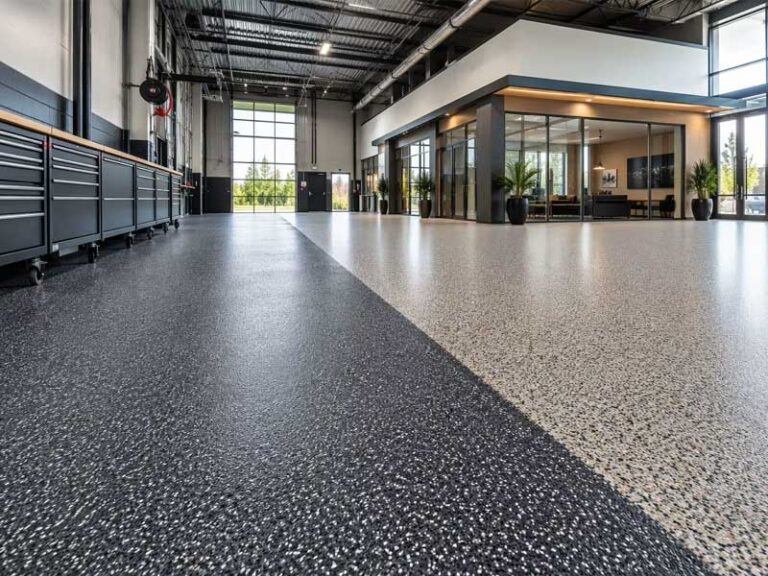
Quartz epoxy flooring is better for heavy-duty commercial environments requiring maximum durability, chemical resistance, and slip resistance. Epoxy flake flooring is better for decorative commercial applications where customization, comfort, and lower upfront cost are priorities.
The selection between these two resinous flooring systems depends on your facility’s specific performance requirements—whether the priority is maximum traction in wet environments, decorative versatility, or total cost of ownership over the facility’s lifecycle. This guide provides a practical comparison based on industry standards and real-world installation experience to help facility managers, architects, and business owners make an evidence-based decision.
Quick Comparison Table
| Fitur | Quartz Flooring | Flake Flooring |
|---|---|---|
| Jenis Lantai | Broadcast quartz epoxy system | Decorative epoxy/polyaspartic flake system |
| Terbaik untuk | Heavy-duty commercial areas | Decorative commercial spaces |
| Daya tahan | ⭐⭐⭐⭐⭐ | ⭐⭐⭐⭐ |
| Resistensi Selip | Luar biasa | Bagus. |
| Design Options | Sedang | Luar biasa |
| Initial Cost | Lebih tinggi | Lower |
| Expected Lifespan | 15–20+ years | 10-15 tahun |
| Resistensi Kimia | Luar biasa | Baik hingga Sangat Baik |
| Repair Complexity | More difficult | Sedang |
Which Flooring Is Better? Quick Decision Guide
| Persyaratan | Winner |
|---|---|
| Heavy traffic areas | Quartz |
| Wet environments (kitchens, pool decks) | Quartz |
| Chemical exposure (laboratories, food processing) | Quartz |
| Color customization and design flexibility | Flake |
| Lower upfront cost | Flake |
| Comfort underfoot | Flake |
| Outdoor installation | Quartz |
| Quick installation (polyaspartic systems) | Both |
1. What Is Quartz Flooring?
Quartz flooring, also known as broadcast quartz flooring or quartz epoxy flooring, uses natural quartz aggregate broadcast into or mixed with an epoxy or polyaspartic resin base, then sealed with a clear protective topcoat. The quartz granules are the same mineral found in natural stone and sand, providing a distinctive, uniform texture with a subtle sparkle.
Key material characteristics:
- Aggregate hardness: Quartz aggregate has a Mohs hardness of approximately 7, contributing to excellent wear resistance when incorporated into resin flooring systems.
- Thickness: Typically installed at 1/8″ to 1/4″ thickness, creating a denser, more substantial wear layer.
- Surface texture: Pronounced, uniform texture with excellent inherent slip resistance.
- Aesthetic: Natural stone appearance, available in understated color blends.
2. What Is Flake Flooring?
Flake flooring, also called epoxy flake flooring, chip flooring, or decorative flake flooring, incorporates colored vinyl chips or flakes broadcast into a wet epoxy or polyaspartic base coat, then sealed with a clear topcoat. The flakes can be applied in various sizes and densities to achieve different visual effects.
Key material characteristics:
- Aggregate composition: Colored vinyl polymers with decorative properties.
- Thickness: Medium-thickness system (approximately 1/8″ typical).
- Surface texture: Slightly textured, smoother underfoot than quartz.
- Aesthetic: Terrazzo-like appearance with virtually unlimited color combinations and custom blends.
3. Quartz vs Flake Flooring: Head-to-Head Comparison
3.1 Durability and Abrasion Resistance
Quartz flooring demonstrates superior abrasion resistance because quartz aggregate provides a hard, wear-resistant surface within the resin matrix. ASTM D4060 is commonly used to evaluate coating abrasion performance, and quartz-filled systems typically achieve excellent results.
Flake flooring provides good durability for light-to-moderate commercial traffic. The vinyl flakes are softer than quartz and may show wear patterns sooner in high-traffic areas. However, with a quality polyaspartic topcoat, flake systems can achieve a service life of 10–15 years in appropriate applications.
Key Takeaway: Quartz flooring provides better long-term durability because quartz aggregate has superior hardness and abrasion resistance.
3.2 Slip Resistance and Safety
The pronounced texture of quartz systems provides excellent slip resistance even when wet, making it the top choice for environments where moisture is common—commercial kitchens, pool decks, restrooms, and outdoor commercial patios.
Flake flooring provides good slip resistance through the texture of the vinyl flakes and topcoat, but the surface is generally smoother underfoot. This makes flake systems preferable for environments where comfort matters—garages, showrooms, retail spaces.
Key Takeaway: For wet industrial environments, quartz flooring is generally the safer option.
3.3 Chemical Resistance
Both systems offer excellent chemical resistance when properly topcoated with high-performance resins. Quartz systems have an inherent advantage: the quartz aggregate itself is chemically inert and resistant to acids, alkalis, solvents, and oils. This makes quartz epoxy flooring suitable for chemical-resistant flooring applications in laboratories, food processing facilities, and industrial environments.
Flake systems rely primarily on the topcoat for chemical protection. With a polyaspartic or epoxy topcoat, flake systems can withstand exposure to automotive fluids, mild acids, and cleaning agents common in commercial settings.
3.4 Aesthetic and Design Flexibility
Flake flooring provides better design flexibility because vinyl chips are available in unlimited colors and blends. Custom color combinations can match brand identities, create wayfinding patterns, or achieve specific design visions. The multi-colored pattern effectively camouflages minor concrete imperfections, dirt, and traffic patterns.
Quartz flooring offers a more uniform, natural stone aesthetic with limited color options. The consistent particle size and distribution create a clean, professional finish preferred in laboratories, pharmaceutical facilities, and corporate environments where sterility and understated elegance are priorities.
Key Takeaway: Flake flooring provides better design flexibility because vinyl chips are available in unlimited colors and blends.
3.5 Installation and Maintenance
Installation requirements are similar for both systems:
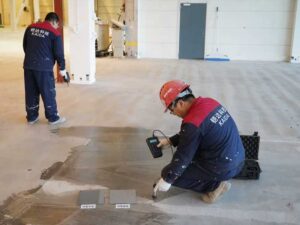
- Surface preparation: Diamond grinding or shot blasting to achieve proper concrete profile (CSP 3–5)
- Crack repair: Essential for both systems
- Cure time: Typically 24–72 hours (polyaspartic topcoats can reduce to 24 hours)
Maintenance for both systems is straightforward:
- Regular sweeping or dust mopping
- Damp mopping with pH-neutral cleaners
- Avoid harsh chemicals
Quartz systems may require occasional pressure washing for outdoor applications due to the deeper texture trapping fine dust. Flake systems may benefit from periodic resealing or topcoat refresh after 10–15 years.
4. Quartz Flooring: Pros and Cons
Kelebihan
- Exceptional durability: 15–20+ year service life in high-traffic conditions
- Superior slip resistance: Excellent traction in wet environments
- Outstanding chemical resistance: Inert quartz aggregate resists acids, solvents, oils
- UV stability: Natural stone provides inherent resistance to UV degradation
- High compressive strength: Withstands heavy loads and equipment
Kekurangan
- Higher initial cost: Typically higher than flake systems
- Limited color options: Restricted to natural stone palette
- More difficult repairs: Patching blends less easily than flake systems
- Rougher texture: May be less comfortable for barefoot traffic
5. Flake Flooring: Pros and Cons
Kelebihan
- Superior design flexibility: Unlimited color combinations and custom blends
- Lower initial investment: Generally more budget-friendly than quartz
- Comfortable underfoot: Smoother surface than quartz
- Dirt-hiding properties: Multi-color pattern conceals minor debris and wear
- Easier repairs: Patches blend more readily with decorative pattern
Kekurangan
- Shorter lifespan: 10–15 years in commercial applications
- Lower abrasion resistance: Vinyl flakes softer than quartz aggregate
- UV vulnerability: Requires UV-resistant topcoat for outdoor use
- Reliance on topcoat: Chemical resistance depends primarily on topcoat quality
6. Best Applications for Each System
Choose Quartz Flooring When:
- Maximum durability is required—heavy equipment, forklift traffic, constant pedestrian flow
- Slip resistance is critical—wet environments, pool decks, commercial kitchens
- Outdoor installation—natural UV resistance eliminates topcoat concerns
- Long-term investment priority—15–20+ year service life with minimal maintenance
- Chemical exposure is constant—laboratories, pharmaceutical, food processing
Ideal applications: Pharmaceutical facilities, commercial kitchens, industrial warehouses, outdoor patios, pool decks, laboratories, food processing plants
Choose Flake Flooring When:
- Aesthetic customization is paramount—specific brand colors, decorative patterns
- Budget constraints exist—lower initial investment for comparable visual impact
- Indoor application with controlled environment—garages, showrooms, retail
- Comfort underfoot matters—shopping centers, offices, hospitality venues
- Shorter planning horizon—10–15 year service life is acceptable
Ideal applications: Residential garages, retail showrooms, workshops, basements, light commercial spaces, entertainment areas
7. Is Quartz Flooring Right for Your Facility?
Quartz flooring is particularly well-suited for facilities with demanding operational conditions. Consider quartz flooring if your facility falls into any of these categories:
- Manufacturing plants with heavy equipment, forklift traffic, and constant wear
- Food processing facilities requiring chemical resistance and sanitation
- Commercial kitchens where slip resistance and grease resistance are critical
- Healthcare facilities requiring seamless, hygienic surfaces
- Laboratories with chemical exposure and sterility requirements
- Gudang with high-traffic zones and heavy loads
8. Cost Comparison: Initial Investment and Lifecycle Value
8.1 How Much Does Quartz Epoxy Flooring Cost?
Quartz epoxy flooring typically costs more than flake systems due to the higher aggregate loading, denser material requirements, and increased labor for full broadcast application. Total project cost depends on substrate condition, resin type selection, aggregate blend, and geographic location.
For accurate pricing, project specifications should account for:
- Concrete preparation and moisture mitigation requirements
- Desired floor thickness and aggregate density
- Topcoat selection (epoxy vs polyaspartic)
- Project size and access conditions
8.2 How Much Does Epoxy Flake Flooring Cost?
Epoxy flake floor cost typically ranges lower than quartz systems for equivalent areas, though polyaspartic flake flooring systems may be at the higher end of the range due to faster cure times and enhanced durability. Custom color blends and decorative patterns can add 10–20% to material costs.
8.3 Typical Cost Ranges and Lifecycle Value
| Faktor Biaya | Quartz Flooring | Flake Flooring |
|---|---|---|
| Initial Installation Cost | Higher range | Lower to moderate range |
| Expected Service Life | 15–20+ years | 10–15+ years |
| Annualized Cost (20-year period) | $0.35–$0.75 per sq ft/year | $0.33–$1.00 per sq ft/year |
| Maintenance Requirements | Minimal—sweep and mop | Easy—sweep and mop |
| Repair Difficulty | More challenging | Sedang |
8.4 Factors Affecting Quartz Flooring Cost
Quartz flooring price depends on several variables:
- Concrete preparation requirements: Crack repair, moisture mitigation, and surface profiling needs
- Floor thickness: Thicker systems require more material and higher cost
- Resin type: Epoxy, polyaspartic, or hybrid formulations affect pricing
- Aggregate size and color: Custom blends and larger particle sizes may increase cost
- Project area: Larger projects typically achieve lower per-square-foot pricing
- Moisture mitigation requirements: Vapor barrier systems add cost if needed
- Geographic location: Labor rates vary by region
8.5 Factors Affecting Flake Flooring Cost
Epoxy flake floor cost depends on:
- Base coat thickness: Standard vs. heavy-duty specifications
- Flake density: Full broadcast (100% coverage) vs. partial broadcast (lower coverage)
- Topcoat type: Epoxy vs. polyaspartic (polyaspartic typically costs more but cures faster)
- Color customization: Standard vs. custom blended colors
- Project size and complexity: Larger spaces reduce per-square-foot costs
8.6 Lifecycle Value Analysis
While quartz carries a higher initial investment (typically 30–50% more than flake systems), the extended service life and reduced maintenance requirements often result in comparable or lower total lifecycle costs for facilities with a 15+ year planning horizon.
9. Installation Differences
Quartz Flooring Installation Process
- Surface preparation: Diamond grinding or shot blasting to achieve CSP 3–5 profile
- Application of primer (if required)
- Base coat application
- Broadcast quartz aggregate into wet base coat
- Remove excess aggregate after curing
- Apply clear topcoat (typically epoxy or polyaspartic)
Flake Flooring Installation Process
- Surface preparation: Diamond grinding or shot blasting
- Application of primer (if required)
- Base coat application
- Broadcast vinyl flakes into wet base coat
- Remove excess flakes after curing
- Apply clear topcoat (epoxy or polyaspartic)
Key differences:
- Quartz systems require higher aggregate coverage (full broadcast) for optimal performance
- Flake systems can be applied at lower densities (partial broadcast) for cost savings
- Both systems require professional installation with specialized equipment
10. Frequently Asked Questions
Q: What is the difference between quartz flooring and flake flooring?
A: Quartz flooring uses natural quartz aggregate to create a highly durable, slip-resistant surface, while flake flooring uses decorative vinyl chips to provide greater color customization and visual flexibility. Quartz is generally more durable and chemical-resistant; flake offers more design options and lower initial cost.
Q: Which flooring lasts longer, quartz or flake?
A: Quartz flooring typically lasts 15–20+ years compared to 10–15 years for flake flooring in commercial applications. The superior hardness of quartz aggregate provides greater abrasion resistance and extended service life.
Q: Which flooring is more slip-resistant when wet?
A: Quartz flooring offers superior slip resistance in wet conditions due to its inherently textured surface. Flake flooring provides good slip resistance but is smoother underfoot.
Q: Is quartz flooring more expensive than flake flooring?
A: Quartz flooring usually has a higher upfront installation cost because of the higher aggregate loading and material requirements. However, its longer service life can reduce replacement costs over time, often resulting in comparable lifecycle costs.
Q: Can quartz and flake flooring be combined?
A: Yes. Many commercial facilities combine quartz flooring in high-performance zones with flake flooring in decorative areas, creating a hybrid approach that maximizes both durability and aesthetics where needed.
Q: Is flake flooring suitable for outdoor use?
A: Flake flooring can be used outdoors but requires a UV-resistant polyaspartic topcoat to prevent yellowing and degradation from sunlight exposure. Quartz flooring has inherent UV stability and performs better outdoors.
Q: Which system is easier to repair?
A: Flake flooring is generally easier to repair—patches blend more readily with the decorative pattern. Quartz flooring requires more careful patching and blending to match the uniform aggregate appearance.
Q: Are both systems low-maintenance?
A: Yes. Both systems require regular sweeping or dust mopping and damp mopping with pH-neutral cleaners. Quartz may require occasional pressure washing for outdoor applications; flake may benefit from periodic resealing after 10–15 years.
Q: Is quartz flooring suitable for commercial kitchens?
A: Yes. Quartz flooring is highly suitable for commercial kitchens due to its excellent slip resistance, chemical resistance (grease, oils, cleaning agents), and seamless, hygienic surface.
11. Final Recommendation
Based on comprehensive performance analysis and real-world installation feedback, our recommendation follows a decision matrix approach:
Prioritize Quartz Flooring when your facility requires:
- Maximum durability and impact resistance
- Superior slip resistance in wet environments
- 15–20+ year service life with minimal maintenance
- Chemical and thermal resistance
- Outdoor or temperature-variable environments
Prioritize Flake Flooring when your facility requires:
- Maximum aesthetic customization and visual versatility
- Lower initial capital investment
- Comfortable surface for barefoot or soft-shoe traffic
- Indoor, climate-controlled environments
- 10–15 year service life is acceptable
Hybrid Approach: For facilities requiring both durability and aesthetics in different zones (e.g., wet processing areas plus customer-facing spaces), consider using quartz in high-risk zones and flake in decorative areas.
Commercial Quartz and Flake Flooring Solutions from KAIDA PAINT
KAIDA PAINT manufactures commercial and industrial resin flooring systems, including quartz epoxy flooring, decorative flake flooring, polyaspartic coatings, and urethane cement flooring solutions.
Our capabilities include:
- Superior Product Technology: Compressive strength exceeding 12,000 psi and industry-leading abrasion and chemical resistance
- Comprehensive Technical Support: Specification guidance, moisture testing consultation, and installation training
- Terbukti Tahan Bahan Kimia: Tested against industrial chemicals, sterilants, and cleaning agents
- Slip-Safe Design: Systems can be specified with slip-resistant finishes to meet commercial safety standards
- Keserbagunaan Dekoratif: Unlimited color and aggregate blend options for brand-aligned designs
- Warranty Protection: Comprehensive warranties for qualifying installations
Contact KAIDA PAINT for complimentary consultation, system recommendations, and project costing.


 English
 Spanish
 Portuguese
 Arabic
 French
 Italian
 Russian
 Indonesian
 Swedish