
A polyurethane floor coating is usually compliant with volatile organic compound limits before anyone opens a drum, because the high-performance systems used on industrial floors are largely solids.
The exceptions are solvent-borne products, thinned products and the primers that go underneath them. Those are where the solvent content matters and where an audit finds a problem.
This article sets out the EU and US frameworks, the typical values by chemistry, where the number lives on a safety data sheet, and the difference between content and emissions, which is the distinction most specifications get wrong.
The short answer for a floor project
A 100 per cent solids polyurethane screed sits near zero. A water-borne system typically sits between 30 and 150 grams per litre. A solvent-borne product sits between 300 and 600.
Only the last group is at risk of exceeding a regulatory limit, and even then the risk depends on the category the product falls into and the jurisdiction it is sold into.
The practical rule is simple: know the chemistry, know the number, and know which rule applies to the building you are coating. A polyurethane floor coating specified for a European food plant and one specified for a Texas warehouse can be the same drum with different paperwork.
Table 1: Typical VOC content by chemistry.
| Sistem | Solids | VOC, g/L |
|---|---|---|
| PU screed, 100% solids | 98-100% | 0-50 |
| Solvent-free coating | 95-100% | 0-50 |
| Water-borne coating | 45-65% | 30-150 |
| Solvent-borne coating | 40-60% | 300-600 |
| Solvent-borne primer | 30-45% | 400-700 |
Note that the last row is the one that catches people out. A project can specify a compliant polyurethane floor coating and a compliant topcoat, then use a solvent-borne primer that takes the whole system over the line.
What VOC means in a coating
Volatile organic compound means an organic chemical with a boiling point below a defined threshold, which here means a solvent that evaporates during curing.
Content is expressed in grams per litre of product, and the calculation excludes water and a short list of exempt compounds. That exclusion is why a water-borne product can have a low number while still containing organic cosolvents.
For a polyurethane floor coating the calculation is rarely marginal, because the solids are high and the solvent is low. It becomes marginal on water-borne products, where the water is excluded and the cosolvent is not.
The exempt list is also why two products with the same performance can report different figures. Acetone, for example, is exempt in some jurisdictions and counted in others.
The solvent content figure also tells you how much of the drum will leave the building as vapour. A product at 500 grams per litre loses more than half its volume to the atmosphere, which is a ventilation requirement as well as a compliance one.
Read the number as a property of the product as supplied. It says nothing about what happens when a contractor adds thinner on site, which is the subject of a later section.
The EU framework
Architectural paints and varnishes in the EU are regulated by the Decopaint Directive, which sets limit values by product category in its Annex II. Floor coatings are one of those categories.
The values in force for the floor-coating category are 140 grams per litre for water-borne products and 500 grams per litre for solvent-borne products. Both phases have applied since 2010.
A water-borne system is judged on the same basis as a solvent-borne one, and its low figure comes from the water it carries rather than from an absence of organics. That is why the calculation basis on the sheet matters.
For a plant that needs to document a polyurethane floor coating against the Directive, the submittal should state the category code and the value, not just the trade name. Auditors ask for the category first.
Two cautions. First, the Directive is implemented through national law, and member states have added their own registration and labelling requirements. Second, the consolidated text is amended from time to time, so check the current Annex II rather than a summary.
For a polyurethane floor coating sold into Europe, the practical consequence is that a 100 per cent solids screed and a solvent-free system are both comfortably inside the limit, while a solvent-borne primer may not be.
Table 2: The two frameworks compared in structure.
| Item | UNI EROPA | US |
|---|---|---|
| Instrument | Decopaint Directive | State and district rules |
| Structure | Limits by product category | Limits by category and district |
| Floor coating value | 140 or 500 g/L by type | Varies, often 100-450 g/L |
| Enforcement | National law | Air district permits |
| Dokumentasi | Technical data plus SDS | SDS plus district records |
The US framework, and why it is harder to answer
There is no single federal limit for architectural or industrial floor coatings. The Clean Air Act delegates the work to states and air districts, and each writes or adopts its own rule.
Most districts adopt a model rule for architectural and industrial maintenance coatings, which sets limits by category. Industrial maintenance coatings are one category, floor coatings another, and the two can carry different numbers.
That variance is not a loophole. A district rule carries the force of law, and applying a non-compliant product can stop a job and expose the contractor to a penalty. Where a client pursues a regulatory limit, the same rule is usually the reference point.
California districts, and the South Coast district in particular, have the tightest limits and the most frequent amendments. A product that is compliant in one state can be non-compliant in another without any change to the formulation.
That is why the answer to is this product compliant is always a question back: where is the building, what category does the product fall into, and what is the rule in force on the date of application.
Where the number lives on the safety data sheet
The safety data sheet carries the number in two places, and they do not always agree. Section 3 lists the hazardous components with concentrations; section 9 gives the physical data, including density and sometimes VOC content.
For a polyurethane floor coating supplied into a regulated district, we send both the section 9 figure and the calculation, because the two are what a buyer will be asked to produce.
If section 9 states a VOC figure, check the basis. Some sheets quote grams per litre of product, others grams per litre of material excluding water, and the two differ substantially for a water-borne system.
If the figure is missing, it can be calculated from the formulation: the mass of volatile organic components divided by the volume of the product as supplied. Ask the manufacturer for that calculation in writing rather than doing it from a partial sheet.
For a project that needs documented compliance, ask for the calculation and the category. A number without a category cannot be compared with a limit that is written by category.

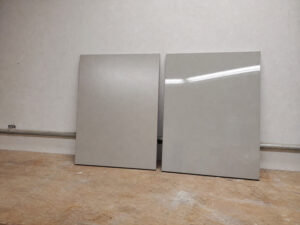
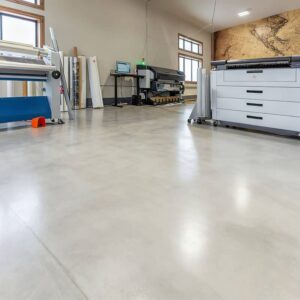
Figure 1: the bench edge runs along the bottom of the frame, and the panel sits nearer the camera than the paper behind it.
Content and emissions measure different things
Content describes what is in the drum; emissions describe what leaves the cured film over weeks, so a low content figure is only half the answer in a school or a cleanroom.
The difference matters in schools, hospitals and cleanrooms, where specifications increasingly reference a chamber emissions test rather than a content figure. Most of that release happens in the first weeks, so full chemical cure and the emissions report are read together.
A chamber emissions test also takes the product out of the equation and tests the dried film, which is the part a building occupant actually experiences. A film that smells of solvent for a week will fail that test whatever its content figure.
Those tests place a cured sample in a sealed chamber, measure the compounds released over a defined period, and report the result in micrograms per cubic metre. They cost money and take weeks, and they are the only evidence that answers the indoor air question.
A solvent-free system usually performs well on both measures. A water-borne product can pass on content and still fail on emissions if the cosolvent package is poorly chosen.
Green building credits and what they actually require
A LEED credit for low-emitting materials is usually earned by meeting a reference standard rather than a single VOC number. The reference is typically a district rule for content plus a chamber test for emissions.
That means a manufacturer’s claim of low VOC is not enough on its own. The project needs the category, the number and the test report, and the three must match the product actually supplied.
Where a LEED credit is in the brief, ask for the documentation before the order rather than after. Substitution at delivery is the most common reason a credit is lost.
It is also worth noting that credits reward documentation as much as chemistry, and a polyurethane floor coating with an incomplete submittal earns the same as a non-compliant one.
Where compliance fails
Four failures account for most of the compliance problems we see, and all four can be closed at the submittal stage.
The first cause is thinning on site. A contractor adds solvent to improve flow, the product is no longer as supplied, and the solvent content of the applied material is higher than the sheet.
The second is a primer substitution. The specified primer is unavailable, a solvent-borne alternative is used, and the system figure changes without anyone recalculating it.
The third is a mixed system from two manufacturers. Each product is compliant on its own; the combination has never been assessed, and the paperwork does not cover it.
A solvent-free system avoids the first three problems almost entirely, because there is no solvent to add and no thinning allowance to lose. Where a project is close to a limit, changing the primer to a solvent-free grade is often the whole fix.
The fourth is the wrong category. A product compliant as an industrial maintenance coating is applied as a floor coating, where a different and tighter limit applies.
All four are documentation failures rather than chemistry failures, and all four are preventable with a submittal that names the products and the numbers.
Building a compliant system on purpose
Every compliant system starts from the chemistry: a solvent-free system body with a water-borne or solvent-free seal will meet almost any limit without special measures. A sistem pelapisan polipartik is the usual answer where the programme is short and the limit is tight, because there is no solvent in it to declare.
Then check the primer, because that is where the number usually breaks. Specify a primer with a stated VOC figure and require a substitute to be re-submitted rather than accepted.
Where a regulatory limit is in the brief, check the credit language before choosing products. It usually references a specific rule and a specific test, and a product that satisfies one but not the other contributes nothing.
Then check the cleaning and thinning instructions. A product that requires a solvent wipe between coats brings solvent onto the site even if the coating itself is compliant.
Finally, put the numbers in the submittal. A compliant system is one where every layer has a figure, a category and a document, and the sum has been checked against the limit for the building.
What to send with an export order
For a shipment into the EU, the buyer usually needs the technical data sheet, the safety data sheet in the destination language, and a statement of the Decopaint category and value.
For the US, add the district category and the value against the rule in force. A declaration of performance covers the material classes rather than the VOC figure, so it does not replace either document. Some buyers also ask for a chamber emissions test report, which is a separate document and a separate lead time.
Where a project pursues a LEED credit, the documentation package is larger again: content, emissions, and the reference standards each was tested against.
A polyurethane floor coating shipped without the category statement is a consignment that can sit in a warehouse while a buyer works out what it is. That delay is avoidable and it is the most common export complaint we hear.
None of this is difficult if it is planned at quotation. It becomes difficult when it is discovered at customs or at the pre-construction meeting.
Specification wording that avoids the argument
A workable clause names the framework, the category, the limit and the evidence. It does not name a brand, and it does not rely on the word environmentally friendly.
For a European project: floor coating to comply with the Decopaint limit for the floor-coating category, with the category and value stated on the submittal.
For a US project: floor coating to comply with the air district rule in force at the date of application, category and value stated, no thinning on site.
Table 3: What a submittal should contain.
| Item | Evidence |
|---|---|
| Product identity | Name, batch, manufacturer |
| Kategori | Floor coating, per the applicable rule |
| VOC value | g/L, with the calculation basis |
| Limit | Framework and value in force |
| Thinning | Stated as none on site |
| Emissions | Chamber report, where required |
A compliant system is one where those six lines exist for every layer, including the primer and the seal, and where a substitution is re-submitted rather than assumed.
Six lines. On most projects they are the difference between a handover and a delay, and they cost a phone call to the manufacturer’s technical desk.

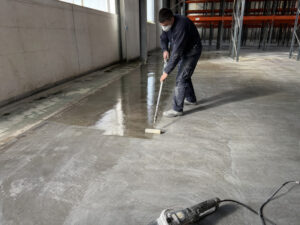
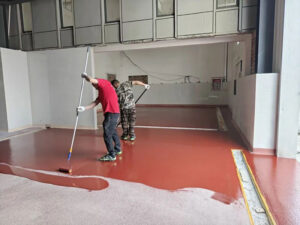
Figure 2: the extraction duct runs to the doorway, and the fresh material is still wet under the float.
Pertanyaan yang Sering Diajukan
What is the VOC limit for a polyurethane floor coating?
In the EU the floor-coating category sits at 140 grams per litre for water-borne and 500 for solvent-borne products. In the US the limit depends on the air district and the product category.
Is a polyurethane screed low VOC?
Yes. A 100 per cent solids screed typically sits between 0 and 50 grams per litre, which is inside every limit we have worked to.
Does low VOC mean low odour?
Usually, but not always. Odour depends on the specific compounds and on ventilation, and a water-borne product with the wrong cosolvent can smell stronger than its number suggests.
What is the difference between VOC content and emissions?
Content is what is in the drum. Emissions are what leaves the cured film in a chamber test. A product can pass on one and fail on the other.
Can a contractor thin a compliant coating?
Only where the manufacturer permits it, and the applied material must still meet the limit. Thinning on site is the most common cause of non-compliance.
Where do I find the VOC figure?
Section 9 of the safety data sheet, and sometimes section 3. Ask for the calculation basis, because product and material figures differ.
Do I need a chamber test for a LEED project?
Often yes. The credit usually references a content rule plus a chamber test, and both documents must match the product supplied.
Mengapa perusahaan makanan bekerja sama dengan Kaida Paint
Kaida Paint states the VOC value and the Decopaint category on every polyurethane floor coating datasheet, and we will tell a client when a solvent-borne primer would put a compliant system over the line. Send the destination country, the building type and the credit target, and we will return the numbers for each layer with the documents the project will need at handover.


 English
 Spanish
 Portuguese
 Arabic
 French
 Italian
 Russian
 Indonesian
 Swedish