A flooring MOQ is not one number. It is a set of numbers that depend on the SKU, the colour, the pack size and the production slot, and buyers who ask for a single figure usually get an answer that changes at the order stage.
Four numbers decide whether a first order is practical: the minimum per SKU, the lead time from purchase order to loaded container, what samples cost, and how much product fits in a 20ft container.
This article sets out each one, the packing that sits behind it, and a one-page checklist for placing a first order without surprises.
The four numbers every buyer asks for
For a first enquiry, the flooring MOQ is often the only question asked, and the answer then arrives without the other three. That is why a single figure quoted without context misleads: the same product has four different minimums depending on how it is packed.
The four are related, and that is why a flooring MOQ quoted without context misleads. A small MOQ usually means a longer lead time or a higher unit price, because the batch still has to be made.
Ask for the four together and in writing: minimum per SKU, lead time from PO, sample terms, and loading quantity per container type. A supplier who answers all four coherently is organised; one who answers only the first is improvising.
The minimum order quantity is usually set by the batch size of the mixer, not by the customer’s project. That is why it can sometimes be met by combining SKUs of the same base, and often cannot be met by combining different systems.
A first order from a resin flooring lead time perspective is really a trial: enough material to prove the product and the logistics, without committing to a container that will sit in a warehouse.
Table 1: The four numbers, and what each one depends on.
| Number | Depends on |
|---|---|
| MOQ per SKU | Batch size, pack size, colour |
| Lead time | Raw material stock, production week, packing |
| Sample terms | Whether the sample is a stock or a made-to-order item |
| Loading quantity | Pack size, pallet height, weight limit |
MOQ: per SKU, per colour, per pack size
A minimum order quantity is stated per SKU and per colour, because changing colour means cleaning the line and losing the batch. Two colours of the same base do not add up to one minimum.
A minimum order quantity also varies with the market. A distributor buying for stock can meet a batch minimum; a contractor buying for one project often cannot, and that is where a mixed pallet or a smaller trial quantity becomes the practical route.
Pack size changes the number too. A product sold in 20 kg pails will have a pail-based minimum, while the same product in 200 kg drums has a drum-based one, and the two are rarely the same tonnage.
Where the order is for a project rather than a stock position, ask whether the MOQ can be met across a mixed pallet. Many suppliers will do it for a first order and then revert to a per-SKU minimum afterwards.
The flooring MOQ also depends on whether the product is stock or made to order. A stock item can ship from a part pallet; a made-to-order batch starts at the mixer size.
Lead time: from PO to loaded container
The resin flooring lead time that matters is not the production time but the total: raw material, the production week, quality release, packing and loading. Each stage has its own queue.
Where the product is a pallet specification item rather than a bulk liquid, the packing queue sits between the batch and the container. Labels, pails and cartons are often the slowest item, and they are the ones nobody asks about.
A typical first order runs 25 to 35 days from PO to loaded container, with the production slot being the widest variable. A busy month can add a week; a colour that has to be matched can add two.
Ask for the production slot in writing rather than a lead time in days. A supplier who can name the week the batch is scheduled is easier to hold to a date than one who quotes a range.
For a project with a fixed start date, work backwards from the site date through shipping, customs and the resin flooring lead time rather than forward from the order. The gap is usually in the shipping schedule, not the factory.
Sample policy: what is free and what is charged
A sample policy is usually one of three arrangements: free samples from stock, charged samples with the cost credited against the first order, or a paid trial kit.
Ask which one applies before requesting anything. A free sample from stock tells you the colour; a made-to-order sample tells you the product, and that is the one worth paying for.
Sample lead time is typically two to three weeks for a made-to-order item, and the shipping is usually paid by the buyer. That is normal and not a warning sign.
Keep the sample and its batch number. A sample policy that arrives without a batch reference cannot be compared with the production delivery, which defeats the purpose. Free from stock, charged for made-to-order and creditable against the first order are three different arrangements, and the third is worth asking for in writing. Credit that arrives after the invoice is issued is not credit.
Container loading: pallets, drums and IBCs
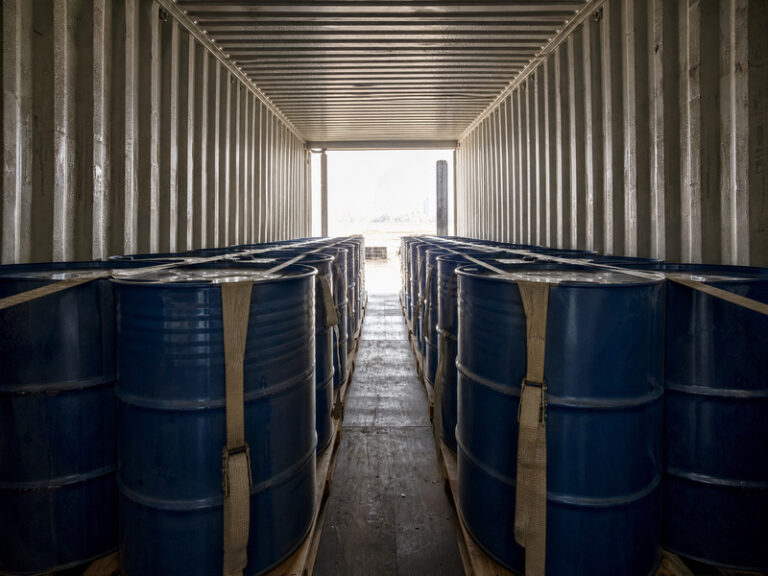
Loading is a weight exercise before it is a volume exercise. A 20ft container takes roughly 18 to 20 tonnes, and resin products reach that limit before they fill the space.
A pallet specification should state the pallet footprint, the height and the gross weight, and whether the pallets are heat-treated. Getting this wrong is how a container arrives half empty or over weight.
A pallet specification is also the document a freight forwarder needs before quoting, so an order that starts without one tends to stall at the booking stage rather than at the factory.
The question of how many m2 in 20ft container is best answered with a loading plan rather than a coverage figure, because the plan shows what the weight limit does to the pallet count.
A drum and IBC packing decision changes the loading plan completely: 200 kg drums stack two high on a pallet, an IBC does not stack at all, and pails are the only format that fills the gaps around drums.

Figure 1: A loading plan is ten minutes of work and the difference between a full container and a claim.
Two loading details decide whether the drums survive the sea leg. The drum and IBC packing has to allow for a desiccant in a humid season, and the pallets need edge protection where the straps cross the top layer.
The loading conversation is easier when the buyer knows the destination restrictions. Some markets limit the gross weight per pallet, and some ports charge by volume rather than weight, which changes the packing choice.
Volume is the other half of the exercise. Drums are round and containers are square, so the gaps between pallets matter. A plan that ignores them can leave two metres of floor space empty in a container already at its weight limit. A plan that fills them with pails still has to prove the weight works.
Ask for a loading plan with the quotation. It takes a supplier ten minutes and saves a week of argument at the port.

Figure 2: Weight, not volume, usually limits a resin container. The loading plan should show both.
How many square metres fit in a 20ft container
The how many m2 in 20ft container depends entirely on the system and the thickness. A 1 mm epoxy broadcast system uses roughly 1.7 to 2.2 kg per m² of mixed material; a 6 mm cementitious urethane uses about 10 to 12 kg per m².
At 18 tonnes, a 20ft container therefore carries something like 8,000 to 10,000 m² of a thin epoxy system, and about 1,500 m² of a 6 mm urethane. Those two numbers explain most of the confusion in first enquiries. The 18 t column is a weight case; a thin coating fills the container on volume long before it reaches that figure.
Pack size moves the how many m2 in 20ft container answer too: pails and small packs cut the usable tonnage by 10 to 15 percent.
Table 2: Indicative coverage in a 20ft container, by system.
| Sistem | kg per m² | m² at 18 t |
|---|---|---|
| Epoxy, 1 mm broadcast | 1.7-2.2 | 8,000-10,000 |
| Polyurethane, 3 mm | 3.5-4.5 | 4,000-5,000 |
| Cementitious urethane, 6 mm | 10-12 | 1,500-1,800 |
Payment terms and inspection
A first order also needs a named contact for the drum and IBC packing documents: packing list, certificate of analysis, safety data sheet and invoice, each matching the drum labels. A mismatch between the invoice and the pallet is a customs delay, not a paperwork detail.
Payment terms are part of the flooring MOQ negotiation, because a small first order rarely justifies the same terms as a container programme. A deposit with the balance against documents is normal.
The export packing on a first order should include photographs of the finished pallets, because the way a pallet is wrapped and labelled tells you how the next one will arrive.
Ask who inspects. A third-party inspection before loading costs a few hundred dollars and answers the question that matters: is the product in the drums what the paperwork says.
Inspection happens twice on a first order: at loading for count and condition, and on arrival for damage that loading could not show. It also creates the record you would need if something arrives wrong.
Where the buyer has an agent in the country, use them for the export packing check as well. A pallet that is strapped and labelled correctly is the difference between a clean delivery and a claim.
A one-page order checklist
Documentation is the last item and the one that delays clearance. The packing list has to match the invoice line by line, the certificate of analysis has to carry the batch numbers on the drums, and the safety data sheet has to be in the destination language. A single mismatch turns a clean shipment into a week at the port.
A first order is also the moment to agree what happens on a short delivery. One drum short on a two-pallet order is a problem; on a container it is a claim. Stating the remedy now is cheaper than negotiating it later.
Two habits shorten a first order. Confirm the colour against a physical sample rather than a screen, and accept a slightly later production week instead of a rushed one. Rushing the batch is how a colour match fails after everything else has gone right.
For a repeat order, the flooring MOQ conversation should not happen again. Hold the approved quantities, pack sizes and loading plan in one file, and the second order becomes a quantity and a date. Once the batch size is known, the minimum, the lead time and the loading plan can be held on file and only the quantity changes.
The checklist has eight lines: SKU, colour, quantity, pack size, flooring MOQ per SKU, price basis per square metre and per kilogram, resin flooring lead time and loading plan. Every line should be answered in the order confirmation, not in an email thread.
Add the sample policy reference you approved, so the production batch can be compared with it. The reference is usually a physical panel or a cured coupon, and a photograph is not a substitute for either. That single line prevents most disputes about colour and texture.
Add the export packing requirement: pallet type, labelling, and whether the drums carry your brand or the factory’s. For a private label first order, this is where the artwork approval sits.
Finally, agree the production slot in the confirmation rather than in a separate message. A production week is the only date that can be checked against a shipping schedule.
Table 3: The eight lines of an order confirmation.
| Line | What to confirm |
|---|---|
| SKU and colour | Code, name, approved sample reference |
| Kuantitas | kg or m² coverage, per SKU |
| Pack size | Pail, drum or IBC |
| Price basis | Incoterm and validity |
| Lead time | Production week and loading date |
| Loading plan | Pallets, weight, height |
| Labels | Brand, language, batch field |
| Documents | COA, SDS, packing list, invoice |
Frequently asked questions
What is a typical flooring MOQ?
Usually one batch of the base system, often 500 kg to 1 tonne per SKU, and per colour rather than across colours. Stock items can sometimes ship smaller.
How long is lead time from order to container?
Twenty-five to thirty-five days is typical for a first order, with the production slot as the widest variable. A colour match or a new label can add a week or two.
Are samples free?
Sometimes from stock, often charged for a made-to-order item and credited against the first order. Ask which arrangement applies before requesting one.
How many square metres are in a 20ft container?
It depends on the system. At 18 tonnes you can expect roughly 8,000 to 10,000 m² of a 1 mm epoxy. A 3 mm polyurethane gives 4,000 to 5,000 m², and a 6 mm cementitious urethane 1,500 to 1,800 m².
What is the difference between a drum and an IBC?
A 200 kg drum can be palletised and stacked two high; a 1,000 kg IBC cannot be stacked. The choice affects the loading plan and the handling equipment on site.
Can I mix SKUs to reach the minimum?
Sometimes, especially on a first order and where the SKUs share a base. Ask explicitly, because the standard policy is usually per SKU and per colour.
What payment terms are normal for a first order?
A deposit with the balance against shipping documents is common. Third-party inspection before loading is worth the cost on a first shipment.
Why food plants work with Kaida Paint
Kaida Paint manufactures epoxy, polyurethane, cementitious urethane and MMA systems for food and beverage plants, and supplies them as finished systems or as OEM and private-label production for distributors. We quote the four numbers together: flooring MOQ per SKU and colour, lead time from PO to loaded container, sample terms, and a loading plan with pallet dimensions and gross weight.
Send the system, the colour and the area, and the reply gives the tonnage, the pallet count and the production week in one table.







 English
 Spanish
 Portuguese
 Arabic
 French
 Italian
 Russian
 Indonesian
 Swedish