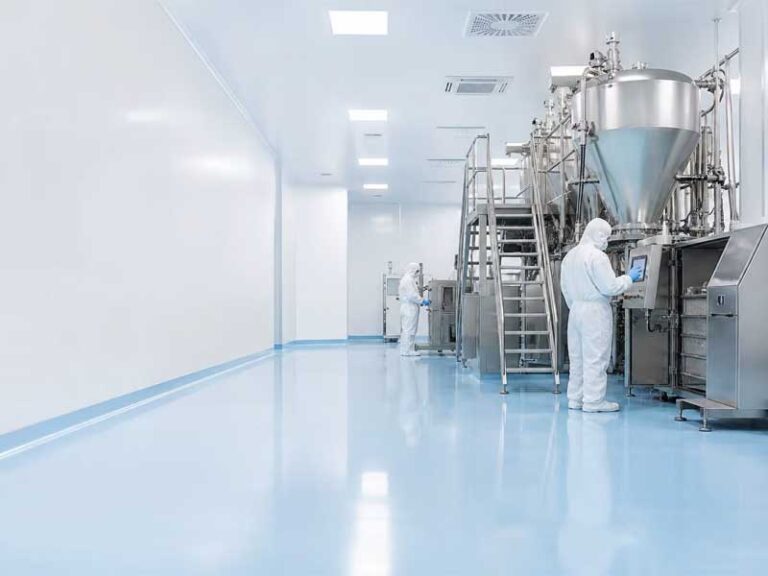
What Is the Best Pharmaceutical Cleanroom Flooring?
The best pharmaceutical cleanroom flooring depends on the GMP grade and contamination control requirements:
- GMP Grade A/B sterile areas: Homogeneous vinyl or pharmaceutical nitrile flooring with VHP compatibility is commonly preferred because of extremely low particle generation and seamless installation.
- GMP Grade C/D production areas: Seamless epoxy and polyurethane cement flooring are widely used because they provide chemical resistance, durability, and easy cleaning.
- Heavy-duty pharmaceutical areas: Polyurethane cement flooring is usually the best choice due to exceptional thermal shock and chemical resistance.
What Is Pharmaceutical Cleanroom Flooring?
Pharmaceutical cleanroom flooring is a specialized contamination-control flooring system designed to maintain ISO 14644 cleanroom classifications by minimizing particle generation, preventing microbial growth, and supporting GMP cleaning and sterilization procedures. These seamless flooring systems are engineered to withstand rigorous chemical sanitization protocols while maintaining surface integrity under heavy equipment traffic and continuous cleaning cycles.
KAIDA PAINT develops seamless epoxy and polyurethane flooring systems for pharmaceutical plants, laboratories, and controlled environments where contamination control, chemical resistance, and long-term durability are critical. Our flooring solutions are engineered to meet the rigorous demands of ISO 14644 compliance, FDA regulations, and EU GMP Annex 1 requirements.
1. What Is Pharmaceutical Cleanroom Flooring?
Pharmaceutical cleanroom flooring refers to specialized seamless flooring systems designed to maintain ISO 14644 cleanroom classifications in pharmaceutical manufacturing environments. These flooring systems minimize particle generation, resist microbial growth, withstand aggressive chemical sanitization protocols, and support GMP contamination control strategies.
Unlike conventional industrial flooring, pharmaceutical cleanroom flooring must maintain surface integrity under constant cleaning, heavy equipment traffic, and sterilization cycles while preventing contamination that could compromise drug product quality.
2. ISO 14644 Requirements for Pharmaceutical Flooring
Understanding Cleanroom Classification and Flooring Performance
ISO 14644-1:2015 establishes cleanroom classifications based on airborne particulate concentration limits per cubic meter of air. Pharmaceutical flooring must not compromise these classifications by releasing particles during routine operations. For a GMP Grade A classified area, particle levels must not exceed ISO Class 5 during operation, requiring flooring that meets at least ISO 5 standards under ISO 14644-1.
How Flooring Affects Airborne Particle Control
The connection between flooring and airborne particle control is direct and measurable. Every time personnel walk across the floor, equipment is moved, or cleaning occurs, the flooring surface either generates particles or remains inert. Standard commercial flooring can release thousands of particles per cubic meter through foot traffic alone.
According to industry data, approximately 70% of residual airborne particles in cleanrooms eventually settle on the floor after air treatment, making the floor a critical accumulation point that must be easily cleanable.
Material Properties Required for ISO 14644 Compliance
| Properti | Standar | Persyaratan |
|---|---|---|
| Particle Emission Control | ISO 14644-14 | Minimum particle release below required ISO class |
| Biocontamination Resistance | ISO 846 | Zero bacterial/fungal growth over 28 days |
| Resistensi Kimia | In-house testing | Withstands IPA 70%, NaOCl, QACs, VHP |
| Decontamination Verification | ISO 4628-1 & -2 | No residual particles after cleaning |
| Watertightness | Visual/Test | Seamless, hot-welded or monolithic |
3. GMP Grade Flooring Requirements (A, B, C, D)
Mapping GMP Grades to ISO Classifications
EU GMP Grade A, B, C, and D areas correspond to specific ISO 14644-1 cleanliness classifications, which directly govern flooring specifications:
| GMP Grade | ISO Class (at rest) | ISO Class (in operation) | Flooring Priority |
|---|---|---|---|
| Grade A | ISO 4.8 | ISO 5 | Critical — zero tolerance for particle shedding |
| Grade B | ISO 5 | ISO 7 | High — seamless, cleanable, disinfectant-resistant |
| Grade C | ISO 7 | ISO 8 | Moderate — impervious, sealed seams |
| Grade D | ISO 8 | Not classified | Low-moderate — cleanable, slip-resistant |
Grade A (ISO 5) Environments
Grade A environments—including open-RABS, closed-RABS, and isolator-based operations—require:
- Pharmaceutical-grade nitrile with verified VHP/HPV compatibility
- Seamless bonded sheet or roll with no interlocking joints
- Heat-welded seams mandatory
- Light grey or white colouration supports visual contamination detection
Grade B (ISO 5/7) Environments
Grade B sterile preparation background environments require:
- Pharmaceutical-grade nitrile or light-coloured EPDM
- Seamless bonded roll or sheet with hot-welded seams
- Disinfectant compatibility verified with supplier data sheets
- PTV ≥40 wet slip resistance rating
Grade C and D Environments
Less critical sterile zones and general manufacturing areas require:
- Bonded roll or sheet with sealed seams
- Anti-fatigue closed-cell pharmaceutical nitrile matting
- Dissipative anti-static nitrile where APIs are ESD-sensitive
4. FDA Requirements for Pharmaceutical Cleanroom Flooring
FDA 21 CFR Part 211 requires pharmaceutical manufacturing facilities to maintain equipment and facilities that prevent contamination. Flooring surfaces must be smooth, cleanable, and resistant to degradation from cleaning procedures.
Key FDA expectations for pharmaceutical flooring:
- Surfaces must be easily cleanable and non-porous
- Flooring must not contribute to product contamination
- Cleaning and sanitization procedures must be validated
- Change control documentation required for any flooring modifications
FDA inspections frequently examine flooring conditions in manufacturing areas, and non-compliant surfaces can trigger Form 483 observations or warning letters.
5. Best Flooring Materials Comparison
Pharmaceutical Cleanroom Flooring Material Comparison
| Material Type | Key Properties | Aplikasi Khas | ESD Options |
|---|---|---|---|
| Seamless Epoxy | Smooth, non-porous, chemical-resistant, economical | Sterile processing rooms, compounding pharmacies, drug manufacturing suites | Available |
| Homogeneous Vinyl | Heat-welded seamless installation, long-term durability | R&D labs, vaccine production, sterile suites | Available |
| Polyurethane Cement | Exceptional chemical resistance, thermal shock resistance | Pharmaceutical packaging, chemical handling areas, washdown zones | Available |
| Pharmaceutical Nitrile | Low particle generation, anti-fatigue properties | Grade C/D areas, dispensary, filling support stations | Available |
Seamless Epoxy Flooring Systems
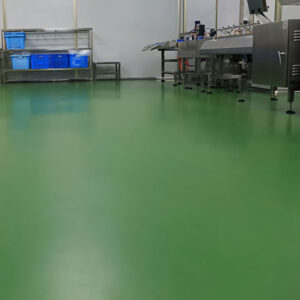
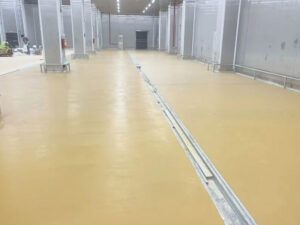
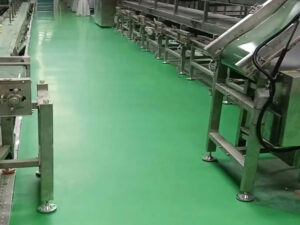
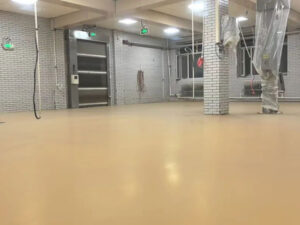
Seamless epoxy flooring provides a smooth, non-porous finish that prevents microbial contamination and resists chemical spills, disinfectants, and abrasion. Epoxy systems are commonly specified for sterile processing rooms, compounding pharmacies, and drug manufacturing suites.
KAIDA PAINT Pharmaceutical Epoxy Flooring System offers seamless surface finish, excellent chemical resistance, low VOC emissions, and GMP-compliant installation. Our epoxy systems can incorporate ESD properties for static-sensitive pharmaceutical operations.
Polyurethane Cement Flooring
Polyurethane cement flooring offers exceptional resistance to aggressive chemicals and thermal shock. These systems provide dense, impervious floor finishes suitable for pharmaceutical applications including cleanrooms, laboratories, packing halls, and warehouses.
Homogeneous Vinyl Flooring
Homogeneous vinyl sheet flooring with heat-welded seams provides fully seamless installation for infection control and long-term durability. Testing conducted by the Fraunhofer Institute demonstrates that certain vinyl flooring products maintain ISO 4 compliance even after simulating 10 years of regular wear and tear.
6. Epoxy vs Polyurethane vs Vinyl: Which Pharmaceutical Flooring Is Better?
Lantai Epoksi
Terbaik untuk:
- Laboratories and compounding rooms
- Medium chemical exposure areas
- Budget-conscious pharmaceutical projects
- Applications requiring seamless, smooth surfaces
Advantages: Cost-effective, excellent chemical resistance, seamless finish, easy to clean, suitable for ESD requirements
Limitations: Lower thermal shock resistance compared to polyurethane, may degrade under repeated steam cleaning
Polyurethane Cement Flooring
Terbaik untuk:
- Washdown areas and packaging zones
- High-temperature cleaning environments
- Heavy traffic pharmaceutical facilities
- Areas with extreme chemical exposure
Advantages: Exceptional thermal shock resistance, withstands aggressive chemicals and steam cleaning, extremely durable, long service life
Limitations: Higher initial cost, requires specialized installation expertise
Homogeneous Vinyl Flooring
Terbaik untuk:
- Grade A and B sterile rooms
- Vaccine production facilities
- Environments requiring quick repair capability
Advantages: Very low particle emission, demonstrated long-term ISO compliance, easy repair through hot welding, excellent for sterile environments
Limitations: Requires heat-welded seams for seamless installation, limited chemical resistance compared to epoxy and polyurethane
7. Best Pharmaceutical Flooring by Application
| Aplikasi | Recommended Flooring | Key Consideration |
|---|---|---|
| Sterile filling rooms | Homogeneous vinyl / Pharmaceutical nitrile | Extremely low particle generation |
| Tablet manufacturing | Lantai epoksi | Chemical resistance, durability |
| Chemical processing rooms | Polyurethane cement | Thermal shock and chemical resistance |
| Vaccine production | Vinyl / Epoxy | VHP compatibility, seamless installation |
| Packaging areas | Polyurethane cement | Heavy traffic, washdown resistance |
| Laboratories | Lantai epoksi | Chemical resistance, easy cleaning |
| Warehousing | Polyurethane cement / Epoxy | Impact resistance, durability |
| Dispensary areas | Pharmaceutical nitrile | Anti-fatigue, low particle generation |
8. How Much Does Pharmaceutical Cleanroom Flooring Cost?
Pharmaceutical Flooring Cost per Square Foot
| Sistem Lantai | Typical Cost (USD/sq.ft) | Termasuk |
|---|---|---|
| Epoxy Cleanroom Flooring | $5–$12 | Material, surface preparation, installation, basic coving |
| Polyurethane Cement Flooring | $10–$25 | Material, specialized installation, enhanced chemical resistance |
| Homogeneous Vinyl Flooring | $8–$20 | Material, heat-welded seams, professional installation |
| Pharmaceutical Nitrile Flooring | $12–$28 | Anti-fatigue properties, ESD options, seamless bonding |
Pharmaceutical Cleanroom Flooring Installation Cost Factors
In regulated pharmaceutical facilities, flooring cost is not only the material price. Validation documentation, production downtime, and qualification procedures can significantly influence total project cost.
Factors affecting total project cost:
- Material Cost: Flooring type and thickness directly impact material pricing
- Labor Cost: Specialized installation expertise required for pharmaceutical environments
- Persiapan Permukaan: Existing floor condition significantly affects preparation time and cost
- Validation Cost: IQ/OQ/PQ documentation, testing, and qualification add to project cost
- Downtime Cost: Production shutdown during installation can represent significant opportunity cost
- Cove Installation: Wall-to-floor coving adds material and labour costs
- Facility Size: Larger areas benefit from economies of scale
- ESD Requirements: Static-dissipative systems carry premium pricing
- Installation Timing: Weekend or shutdown installation may incur premium rates
9. Installation Process for ISO-Compliant Pharmaceutical Flooring
Step 1: Facility Assessment
Comprehensive on-site walkthrough to understand cleanroom classification, sanitization protocols, chemical exposures, and production schedule before recommending any flooring system.
Step 2: System Engineering
Appropriate flooring system specified for each zone, balancing GMP compliance, chemical resistance, and demands of formulation rooms, fill lines, and compounding areas.
Step 3: Controlled Installation
Installation occurs under strict containment using HEPA filtration, pressure controls, and seamless application techniques that protect adjacent classified spaces throughout the project.
Step 4: Validation Documentation
Every project is documented against GMP, FDA, ISO 14644, and EU Annex 1 requirements:
- Material certifications and safety data sheets
- Installation qualification (IQ) documentation
- Operational qualification (OQ) including cleaning validation
- Environmental monitoring data
- Change control procedures for repairs or modifications
10. Validation and Qualification (IQ/OQ/PQ)
Installation Qualification (IQ)
Documentation verifying that flooring materials meet specified requirements and are installed according to manufacturer specifications and GMP standards.
Operational Qualification (OQ)
Verification that the flooring performs as expected under operational conditions, including cleaning validation to demonstrate compatibility with disinfectant protocols.
Performance Qualification (PQ)
Ongoing monitoring to ensure the flooring maintains ISO compliance during routine production operations, including environmental monitoring data collection and particle testing.
Change Control
Any modification to cleanroom flooring—including patch repairs—must be managed through the site’s GMP change control procedure and may trigger re-qualification of the environmental monitoring programme.
11. Regulatory Standards and EU GMP Annex 1
Key Standards and Regulations
| Regulation/Standard | Relevance to Flooring |
|---|---|
| EU GMP Annex 1 (2022) | Cleanroom surfaces must not shed particles, support microbial growth, or harbour contamination |
| ISO 14644-1:2015 | Cleanroom classification by airborne particulate cleanliness |
| ISO 14644-2:2015 | Cleanroom monitoring — floor surface condition feeds into environmental monitoring programme |
| ISO 14644-5:2004 | Flooring material compatibility with cleaning agents and disinfectants |
| FDA 21 CFR Part 211 | Current Good Manufacturing Practice for finished pharmaceuticals |
| ICH Q9 | Risk-based approach to surface material selection |
EU GMP Annex 1 Requirements
The 2022 revision of EU GMP Annex 1 introduced the Contamination Control Strategy (CCS) requirement—a holistic documented approach to identifying all contamination risks across a sterile manufacturing facility. Flooring is explicitly within scope of the CCS for Grade A and B environments.
12. 10 Common Pharmaceutical Flooring Failures
- Particle Shedding: Flooring degradation releases particles exceeding ISO class limits
- Retak: Thermal shock or impact causes surface cracks compromising cleanability
- Delamination: Adhesion failure between flooring and substrate
- Chemical Blistering: Incompatible chemicals cause surface bubbles and degradation
- Seam Contamination: Poorly welded vinyl seams harbour microbial growth
- Poor Coving Installation: Inadequate floor-to-wall transitions create contamination traps
- Static Control Failure: ESD flooring loses dissipative properties over time
- Slip Resistance Failure: Surface texture wears down creating safety hazards
- Cleaning Chemical Incompatibility: Flooring degrades under routine sanitization
- Lack of Validation Documentation: Insufficient qualification records for regulatory inspections
13. How to Select Pharmaceutical Cleanroom Flooring: A Decision Guide
Step 1: Identify GMP Grade
Determine whether your area is Grade A, B, C, or D. This establishes the minimum ISO 14644 classification your flooring must maintain.
Step 2: Determine ISO Classification
Understand whether the area must meet ISO 5, ISO 7, or ISO 8 requirements at rest and in operation.
Step 3: Evaluate Chemical Exposure
List all cleaning agents, disinfectants, and chemicals used in the area. Ensure the flooring material is compatible.
Step 4: Check Sterilization Method
Identify whether VHP, HPV, steam cleaning, or other sterilization methods are used. Not all flooring materials are compatible with all methods.
Step 5: Consider Application Requirements
Evaluate traffic levels, equipment loads, and specific operational demands.
Step 6: Select Flooring Material
Based on the above criteria, choose from epoxy, polyurethane cement, homogeneous vinyl, or nitrile flooring.
Step 7: Validate Performance
Require independent laboratory testing data demonstrating particle emission, microbial resistance, and chemical compatibility for your specific requirements.
Step 8: Plan Installation and Validation
Coordinate installation timing with production schedules and prepare validation documentation requirements.
14. Pharmaceutical Cleanroom Flooring FAQ
What flooring is used in pharmaceutical cleanrooms?
Pharmaceutical cleanrooms commonly use seamless epoxy, polyurethane cement, homogeneous vinyl, and pharmaceutical nitrile flooring because these materials minimize particle generation and support GMP contamination control requirements. The specific choice depends on the cleanroom grade, chemical exposure, and sterilization methods used.
Does epoxy flooring meet ISO 14644?
Yes, properly designed seamless epoxy flooring can meet ISO 14644 cleanroom requirements when tested for particle emission, chemical resistance, and contamination control performance. Epoxy flooring must be installed seamlessly and validated according to ISO 14644 standards.
What flooring is required for GMP Grade A cleanrooms?
GMP Grade A areas require flooring with extremely low particle generation, seamless construction, microbial resistance, and compatibility with sterilization methods such as VHP. Common choices include homogeneous vinyl and pharmaceutical-grade nitrile with verified VHP/HPV compatibility.
Is ESD flooring required in pharmaceutical cleanrooms?
ESD flooring is required in pharmaceutical cleanrooms where electrostatic discharge could damage sensitive active pharmaceutical ingredients (APIs), disrupt machinery, or create fire/explosion risks in ATEX areas. Conductive and dissipative flooring systems are available to meet BS EN 61340-5-1 and ANSI/ESD S20.20 standards.
How often should pharmaceutical cleanroom flooring be replaced?
Pharmaceutical cleanroom flooring should be replaced when environmental monitoring data indicates particle counts increasing toward the ISO class limit, when surface degradation compromises cleanability, or after significant impact or chemical damage. With proper maintenance, high-quality systems can last 10–15 years or more.
What is the cost of pharmaceutical cleanroom flooring?
Pharmaceutical cleanroom flooring costs typically range from $5 to $28 per square foot depending on material selection, cleanroom grade, installation complexity, and validation requirements. Epoxy systems are the most economical at $5–$12/sq.ft, while specialized polyurethane cement and nitrile systems range from $10–$28/sq.ft.
Can epoxy flooring be used in GMP cleanrooms?
Yes, epoxy flooring is widely used in GMP cleanrooms for Grades C and D environments. For Grade A and B areas, epoxy may be suitable if it meets particle emission, microbial resistance, and VHP compatibility requirements.
What is the best flooring for sterile pharmaceutical manufacturing?
The best flooring for sterile pharmaceutical manufacturing is homogeneous vinyl or pharmaceutical nitrile with seamless heat-welded installation, verified low particle generation, and VHP compatibility.
Is polyurethane cement flooring suitable for pharmaceutical plants?
Yes, polyurethane cement flooring is highly suitable for pharmaceutical plants, particularly in areas requiring thermal shock resistance, heavy traffic durability, and aggressive chemical exposure protection.
What ISO standard applies to pharmaceutical cleanroom flooring?
ISO 14644-1:2015 establishes cleanroom classification requirements. ISO 14644-5:2004 addresses material selection and compatibility with cleaning agents. ISO 14644-14 provides particle emission testing methods.
Does cleanroom flooring require validation?
Yes, pharmaceutical cleanroom flooring requires validation through IQ/OQ/PQ documentation, particle emission testing, cleaning validation, and ongoing environmental monitoring to demonstrate continued ISO compliance.
Meeting ISO 14644 standards through proper pharmaceutical cleanroom flooring requires careful material selection, controlled installation, and ongoing validation. The choice of flooring system directly impacts your facility’s ability to maintain cleanroom classification, protect product quality, and pass regulatory inspections.
Seamless epoxy, homogeneous vinyl, and specialized polyurethane systems each offer distinct advantages depending on the cleanroom grade and operational requirements. For critical Grade A and B environments, materials that maintain low particle generation after years of use provide the most reliable path to sustained compliance.
With decades of industrial coating expertise, KAIDA PAINT provides pharmaceutical flooring solutions from material selection through installation support for global GMP manufacturing facilities. Our seamless epoxy and polyurethane systems are engineered to meet the rigorous demands of ISO 14644 compliance, GMP standards, and the daily challenges of pharmaceutical manufacturing environments.
Learn more about urethane cement flooring systems here](Urethane Cement Flooring: Complete Guide To Benefits, Uses, Cost, And Installation.
KAIDA PAINT Technical Team specializes in industrial flooring systems, including pharmaceutical cleanroom flooring, epoxy coatings, polyurethane flooring, and contamination-controlled environments. Our experience spans pharmaceutical manufacturing facilities, food processing plants, chemical industries, and industrial cleanrooms across global regulated markets.
Contact KAIDA PAINT for expert guidance on selecting the right ISO 14644-compliant flooring system for your pharmaceutical facility. Our team provides comprehensive support from material specification through installation validation.



 English
 Spanish
 Portuguese
 Arabic
 French
 Italian
 Russian
 Indonesian
 Swedish