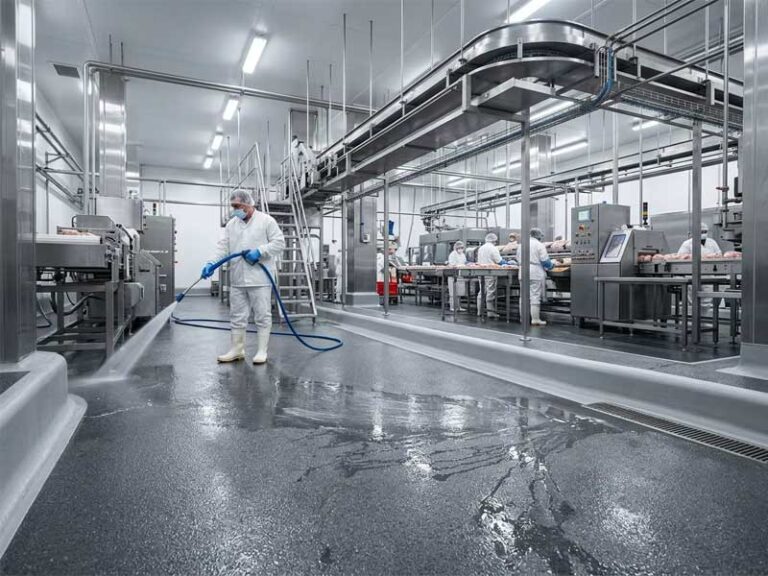
What Is the Best Flooring for Food Processing Plants?
The best flooring for food processing plants depends on the production environment—urethane cement is the preferred choice for wet processing areas with hot washdowns, while epoxy suits dry storage zones.
| Facility Condition | Recommended Flooring System |
|---|---|
| Hot washdown areas (meat, dairy, beverage) | Urethane cement flooring |
| Meat and poultry processing | Urethane cement flooring (6–9 mm) |
| Dairy production facilities | Urethane cement or polyurethane mortar |
| Beverage and juice plants | Urethane cement (acid-resistant formulation) |
| Dry storage and warehousing | Epoxy flooring (100% solids) |
| Cold storage and freezer zones | Cold-grade urethane cement |
| Seafood processing | Urethane cement (saltwater-resistant) |
For most wet and hygienic food production environments, urethane cement flooring is considered the preferred solution because it provides seamless sanitation, thermal shock resistance up to 250°F, chemical durability against acids and sanitizers, and a service life of 10–15 years.
What Flooring Is FDA and USDA Compliant?
FDA and USDA compliant flooring for food processing plants must be seamless, non-porous, resistant to moisture absorption, and easy to sanitize under high-temperature washdown conditions.
In practice, this means the flooring system must:
- Have zero joints or seams where bacteria can harbor
- Withstand repeated thermal shock (from -20°F freezers to 180°F washdowns)
- Resist chemical attack from lactic acid, citric acid, caustic cleaners, and sanitizers
- Maintain slip resistance in wet or fatty environments
- Allow complete drainage without pooling
1. What Does FDA Compliant Flooring Mean? FDA Requirements for Food Processing Floors
The U.S. Food and Drug Administration (FDA) and the U.S. Department of Agriculture (USDA) do not issue certifications, approvals, or seals for flooring products. There is no official “FDA Approved Flooring” list.
Instead, compliance is defined by performance standards set forth in regulatory codes. Under FDA Food Code Section 6-101.11, flooring in food handling areas must be:
- Smooth and easily cleanable
- Durable under expected wear
- Nonabsorbent in areas subject to moisture (including walk-in coolers, preparation zones, and warewashing areas)
For meat and poultry facilities, the USDA Food Safety and Inspection Service (FSIS) adds further expectations around sanitation standard operating procedures (SSOPs) and slip resistance to prevent both contamination and worker injury.
Key Distinction: When a supplier claims “FDA approved flooring,” they are using marketing shorthand. The accurate and defensible term is “FDA-compliant” —meaning the product has been independently verified to meet the regulatory performance criteria.
What to ask your supplier:
- Do you provide third-party test reports showing chemical resistance and cleanability?
- Do you provide HACCP-related documentation or third-party food safety evaluations where applicable?
- Can you supply material data sheets (MDS) that cite compliance with FDA Food Code?
2. FDA Approved vs FDA Compliant Flooring: What’s the Difference?
This distinction generates significant search volume and confusion among facility engineers.
| Term | Meaning | Regulatory Basis |
|---|---|---|
| FDA Approved | Misnomer. Implies direct FDA endorsement, which does not exist for flooring. | None. Avoid suppliers using this term. |
| FDA Compliant | Accurate. The flooring system meets the performance criteria of FDA Food Code Section 6-101.11. | Third-party testing or HACCP-related documentation. |
| USDA Accepted | Rarely used for flooring. Typically applies to equipment. | USDA does not certify floors. |
| USDA Compliant | Meets FSIS expectations for sanitation and durability in meat/poultry plants. | Verified via installation records and material specs. |
The takeaway: Insist on documented compliance, not approval claims. HACCP-related documentation can help demonstrate that a flooring system has been evaluated for food safety requirements.
3. Food Processing Flooring Requirements: What Does a Facility Need?
Before selecting a material, you must assess your facility’s operational load. The USDA and FDA do not prescribe a specific material (urethane, epoxy, or tile)—they prescribe outcomes.
Required Performance Outcomes
| Persyaratan | What It Means in Practice |
|---|---|
| Smooth & Non-Porous | No cracks, no joints, no gaps where organic matter or moisture can hide. |
| Tahan Guncangan Termal | Floors in processing zones cycle between freezing storage and 180°F steam cleaning. Materials must not delaminate or crack. |
| Resistensi Kimia | Resistance to lactic, acetic, citric acids (from dairy, juice, meat), plus alkaline cleaners (sodium hypochlorite) and quaternary sanitizers. |
| Resistensi Selip | Must meet or exceed ANSI/NFSI B101.1 wet static coefficient of friction (SCOF) standards, typically ≥0.60 in wet conditions. |
| Drainage | Floor slopes must direct liquids to drains without pooling. Cove bases (integral 4-inch curved wall-to-floor transitions) prevent moisture ingress at walls. |
Additional USDA FSIS Considerations for Meat/Poultry:
- Floors must facilitate complete cleaning during daily sanitation shutdowns
- Resistance to animal fats, blood, and proteins which can degrade cheap coatings
- No peeling or blistering that could introduce foreign material into product streams
4. What Is Food Grade Flooring?
Food grade flooring is not a specific coating material. It refers to flooring systems designed for food manufacturing environments where hygiene, sanitation, chemical resistance, and durability are critical.
A food grade flooring system should provide:
- A seamless surface without bacteria-harboring joints
- Resistance to water absorption and chemicals
- Easy cleaning and sanitation with standard food plant protocols
- Slip resistance in wet conditions
- Long-term durability under production loads and equipment traffic
Common food grade flooring systems include:
- Urethane cement flooring (also called polyurethane mortar or PU cement)
- Epoxy flooring (100% solids formulations)
- MMA (methyl methacrylate) flooring
- Vinyl sheet or tile (limited to dry areas)
Among these, urethane cement and polyurethane mortar systems are most widely specified for wet processing environments due to their thermal shock and chemical resistance.
5. Types of Food Processing Plants That Need Sanitary Flooring
Sanitary flooring requirements apply across the full spectrum of food production. The specific performance demands vary by product type and processing method.
| Jenis Fasilitas | Key Flooring Demands | Recommended System |
|---|---|---|
| Meat and Poultry Processing | Animal fats, blood, proteins, hot washdowns, heavy equipment | Urethane Cement (6–9 mm) |
| Dairy Processing | Lactic acid, hot caustic cleaning, wet environments, thermal shock | Urethane Cement (6–9 mm) |
| Beverage Production | Acids (citric, phosphoric), high humidity, frequent washdowns | Urethane Cement (4–6 mm) |
| Seafood Processing | Saltwater corrosion, proteins, cold-to-hot cycling | Urethane Cement (6–9 mm) |
| Bakery and Confectionery | Fats, sugars, dry ingredients, moderate washdown | Epoxy or Urethane Cement |
| Cold Storage / Freezer Warehouses | Extreme cold, freeze-thaw cycling, forklift traffic | Urethane Cement (cold-grade formulation) |
| Pharmaceutical & Clean Production | Chemical resistance, sterile sanitation protocols | Epoxy or Urethane Cement (ESD options) |
6. Best Food Processing Flooring Systems: Urethane Cement vs Epoxy vs MMA vs Vinyl Comparison
Facility managers typically evaluate four main systems. Each has distinct performance envelopes.
| Performance Factor | Semen Uretan | Epoxy (100% Solids) | MMA (Methyl Methacrylate) | Vinyl Sheet/Tile |
|---|---|---|---|---|
| Tahan Guncangan Termal | Excellent (stable to 250°F) | Limited (may soften above 104–120°F) | Good (stable to 140°F) | Limited (softens <140°F) |
| Chemical Resistance (Acids/Fats) | Luar biasa | Good (varies by formulation) | Bagus. | Poor (swells/degrades) |
| Seamless Application | Yes (trowel/self-leveling) | Ya. | Ya. | No (seams harbor bacteria) |
| Toleransi Kelembaban | High (can be applied to damp substrates) | Low (requires <4% moisture & 28-day cure) | Sedang | Low (requires dry substrate) |
| Return-to-Service | 24-48 jam | 5–7 days | 12–24 hours | 3–5 days |
| Typical System Life (Heavy Use) | 10–15 years | 5-8 tahun | 5-10 tahun | 3–5 years |
| Field Repairability | Excellent (sectional repair) | Bagus. | Adil | Limited (requires full sheet replacement) |
| FDA/USDA Compliance | Yes (meets all criteria) | Yes (if specified correctly) | Ya. | Limited (seams issue) |
7. Why Urethane Cement Is Widely Specified in Food Processing Environments
Based on industry experience and performance characteristics of urethane cement systems in food processing applications, this material delivers the lowest total cost of ownership over a 15-year lifecycle.
Thermal Stability in Practice
Consider a typical poultry processing line: The area operates at 40–50°F during production, followed by a 180°F caustic washdown for 30 minutes, repeated daily. Under these cycles:
- Epoxy systems may develop cracking or delamination earlier than urethane cement when exposed to repeated thermal shock and aggressive washdown cycles.
- Urethane cement floors maintain structural integrity for 10+ years because their coefficient of thermal expansion closely matches concrete, preventing delamination.
Chemical Resistance Specifics
Urethane cement formulations resist:
- Lactic acid (up to 20% concentration) from dairy
- Citric acid from beverage processing
- Sodium hypochlorite (bleach) used in sanitization
- Quaternary ammonium compounds (quats)
This broad resistance profile makes urethane cement suitable for multi-product facilities that switch between different cleaning chemistries.
Moisture Management Advantage
Unlike epoxy systems that require moisture vapor emission rates below 4–5% (and typically a 28-day concrete cure), many urethane cement systems tolerate higher residual moisture. This is critical for facility expansions where production deadlines cannot accommodate extended concrete drying periods.
8. Is Urethane Cement the Same as Polyurethane Mortar Flooring?
Urethane cement flooring is also commonly known as polyurethane cement flooring or PU mortar flooring. These terms generally refer to high-performance flooring systems combining polyurethane resin with cementitious aggregates.
The naming variation depends on regional terminology and manufacturer preference. In North America, “urethane cement” is more common, while in European and Asian markets, “polyurethane mortar” or “PU cement” is frequently used. The material composition and performance characteristics are essentially the same, and both terms indicate a flooring system suitable for demanding food processing environments.
When specifying, confirm that the system meets FDA and USDA performance criteria regardless of the naming convention used by the supplier.
9. Installation Best Practices for Operating Food Plants
Installing flooring in a food facility while maintaining production in adjacent areas requires specialist protocols.
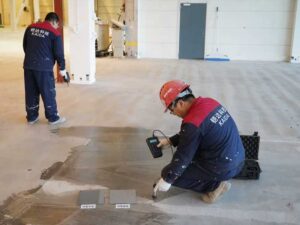
9.1 Surface Preparation
- Degreasing: Full removal of fats and oils using industrial degreasers and mechanical agitation.
- Profiling: Shot blasting or diamond grinding to create an open surface texture (CSP 3–5) for mechanical adhesion.
- Crack Repair: All cracks filled with moisture-tolerant repair mortars to prevent reflective cracking.
- Vapor Testing: Calcium chloride or in-situ probe testing to confirm moisture levels are within the chosen system’s tolerance.
9.2 Application in Active Facilities
- Phased isolation: Physical barriers, negative air pressure, and dedicated foot traffic paths.
- Off-hours scheduling: High-risk zones scheduled during weekends or plant shutdowns.
- Ventilation and odor control: Urethane cement systems are low-VOC and non-tainting, allowing production to continue in neighboring areas.
9.3 Quality Documentation for Audits
Retain the following for FSIS or third-party (BRC, SQF) audits:
- Material certificates showing FDA/USDA compliance statements
- Installation logs (ambient temperature, mix ratios, thickness checks)
- Slip resistance test results (ANSI/NFSI)
- Maintenance schedules and inspection records
10. Common HACCP and Regulatory Pitfalls
Based on analysis of FDA Form 483 inspection observations and USDA non-compliance reports, these are the most frequently cited flooring-related deficiencies:
1. Cracked or Damaged Floor Surfaces
Even hairline cracks harbor Listeria monocytogenes dan Salmonella. Pencegahan: Specify 6–9 mm thickness in heavy-use areas and require thermal shock-tested formulations.
2. Missing or Damaged Cove Bases
The floor-to-wall joint is the most critical sanitary control point. Damaged or missing coves allow moisture to wick behind equipment. Pencegahan: Specify integral urethane cement coves, not sealant-based transitions.
3. Poor Drain Integration
Standing water supports biofilm formation. Drains must be flush with the floor surface and have compatible materials. Solusi: Require floor drains with integral flanges and test slope fall rates (typically 1/4 inch per foot).
4. Incomplete Documentation
Inspectors increasingly request proof of compliance. Best Practice: Request a compliance dossier from your flooring contractor before purchase, including all test reports and manufacturer compliance letters.
11. Food Processing Flooring Cost Breakdown
Budgeting for a food-grade floor requires understanding cost drivers beyond the material price per square foot.
Average Installed Costs (2026 Estimate)
| Jenis Lantai | Typical Installed Cost (USD/sq. ft.) | Catatan |
|---|---|---|
| Epoxy Flooring (3–5 mm) | $3 – $8 | Suitable for dry storage, lab areas |
| Urethane Cement (6–9 mm) | $8 – $15 | Standard for processing, washdown zones |
| MMA Systems (3–6 mm) | $7 – $12 | Fast cure, cold-temperature application |
| Vinyl Composition Tile (VCT) | $2 – $5 | Not recommended for wet processing areas |
Factors That Increase Project Cost
- Substrate repair: Filling spalls, leveling uneven concrete can add $1–$3/sq. ft.
- Extensive drainage: Complex slope requirements increase labor.
- Cove base: Integral urethane coves add $2–$4 per linear foot.
- Expedited scheduling: Weekend or night shifts may incur premium labor rates.
- Temporary production relocation: If equipment must be moved, factor in rigging costs.
Regional Cost Variations
Actual costs vary depending on:
- North America: Labor rates typically $60–$100/hour for specialized applicators
- Europe: Higher material standards may increase base costs by 10–15%
- Asia-Pacific: Competitive labor rates but varying quality control standards
- Surface preparation complexity: Heavily contaminated or uneven substrates add significant cost
- Shutdown requirements: Weekend or overnight installation carries premium rates
Total Project Budget Estimate: For a 10,000 sq. ft. processing area with urethane cement (6 mm), coves, and drains, budget typically ranges $120,000 – $180,000 installed.
12. Choosing a Food Processing Flooring Contractor
Selecting the right food processing flooring contractor or industrial flooring contractor is as critical as choosing the material itself.
Essential Qualifications:
- Minimum 10 food processing projects completed
- Verifiable references from dairy, meat, or beverage plants
- Written contamination control plan for active facilities
- Certified applicator status with the material manufacturer
- Ability to provide full documentation packages for regulatory audits
Questions to Ask:
- Can you complete this installation without shutting down adjacent production lines?
- What moisture testing protocols do you follow?
- Who holds the warranty—you or the material manufacturer?
- Can you repair sections without evidence of the repair (seamless match)?
Red Flags:
- Claims of “FDA certification” rather than compliance
- Inability to produce third-party chemical resistance data
- No moisture testing equipment or protocols
- Vague warranty terms or exclusion of thermal shock coverage
13. Frequently Asked Questions (FAQ)
Q: What is the best flooring for meat processing plants?
A: Urethane cement is the industry standard due to its resistance to animal fats, blood, thermal shock from hot washdowns, and its seamless application. Standard epoxy is not recommended for kill floors or high-moisture processing areas.
Q: Is epoxy flooring FDA compliant?
A: Yes, epoxy flooring can meet FDA compliance if it is smooth, non-porous, and chemically resistant. However, in environments with thermal cycling (washdowns), epoxy is more prone to cracking and delamination than urethane cement.
Q: How much does food grade flooring cost?
A: Installed urethane cement systems for food processing typically range from $8–$15 per square foot, while epoxy systems suitable for dry areas range from $3–$8 per square foot. Total project costs depend on floor thickness, drainage requirements, and substrate condition.
Q: What is the difference between FDA approved and FDA compliant flooring?
A: “FDA approved” is a misnomer—the FDA does not approve flooring products. “FDA compliant” is the correct term, meaning the material meets the performance standards of the FDA Food Code for cleanability and non-absorption.
Q: How long does urethane cement flooring last?
A: With proper installation and maintenance, urethane cement floors last 10 to 15 years in demanding food processing environments. Many facilities report 15+ years of service before requiring major refurbishment.
Q: What is polyurethane mortar flooring?
A: Polyurethane mortar flooring (also called PU cement or urethane cement) is a high-performance seamless flooring system combining polyurethane resin with cementitious aggregates. It is widely used in food and beverage facilities for its thermal shock and chemical resistance.
Q: Can urethane cement flooring be installed in cold storage areas?
A: Yes, cold-grade urethane cement formulations are specifically designed for freezer environments. They maintain flexibility and adhesion at temperatures as low as -40°F and withstand freeze-thaw cycling.
Q: Is urethane cement flooring slip resistant?
A: Yes, urethane cement floors can be finished with textured aggregates to meet ANSI/NFSI B101.1 wet slip resistance standards. Slip resistance is a key requirement for USDA-compliant facilities.
Q: How long does urethane cement flooring take to install?
A: Depending on area size and complexity, urethane cement systems typically take 2–4 days to install, with rapid-cure formulations allowing return-to-service within 24–48 hours.
Q: What maintenance is required for food processing flooring?
A: Regular cleaning with approved sanitizers, immediate repair of any damage, and periodic slip resistance testing. Urethane cement floors require minimal maintenance compared to vinyl or tile systems.
14. Kaida Paint Urethane Cement Flooring Solutions
Kaida Paint manufactures high-performance flooring systems for food processing applications, including:
- Urethane cement flooring systems (food-grade formulations)
- Polyurethane mortar flooring (PU cement systems)
- Epoxy industrial flooring (for dry and light-duty areas)
- Food processing floor coatings (FDA-compliant)
Our Technical Services Include:
- Site Condition Analysis: We assess your substrate, moisture levels, chemical exposure, and thermal load to recommend the optimal urethane cement or epoxy formulation.
- Compliance Dossiers: Every project receives a compliance package with FDA and USDA alignment statements, HACCP-related documentation, and third-party test reports.
- Installation Quality Assurance: Our factory-trained applicator network follows documented procedures to ensure 6–9 mm thickness, proper cove integration, and drain compatibility.
- Project Scheduling: We develop phased installation plans that minimize or eliminate production downtime in active facilities.
Kaida Paint works with:
- Food manufacturers (meat, dairy, beverage, bakery, seafood)
- Industrial contractors and general contractors
- Professional flooring installers
- Engineering and consulting firms
Why Facility Engineers and Contractors Choose Kaida Paint:
- 20+ years of urethane cement and epoxy chemistry expertise
- Products field-tested in poultry, red meat, dairy, beverage, and bakery plants
- Rapid-cure formulations for 24–48 hour return-to-service
- Transparent product data: no marketing claims of “approval”—only verifiable compliance
- Global supply capability for international projects
Ready to specify your food processing flooring? Contact Kaida Paint for a project consultation. Our technical team provides free specification guidance, budget estimates, and contractor referrals to ensure your facility meets FDA and USDA standards for the long term.




 English
 Spanish
 Portuguese
 Arabic
 French
 Italian
 Russian
 Indonesian
 Swedish